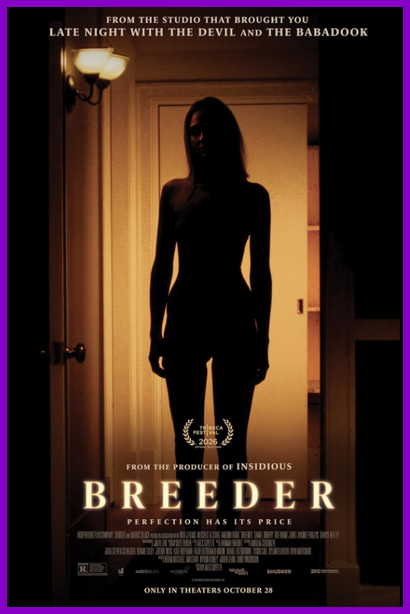
What constitutes perfection? Who decides what is desirable, what is defective, and what is disposable? And just how far will someone go in pursuit of an ideal? Writer/director/editor Alex Goyette takes those questions to deliciously disturbing extremes with BREEDER, a dark psychological thriller that combines the unsettling implications of eugenics-adjacent thinking with an obsessive champion poodle breeder, a young man in search of research funding, and one of the most chilling performances of Dot-Marie Jones’s career.
The result is a film that knows how to make an audience uncomfortable, sometimes without anyone saying a word.
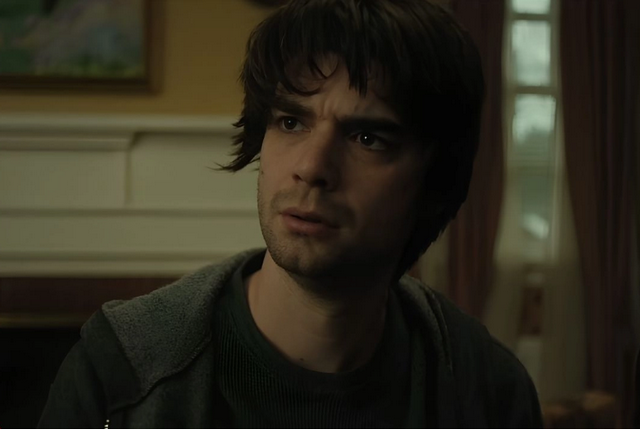
Daniel Doheny stars as Russell, a college student whose research involving bees brings him into the orbit of Patti (Dot-Marie Jones), a woman who has dedicated her life to breeding championship poodles. Intrigued by Russell’s work, Patti offers to fully fund his research in exchange for his assistance with her own endeavors. But Patti’s interest in creating the perfect specimen extends well beyond the canine world. Her fascination with genetics and the selective cultivation of desirable characteristics has developed into an obsession with producing better human beings.
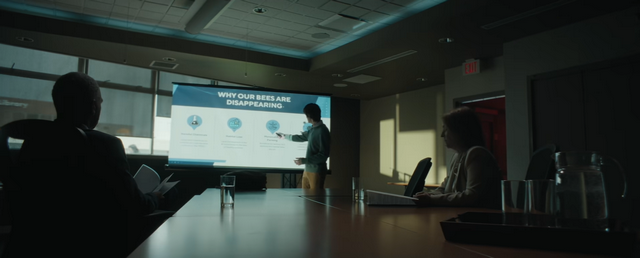
But Russell is hardly without his own obsessive tendencies. His dedication to his research and determination to secure funding take precedence even over his relationship with his fiancée, Haley (Tanaya Beatty). In this respect, Russell and Patti are two sides of the same coin, each consumed by a singular pursuit. The distinction lies in the nature of their ambitions and the lengths to which they are willing to go to achieve them. Russell’s fixation on his work makes Patti’s offer all the more tempting, while raising an uncomfortable question: just how much is he prepared to sacrifice in the name of scientific advancement?
And Patti is not a woman accustomed to having her decisions questioned.
Goyette wastes little time establishing the peculiarity of Patti’s world, although he takes a measured approach to revealing its darker dimensions. What initially appears to be an eccentric encounter gradually becomes something far more sinister. There is an underlying absurdity to the premise, but Goyette understands that the most effective way to exploit it is not through broad comedy. Instead, he allows the outrageousness of the situation to collide with the absolute seriousness of Patti’s convictions.
Much of that success rests on Dot-Marie Jones.
Jones is an imposing physical presence, but it is her extraordinary restraint that makes Patti so frightening. There is a coldness to her performance that goes beyond a simple lack of warmth. Her face is often virtually immobile, her expressions revealing little beyond irritation or anger. And on those rare occasions when Patti smiles or laughs, the effect is almost more disturbing than her impassivity. The expressions seem forced, mechanical, as though someone has momentarily activated an animatronic figure.
There is something almost ventriloquist-dummy-like about the way Patti attempts to demonstrate ordinary human emotion.
Yet Jones never reduces the character to caricature. Her deadpan delivery gives even the most preposterous pronouncements an unnerving authority. Patti doesn’t recognize the absurdity of her demands because, in her mind, everything she does is perfectly reasonable. It is that complete conviction, coupled with Jones’s formidable screen presence, that makes the performance so effective.
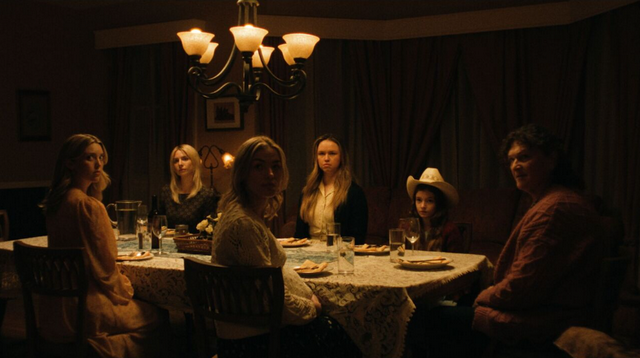
A particularly uncomfortable encounter involving Russell and Ainsley (Maddie Phillips), one of Patti’s five daughters, illustrates just how completely Patti disregards conventional boundaries. Her matter-of-fact attitude toward an intensely private situation is simultaneously horrifying and darkly funny, and Jones plays it without the slightest acknowledgment of the absurdity.
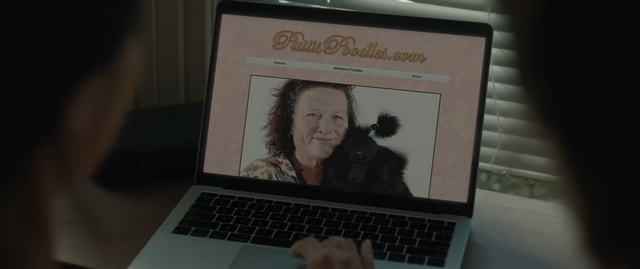
Equally revealing are Patti’s championship poodle videos. Watching her become animated over her prized animals, particularly when contrasted with her emotional detachment from the people around her, speaks volumes about where her affections and priorities lie.
Doheny provides a necessary counterweight to Jones’s formidable performance. Russell’s growing discomfort and vulnerability ground the increasingly bizarre circumstances, giving the audience someone through whom to experience the mounting dread. His reactions are essential because Patti’s behavior becomes progressively more alarming even as she continues to regard it as entirely rational.
Yet Russell’s vulnerability does not negate his own responsibility for the choices that bring him into Patti’s world. His ambition is both his driving force and his weakness, a contradiction that adds an intriguing psychological dimension to the story.
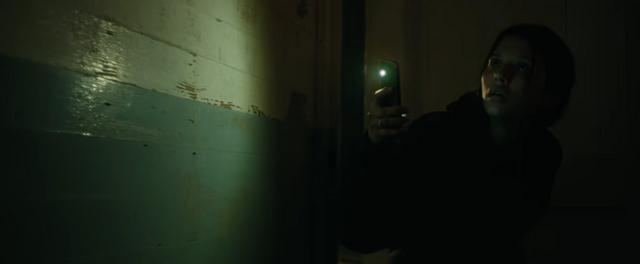
Tanaya Beatty, as Haley, offers an important emotional and visual contrast. There is a freshness and natural warmth to Haley that stands in opposition to Patti’s manufactured notions of perfection. The irony is unmistakable: someone who appears lovely and wholly human is dismissed within a worldview that assigns worth according to an arbitrary standard of genetic desirability.
It is one of the film’s most interesting contradictions, and one that reinforces its underlying thematic concerns without requiring a lengthy discourse on eugenics.
Goyette’s direction is especially effective in his use of silence and visual composition. Rather than relying exclusively on sudden shocks, he allows discomfort to develop within the frame. A prolonged look, an awkward pause, or Patti’s unyielding expression can generate more tension than an overt threat.
And there is a great deal of silence in BREEDER.
That silence becomes a weapon, particularly when the camera holds on Patti and we are left wondering what she is thinking, what she intends, or whether she is capable of any genuine empathy. The absence of dialogue forces us to study her, and the longer we look, the more disquieting she becomes.
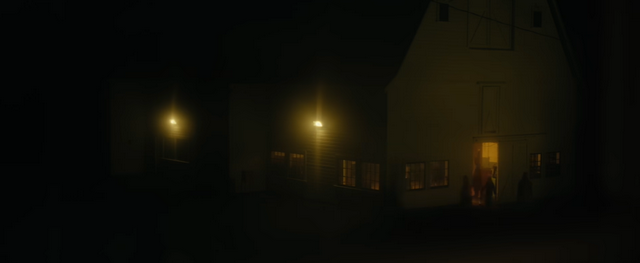
Working with cinematographer Jaryl Lim, Goyette establishes a distinct visual grammar that separates Patti’s ranch from the world beyond its boundaries.
The ranch is dominated by warm amber hues, but there is nothing particularly comforting about that warmth. Within the barn, the illumination takes on an almost oppressive quality, creating pools of light surrounded by deep shadows. Low-key lighting heightens the atmosphere of confinement, while the contrast between illuminated faces and surrounding darkness reinforces the uncertainty of what may be lurking beyond our immediate view.
The barn is especially impressive as a cinematic environment. Its practical lighting sources, including the amber glow associated with the animal enclosures, create a visual texture that is simultaneously believable and ominous. The location feels tangible, lived in, and increasingly threatening.
Outside the ranch, the palette shifts toward cooler, more neutral tones. Scenes involving Haley provide fleeting visual relief from the oppressive environment surrounding Patti. Those moments are not simply brighter; they feel emotionally different, suggesting the possibility of a life beyond the rigid boundaries of Patti’s world.
Lim’s lighting and framing reinforce that division without making the contrast feel artificially imposed.
Goyette also makes an intriguing editorial decision by withholding the opening title sequence until approximately fourteen minutes and forty-two seconds into the film. By that point, the story has already established its unsettling trajectory. The delayed titles function almost as a threshold, signaling the passage into the darker territory ahead.
As both director and editor, Goyette demonstrates a clear understanding of pacing, particularly in the way he allows unease to accumulate before escalating the tension. The film’s measured rhythm gives its more startling moments greater impact.
Sound is another of BREEDER’s greatest strengths.
Composer Hannah Parrott and sound designer Ryan Marchant create an aural environment that seems to emerge from the ranch itself. The score incorporates organic, sometimes almost tactile textures, with sounds that suggest the animals and physical surroundings. The occasional wailing of dogs becomes part of the unsettling musical atmosphere, blurring the distinction between environmental sound and composition.
Rather than using music merely to announce danger, Parrott’s score seeps into the film, establishing an undercurrent of dread. Marchant’s sound design complements that approach, immersing us in a world where seemingly ordinary noises can become deeply uncomfortable.
Just as importantly, the filmmakers understand when to let the soundtrack fall away.
Those stretches of silence are among the film’s most effective moments, allowing the visual compositions and performances to carry the psychological tension without musical assistance.
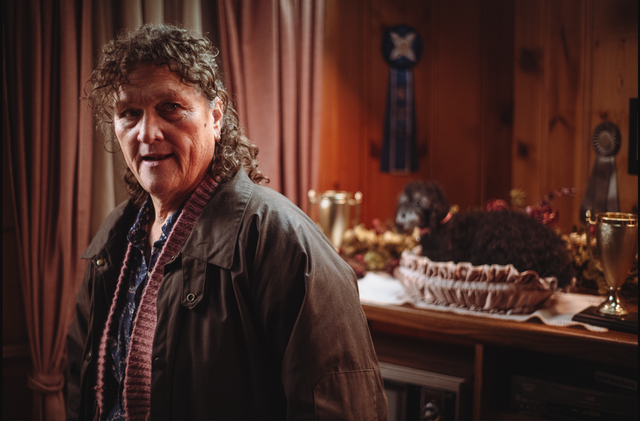
Production designer Skye Dyken deserves equal recognition for the extraordinary specificity of Patti’s surroundings.
From the metal entrance gates adorned with prancing black poodles to the repetition of that emblem elsewhere on the property, Patti’s devotion to her animals is embedded into the architecture and décor. The imagery initially possesses an almost whimsical quality, but as the story develops, those decorative flourishes take on a decidedly more sinister significance.
Patti hasn’t simply furnished a home. She has constructed an environment that reflects and reinforces her entire philosophy.
Inside the house, the wallpaper, furnishings, and accumulated objects create an eccentric but carefully defined personality for the space. Particularly memorable is the staircase wallpaper with its distinctive green figures, a pattern that contributes to the strange visual identity of the residence.
And then there is the taxidermied poodle.
An object that might be merely peculiar in another setting becomes genuinely creepy within Patti’s domain. Its preserved stillness is particularly appropriate in a film concerned with the obsessive pursuit of an ideal. Here is an animal that has been rendered permanently motionless, its appearance fixed for display. Whether intended as a conscious metaphor or simply another expression of Patti’s peculiar sensibilities, the image resonates with the film’s preoccupation with control and manufactured perfection.
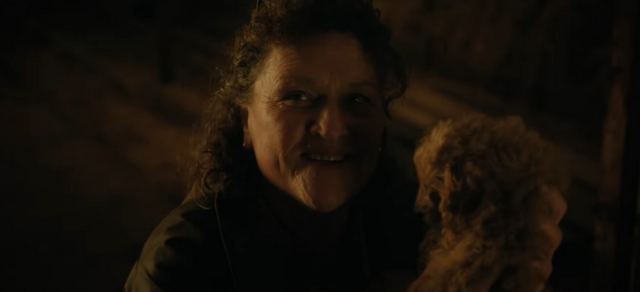
Dyken’s production design is not simply background decoration. It provides a visual extension of Patti’s psychology, reinforcing character and theme through the physical environment.
There are moments when BREEDER embraces the absurdity of its premise, and that willingness to find humor within the horror is part of its appeal. Goyette occasionally punctures the oppressive atmosphere with an unexpected visual flourish, creating a momentary release from the tension before drawing us back into Patti’s disturbing world.
Yet the film is at its strongest when it trusts the inherent uneasiness of its central concept and the formidable presence of Jones to do the work.
BREEDER also raises questions that extend beyond its immediate thriller mechanics. The idea of creating better people (and poodles) through selective breeding is not merely eccentric; it draws upon deeply troubling assumptions about human value, desirability, and the authority to determine which characteristics should be perpetuated.
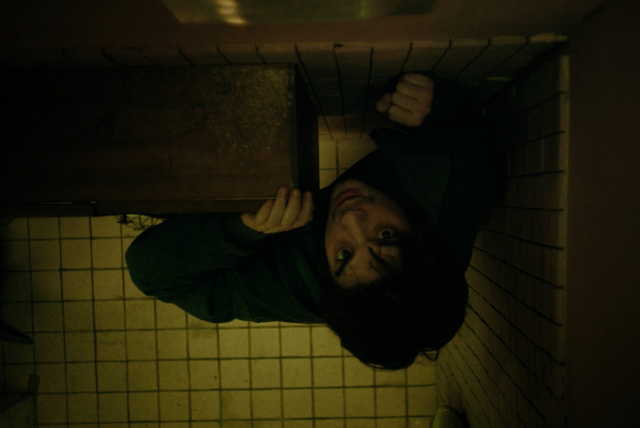
Goyette does not turn the film into a historical examination of eugenics. Rather, he explores the disturbing ideas associated with it through a character whose pursuit of perfection has obliterated ordinary moral boundaries.
That distinction matters. Patti’s obsession is frightening not simply because her methods are extreme, but because she is so utterly convinced of the righteousness of her objectives.
With BREEDER, Goyette delivers an unusual and visually distinctive psychological thriller that benefits enormously from its attention to cinematic craftsmanship. Lim’s carefully controlled cinematography, Parrott’s disquieting score, Marchant’s immersive sound design, and Dyken’s character-rich production design work in concert to establish a world that is as fascinating as it is uncomfortable.
And presiding over it all is Dot-Marie Jones, delivering a performance of remarkable control and chilling conviction.
Perfection, it seems, is very much in the eye of the beholder. And in Patti’s eyes, that is a terrifying proposition.
Written and Directed by Alex Goyette
Cast: Dot-Marie Jones, Daniel Doheny, Tanaya Beatty, Maddie Phillips, Isla Spencer
by debbie elias, 10/18/2026
BREEDER opens in theatres on October 28, 2026.