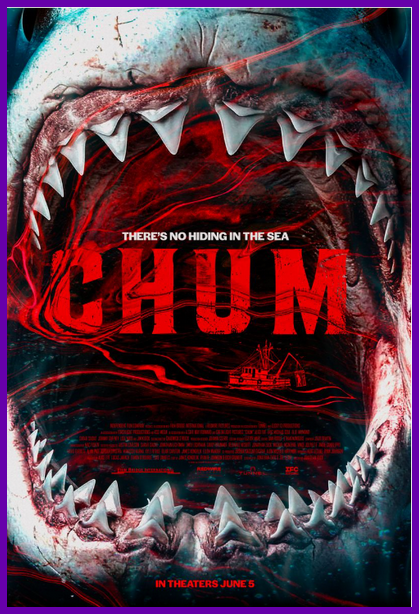
Relationship Problems Are Hard. Sharks Make Them Worse.
If ever there was a movie where rooting for the shark feels not only justified but emotionally necessary, it’s CHUM.
Directed by Jonathan Zuck with script by Zuck and Joe Leone, CHUM gleefully embraces its identity as a chaotic hybrid of shark thriller, relationship soap opera, revenge tale, and survival horror, throwing an increasingly unlikeable wedding party into the Mediterranean Sea and then asking audiences one very important question: Who deserves to get eaten first?
The answer changes frequently.
Set against the stunning coastal beauty of Malta, the film begins with newlyweds and their assorted entourage embarking on a celebratory catamaran excursion despite the inconvenient reality that the bride and groom are already discussing annulment less than 24 hours after saying “I do.” Add in a rich loose-cannon best friend, simmering interpersonal resentment, horny opportunism, sibling friction, and enough emotional dysfunction to sink the boat before the shark ever appears, and CHUM quickly establishes itself as less “destination wedding fantasy” and more “floating disaster waiting to happen.”
And then the boat catches fire.
And then people start getting eaten.
And then things somehow become even more unhinged.
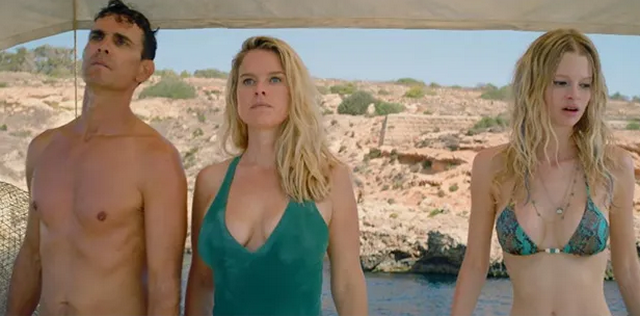
What follows is an escalating spiral of shark attacks, psychotic revenge obsession, betrayal, underwater carnage, improvised chum deployment, spear guns, broken relationships, and increasingly catastrophic decision-making that often plays like a soap opera engineered specifically for Great White sharks.
And honestly? That’s part of the fun.
To the film’s credit, Zuck appears fully aware of the absurdity he’s orchestrating. CHUM never feels embarrassed by its premise. Instead, it confidently leans into its B-movie chaos while still delivering enough technical craftsmanship and visual polish to keep audiences thoroughly entertained.
A major reason the film works as well as it does is cinematographer Mac Fisken, whose lensing consistently elevates the material. Fisken, whose desert photography in The Last Stop in Yuma County was equally striking, turns Malta and the Mediterranean Sea into visual playgrounds of saturated blues, shimmering sunlight reflections, gorgeous twilight hues, and richly textured underwater photography.
The contrast between beauty and brutality becomes one of the film’s strongest visual assets. Crystal blue waters are repeatedly interrupted by violent bursts of deep red blood, while serene sunsets give way to panic, paranoia, and floating body parts.
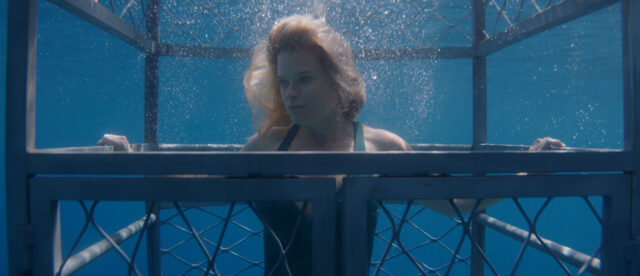
Particularly impressive is Fisken’s ability to maneuver visually within highly restrictive environments. Whether shooting aboard the cramped fishing vessel cluttered with equipment and rigging or the luxury catamaran designed more for partying than survival, or jumping into the Mediterranean with a GoPro capturing beautiful underwater images, the cinematography maintains spatial clarity and kinetic momentum despite extremely confined shooting conditions. The logistical challenges of placing cameras, navigating actors, and managing lighting within those spaces only make the finished work more impressive.
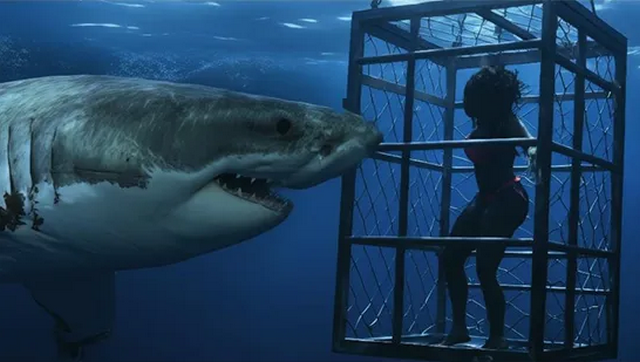
Equally effective is the shark itself. The combination of CGI and even an inflatable alligator, works surprisingly well, especially during underwater sequences in open ocean waters (no water tank was used) and several full-body attack moments, including an especially entertaining leap from the water as the Great White launches itself toward the boat in search of fresh chum.
But the film’s true wildcard is Jim Klock as Roy, a fisherman whose apparent rescue of the stranded wedding party quickly reveals itself to be something far more sinister. Obsessed with hunting the Great White he believes killed the love of his life years earlier, Roy has fully abandoned rational thought somewhere out at sea. In all honesty, Roy is the villain. The shark is a victim.
And yes, his plan eventually involves using human beings as shark bait because, as Roy matter-of-factly explains, “people work better than cats and dogs.”
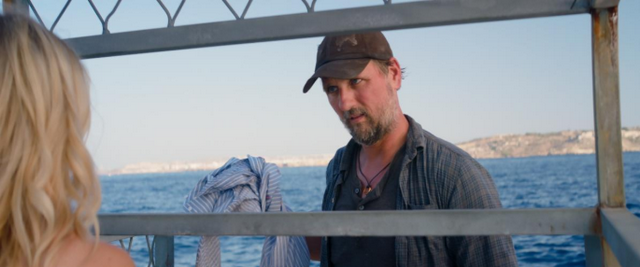
Klock fully commits to the role’s deranged intensity, giving Roy the kind of sweaty, obsessive instability necessary for the film to maintain its increasingly outrageous momentum. Zuck smartly reinforces Roy’s psychological dominance through repeated upward-angled Dutch framing that constantly positions him as both visually and emotionally overpowering within the confined environment of the boat.
Meanwhile, Johnny Gaffney weaponizes annoyance beautifully as wealthy chaos agent Rick, whose unpredictability keeps both the characters and audience perpetually uneasy because you genuinely never know what spectacularly bad decision he’s about to make next.
Alice Eve delivers a solid performance as the increasingly hardened bride forced to confront both literal survival and the collapse of her marriage simultaneously. Countering Eve is Eric Michael Cole as her disillusioned environmentalist groom, whose ideological conflict with his new wife over corporate environmental destruction adds another layer of friction beneath the shark attacks and interpersonal chaos.
Elle Haymond brings sharp-edged defiance and combative energy as the bride’s younger sister, helping maintain the film’s ongoing emotional volatility even between attacks.
Editors Ethan Maniquis and Dan Riddle keep the pacing brisk while skillfully balancing suspense, jump scares, underwater tension, and outright absurdity. Particularly effective is the stealthy way the shark is staged and edited. One moment, its fin cuts across the surface. The next, it’s vanished entirely beneath the water. That uncertainty keeps both the characters and audience in a constant state of uneasy anticipation.
Importantly, CHUM understands that escalation is everything.
Every time the situation appears incapable of becoming more chaotic, somebody:
gets stabbed,
gets dragged underwater,
gets fed to the shark,
gets hit with a spear,
gets trapped in a shark cage,
or makes another catastrophically stupid decision.
And yet somehow the movie still finds room for relationship reconciliation, emotional revelations, environmental messaging, and a bizarrely romantic visual punchline involving skulls resting together on the ocean floor beneath the shadow of the shark itself.
It is ridiculous.
It is excessive.
It is gloriously committed.
Will you care deeply about most of these people? Probably not.
Will you root for the shark? Absolutely.
But between the beautiful Mediterranean photography, committed performances, entertaining carnage, escalating madness, and a film fully willing to embrace its own absurdity, CHUM delivers exactly what a movie called CHUM should.
Tiny violins for love. Applause for the shark.
Directed by Jonathan Zuck
Written by Jonathan Zuck and Joe Leone
Cast: Alice Eve, Eric Michael Cole, Jim Klock, Elle Haymond, Lisa Yaro, Johnny Gaffney
by debbie elias, 05/21/2026
CHUM is in theatres and available on VOD and Digital on June 5, 2026.