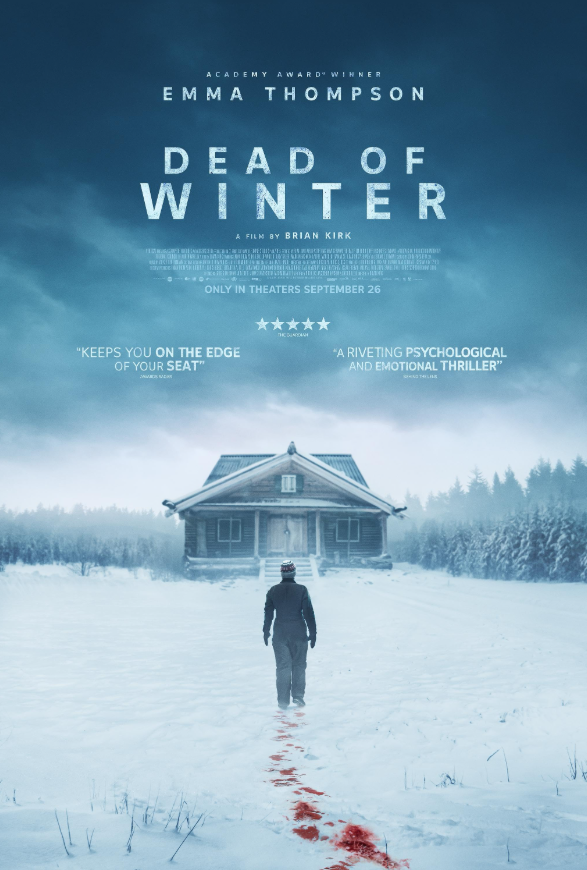
With director Brian Kirk at the helm, I knew that DEAD OF WINTER would be a pressure cooker. I was not disappointed. DEAD OF WINTER is a riveting psychological and emotional thriller, an action-filled roller-coaster that will have you on tenterhooks until the very last frame.
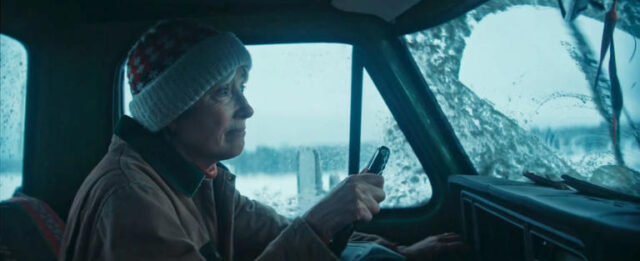
Shot in the icy north of Finland as a perfect stand-in for a frigid Minnesota winter, we meet an older woman, a widow, whose name we later learn is Barb. She appears content being alone, or is she? At times, she seems lost in sun-drenched memories of her youth, especially when it comes to a small green metal tackle box that she clutches to her as if the Holy Grail itself. Taking that metal box, she jumps into an old pick-up truck and heads out into a snowstorm, intent on driving to Lake Hilda for some ice fishing.
We are enveloped in a soundscape that magically blends the sounds of nature and the storm with a somewhat mysterious and somber score by Volker Bertelmann. Chilling is Bertelmann’s use of drums at specific points in the film, giving an almost tribal warring sensibility to the proceedings. We hear the blowing of snow, the wind, bending trees, windshield wipers (one of which needs to be replaced), the sound of the motor of the old Ford pick-up, an occasional bird, snow crunching under boots, tires driving on ice, and then as Barb stops her truck because she’s lost, a sound that is either far-off gunfire or chopping wood. With no dialogue at this point, that soundscape, together with the visuals, sets the tone and immerses us in this unforgiving world.
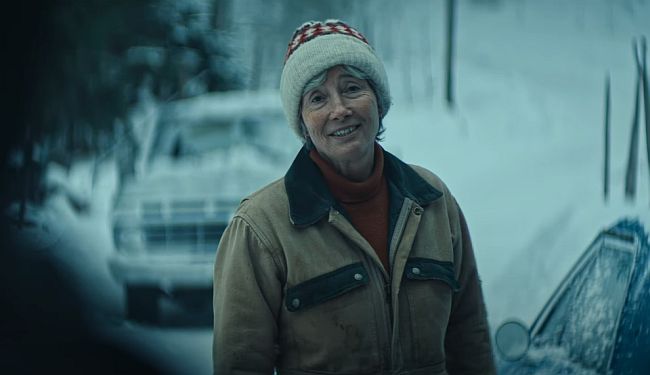
Our curiosity turns into a riveting obsession as Barb asks a sunglasses-wearing man chopping wood outside his cabin for directions to Lake Hilda. A strange trip in a snowstorm becomes even stranger as Barb spots a patch of fresh, bright red blood against the virgin white snow. Although a bit flustered and suspicious, she takes leave of the man and continues on her way.
As Barb reaches Lake Hilda and walks out on the lake to cut a hole for ice fishing and is sitting there quiet and reflective, the past comes to life as editor Tim Murrell cuts back and forth between the cold, grey, frigid, empty present, and a past with a happy young woman and boy on their first date in the exact same spot on the ice as Barb now sits. The past is bright and sunny (with some beautiful sun flares courtesy of DP Chris Ross), filled with the golden warmth of the sun as it sparkles atop the ice. We hear the joy and laughter in their voices versus the present with Barb alone and the only sound being that of a cold wind. And right there with Barb in the present is the same little green metal tackle box that she first held in her hands that sunny day on the ice lake so many decades ago.
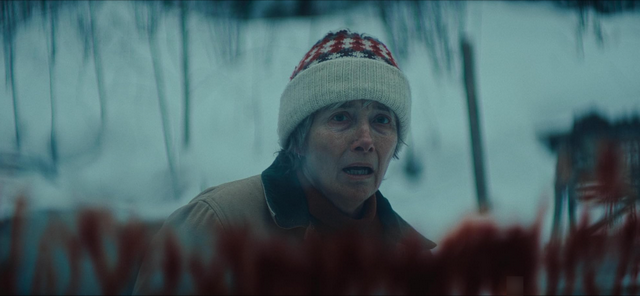
A lifetime shows itself on Barb’s thick facial wrinkles. No salons or chemical peels or Botox for her. Just life. And here she now sits alone as salty tears slowly fall on her cheek. Disrupting the silence of the wind, Barb hears gunfire in the distance. And yelling. Screaming. Suddenly, the poignant quiet beauty is enveloped in terror as Barb races back to the shore and her truck and sees someone being chased by another person with a rifle, shooting at her.
Tension and fear ratchet up as Barb can’t get her truck off the ice and up the snowy ice embankment to drive for help, forcing her on foot to head to the cabin and the man she spoke to earlier. Arriving near the cabin, she sees more fresh blood on the snow. Silently watching, she sees the man leave in his dated El Camino, seizing the opportunity to get closer to the cabin to find out what’s going on, especially when she hears a woman screaming. Moving quickly, but cautiously, Barb circles the house and sees broken old windows in a basement. She sees a girl. Chained and handcuffed.
But as Barb sees her, the man returns with a friend, a woman with a rifle. As the camera closes in to a close two-shot, we see the woman’s face. She looks ill and totally drugged out. As the man and woman start conversing/arguing (the most dialogue we have heard in the film as of this point), we quickly learn that the woman kidnapped the girl.
With a chance to get away and go get help, Barb’s first priority is to let the kidnapped girl know she is going for help and that “I won’t leave. Promise!”
Tension so thick you can cut it with a knife, explodes as the sick, crazed woman freaks out while we cut back to the lake and see an ice house set up with smoke coming out of the stove pipe. Has Barb set a trap?
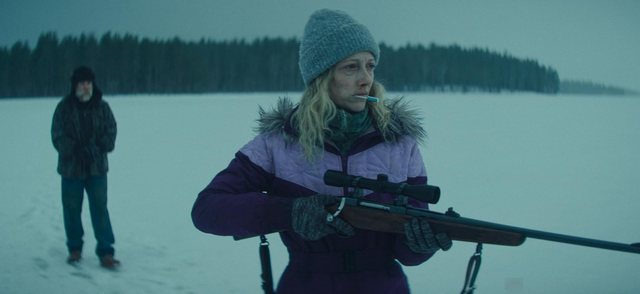
Kirk and cinematographer Christopher Ross shift the focal length back and forth throughout, with things first at a distance and in wide shots, then closer through Barb’s binoculars, and then close-up two-shots and ECUs, as events become clearer and the story continues with Barb enmeshed in a cat and mouse game with the nameless woman in the purple ski suit, played Judy Greer.
As the battle between the two women heats up, the camera intensifies, honing in on specific, deliberate elements of the battle. Handcuffs, the little green tackle box, boots, matches, a tie rod tool, a knife, fishing line, and lures. We are in the moment with Barb, living this experience with her. So wonderful and purposeful in the lensing and the lighting, as well as with the editing and the pacing.
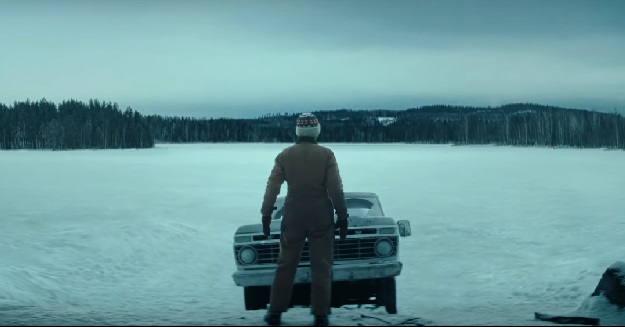
Action keeps ramping up, and just when we think that Barb is down and out or at a loss for what to do, we get flashbacks of her life with her husband Carl as the color palette shifts between the cold and grey present and the warmer glow of her life with Carl.
In the basement where the girl, who we ultimately learn is named Leah, is held captive, golden light becomes almost a beacon. Very metaphoric. We’ve been teased by that light with flashbacks of Barb’s life, but now, that golden glow of the sun in Barb’s past is in the present in the form of a lantern. Interesting is the use of two different lanterns – one a GE “bright white blind you with headlights” oblong light, and then the more traditional lantern with the golden glow.
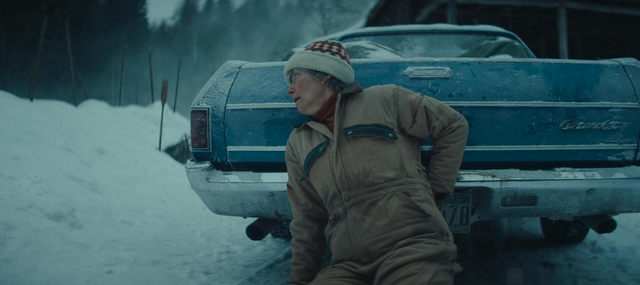
By the climactic third act, action is king and metaphor explodes with beauty. With more bloodshed, mayhem, and murder at the hands of the purple-suited woman, we are on tenterhooks as tension and fear quickly escalate into edge-of-your-seat, nail-biting moments for the rest of the film. The more dire the circumstances seem, the more resilient, strong, and determined Barb becomes. As it turns out, not only is there a purpose to the purple-suited woman’s actions and her kidnapping of Leah, but Barb is on a mission of her own. And through it all, the gunfights, catfight rolls on the ice, being tossed through the ice hole into freezing water, Barb clings to the small green metal tackle box.
Every element of DEAD OF WINTER is perfectly connected like a jigsaw puzzle. Written by Nicholas Jacobson-Larson and Dalton Leeb, under the directorial vision of Brian Kirk who is masterful with building tension (just look at his episodic work or the action thriller “21 Bridges” starring Chadwick Boseman), there is little dialogue overall, including some perfectly placed VO that gives us some context about Barb, relying heavily on Christopher Ross’s cinematography for gripping visuals, and the unforgettable, gritty performances of Emma Thompson and Judy Greer.
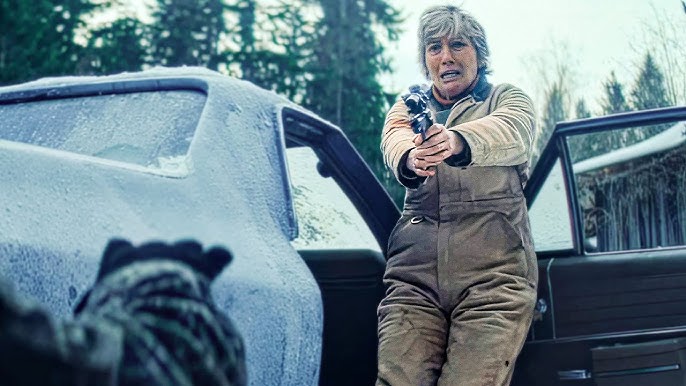
Emma Thompson amazes as Barb. Award-worthy. She is the new action hero for our time! At 66 years old, she brings a life lived to the role and embodies the strength, grit, and determination of a mature woman. She doesn’t need words. You see her emotion and conviction on her face. She also subjected herself to the harsh conditions of Finland and the icy water. Doing much of her own fight sequences, impressive is the fact that the fighting entails a lot of pushing and kicking, which is something an average woman of Barb and Emma’s age would do. It’s believable and, for those of us in that age bracket, extremely palpable and resonant. Knowing that Barb can’t rely on physical strength or specialized training, she thinks things through using her life skills, almost in a MacGyver-ish way. And Thompson sells every second of it.
Thompson has a terrific adversary in Judy Greer as the “purple-suited woman”. While Thompson brings a 66-year-old life fully lived sensibility to Barb, Greer brings a younger, more frenetic, and, although purposeful in her mind, irrational energy to the table. Each woman gives it their all with their performances. Harkening back to the days of “Dynasty’s” Krystle Carrington and Alexis Carrington Colby, Thompson and Greer give new meaning to the term “cat fight”.
Marc Menchaca is solid as our camo-clad guy in the woods. Interesting to watch the dynamic between Greer and Menchaca. We know who wears the pants in that pairing. Laurel Marsden is solid as the panicked captive Leah and has wonderful chemistry with Thompson and Barb’s maternal instincts. Speaking of maternal, given that Emma Thompson is her mother, a lovely touch having Gaia Wise as the younger Barb.
But it’s the strength and beauty of Brian Kirk’s directorial vision, Chris Ross’s lighting and lensing, Volker Bertelmann’s score, and the work of sound designer Corinna Fleig and her team that envelop us in the DEAD OF WINTER, a heart-pounding, terror-filled tale of survival that gives way to poignant emotional beauty thanks to a powerhouse performance by Emma Thomson, superb lensing and an all-encompassing sensory experience of sound and score.
Directed by Brian Kirk
Written by Nicholas Jacobson-Larson and Dalton Leeb
Cast: Emma Thompson, Judy Greer, Marc Menchaca, Laurel Marsden, and Gaia Wise
by debbie lynn elias, 07/23/2025
DEAD OF WINTER is now playing in theatres.