By debbie lynn elias
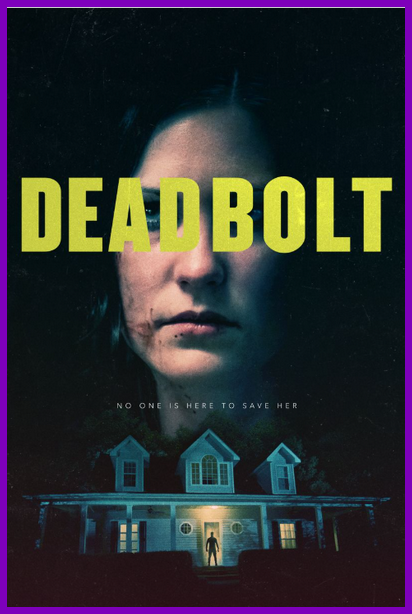
Lock your doors! Check your windows! And for heaven’s sake, keep your cell phone handy! Because with DEADBOLT, director Zac Coleman is about to turn the sanctity of home into a living nightmare filled with terror, tension, blood, deception, and one gloriously unhinged madman named Theo! A taut psychological thriller that starts with the familiar trappings of a home invasion before taking some decidedly unexpected turns, DEADBOLT is a deliciously twisted exercise in suspense that showcases not only Coleman’s talents as a filmmaker but also those of his outstanding cast and creative team. And did I mention the duct tape? Oh, there’s duct tape!
Working from a screenplay by Dylan Noe, based on a story by Craig Deering and Coleman, DEADBOLT wastes no time establishing its unsettling tone. An affluent older couple finds themselves bound and duct-taped to chairs, subjected to the torment of an intruder whose behavior is as bizarre as it is terrifying. It’s a disturbing opening that immediately establishes the film’s willingness to embrace violence, cruelty, and a certain perverse sense of humor. But that’s only the beginning.
At the center of DEADBOLT is Anne Harrington (Callie Deering), an intelligent, accomplished woman who runs a foundation dedicated to helping women who have experienced abuse. With a possible future in politics also on her mind, Anne has a comfortable life, a beautiful home, and a deeply ingrained commitment to helping others. She’s compassionate, thoughtful, and resourceful. She’s also about to discover just how quickly everything she takes for granted can disappear.
Returning home from a funeral, Anne notices something seemingly insignificant but immediately troubling: a door she knows she locked is standing slightly ajar. It’s a small detail, but one that sets the entire film in motion.
What follows is a nightmare of escalating danger as Anne finds herself confronting an intruder whose intentions are anything but clear. With her connection to the outside world compromised, she must rely on her intelligence and instincts to survive.
And while DEADBOLT initially appears to be a straightforward home-invasion thriller, Coleman has something considerably more complicated up his sleeve. One of the film’s greatest strengths is its refusal to reveal its hand too early. There are layers of deception and manipulation at work, with a political dimension that gradually becomes integral to the narrative. What seems obvious at one moment may look very different a few scenes later, and Coleman wisely allows those revelations to unfold without telegraphing their significance.
But even before the psychological games begin, DEADBOLT establishes its greatest visual asset. The Harrington House. What a house! What a location! And what a spectacular playground for a cinematographer!
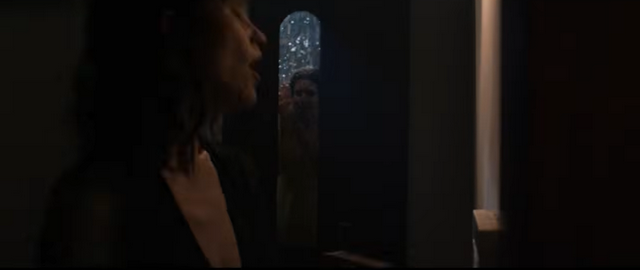
A historic residence dating to the nineteenth century, the Harrington house is practically a character unto itself. Rich woodwork, intimate rooms, narrow staircases, elegant furnishings, crystal, glass, and carefully arranged decorative details create an environment of warmth and sophistication. There’s a sense of history to the house, an impression of generations of lives having passed through its rooms. And then there’s the wood grain.
Much of what appears to be naturally grained wood is actually hand-painted, a remarkable decorative detail that contributes to the richness of the interiors. The cognac and burgundy tones of the woodwork are complemented by equally warm furnishings, including a beautiful cognac-colored couch, glass shelving, and crystal accessories.
The production design and set dressing are excellent, giving the house a distinctive personality without making it feel artificially dressed for a movie. Particularly effective is the contrast between the elegant principal living spaces and the areas undergoing renovation. Plastic sheeting, exposed construction materials, unfinished surfaces, and more utilitarian spaces introduce visual disruptions into an otherwise carefully maintained home. Those disruptions become increasingly important as the action unfolds.
And cinematographer Julius Damenz makes the most of every inch.
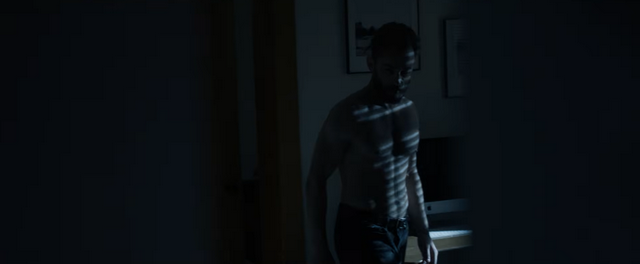
At just 22 years old when he photographed DEADBOLT, Damenz demonstrates a remarkably sophisticated command of cinematic visual grammar. Working closely with Coleman, he creates a visual language that is both elegant and psychologically unsettling, employing carefully controlled compositions, deliberate camera placement, and a striking contrast between warm interior tones and the cooler blues of the outside world. There’s an almost tactile quality to his photography.
Look at the use of candles and crystal, particularly the tiny tea lights positioned within glass candleholders. Photographed from a low angle, the flickering flames create delicate points of illumination, reflecting and refracting through the glass. It’s a beautiful composition that adds warmth and dimension to the image while emphasizing the intimate atmosphere of the house. And then consider how that same environment changes as the tension increases.
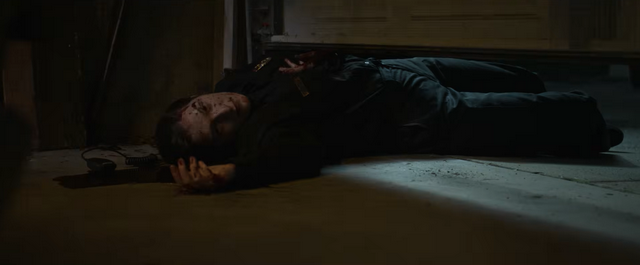
The wood-paneled rooms that initially feel inviting begin to take on an oppressive quality. Narrow staircases become places of uncertainty. Doorways and corners create opportunities for concealment. The relationship between the camera and the architecture gradually alters our perception of the space.
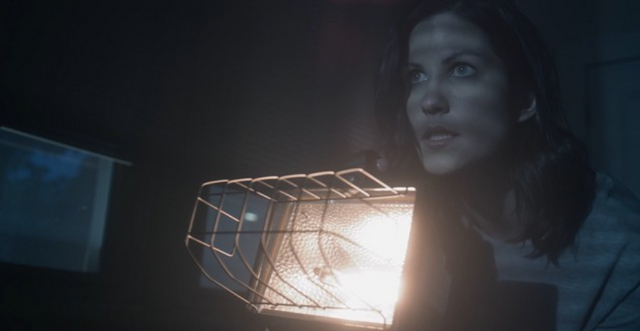
Damenz makes particularly effective use of Dutch angles along the staircases, subtly destabilizing the frame while reinforcing the growing sense that something is terribly wrong. Shooting into corners, down hallways, and through doorways, he creates depth while maintaining a clear sense of spatial geography. We understand where characters are in relation to one another, an essential element in a thriller dependent upon pursuit, concealment, and sudden confrontation.
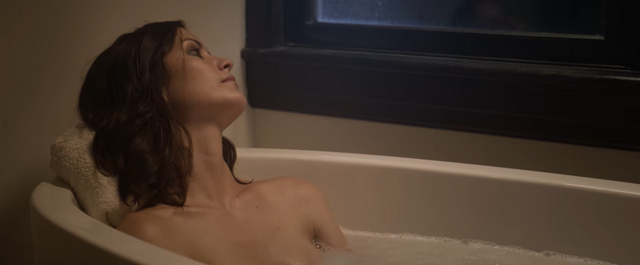
Equally effective is the use of cooler blue tones in the upstairs bedroom and bathroom, providing a visual connection to the rainy exterior while separating those spaces from the warmer principal rooms. And the bathroom itself, with its distinctive bathtub, becomes another beautifully photographed location.
But one of the most arresting compositions in the entire film involves Theo, our home invader.
With the camera positioned low to the floor, Theo presses his forehead against a door in a moment of frustration. The extreme low angle exaggerates his facial features, creating an almost grotesque distortion reminiscent of the Joker. It’s a stunning image, one that captures both the absurdity and the menace of the character.
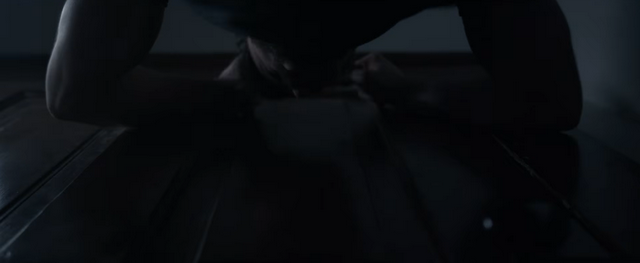
The influence of Stanley Kubrick’s The Shining is unmistakable, but Coleman and Damenz make the composition their own.
It’s precisely the kind of visual storytelling that elevates DEADBOLT above the ordinary. Rather than simply telling us that Theo is dangerous, the camera allows us to experience his psychological instability through framing and perspective.
And that brings us to Matt Gorkis. What a performance!
As Theo, Gorkis delivers a gloriously deranged portrayal of a man whose behavior is unpredictable, frequently outrageous, and often so bizarre that you almost don’t know whether to scream or laugh. Theo is violent. He’s cruel. He’s manipulative. He’s also strangely theatrical, with an unusual accent, peculiar mannerisms, and a physicality that borders on the feral. Gorkis throws himself into the role with reckless abandon, hurling his body around rooms, collapsing onto hard surfaces, and embracing every opportunity to make Theo as uncomfortable and unsettling a presence as possible. There’s nothing restrained about his performance, nor should there be. Theo is a creature of excess, a man whose aggression and bizarre sense of entitlement make him both terrifying and, at times, absurdly funny. Gorkis understands that contradiction and plays it beautifully. And that accent! Where on earth did he find it? Whatever its origins, it adds another deliciously strange dimension to the character.
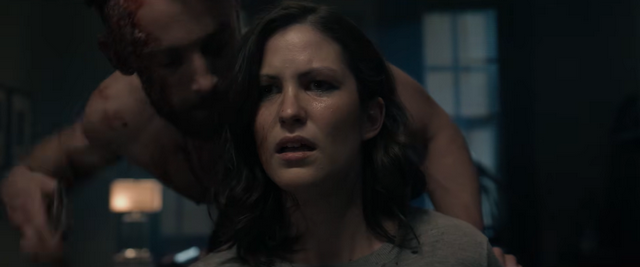
But Coleman is careful not to let Theo overwhelm the film. As outrageous as Gorkis may be, the narrative belongs to the women whose lives become entangled in his madness.
And what a trio of performances!
Callie Deering anchors the film as Anne Harrington, delivering a beautifully measured portrayal of a woman forced to confront extraordinary circumstances without abandoning her intelligence or compassion. Anne is no helpless victim waiting to be rescued. She thinks. She observes. She questions. She makes decisions based upon the information available to her, even when those decisions carry potentially devastating consequences. Her compassion is particularly important.
Anne’s work assisting abused women informs her response to Sabi (Jaslen Gonzalez), a young woman who appears to be in desperate need of help. Anne’s willingness to assist her may seem questionable under the circumstances, but it is entirely consistent with the character’s established values. And Deering makes that conflict believable. We see Anne’s hesitation. We see her assessing the situation. We see the internal struggle between self-preservation and her instinct to help someone in danger. It’s a nuanced performance that never sacrifices character integrity for the convenience of the screenplay.
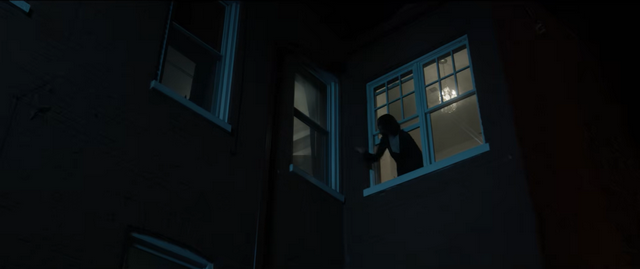
Jaslen Gonzalez is equally impressive as Sabi, a character whose emotional journey becomes increasingly complex as the story progresses. Gonzalez initially presents Sabi with a vulnerability that invites sympathy, but there are additional dimensions to her performance that become apparent as the narrative unfolds. Without revealing those developments, suffice it to say that Gonzalez handles the character’s evolving circumstances with considerable skill. She understands the importance of restraint, particularly in the early scenes, allowing subtle shifts in expression and behavior to communicate more than dialogue alone.
Then there’s Kathy Sinclair (Adria Dawn), an established political figure with ambitions that extend well beyond her current position. Unlike Anne, who is merely contemplating a political future, Kathy is already entrenched in that world, with all the calculations, maneuvering, and hunger for power that entails. And beneath her carefully cultivated public persona lies a simmering jealousy of Anne, whose accomplishments and potential represent something Kathy finds increasingly difficult to tolerate. It’s a fascinating undercurrent to their relationship, one that gives additional psychological weight to the film’s political dimension without revealing the narrative’s carefully guarded secrets.
Adria Dawn is a force of nature, commanding the screen with a performance that is simultaneously controlled, calculating, and deliciously audacious. Kathy is a formidable presence, and Dawn embraces every opportunity to explore the character’s complexities. As the story develops, her performance becomes increasingly heightened, culminating in an extended dramatic passage that is a showcase for both her talent and Coleman’s willingness to embrace the more theatrical aspects of the material.
There’s a touch of camp here, but it’s deliberate and wonderfully effective.
Rather than undermine the suspense, that heightened quality introduces a welcome element of unpredictability. DEADBOLT understands that psychological thrillers can accommodate moments of absurdity without losing their dramatic impact. And Dawn knows exactly how to walk that line.
Together, Deering, Gonzalez, and Dawn provide the film with three distinct female characters, each possessing intelligence, agency, and a clearly defined personality. Their performances are among DEADBOLT’s greatest strengths, particularly in a genre that too often reduces women to frightened victims or convenient plot devices.
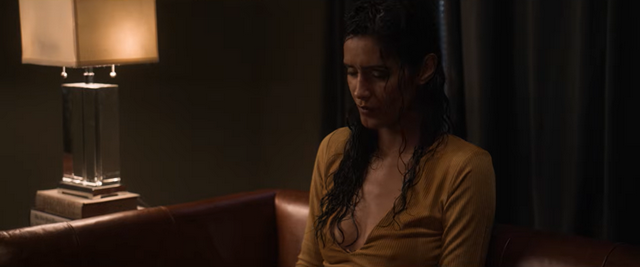
Equally important to the film’s success is the editing by Craig Deering. What a pleasure to watch a thriller that doesn’t feel compelled to cut every two seconds!
Deering allows shots to breathe, giving the performances and compositions the time necessary to generate genuine tension. Rather than relying on incessant rapid-fire cutting, the editing frequently holds on a character’s reaction, a carefully composed frame, or a moment of unsettling silence. The result is a rhythm that feels deliberate and controlled.
This approach is particularly effective during Anne’s attempts to assess her surroundings and understand the danger confronting her. The audience is given time to observe alongside her, to notice details, and to experience the uncertainty of not knowing what may be lurking beyond the next doorway. And when the action does accelerate, the contrast makes those moments all the more effective.
Deering also demonstrates a keen understanding of performance, allowing Gorkis’s outrageous physicality and Dawn’s commanding dramatic moments to unfold without unnecessary interruption.
The film’s relatively lean running time is another advantage. Coleman and Deering understand that a thriller doesn’t need to overstay its welcome to make an impression. DEADBOLT gets down to business, establishes its characters and environment, and keeps the narrative moving toward its increasingly complicated revelations.
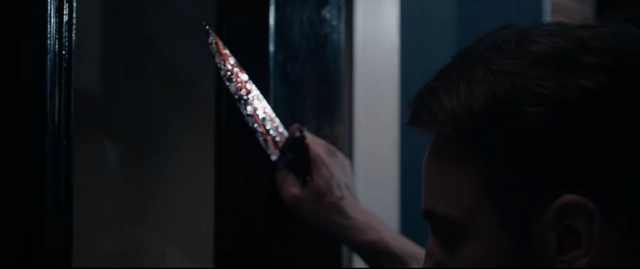
The musical score by Cody Martin is another standout.
Avoiding the predictable musical stingers and relentless sustained-note clichés that dominate so many contemporary thrillers, Martin creates a textured, atmospheric soundscape that complements the visual sophistication of the film. Of particular note is his use of violins and low, guttural string movements, creating an undercurrent of tension that is felt as much as heard. There’s a richness to the orchestration, a sense of classical suspense filmmaking filtered through a contemporary sensibility.
The influence of films like What Lies Beneath, The Ring, and The Invisible Man can be felt in the score’s approach to atmosphere and emotional tension, while occasional touches evoke the more traditional suspense language associated with Hitchcockian thrillers. But Martin never allows those influences to become mere imitation.
Instead, the music becomes an extension of the film’s visual and psychological world, supporting the performances and enhancing the carefully constructed atmosphere without overwhelming either.
And when silence is more effective than music, the film isn’t afraid to use it. That balance between image, sound, performance, and editing is one of the reasons DEADBOLT works so well.
Coleman clearly understands that suspense isn’t simply about what happens. It’s about how information is presented, what the audience is allowed to see, what remains concealed, and how long a filmmaker is willing to sustain uncertainty before providing an answer.
There’s a wonderful appreciation here for the psychological thrillers of the 1990s and early 2000s, particularly the carefully composed imagery and atmospheric storytelling of films like Panic Room, What Lies Beneath, and The Ring. Yet DEADBOLT is not content merely to reproduce those influences.
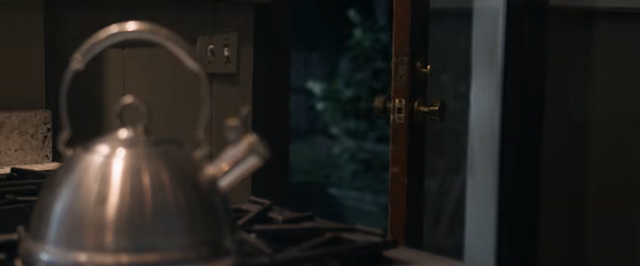
Coleman introduces a contemporary political dimension, explores questions of power and manipulation, and allows his characters to operate within a moral landscape that is considerably more complicated than the traditional division between victim and villain.
And while the film occasionally ventures into heightened, almost outrageous territory, it does so with a refreshing willingness to have fun. Because make no mistake: DEADBOLT has a wicked sense of humor. Much of that humor comes courtesy of Theo, whose behavior is frequently so outlandish that laughter becomes an almost involuntary response. It’s the kind of laughter that comes from disbelief, from the sheer audacity of what we’re watching, and from the uncomfortable realization that we’re finding something funny that probably shouldn’t be. And Coleman knows it.
The film doesn’t demand that we treat every moment with solemn reverence. It allows room for the absurdity inherent in its increasingly elaborate circumstances. Which brings us back to the blood. And the violence. And, naturally, the duct tape! You all know by now how much I love seeing the many different ways duct tape is used in films, and DEADBOLT certainly doesn’t disappoint.
From its disturbing opening sequence to the increasingly chaotic developments that follow, the film understands the effectiveness of practical physical details in establishing danger. Duct tape, restraints, blood, and the tangible consequences of violence give the action an immediacy that no amount of digital trickery could replace. There’s something particularly unsettling about the ordinary becoming an instrument of terror.
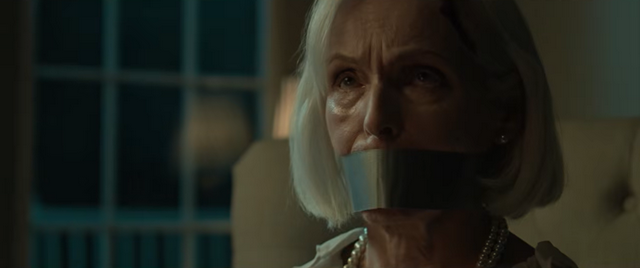
A chair. A doorway. A staircase. A bathroom. A roll of duct tape.
These are familiar objects and spaces, things we encounter every day without a second thought. But in Coleman’s hands, they become components of an increasingly dangerous psychological game. And that’s the real genius of the home-invasion thriller when it’s done well. It takes the one place where we expect to feel safe and transforms it into a place of uncertainty.
DEADBOLT does precisely that.
For a feature directorial debut, Coleman’s command of the material is impressive. He understands his characters, appreciates the contributions of his collaborators, and demonstrates a clear sense of how cinematography, production design, editing, music, and performance must work together to create a cohesive cinematic experience. The eleven-day shooting schedule makes the accomplishment all the more noteworthy.
With limited time and resources, Coleman and his team have produced a film that looks and feels considerably more ambitious than its independent origins might suggest.
Damenz’s cinematography is sophisticated and visually striking. The historic Harrington house provides a spectacular setting. Martin’s score is evocative and carefully integrated. Craig Deering’s editing allows tension and performance to develop organically. And the ensemble, particularly Callie Deering, Jaslen Gonzalez, Adria Dawn, and Matt Gorkis, delivers performances that give the material both emotional substance and considerable entertainment value.
There are moments when the film’s heightened performances and tonal shifts push the boundaries of plausibility, but that’s also part of its personality. Coleman isn’t afraid to let the material become a little wild, a little theatrical, and occasionally downright outrageous. And I, for one, appreciate that willingness to take chances.
Most importantly, DEADBOLT knows how to keep its secrets. The less you know about where this story is headed, the more satisfying the experience becomes.
So check the locks. Draw the curtains. Keep your phone close. And if you hear something suspicious on the other side of the door, perhaps think twice before opening it, because Zac Coleman has crafted a psychological thriller filled with tension, atmosphere, terrific performances, and enough deliciously deranged behavior to keep audiences guessing.
And if Theo comes knocking? Don’t answer the door! Especially if he’s carrying duct tape.
Directed by Zac Coleman
Written by Dylan Noe with story by Zac Coleman and Craig Deering
Cast – Callie Deering, Matt Gorkis, Jaslene Gonzalez, Eric Nelson, Adria Dawn
DEADBOLT is available On Digital and On Demand on November 13th.