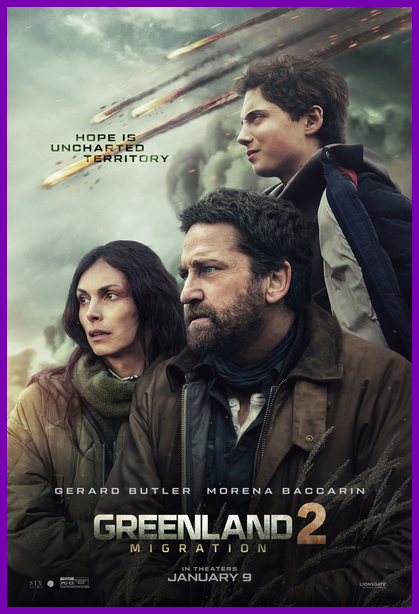
Comet Clarke, it turns out, is the gift that keeps on giving.
With GREENLAND 2: MIGRATION (Migration), director Ric Roman Waugh doesn’t just return to the wreckage left behind by the first film—he deepens it. This sequel expands the scale of danger, yes, but more importantly, it sharpens its focus on what truly matters: family, human connection, and the fragile hope that life is still worth fighting for after everything familiar has been stripped away.
Waugh has always been a filmmaker drawn to the “shades of gray” of story and character, practical action, in-camera effects, and immersive spectacle—and Migration delivers all of that in abundance. Breathtaking action, explosions that tear through the night, environments collapsing, storms raging, and the world feeling perpetually on the brink. Yet what distinguishes this film, and elevates it beyond typical disaster fare, is how consistently those elements are used in service of emotion.
This is not destruction for destruction’s sake. This is survival with purpose.
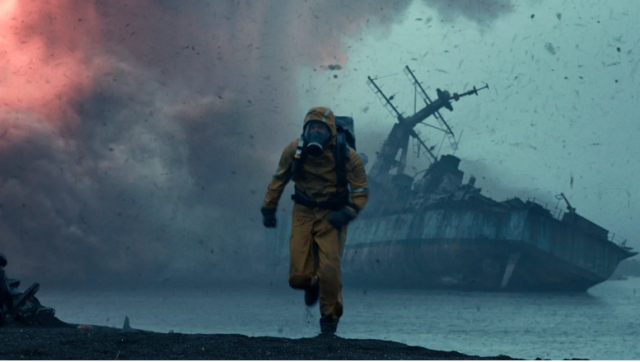
Five years after Greenland chronicled the Garrity family’s desperate race to reach safety as Comet Clarke devastated the Earth, GREENLAND 2: MIGRATION finds John, Allison, and their son Nathan forced to leave the bunker that has kept them alive. Radiation still permeates the planet. The air remains unsafe. Seismic instability, tidal shifts, and sporadic comet fragments continue to threaten what remains of civilization. Communication is unreliable. Stability is an illusion. So when the bunker becomes untenable, John Garrity does what he has always done: he fights.
Gerard Butler and Morena Baccarin return with renewed depth as John and Allison, while Roman Griffin Davis—now playing their 15-year-old son Nathan—brings remarkable emotional weight to the story’s generational arc. Davis, who stole scenes in Jojo Rabbit, more than holds his own here, grounding Nathan as a young man shaped by confinement, loss, and inherited responsibility.
What struck me most powerfully is how Migration shifts the emotional dynamic established in the first film. Where Greenland tore the Garrity family apart and forced them to claw their way back to one another, this next chapter takes full advantage of the fact that they are together—and refuses to let go of that unity.
The film is filled with small, intimate moments that speak volumes: Allison taking John’s hand in the bunker, quiet glances exchanged in a lifeboat, physical closeness that feels earned rather than sentimental. These gestures become the film’s emotional glue. They are reminders that survival is not enough—connection is the point.
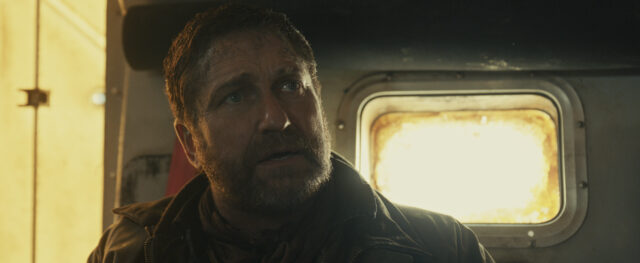
Make no mistake, GREENLAND 2: MIGRATION is terrifying.
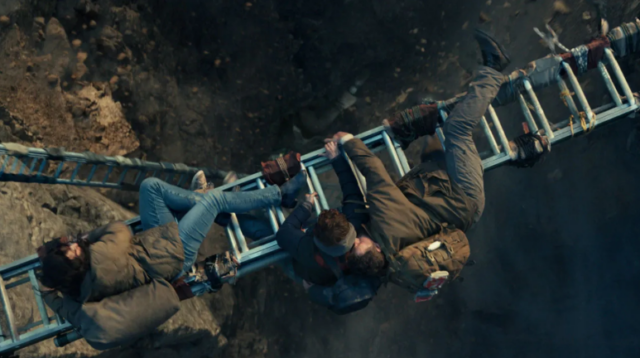
The film delivers relentless, edge-of-your-seat tension, punctuated by expertly staged jump scares that land hard and without warning. A brutal nighttime car attack—glass shattering, blood spraying, a body slumping into view—hits with shocking immediacy. The opening destruction of the bunker through quakes, storms, and tidal waves establishes a tone of instability that never fully relents. One standout sequence—already familiar from the film’s trailers—involves the family crossing a collapsing rope-ladder bridge over a chasm. The vertigo is palpable. The wind howls. The sense of exposure is overwhelming. It’s a masterclass in immersive filmmaking, and a perfect example of how Waugh places the audience inside the danger rather than observing it from a safe distance. This is action that makes your palms sweat.
One of the film’s greatest strengths is its visual grammar, crafted through Waugh’s collaboration with cinematographer Martin Ahlgren. Together, they construct a visual arc that mirrors the emotional journey of the story. The film begins in the bunker, steeped in concrete grays, greenish lighting, and a faintly yellow pallor to the skin tones. The air feels thick. The world feels suffocating. Outside, the landscape remains bleak—gray skies, dark oceans, scorched land. But as the Garrity family journeys forward, something subtle begins to change.
Color is slowly, deliberately introduced into the world. Not all at once. Not artificially. Brick buildings in London carry grime and history. Mackenzie’s small hospital glows warmly with Christmas lights—an oasis of humanity amid ruin. Laurent’s home, carved out of a former mail processing plant near Paris, radiates warmth through scavenged remnants of the old world.
By the time the story leads us toward Clarke Crater—rumored to be a kind of Eden—the palette blossoms into blues and greens: grass, water, birds in flight, life visibly returning. The payoff is deeply satisfying, both visually and emotionally, aided by a seamless blend of live action and visual effects.
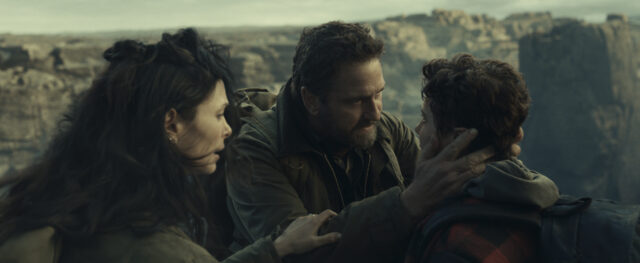
Ahlgren’s cinematography excels not only in conveying scale and desolation but in finding humanity within it. Close-ups of hands touching, faces framed against vast emptiness—small details that reinforce what’s at stake.
The film is rich with thoughtful continuity from the first Greenland, none more effective than Nathan’s insulin. What once served as a catalyst for separation becomes a moment of unity here, as Allison urgently shouts for Nathan to grab all of it—because they are not coming back. It’s a small but meaningful beat that reinforces the film’s central thesis: we survive together, or not at all.
The nighttime battle sequences are another highlight. Slightly more restrained than Waugh’s most explosive work (Angel Has Fallen, Kandahar), they are nevertheless beautifully staged. Explosions—designed by longtime collaborator Terry Glass—serve as primary light sources for Ahlgren, bathing towering trees and battlefield corridors in fire and shadow. Production designer Vincent Reynaud’s Maginot Line-inspired layouts visually echo the bunker corridors the characters have lived in for years, reinforcing themes of entrapment, passage, and endurance.
One breathtaking moment pauses amid the chaos to reveal a crystal-clear night sky—Andromeda, the Milky Way—visible in stunning clarity. It’s a quiet reminder of the beauty that still exists above the devastation, and for me, one of the film’s most perfect sequences.
Not to be overlooked is David Buckley’s score, which is deeply moving, filled with recurring motifs and melodic emotional cues that elevate the film’s final act. The near-angelic chorale voices that emerge late in the story align beautifully with the visual introduction of light and life, reinforcing the film’s hard-won sense of hope.
Written by Mitchell La Fortune and Chris Sparling, story structure is strong, balancing large-scale action with intimate character beats. The Garrity family remains the heartbeat of the film throughout, and Gerard Butler’s voiceover—both at the beginning and the end—lands with quiet authority and emotional resonance.
Performances across the board are solid, with particular growth evident in Morena Baccarin’s Allison, now confident, capable, and firmly positioned as a leader. The shared POV between John and Allison—thinking, acting, and deciding as one—is one of the film’s most satisfying evolutions.
GREENLAND 2: MIGRATION is not about the end of the world. It’s about responsibility—what we inherit, what we protect, and what we choose to leave behind. It is a film that made me cry—ugly cry—and then immediately grip my seat in fear. A rare blend of emotional intimacy and visceral spectacle, it stands as Ric Roman Waugh’s most humane and affecting work to date.
Heart, home, and hope triumph. The only question that remains is: do we deserve the world that comes next?
Directed by Ric Roman Waugh
Written by Mitchell La Fortune and Chris Sparling
Cast: Gerard Butler, Morena Baccarin, Roman Griffin Davis
by debbie elias, 12/25/2025
GREENLAND 2: MIGRATION is in theatres on January 9th, 2026.