
By debbie lynn elias
FUN! FUN! FUN! From start to finish, that’s what writer/director Ballard C. Boyd delivers with JACKRABBIT, a wonderfully entertaining blend of comedy and mystery that takes two mismatched women, throws them into the middle of a missing-person investigation, and lets the laughs, clues, and complications fly! Anchored by the irresistible chemistry of Taylor Ortega and Kuhoo Verma, JACKRABBIT is a delightful cinematic romp that proves you can have a genuinely intriguing mystery without sacrificing humor, heart, or a gloriously eccentric supporting cast.
At its core, JACKRABBIT is a story about friendship, although friendship is the last thing on the minds of Avery (Taylor Ortega) and Georgina, aka George (Kuhoo Verma), when they first meet. George, an aspiring investigative journalist, has moved to New York City for a promising job at a digital media startup, only to discover that a corporate merger has eliminated her position before she can even begin. Suddenly unemployed, unfamiliar with the city, and without a place to call home, George turns to her childhood best friend, Trish (Soojeong Son), for help.
Trish has a solution. Her New York friend Avery, a struggling actress recently separated from her girlfriend, needs a roommate to help pay the rent. What could possibly go wrong?
PLENTY!
Avery is street-smart, sarcastic, fiercely independent, and possessed of an attitude that could cut glass. George, meanwhile, is intelligent, inquisitive, occasionally naive, and inclined to approach every situation as though she’s assembling evidence for an investigative exposé. The two women are instant adversaries, their personalities clashing almost as soon as they occupy the same space. And matters aren’t helped by the fact that each considers herself Trish’s closest friend.
It’s an Odd Couple dynamic, to be sure, but for my money, Avery and George are more like oil and vinegar. Initially resistant to blending, the more they’re stirred together, the smoother the mixture becomes, with the individual flavors melding into something unexpectedly delicious.
And that mixture is the secret ingredient that makes JACKRABBIT so entertaining.
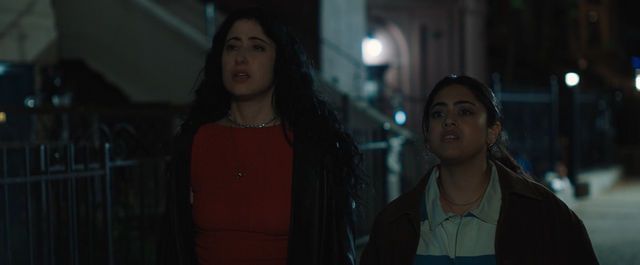
Two Women, Two Comedic Styles, One Perfect Partnership
Casting is everything in a film like JACKRABBIT, and Boyd has struck gold with Taylor Ortega and Kuhoo Verma.
Ortega is sheer comedic perfection as Avery. She possesses a wonderfully natural ability to deliver street-smart snark with razor-sharp precision, often communicating more with a raised eyebrow, a sideways glance, or a perfectly timed reaction than an entire page of dialogue could accomplish. Avery is quick-thinking, adaptable, and more than capable of talking her way into—or out of—almost any situation. She’s also an actress, which means assuming a persona or telling a convincing lie comes as naturally as breathing.
Verma’s George is a completely different comedic animal. Her humor comes from an appealing combination of wide-eyed innocence, intellectual confidence, and an occasionally exasperating inability to recognize when she’s being too smart for her own good. George wants to be an investigative reporter, and she’s got the instincts for it. She notices details, recognizes patterns, and asks questions that other people might overlook. But she doesn’t always possess the street smarts to appreciate the consequences of asking those questions.
It’s the contrast between these two distinct comedic styles that makes the pairing so irresistible.
Ortega’s timing is sharp and instinctive, while Verma often allows a beat of innocence or bewilderment to settle before delivering a reaction. They don’t compete for laughs. They build them together. And as Avery and George gradually learn to recognize one another’s strengths, the actresses subtly adjust their rhythms, creating an increasingly satisfying sense of partnership.
But Boyd doesn’t rush that evolution. He allows the irritation, mistrust, and competitive friendship to simmer, giving the women room to grow as individuals even as circumstances force them together.
And those circumstances become considerably more complicated when Trish suddenly disappears.
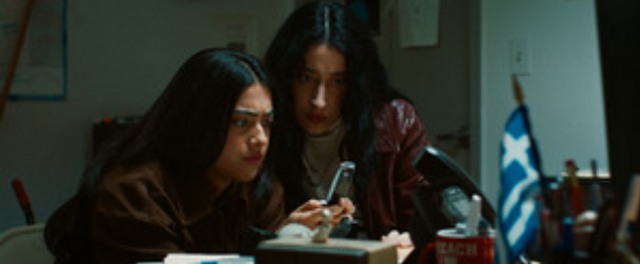
A Missing Friend and a Mystery That Keeps Getting More Intricate
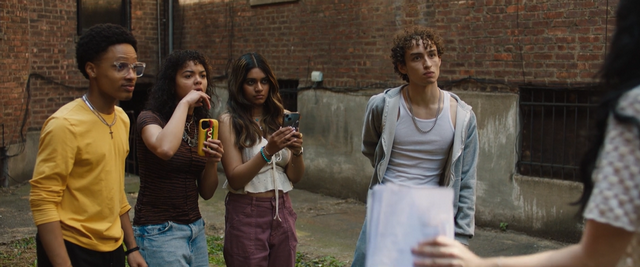
With Trish nowhere to be found, Avery and George discover that their mutual concern outweighs their mutual dislike. Reluctantly, they join forces to investigate her disappearance.
George brings her analytical mind, curiosity, and determination to uncover the truth. Avery contributes her knowledge of New York, her ability to navigate unfamiliar situations, and her willingness to improvise when a little deception might open otherwise closed doors. Together, they’re an unlikely but surprisingly effective investigative team.
Boyd’s screenplay is particularly clever in the way it develops the mystery alongside the evolving relationship between the women. As the search for Trish grows more intricate, so does the dynamic between Avery and George. Every new lead, unexpected encounter, and questionable explanation forces them to reassess not only what they believe about Trish but also what they believe about each other.
The screenplay is rich with misdirection, planting breadcrumbs that appear innocuous or inconsequential until their significance becomes apparent later. And Boyd understands the value of withholding information. He never reveals more than necessary, allowing suspicion to move from one character to another while keeping the audience actively engaged in trying to piece together the puzzle.
What initially appears to be a relatively straightforward missing-person mystery gradually reveals layers of deception, unexpected connections, and secrets that suggest Trish’s life may be far more complicated than either woman imagined. Yet even as the stakes increase, Boyd never loses sight of the comedy.
This is where JACKRABBIT distinguishes itself from so many genre hybrids. Rather than abandoning humor when the mystery becomes serious, Boyd allows the two elements to coexist. The comedy emerges naturally from the characters, their differing perspectives, and the absurd situations into which their investigation leads them. And some of those situations are absolutely hilarious!

Snakes, Suspicious Characters, and One Very Unexpected Party
Boyd populates JACKRABBIT with a wonderfully colorful assortment of supporting characters, each contributing to the film’s humor, mystery, or both.
Particularly memorable is Mark Gessner as Tony, Trish’s co-worker and a man with a rather unsettling fascination with snakes. Not just ordinary snakes, mind you, but dangerous varieties that aren’t exactly appropriate household pets! Tony’s office, adorned with images of his slithering favorites, immediately establishes something peculiar about the man. Yet Gessner plays him with such an appealing blend of geniality, nervous energy, and underlying ambiguity that it’s difficult to determine whether he’s simply an eccentric enthusiast or someone considerably more troubling.
Gessner is a scene-stealer, moving effortlessly between comedy and drama while keeping the audience guessing about Tony’s true nature.
Soojeong Son also brings welcome dimension to Trish, whose disappearance sets the entire adventure in motion. Although much of the story initially revolves around the absence of Trish, Son ensures that she never feels like a mere plot device. As the mystery develops, the emotional significance of her relationships with Avery and George becomes increasingly apparent.
And then there are the assorted New Yorkers the women encounter along the way!
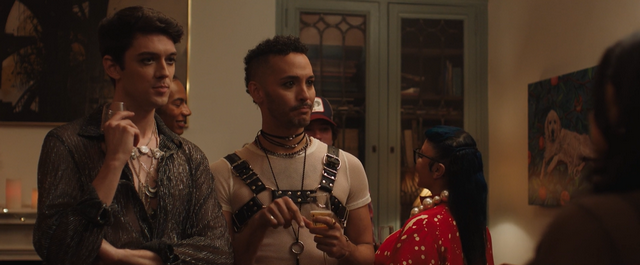
One particularly memorable sequence involves a supposedly glamorous party that turns out to be something altogether different—a gathering connected to the filming of pornography. It’s a wonderfully funny situation, but what makes it work so well is the attention to the people populating the scene.
The costume design, physical mannerisms, and carefully selected character details establish personalities almost instantaneously. These people don’t need lengthy introductions or explanatory dialogue. One look tells us who they are, or at least who they want everyone to believe they are. And let’s not overlook those older women who are perfectly capable of weaponizing a shopping cart! They’re a delight, and like so many characters in JACKRABBIT, they aren’t necessarily what they initially appear to be.
That’s one of the screenplay’s most effective recurring ideas: appearances can be deceiving, and assumptions are often the first casualties of an investigation.
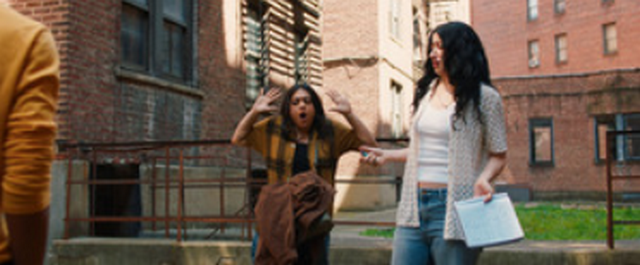
Keeping It Light, Bright, and Beautifully Composed
One of Boyd’s smartest creative decisions is his approach to the film’s visual grammar.
Working with cinematographer Evan Jake Cohen, Boyd resists the temptation to employ flashy camera movements, excessive handheld photography, or heavy-handed visual tricks to manufacture excitement. Instead, the cinematography is clean, composed, and refreshingly unfettered. The camera serves the story rather than calling attention to itself.
There’s some handheld work, but it’s used judiciously. Carefully composed frames, thoughtful camera placement, and an emphasis on spatial clarity allow the actors and their performances to remain the primary focus.
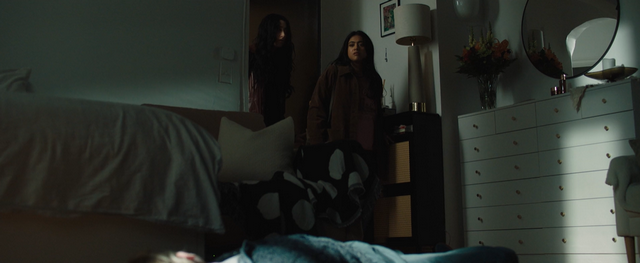
Particularly effective is the film’s overall visual tonal bandwidth. Although JACKRABBIT centers on a disappearance and gradually develops more threatening undertones, Boyd wisely maintains a predominantly light and bright visual atmosphere. Rather than immediately plunging the story into darkness, he allows the cinematography to reflect the film’s comedic foundation, gradually introducing more shadow and noir-inflected imagery as the mystery deepens. It’s a subtle but important distinction.
By avoiding an overwhelmingly dark aesthetic, Boyd gives Ortega and Verma the visual space to exploit their comedic gifts. Their expressions, physical reactions, and interactions remain clearly visible, allowing even the smallest comedic beats to register.
At the same time, Cohen knows when to shift the lighting to suggest uncertainty or danger. The transition is organic, mirroring the film’s progression from mismatched-roommate comedy to increasingly complicated mystery. And the film looks terrific!
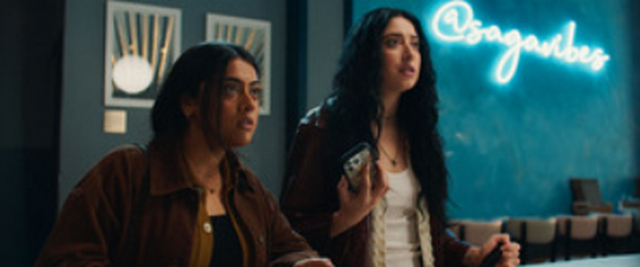
New York Locations and Maggie Mahlock’s Production Design
Another major asset is the extraordinary variety of New York locations.
From apartments and offices to unusual commercial spaces and unexpected corners of the city, JACKRABBIT makes New York feel like a living, breathing participant in the adventure. The locations are beautifully selected, offering both visual interest and narrative possibilities. Boyd and Cohen make excellent use of architectural features, room dimensions, windows, and practical lighting opportunities, allowing each environment to possess its own personality.
But equally important is the work of production designer Maggie Mahlock. Her attention to detail is exceptional, particularly in the apartments occupied by Trish and by Avery and George.
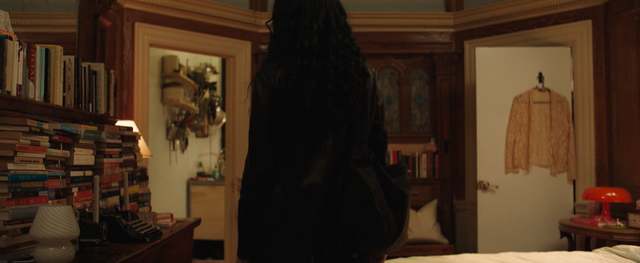
Trish’s apartment is a visual delight, with its unusual architecture, wood paneling, faux stained-glass windows, and remarkable ceiling. It’s the kind of location that immediately invites curiosity, and the production design takes full advantage of its distinctive character.
Avery and George’s apartment, meanwhile, provides a more intimate visual expression of their relationship. Initially, the space is unmistakably Avery’s, reflecting her personality and lifestyle. As George settles in and the women’s relationship evolves, subtle changes in the environment reflect the gradual blending of their separate worlds. It’s character development through production design, and it works beautifully.
Mahlock’s work is equally impressive in the Silk Shop and its basement, where the set dressing creates an atmosphere rich with texture, visual information, and a sense of history.
The basement is particularly striking, with carefully arranged objects, atmospheric haze, and beautifully controlled shafts of light that lend the space an almost cinematic theatricality without sacrificing believability. The more upscale apartment used for the party sequence offers an entirely different aesthetic, its décor and carefully populated rooms reinforcing the social environment and the eccentric personalities inhabiting it.
Throughout the film, Mahlock and her team demonstrate an understanding that production design isn’t merely about making a location look attractive. It’s about telling the audience something about the people who inhabit it. And JACKRABBIT does that exceedingly well.
Editing That Keeps the Rabbit Running
Boyd shares editing duties with Robert Grigsby Wilson, and together they maintain a rhythm that allows the comedy to breathe without letting the mystery lose momentum.
The editing is clean, efficient, and purposeful, moving smoothly between investigative developments, character interactions, and comedic set pieces. There’s an especially pleasing balance between the timing of the performances and the pacing of the overall narrative.
Comedy requires patience. A reaction held for an extra beat can transform an amusing moment into a genuinely funny one. But mystery requires forward movement, a sense that each scene is bringing us closer to an answer even as new questions arise. Boyd and Wilson understand both demands. They give Ortega and Verma the breathing room necessary for their comedic interplay while ensuring that the story continues moving. Transitions between locations and plot developments are fluid, and the accumulation of clues never becomes confusing or cumbersome.
Perhaps most importantly, the editing preserves the pleasure of discovery. Rather than overemphasizing every clue or telegraphing future revelations, the film trusts the audience to pay attention. That confidence makes the unfolding mystery considerably more satisfying.
A Score That Knows How to Have Fun
And then there’s the music! Composer Clarke Jaxton Motorbike delivers a wonderfully inventive score that mirrors the film’s tonal versatility.
Moving between playful electronic textures, comedic accents, intriguing rhythmic passages, and darker atmospheric material, the music complements the changing demands of the story without overwhelming the performances.
There’s a delightful retro sensibility to portions of the score, with synthesizer-driven sounds that evoke the playful sophistication of certain 1980s comedy-thrillers. But the music never feels like a mere exercise in nostalgia. It possesses a personality all its own, frequently adding an unexpected layer of wit or intrigue to a scene.
Motorbike’s score is particularly effective in supporting the relationship between Avery and George. As their investigation becomes more complicated, the music helps bridge the shifting moods, maintaining the film’s essential sense of fun even when the narrative moves into more suspenseful territory. And when the mystery demands greater tension, the score obliges without resorting to intrusive musical cues that announce every potential danger.
It’s a delightful marriage of sound and story. But Boyd saves one of the film’s greatest musical pleasures for last.
The end credits, accompanied by Vulfpeck’s infectious “Outro,” are absolutely spectacular!
The music has a wonderful funky energy that feels perfectly suited to the film’s New York setting, its offbeat humor, and the journey Avery and George have taken together.
It’s the kind of end-credits sequence that makes you want to stay in your seat, enjoy the music, and savor the experience rather than immediately reaching for the remote. And yes, I watched every second!
A Mystery With Laughs, Heart, and Plenty of Personality
What ultimately makes JACKRABBIT such a pleasure is that Boyd understands the film’s greatest strength isn’t merely its mystery, although that mystery is carefully constructed and consistently engaging. It’s the relationship between Avery and George.
The disappearance of Trish provides the narrative engine, but the emotional journey belongs to these two women. Their transformation from reluctant roommates and competing friends into an increasingly effective partnership gives the story its heart.
Boyd never forces that evolution. He allows it to emerge through shared experiences, moments of vulnerability, unexpected discoveries, and the gradual recognition that each woman possesses qualities the other lacks.
Taylor Ortega and Kuhoo Verma are an absolute delight, bringing distinctly different comedic sensibilities that complement one another beautifully. Mark Gessner and Soojeong Son add depth and intrigue, while the colorful supporting players contribute an abundance of personality and laughs. Add Evan Jake Cohen’s clean, thoughtful cinematography, Maggie Mahlock’s richly detailed production design, Boyd and Robert Grigsby Wilson’s carefully calibrated editing, and Clarke Jaxton Motorbike’s wonderfully playful score, and the result is a film that succeeds on virtually every level.
JACKRABBIT doesn’t need visual excess, manufactured melodrama, or an unnecessarily grim atmosphere to hold our attention.
It has characters worth watching, a mystery worth solving, and a filmmaker who know exactly how to make the journey entertaining.
And perhaps best of all, it remembers something too many movies forget. Movies are supposed to be fun! And JACKRABBIT? It’s FUN! FUN! FUN!
Now somebody get Avery and George another mystery to solve. Because after spending this much time with them, I’m not ready to say goodbye!
Director/Writer: Ballard C. Boyd
Cast: Kuhoo Verma, Taylor Ortega, Soojeong Son, Mark Gessner, Saamer Usmani
JACKRABBIT is currently on the festival circuit!