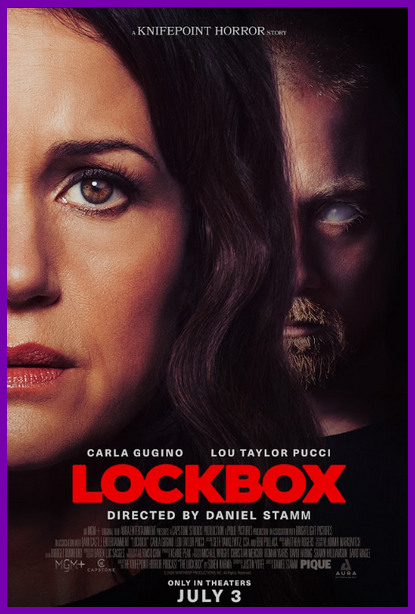
This is one weird movie. I like it. A lot.
Far more than a straightforward supernatural thriller or demonic possession tale, LOCKBOX is an unsettling psychological puzzle that quietly worms its way under your skin. Rather than relying on an endless barrage of jump scares or gore, director Daniel Stamm uses measured rhythm to patiently build an atmosphere of uncertainty, grief, trauma, faith, and mounting dread, cultivating an ever-present unease, asking audiences to question not only the terrifying events unfolding before them, but whether they can trust their own eyes in the first place.
Written by Justin Yoffe and Soren Narnia, based on an episode of Narnia’s “Knifepoint Horror” podcast originally titled “Winthrop”, the story centers on Ellen (Carla Gugino). Following the death of her mother, Ellen retreats to a quiet rural community where she hopes to find peace while caring for her emotionally scarred cousin Winthrop (Lou Taylor Pucci), an Army veteran suffering from severe PTSD and other injuries. Their fragile existence is disrupted by the mysterious neighbor Vahna (Katharine Isabelle), whose increasingly bizarre warnings suggest that Winthrop may be something far more dangerous than a damaged veteran struggling with invisible wounds.
Everybody in the movie is carrying a lockbox. Ellen is locking away grief. Winthrop is literally and emotionally locked away. Vahna is hiding truths. The audience is trying to unlock what’s really happening.
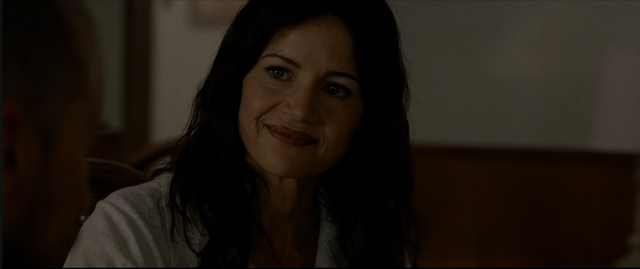
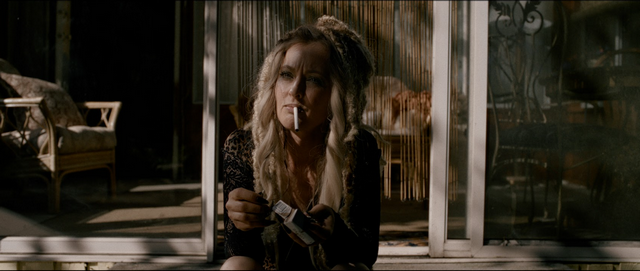
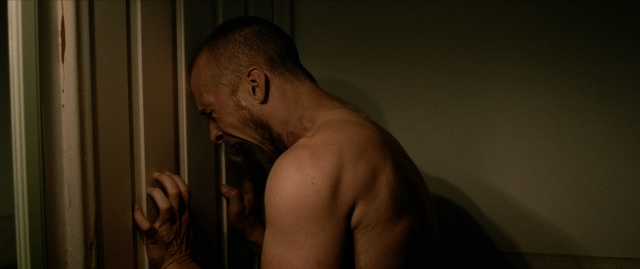
What has consistently distinguished Daniel Stamm’s work is his understanding that genuine horror rarely comes from monsters alone. It comes from uncertainty. He never mistakes noise for fear. Whether in “The Last Exorcism”, “Prey for the Devil”, or now LOCKBOX, Stamm demonstrates remarkable confidence in allowing atmosphere, visual storytelling, and measured pacing to do the heavy lifting rather than overwhelming audiences with exposition or manufactured scares. The result is a film that rewards patience while steadily tightening its grip.
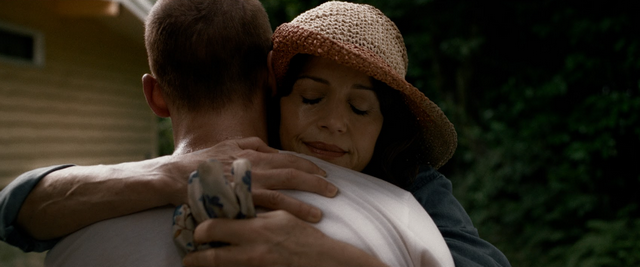
Carla Gugino is simply superb as Ellen. Quiet, compassionate, and emotionally grounded, Gugino never overplays Ellen’s fear. Instead, she conveys volumes with the slightest glance or hesitation, often seeming to search another person’s soul for answers before speaking. Ellen possesses an inner strength that makes her instantly relatable and endlessly watchable, remaining steadfast in her belief in Winthrop even as increasingly disturbing events threaten to unravel everything around her.
Lou Taylor Pucci presents Winthrop as an emotionally wounded enigma, revealing little while constantly inviting questions. His restrained performance keeps audiences perpetually uncertain whether he is victim, threat, or something far more complex. Katharine Isabelle is wonderfully unsettling as Vahna, creating a character whose peculiar behavior and seemingly disconnected observations gradually become one of the film’s most unnerving elements.
Visually, LOCKBOX is meticulously crafted.
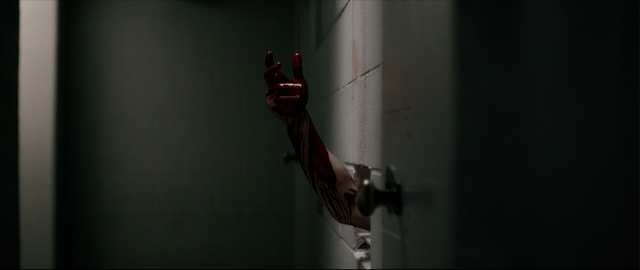
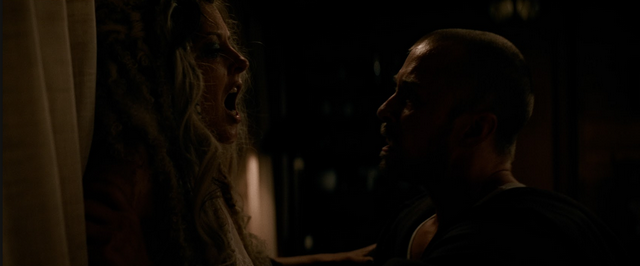
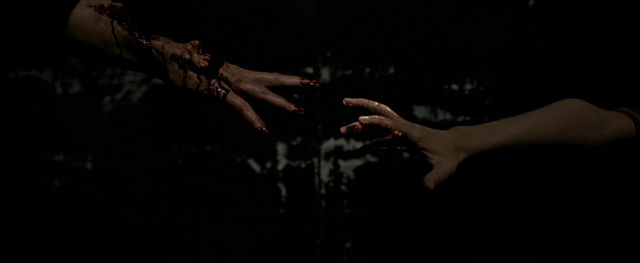
Working with cinematographer Alfonso Chin, Stamm creates a sophisticated visual grammar with unsuspecting subtlety that continually unsettles without drawing attention to itself. Negative space becomes an active participant in the storytelling. Long lenses subtly distort perspective while mirrors, windows, reflections, and water repeatedly challenge our perception of reality. Carefully executed slow push-ins, restrained Dutch angles, and thoughtfully composed two-shots quietly build emotional instability long before the film openly embraces supernatural horror.
One particularly striking image finds Ellen quietly sketching at a glass table, viewed through a drinking glass filled with water. The visual distortion is subtle yet deeply symbolic, reinforcing one of the film’s central ideas: can we truly rely on what our eyes are seeing?
That same visual philosophy extends beautifully into the film’s restrained color palette. Desaturated without ever appearing lifeless, the carefully controlled tones create remarkable visual consistency while lending the production an elegance that feels far more expensive than its independent roots might suggest.
Production designer Daren Luc Sasges deserves enormous praise for creating environments that become characters in their own right. Ellen’s modest home, the eerie, cluttered residence occupied by Vahna, the sparse quarters of the priests, and especially the textured concrete basement featured during the film’s climactic third act all possess distinct personalities that deepen the storytelling. Spatial relationships, confined interiors, narrow hallways, and carefully considered doorways contribute immeasurably to the mounting tension.
One of my favorite aspects of LOCKBOX is its devotion to organic materials. Wood. Glass. Ceramic. Metal. A simple graphite pencil. Cloth napkins. Everyday objects possessing permanence rather than disposable convenience. That commitment to timeless textures gives the entire production an almost ageless quality, quietly reinforcing the story’s supernatural themes while avoiding visual distractions that might date the film.
Equally impressive is Stamm’s handling of visual effects. Rather than overwhelming the narrative, the effects emerge organically from the story itself. Distorted faces, impossibly white eyes, unnerving body movement, and seamless physical transformations serve the narrative instead of existing merely as spectacle. Fans of “The Last Exorcism” will immediately recognize Stamm’s gift for creating genuinely disturbing imagery that lingers long after the credits roll.
As accusations against Winthrop escalate and increasingly impossible events begin surrounding him, LOCKBOX shifts almost imperceptibly from psychological mystery into full-blown supernatural horror. The discovery of violent crimes, an assault seemingly committed behind a locked steel door, and the arrival of priests and medical specialists propel the story into a riveting third act that fully capitalizes on the carefully cultivated unease established throughout the film’s opening acts.
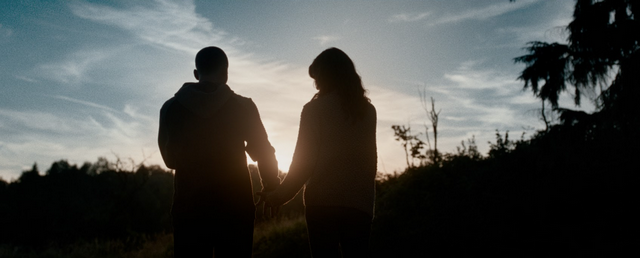
Sound proves every bit as important as image.
Supervising sound editor and re-recording mixer Miguel Nunes crafts an exceptional soundscape built as much upon silence as sound. Moments of near-total quiet become deeply unsettling before giving way to precisely placed sonic jolts that continually keep audiences off balance. Matthew Rogers’ restrained score complements that approach beautifully, never manipulating emotions through bombast but instead quietly reinforcing the film’s pervasive atmosphere of uncertainty.
Editor Bridget Durnford demonstrates exceptional command of pacing. Every reveal feels earned. Every pause serves a purpose. Carefully placed visual and narrative breadcrumbs continually reward attentive viewers while maintaining an ever-present sense of mystery. By the time the film reaches its extraordinary final act, Durnford’s editorial precision allows every technical element to converge into a remarkably effective crescendo of psychological and supernatural horror.
LOCKBOX may occasionally linger a beat longer than audiences accustomed to rapid-fire horror expect, but Daniel Stamm uses that deliberate pacing to quietly build one of the year’s most visually sophisticated and emotionally immersive genre experiences. Thoughtfully written, beautifully photographed, impeccably performed, and technically accomplished across every department, LOCKBOX is less interested in startling audiences than in slowly convincing them they should no longer trust their own senses.
And that’s precisely what makes LOCKBOX so unnervingly effective.
Directed by Daniel Stamm
Written by Soren Narnia and Justin Yoffe based on Narnia’s “Knifepoint Horror” podcast
Cast: Carla Gugino, Lou Taylor Pucci, Katharine Isabelle
by debbie elias, 06/27/2026
LOCKBOX is in theatres on July 3rd.