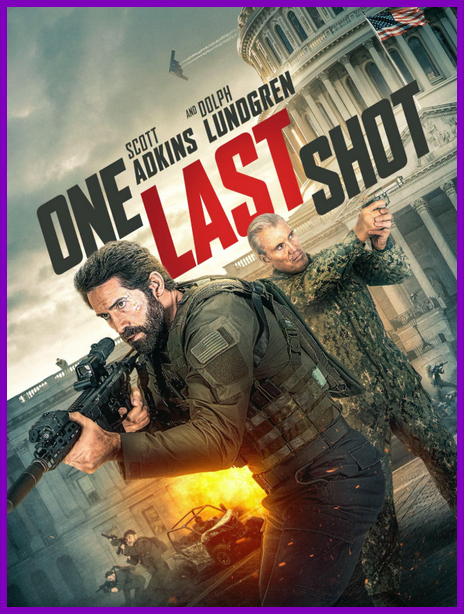
Jake Harris looks like hell.
Beaten, bruised, bloodied and bandaged, he arrives in ONE LAST SHOT carrying the physical evidence of everything Scott Adkins has put his body through in ONE SHOT and ONE MORE SHOT. There has been no convenient movie-magic recovery between missions. Barely hours have passed since the last film. Jake hasn’t had time to heal, sleep or even catch his breath.
Too bad.
The world needs saving again.
Director James Nunn and screenwriter Jamie Russell complete their ONE SHOT TRILOGY with a film that delivers everything one could want from its final installment—fast and furious action, technical bravura, nail-biting tension and Scott Adkins doing what Scott Adkins does best. But ONE LAST SHOT also does something more important. It gives Jake Harris greater emotional depth than we’ve seen before, forcing him to confront questions of loyalty, brotherhood and honor while his battered body runs almost entirely on adrenaline and instinct.
And that makes ONE LAST SHOT not only a fitting culmination of the trilogy, but its most emotionally resonant chapter.
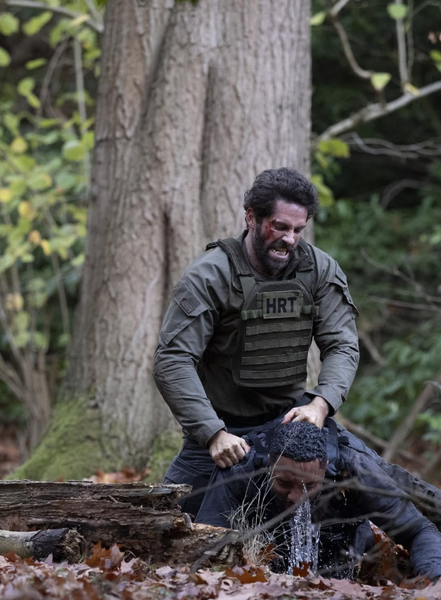
The threat this time is potentially catastrophic. Elliot Carter (Stephen Cree), Jake’s former brother-in-arms, has gone rogue with a plan to gain access to America’s nuclear codes. With members of the Joint Chiefs held hostage, Carter and his mercenaries methodically collect the required DNA and retinal scans, leaving only one biometric key still out of reach: Ella Torres (Hannah Ware). A civilian, Torres is the last person one would ever suspect of holding the final piece needed to unlock the nuclear arsenal, making her both Carter’s most valuable target and the one person Jake absolutely cannot allow him to capture. With time running out, Admiral Mulholland (Dolph Lundgren) drops Jake into a SEAL team assembled to stop Carter and protect Torres.
But Jake doesn’t know these men, and they don’t know him.
That uncertainty immediately gives the mission an added layer of tension. Trust is essential in combat, yet here it must be earned on the fly. Nunn smartly allows us to learn the team as Jake does, giving faces and personalities to the men rather than treating them as anonymous tactical bodies waiting to be dropped.
That pays off beautifully in one of the film’s standout sequences.
A SEAL steps onto a pressure-sensitive explosive and is unable to move. Jake crouches beside a staircase attempting to defuse it while Carter’s mercenaries appear on the level above, weapons trained downward. The tactical advantage is immediately apparent: the mercenaries hold the high ground while the SEALs are trapped below, outnumbered and outgunned. Jake can’t simply join the firefight without abandoning the man whose slightest movement could kill them all.
It’s a nail-biter.
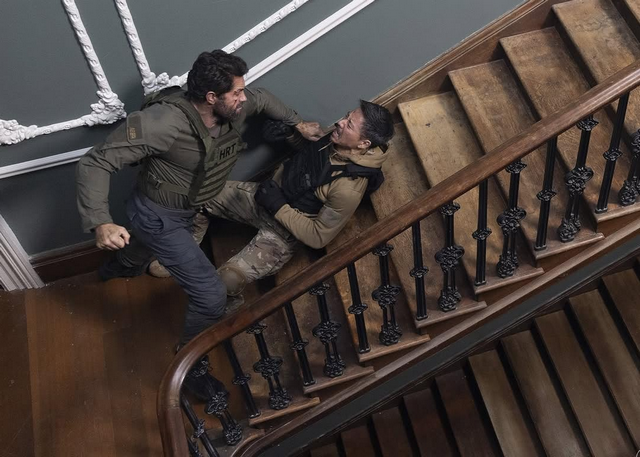
Cinematographer Joseph Fitzgerald makes terrific use of the two-level geography, while editor Richard Blackburn cuts between Jake, the explosive, the immobilized SEAL, the men fighting below and the mercenaries firing from above without ever sacrificing spatial clarity. Blackburn’s editing throughout the film is rapier-sharp, maintaining a relentless pace while still allowing us to understand exactly where we are, where the danger is coming from and who is at risk.
That clarity becomes increasingly important because ONE LAST SHOT is constantly on the move.
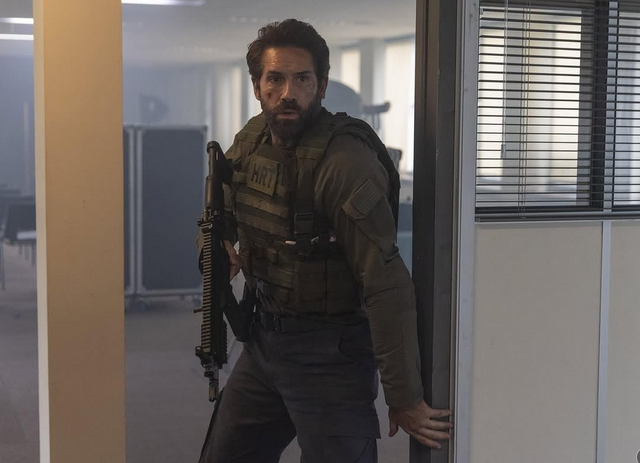
Fitzgerald and Nunn exploit the labyrinthine geography of the sprawling compound, turning tunnels, hallways, staircases, rooms and blind corners into tools of suspense. The camera frequently positions itself over or behind Jake’s shoulder, allowing us to see what he sees ahead while leaving us uncertain about what may be behind him. When Jake brings up the rear of the SEAL team, the frame expands, giving us his peripheral awareness of the men and terrain ahead.
It puts us inside Jake’s tactical perspective.
Once his team is decimated, however, the movie changes.
The mission becomes brutally simple: find Torres before Carter does.
Carter already has every other biometric he needs. Torres is the last key. If he reaches her first, the nuclear codes are his.
What follows is an edge-of-your-seat cat-and-mouse game as Torres hides, Jake searches for her and Carter’s mercenaries close in. The compound provides concealment but also endless opportunities for ambush. Corridors turn into traps. Corners conceal threats. Tunnels can provide escape or lead directly into danger.
And then Nunn throws everybody outside.
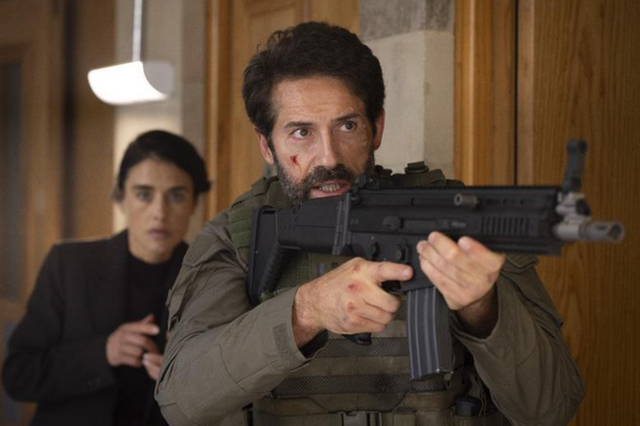
The lush greenery is almost incongruously beautiful against the violence unfolding within it, but once Jake and Torres leave the comparative protection of the compound, that openness makes them even more vulnerable. There are fewer places to hide and more directions from which an attack can come.
And finally—mercifully—Scott Adkins gets to sit down.
Granted, he’s sitting behind the wheel of a Jeep while being chased and shot at, but after what Jake Harris has endured across three movies, we’ll take what we can get.
The Jeep chase is terrific. With the camera riding alongside Jake, we watch Adkins drive and return fire while hostile vehicles appear to his left, keeping the pursuit immediate rather than fragmenting it into conventional coverage. It’s exhilarating action filmmaking and another example of Nunn refusing to let the visual concept of the trilogy become a gimmick. The camera remains part of the action.
Adkins, as always, is a formidable physical presence, but ONE LAST SHOT asks more of him than fighting, shooting and surviving.
The real battle is with Carter.
Stephen Cree is an inspired foil precisely because Carter isn’t presented as a cartoon villain. He and Jake share history. They fought beside one another. They understand the particular bond created between men who entrust each other with their lives. And Carter’s argument about loyalty—to the people who send soldiers into battle or to the men standing beside them—is just persuasive enough to make Jake’s dilemma meaningful.
Carter’s actions may have crossed an unforgivable line, but his grievance isn’t dismissed as madness.
That gives Adkins something far more interesting to play. Jake isn’t merely trying to defeat an enemy. He is trying to reconcile the man Carter has become with the man he once knew.
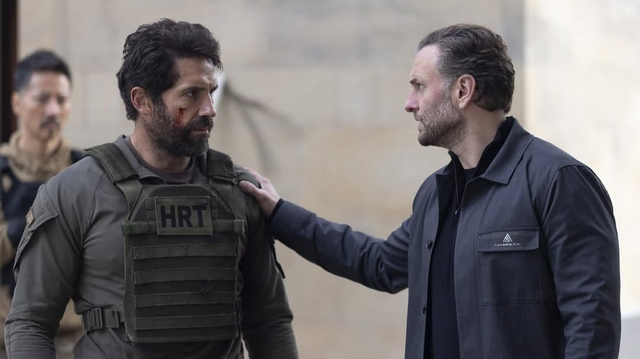
Cree, meanwhile, may not have Adkins’ martial-arts background, but that actually benefits their eventual physical confrontation. This isn’t designed to look like two pristine fighters displaying perfectly choreographed technique. It is ugly, visceral and personal. These are former brothers beating the hell out of one another, and every blow feels fueled by betrayal as much as survival.
Adkins rises beautifully to the dramatic challenge. Jake’s exhaustion has rounded off some of the emotional armor we’ve seen in the previous films. He’s still a warrior, but here we see more clearly the husband, father and friend beneath him.
Hannah Ware proves equally effective as Torres, holding her own within the action without being transformed into either a helpless damsel or an improbable super-soldier. Better still, Nunn and Russell resist saddling Jake and Torres with an unnecessary romantic connection. Their relationship is born of immediate necessity and trust: Jake has to protect her; Torres has to trust that he can.
Jake’s emotional connection remains where it belongs—with his wife and family.
Dolph Lundgren brings imposing authority to Admiral Mulholland, but there is unease beneath that authority from the outset. His orders force Jake into increasingly uncomfortable moral territory, and as the film progresses, the question becomes not merely whether Jake can stop Carter but whether the people commanding him deserve the loyalty they demand.
By the time Mulholland’s true colors fully emerge, the film’s ideas about loyalty have come full circle.
Composer Austin Wintory understands exactly what Nunn is doing tonally. Rather than overpowering the action with bombast, his score works almost subliminally, tightening tension and reinforcing emotion without demanding attention for itself. I became so engrossed in what was happening onscreen that I virtually stopped hearing the score as a separate element. That’s not an absence of musical impact; it’s evidence of how completely the music has fused with the film.
And engrossing is the word.
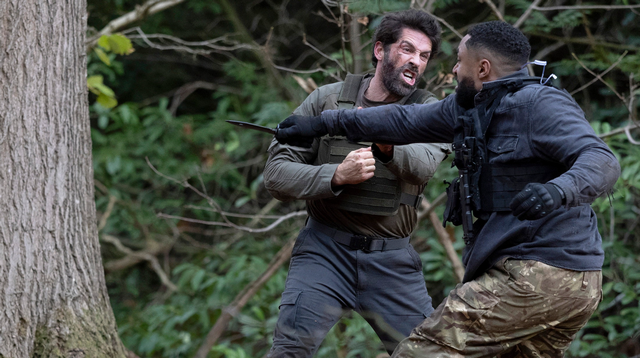
ONE LAST SHOT moves. Blackburn’s editing is tight and muscular, Fitzgerald’s lensing is immersive, and Nunn has become increasingly confident in using the one-shot aesthetic not merely as a technical calling card but as storytelling grammar. We aren’t watching Jake’s mission from a comfortable distance. We’re caught inside it with him.
But what ultimately elevates the film is that all this technical precision is serving character.
Across three films, Jake Harris has been moving almost continuously. He’s been running, shooting, fighting, bleeding, protecting, surviving. ONE LAST SHOT begins with a man who looks as though his body has nothing left to give, yet honor, duty and sheer adrenaline somehow push him to 150 percent one last time.
Then Nunn finally lets him stop.
After the final showdown with Carter, after the truth about Mulholland, after Torres is safe and the immediate threat has passed, Jake sits beside the water.
No gunfire.
No one chasing him.
No one left for him to chase.
He calls his wife and tells her he’s coming home.
For a trilogy built around perpetual motion, it’s a wonderfully quiet and unexpectedly emotional final image. Jake Harris doesn’t need another heroic pose or explosive victory lap.
He needs to go home.
And while I’m happy for Jake Harris—and for Scott Adkins, whose battered body finally gets a reprieve—I’m a little sad for the rest of us.
Because to borrow a sentiment once carved into the headstone of another heroic world-saver: Jake Harris saved the world. A lot.
And damn, it was fun watching him do it.
Directed by James Nunn
Written by Jamie Russell
Cast: Scott Adkins, Dolph Lundgren, Steven Cree, Hannah Ware
by debbie elias, 09/12/2026
ONE LAST SHOW is available on DVD and Digital on September 22, 2026.