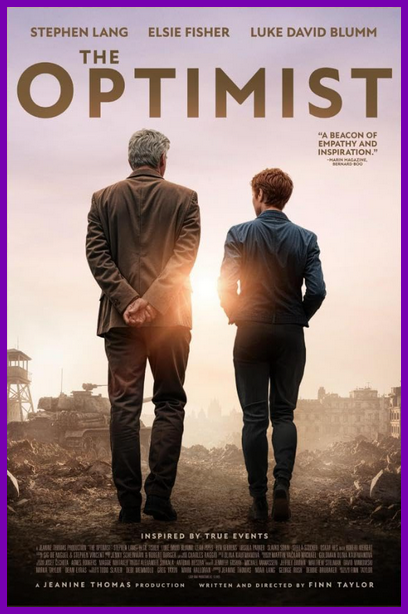
There are films about the Holocaust that assault you with horror, and there are films that approach from a quieter angle, asking you to sit, listen, and be changed. Finn Taylor’s THE OPTIMIST: THE BRAVEST ACT OF TRUTH belongs firmly in the latter camp. It is a work of deep reverence—for history, for truth, and above all for one man, Herbert Heller, yet it ultimately blossoms into something tender, hopeful, and unexpectedly life-affirming.
At the heart of THE OPTIMIST is Herbert Heller, a Czech Jewish boy from Prague who survives Terezín and Auschwitz, and the older man he becomes decades later in Northern California. It’s clear that Taylor never wanted Herbert to be framed simply as a victim, or even as a conventional “inspirational” figure. Taylor himself has described Herbert Heller as “a different kind of hero, the kind of hero we really need right now, that leads with compassion and depth and understanding and grace.”
That phrase quietly defines the film. Rather than focusing on spectacle or on the machinery of genocide, Taylor orients the entire story around Herbert’s moral and emotional presence—how he listens, how he comforts, how he gently reaches out to a contemporary teenager, Abby, who feels her own world collapsing. The film’s title is not a sentimental cover. It is a statement of character. Herbert Heller has seen “the end of the world” and chooses, again and again, not to give up on humanity.
Taylor’s casting of Herbert in both timelines is crucial to that effect. As the older Herbert, Stephen Lang is a revelation. Better known on screen for his hard-edged, macho roles in “Avatar” or “Don’t Breathe”, Lang is here cast deliberately against type. While there are many actors who would have seemed a more obvious fit—men who already read as “Holocaust survivor” at a glance, Lang was an inspired choice as he delivers a completely chameleon-like portrayal of Heller – an individual, a real person.
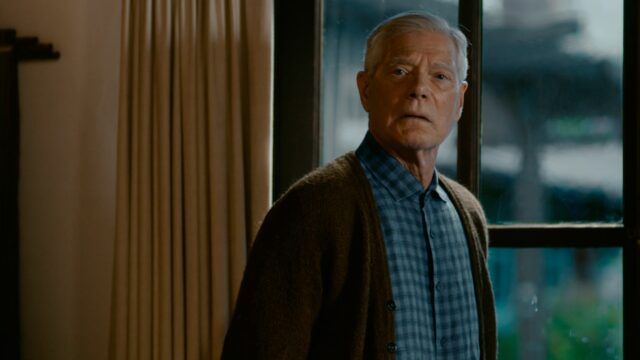
Lang disappears into Herbert with such humility that, according to Taylor, even the Heller family was stunned by the portrayal. The performance is gentle, often fragile, yet suffused with a core of quiet strength. A small anecdote from set says it all as in my exclusive interview with him, Taylor recalled instinctively putting a steadying hand under Lang’s arm as they walked down a muddy path—only to feel the actor’s massive bicep under his costume. The strongman is still there, but in THE OPTIMIST that strength is redirected inward, toward compassion.
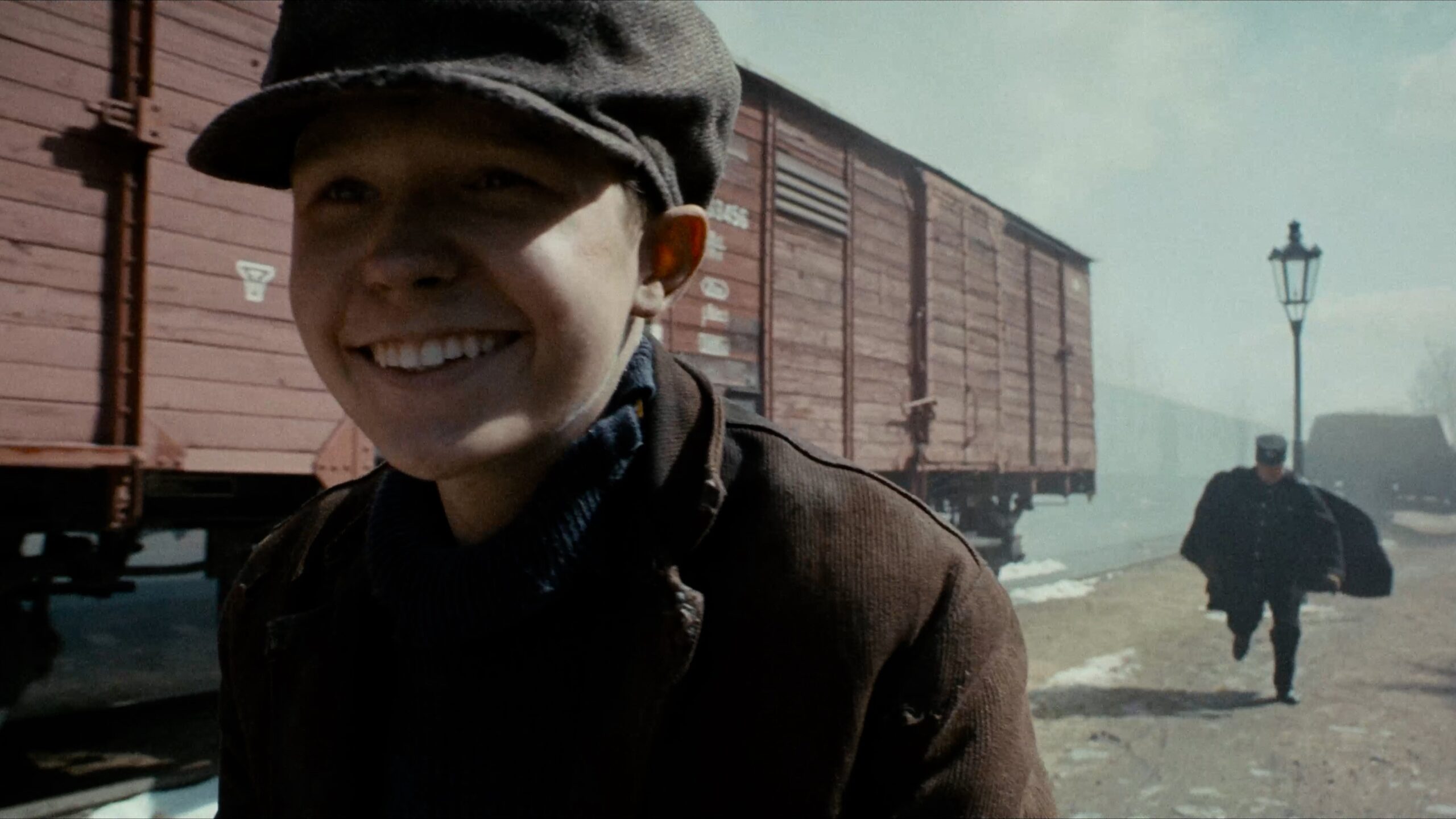
As young Herbert, Luke David Blumm is the kind of discovery most directors can only hope for. The role is technically punishing—often performed inches from a wide-angle lens—and emotionally demanding, carrying the boy through bewilderment, terror, stubborn resolve, and flickers of joy. Blumm never strains; he simply inhabits Herbert, making the child’s experience feel acutely present rather than historical abstraction. Blumm carries the weight of young Herbert, and the film, on his shoulders. If we don’t understand and believe the once joyous child within and the hardships and torturous conditions he then survived, we will not believe Lang’s performance as the older Herbert and his optimistic outlook on life. Luke David Blumm captivates.

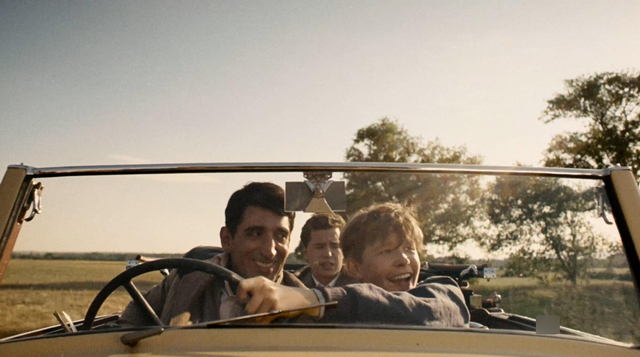
Together, Lang and Blumm present one seamless life: a boy marked and nearly destroyed by history, and an old man who somehow remains warm, funny, and open-hearted.
What makes THE OPTIMIST so quietly powerful is not just who it is about, but how it is told. Taylor’s filmmaking is careful, restrained, and rigorously thought through, always in service of point of view and emotional truth.
Visually, Taylor divides the film between two worlds. In the United States, where the elderly Herbert lives among the Northern California redwoods, US cinematographer Antonio Riestra leans into a natural, sometimes handheld intimacy. In Europe, by contrast, cinematographer Alexandra “Sasha” Cirul works in and around Prague, Terezín, and a purpose-built Auschwitz. The Czech studio, Stillking Films, which hosts blockbuster franchises like “Mission: Impossible” and “Spider-Man”, “bent over backwards” for THE OPTIMIST because it was about one of their own, Herbert Heller from Prague. The studio built Auschwitz. The team was allowed to shoot in the actual Terezin.:
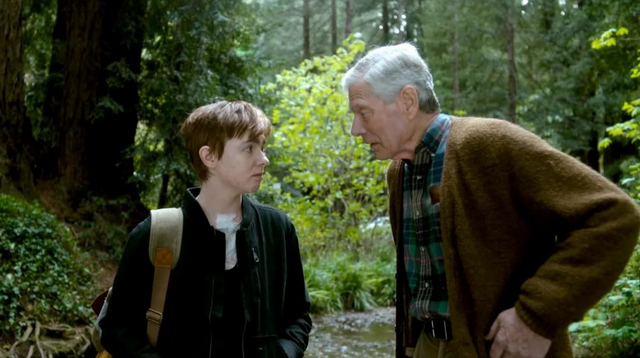
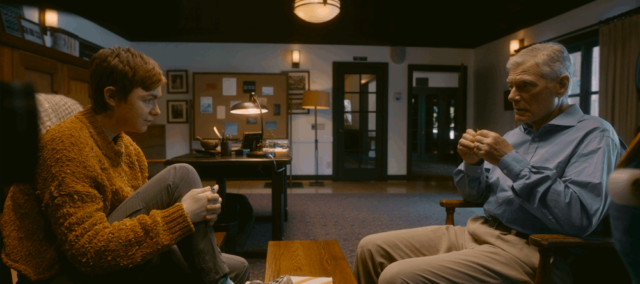
Finn Taylor builds a remarkably coherent visual grammar for THE OPTIMIST by rooting every choice in point of view, geography, and emotion. By splitting the shoot between America and Europe, using Antonio Riestra for the redwood ringed present and Alexandra “Sasha” Cirul for Prague, Terezín, and Auschwitz, Herbert’s Californian refuge stands in stark visual contrast to the death camps. In the U.S. material, Taylor leans into the looser, sometimes handheld intimacy—most notably in the early interview scenes, where the slight instability of the camera mirrors Herbert’s nervousness—while the European sequences are more composed and historically grounded. Determined to see the world through young Herbert’s eyes, Taylor shoots with wide Cooke prime lenses, often inches from the boy’s face, keeping his expressions close while leaving the joy, the Nazi menace, and the camp reality crisply visible behind him. Blocking and angle shifts quietly track character arcs. Abbey and Herbert move from opposite sides of the frame to sitting shoulder to shoulder as the camera creeps closer, while low angles on young Herbert gradually level out as he gains footing in an unforgiving world.
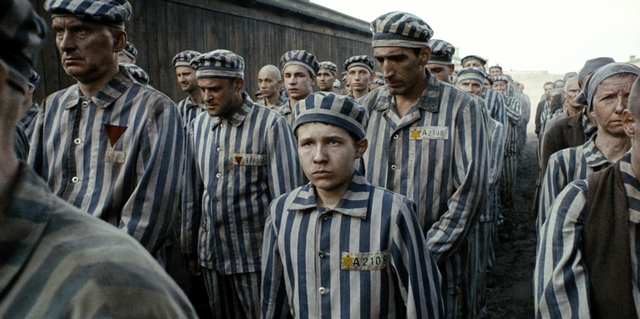
The Holocaust sequences are grounded in a strict visual logic: we experience the past overwhelmingly from young Herbert’s perspective. Taylor chooses wide Cooke primes, staying close to the boy’s face while keeping the world behind him in perfect focus. This approach has a devastating subtlety. Herbert’s expressions anchor us emotionally, but the camps, the uniforms, the cruelty are never softened or blurred. They are the environment he must navigate, sharply legible but never allowed to eclipse his humanity.
Blocking and composition reinforce the emotional arcs. In the present-day story, Abby and Herbert begin seated apart, with the camera holding them at a distance, then gradually drift closer until they are side by side, and the framing tightens. Young Herbert, meanwhile, is initially shot from a child’s low angle, looking up at adult figures. As he ages, matures, and adapts, the camera subtly rises to meet him at eye level. Without fanfare, the film charts both a deepening relationship and the hard-won growth of a child forced into impossible circumstances.
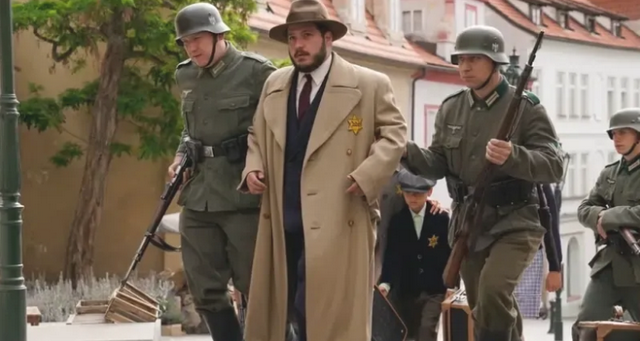
The score, by Rob Berger and violinist composer Jenny Scheinman, is another quiet strength. Taylor treats music as an extension of character and agency rather than mere emotional wallpaper. In early chase scenes—such as the day Herbert first wears his yellow star and is shunned by his friends—the violin tremolo feels almost like an invisible hand pushing him forward, rather than pinning him down in fear.
Songs are used sparingly but with purpose. A Jeff Tweedy track, “Love Is the King,” first appears over contemporary images of Abby and Herbert in the woods, then carries over into Herbert’s return to Prague, linking their experiences across decades. Such choices help the film maintain its dual “present to present” structure. The past is not a sepia-toned dream, but something Herbert is reliving in the now each time he speaks.
Scheinman’s work carries its own moral weight. At one point, she based a cue for an Auschwitz sequence on a historic Jewish bridal song, then reconsidered and consulted a rabbi. When he advised against repurposing the melody in that context, she discarded the cue and composed something new. In a film that is always balancing beauty against atrocity, that kind of ethical self-correction matters. (As a sidenote, Scheinman is the granddaughter of Telford Taylor, the head US prosecutor at the Nuremberg trials.)
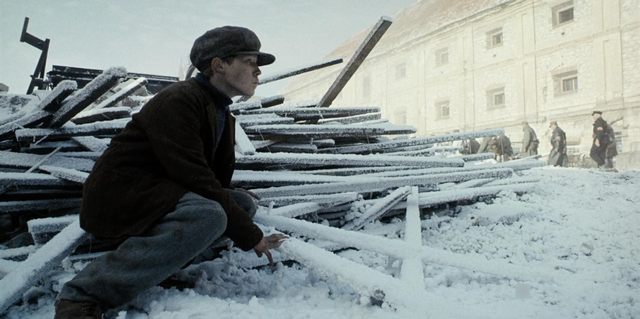
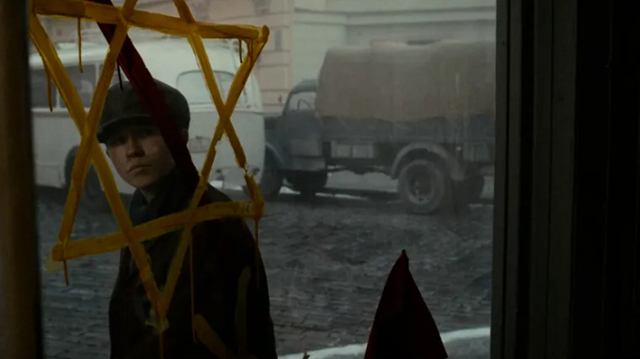
Perhaps the most moving thing about THE OPTIMIST is not just what it shows, but what it reveals about Taylor’s growth as a filmmaker. He is disarmingly honest about the fact that he thought he already had “quite a good script” before visiting Auschwitz and Terezín. It was only after being there, and then writing about Auschwitz every day for months, that he realized how much deeper he needed to go.
That experience pushed him to add historically documented moments—from the collection of prisoners’ hair to a family leaping from a building—that didn’t originate in Herbert’s personal account but in the broader record. It’s a quietly radical statement of artistic responsibility. THE OPTIMIST is, in one sense, an intimate portrait of a single man. But it is also a conversation with all those who did not survive to tell their stories, and with all those who must now listen.
For all the weight of its subject matter, THE OPTIMIST ultimately earns its title. There is the now-famous riverside scene, shot during torrential rains in the California Bay Area, where Abby sits on the brink of despair, and Herbert arrives with a clear umbrella, telling her, “I know it feels like the end of the world, but it’s not. I saw the end of the world inside.” The weather, the mud, the rising river—elements the production could barely control—align almost miraculously with the film’s themes. The moment feels both spontaneous and inevitable.
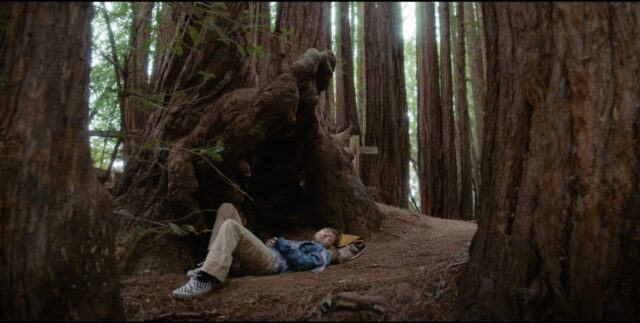
And there is Herbert Heller himself, near the end of his life, being asked on camera whether sharing his story has brought relief. “Yes, yes,” he answers, then adds, with a glint of mischief, “but not like having gas,” making everyone laugh before quickly saying he’s joking. That is the man this film memorializes.
THE OPTIMIST is an exquisite piece of storytelling—visually precise, musically sensitive, and ethically serious. But its quiet power lies in something simpler. It invites us to sit with Herbert Heller, as a boy and as an old man, and to recognize in him not only the scars of history, but a stubborn, luminous belief in other people. In an age hungry for louder, flashier narratives, Finn Taylor has made a film that whispers, listens, and still somehow leaves you walking away lighter.
Written and Directed by Finn Taylor
Cast: Stephen Lang, Luke David Blumm, Elsie Fisher, Robin Weigert, Slavko Slobin, Oskar Hes, Stella Stocker
by debbie elias, 03/04/2026
THE OPTIMIST is in theatres on March 11, 2026.