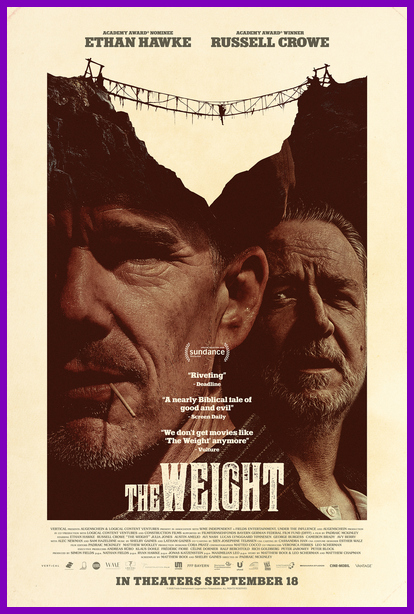
There are some burdens a man is forced to carry and others he willingly takes upon himself. In THE WEIGHT, Samuel Murphy carries both.
Set in 1933 at the height of the Great Depression, THE WEIGHT is a quiet but powerful testament to the resilience of the human spirit, the pursuit of personal freedom and, above all, the lengths to which a father will go for the love of his daughter.
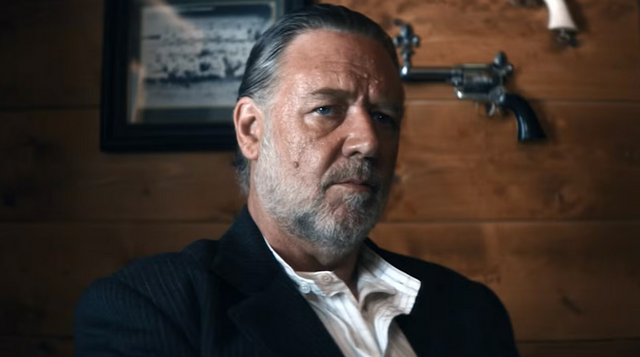
Samuel Murphy is a prisoner when opportunity arrives in the form of Clancy, a corrupt figure played with commanding menace by Russell Crowe. Clancy offers Samuel and a select group of fellow prisoners a seemingly irresistible bargain: help him steal millions in gold and haul it across the mountains and, in return, earn their freedom.
But freedom comes with a price.
And in THE WEIGHT, that price is measured quite literally in gold.
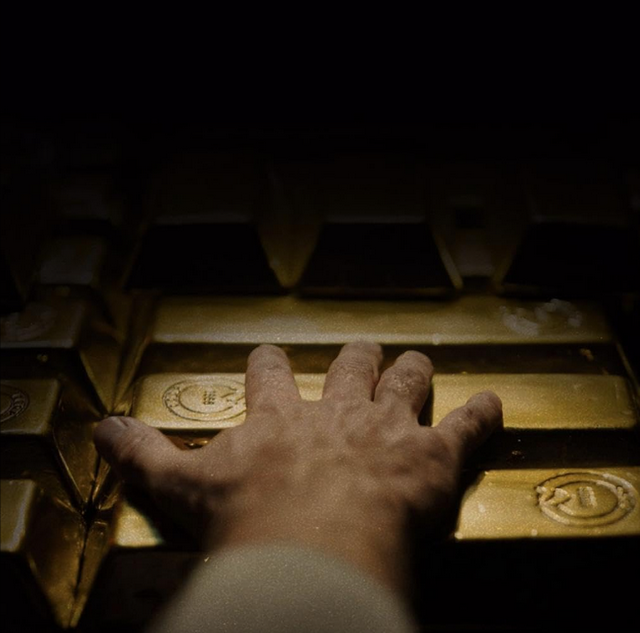
Crowe’s screen time may be limited, but Clancy’s presence hangs over the journey long after he is no longer physically in the frame. He sets the machinery in motion, dangling freedom before desperate men while leaving them to bear the consequences—and the considerable physical burden—of his greed.
A taut thriller directed and edited by Padraic “Pat” McKinley, THE WEIGHT doesn’t need to turn Samuel into a larger-than-life hero. His heroism comes from something far more compelling: integrity, conviction and endurance. He is an ordinary man in an extraordinary circumstance.
Samuel is a quiet, stalwart man. He isn’t looking for glory or recognition. He simply knows what matters to him and what he is unwilling to surrender. Even when circumstances strip away virtually every choice available to him, there remains something inside Samuel that cannot easily be taken.
His sense of self. And his love for his daughter, Penny, who melts your heart in every scene thanks to younng Avy Berry. That love becomes the emotional compass for everything that follows.
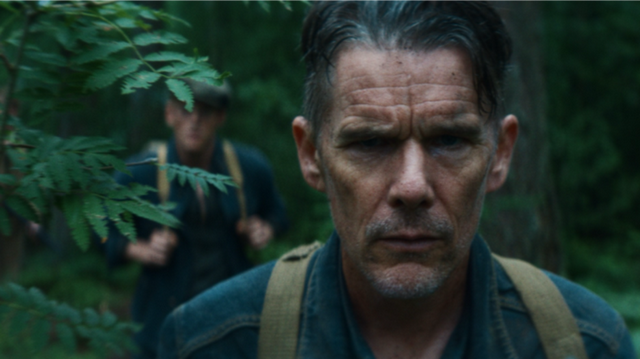
Ethan Hawke is beautifully cast as Samuel, giving us a man whose strength is expressed not through grand speeches or swagger but through stillness, observation and determination. There is a weariness to him befitting both the period and his circumstances, yet Hawke never allows that weariness to become defeat with Samuel. Samuel keeps going.
Sometimes that’s the most heroic thing a person can do.
Even a seemingly small incident involving a teddy bear speaks volumes about the man. In a film built around increasingly difficult physical and moral choices, details such as this reveal Samuel’s character more eloquently than exposition ever could. Integrity isn’t something he switches on when the stakes become high. It’s simply who he is.
McKinley wisely trusts those moments and allows THE WEIGHT to unfold without artificially inflating them. The result is a film that earns its emotion rather than demanding it.
And the physicality we see isn’t entirely performance.
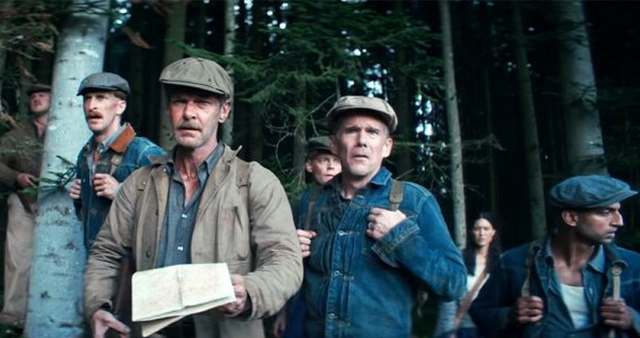
McKinley had his actors make the trek carrying backpacks weighing approximately 80 pounds—the actual weight their characters are supposed to be hauling across the wilderness. As they move from point A to point B over unforgiving terrain, that burden is real. Shoulders bear it. Backs bend beneath it. Footing becomes more deliberate. Fatigue isn’t something that needs to be manufactured when an actor is actually carrying 80 pounds up and down mountains. It gives the film’s title an almost visceral dimension.
These men aren’t merely pursuing the gold.
They’re carrying it.
And with every mile, we feel its weight.
That same physical immediacy carries into the visual storytelling.
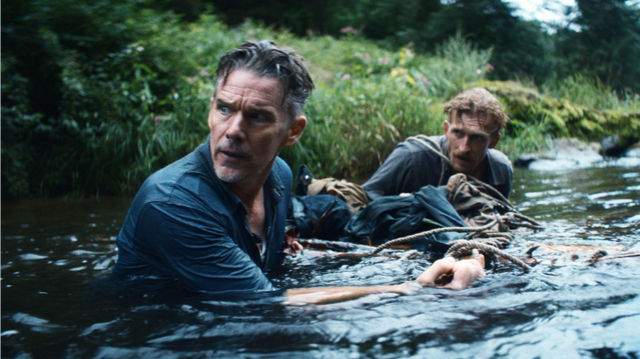
Cinematographer Matteo Cocco immerses us in the wilderness, making the forest both beautiful and formidable. Shot in the Bavarian Forest but standing in for Oregon, the landscape gives THE WEIGHT an extraordinary sense of place and period while carrying an intriguing historical resonance of its own. Cocco’s camera doesn’t merely observe the journey from a comfortable distance. It enters it.
There is an immediacy to the handheld work that puts us alongside these men rather than safely watching them from afar. We feel the uneven terrain, the water, the mud, the physical exhaustion. When the camera goes into the river, so do we.
And as relationships and circumstances become increasingly volatile, the visual language tightens. Wider compositions that once allowed men to occupy the frame together give way to something closer, rougher and more fractured. By the time physical conflict erupts, the imagery itself seems to have lost the breathing room it once possessed.
The landscape is no mere backdrop. It becomes another weight to be carried.
Sound is equally important in creating that immersion. Rather than smothering the wilderness beneath constant music, THE WEIGHT allows the environment to speak. Water, wind, footsteps, movement through brush and the physical sounds of bodies negotiating unforgiving terrain give the film a tactile quality.
The sparse, experimental score complements rather than overwhelms those elements. There are stretches where ambient sound is allowed to carry the emotional burden almost by itself, and the film is stronger for it.
THE WEIGHT also benefits enormously from its refusal to romanticize endurance. There is nothing easy about Samuel’s journey, physically or morally. Freedom isn’t presented as an abstract ideal. It has a cost.
So does conviction. So does love. And that is ultimately where THE WEIGHT finds its power.
Clancy’s greed becomes someone else’s burden.
The gold sits heavily on Samuel’s back. The wilderness tests his body. Circumstance tests his character. And somewhere beyond all of it is the daughter who gives meaning to every step he takes.
Samuel’s journey may unfold against the desperation of Depression-era America and through an unforgiving wilderness, but its emotional foundation is timeless. How much can one person endure? What remains when circumstances take almost everything else away? And what are we willing to carry when the person waiting at the end matters more than the burden itself?
THE WEIGHT answers not with speeches, but with a man who keeps putting one foot in front of the other. A man driven by integrity. A father driven by love.
There are many ways to measure the weight a man carries. And as we see in THE WEIGHT, sometimes the truest measure is simply how far he is willing to carry it.
Directed by Padraic “Pat” McKinley
Written by Matthew Booi and Shelby Gaines
Cast: Ethan Hawke, Russell Crowe, Julia Jones, Sam Hazeldine, Avi Nash, Austinn Amelic and Avy Berry
by debbie elias, 08/30/2026
THE WEIGHT is exclusively in theatres on September 18, 2026.