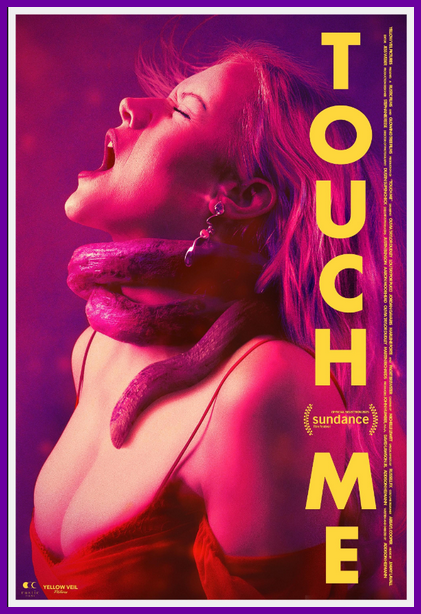
Some films politely invite you into their world. TOUCH ME, writer/director Addison Heimann’s gloriously strange psychosexual horror-comedy, kicks down the door, wraps a tentacle around your brain, and dares you to keep up. And surprisingly, it works.
On the surface, TOUCH ME sounds like the kind of premise that could easily collapse under the weight of its own outrageousness. The story centers on Joey (Olivia Taylor Dudley) and Craig (Jordan Gavaris), two emotionally stalled millennials whose co-dependent friendship has left them drifting through life doing everything possible to avoid actually living it. When Joey’s alien ex-boyfriend Brian (Lou Taylor Pucci) suddenly reappears—complete with a mysterious tentacle appendage capable of eliminating anxiety and depression—the pair find themselves drawn into his desert mansion for what promises to be a weekend of healing, pleasure, and perhaps something darker.

What follows is a wacky, wildly imaginative ride that gleefully blends horror, comedy, science fiction, and exploitation cinema homage into something that is at once outrageous and oddly heartfelt.
Heimann’s film wears its influences proudly on its sleeve. Drawing inspiration from decades of Japanese cinema—from classic samurai storytelling and Kabuki theatricality to the tactile aesthetics of Japanese exploitation films—TOUCH ME embraces stylization in a way that feels both playful and deliberate. This is a film that acknowledges its own artifice and uses it as a storytelling tool.
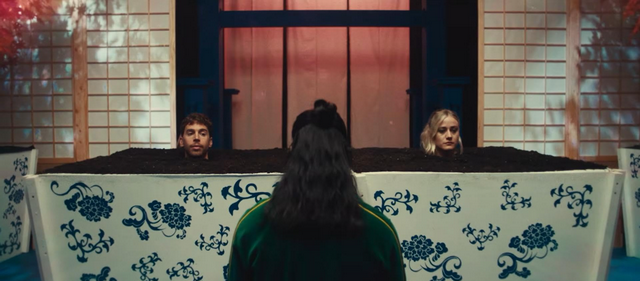
Visually, the film is a feast.
Working with cinematographer Dustin Supencheck, Heimann constructs a striking visual grammar that constantly shifts tone, perspective, and aspect ratio. The sleek modernist house where much of the action unfolds—with its curved hallways, stark concrete surfaces, and UFO-like architecture—creates a sense of tension all on its own. Those rounded corridors suggest that something could appear at any moment, an effect the filmmakers exploit with slow, creeping camera movements and carefully composed frames.
But Heimann doesn’t stop there. Throughout the film, he introduces bursts of theatrical stylization—bold color washes, dreamlike distortions, split screens, symmetrical staging, and inventive in-camera effects—that transform the narrative into something closer to a cinematic fever dream. Practical ingenuity is on full display, with custom lens effects, crystal distortions, and color manipulations that feel refreshingly tactile in an era increasingly dominated by digital slickness. Production Designer Stephanie Reese’s work soars.
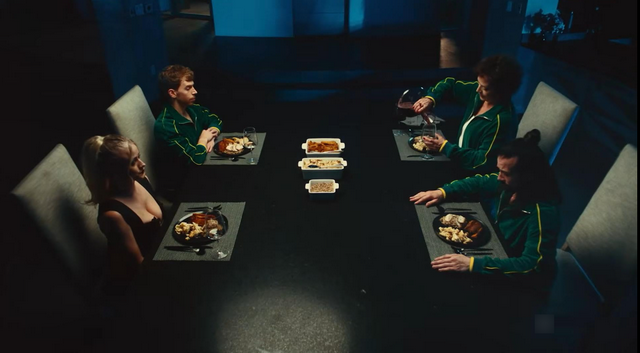
Even when the film veers into the truly outrageous—samurai swords, puppetry, spraying blood, dance sequences, and alien tentacle intimacy—it never loses its visual discipline. Every stylistic flourish feels intentional.
Yet for all its bizarre imagery, TOUCH ME is far more than a parade of strange ideas. Beneath the surface spectacle lies a story deeply rooted in themes of trauma, addiction, depression, and emotional dependence.
Joey and Craig may initially appear as cringe-inducing slackers, but Heimann gradually reveals the wounds beneath their arrested development. Their addictions take different forms—substances, emotional reliance, sexual escapism—but they all stem from the same desperate search for relief from pain. Brian’s alien ability to temporarily remove anxiety becomes less a sci-fi gimmick and more a metaphor for the ways people seek escape from their struggles, often through methods that promise relief but carry hidden consequences.

The performances help ground these themes beautifully.
Olivia Taylor Dudley brings Joey a volatile mixture of vulnerability and reckless self-destruction that makes her both frustrating and deeply sympathetic. Jordan Gavaris turns Craig into an almost painfully recognizable portrait of emotional dependence and avoidance. And Lou Taylor Pucci delivers an inspired performance as Brian, the enigmatic alien whose seductive calm hides something far more unsettling beneath the surface.
Supporting turns from Marlene Forte and Paget Brewster add further texture, reminding us that even in the film’s strangest moments, Heimann remains interested in the emotional dynamics between people.
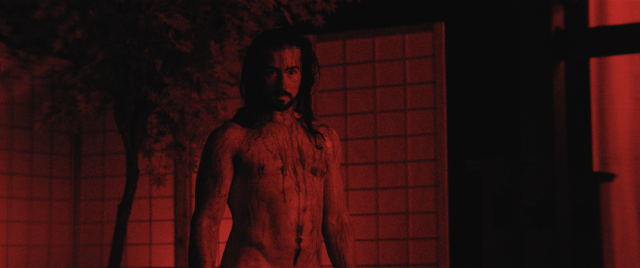
Structurally, Heimann also demonstrates a keen understanding of pacing. The film begins with an extended 9-minute monologue that efficiently lays out the emotional groundwork, freeing the rest of the narrative to lean heavily on visual storytelling. From there, the film gradually escalates its stylistic audacity, easing viewers into its increasingly surreal world before ultimately unleashing a final act that gleefully goes for broke.
By the time the film reaches its most outrageous sequences, audiences have already been acclimated to its peculiar rhythm.
Of course, TOUCH ME is not a film designed to please everyone. Its tonal tightrope—balancing outrageous horror-comedy with sincere emotional exploration—will likely prove too unconventional for some viewers. But for audiences willing to embrace its strange wavelength, Heimann delivers something increasingly rare in modern filmmaking: a genre film that feels genuinely original.
More importantly, TOUCH ME never loses sight of the humanity beneath the absurdity. For all the tentacles, blood, and surreal imagery, the film remains firmly anchored in the emotional struggles of its characters. And that’s ultimately what makes it work.
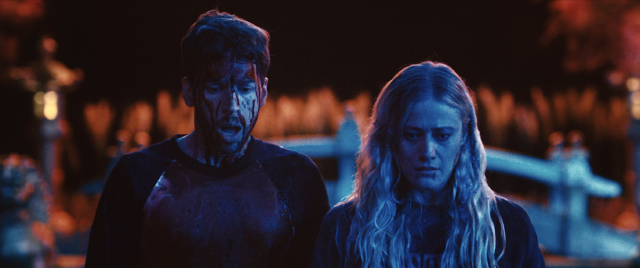
With TOUCH ME, Addison Heimann delivers a film that’s unapologetically weird, visually daring, and emotionally grounded in ways you might never expect from a movie about alien tentacle therapy. It’s bold, inventive, and proof that sometimes the most outrageous genre concepts can say the most about the human condition. One thing’s for sure—whether you come for the spectacle, the satire, or the strange emotional honesty underneath it all, TOUCH ME is not a film you’ll soon forget.
Written and Directed by Addison Heimann
Cast: Olivia Taylor Dudley, Lou Taylor Pucci, Jordan Gavaris and Marlene Forte
by debbie elias, 03/01/2026
TOUCH ME is Exclusively in NY on March 20, 2026; in Limited Theaters on March 27, 2026; and On Demand and Digital April 2, 2026