by debbie elias
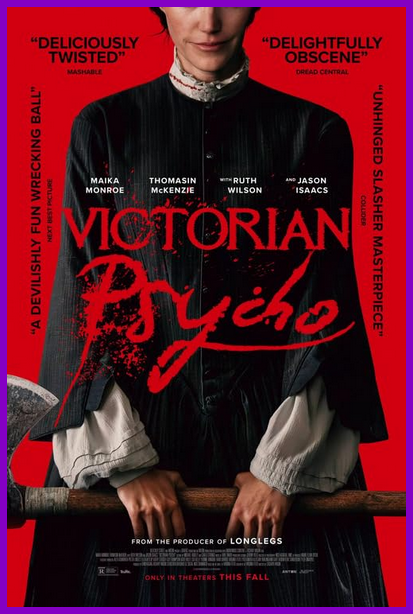
Beautifully demented. Deliciously diabolical. And an absolute bloody delight! With VICTORIAN PSYCHO, director Zachary Wigon delivers a gloriously twisted excursion into Victorian England, where repression, madness, murder, and the most wickedly delicious dark humor collide in a film that is as visually sumptuous as it is psychologically unhinged. Adapted by Virginia Feito from her own novel, VICTORIAN PSYCHO is an intoxicating marriage of Gothic horror, biting satire, and black comedy, all wrapped in exquisite period detail and drenched in an increasingly unsettling atmosphere of insanity. This is a film that revels in its own depravity while displaying remarkable precision in its cinematic craftsmanship.
And what a wickedly wonderful time it is!
At the center of this delicious madness is Winifred Notty, played with extraordinary abandon by Maika Monroe, an eccentric young governess who arrives at the remote and imposing Ensor House to care for the children of the aristocratic Pounds family. But there is something decidedly peculiar about Winifred. Something beyond the usual peculiarities of Victorian manners, rigid social conventions, and the suffocating propriety of the English upper class.
Something dark. Something dangerous. And something very, very funny.
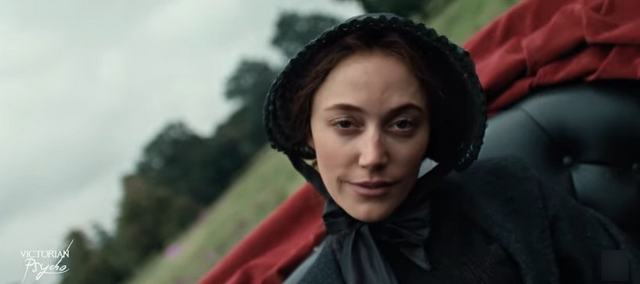
From the outset, Wigon establishes a distinctive visual and narrative grammar that immediately separates VICTORIAN PSYCHO from conventional period horror. Rather than simply transporting us into a Gothic setting and allowing the familiar conventions of the genre to unfold, he invites us directly into Winifred’s increasingly disturbing consciousness. Her voiceover, delivering her innermost thoughts with an often startling matter-of-factness, becomes an essential component of the storytelling. The contrast between what Winifred thinks, what she says, and what those around her believe they are witnessing generates a delicious tension between psychological horror and mordant comedy.
There is something almost conspiratorial about our relationship with Winifred. We are granted access to thoughts that polite Victorian society would never dare acknowledge, much less articulate. The effect is simultaneously intimate, unsettling, and frequently hilarious.
Adding to that distinctive storytelling approach is the film’s chapterized structure, complete with wonderfully suggestive chapter titles that maintain a literary connection to Feito’s source material while allowing Wigon to control the rhythm of Winifred’s descent—or perhaps ascent—into increasingly outrageous behavior. The chapters provide a framework for the escalating madness, but they also contribute to the film’s mischievous sensibility. Each new chapter feels like another invitation to enter a room we probably shouldn’t.
And once inside Ensor House, there is no telling what we might find.
One of the film’s most extraordinary achievements is its visual design. Working with cinematographer Nico Aguilar, Wigon creates an aesthetic that is both meticulously controlled and strikingly unconventional. This is not simply a handsome period production. It is a film in which every composition, every movement of the camera, every interplay of light and shadow becomes part of the psychological experience.
Aguilar’s cinematography is stunning.
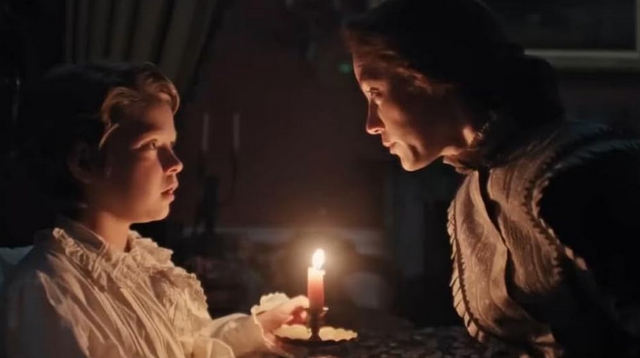
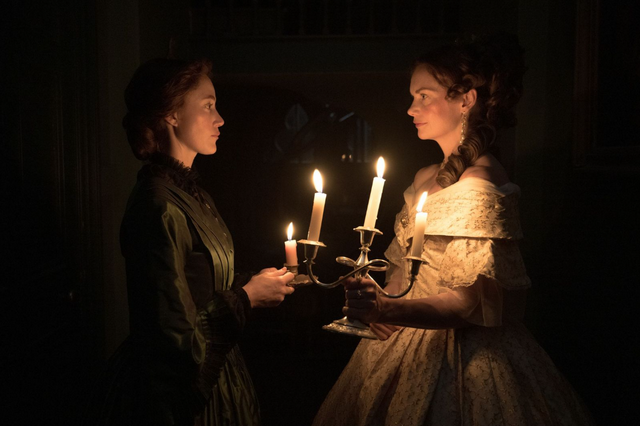
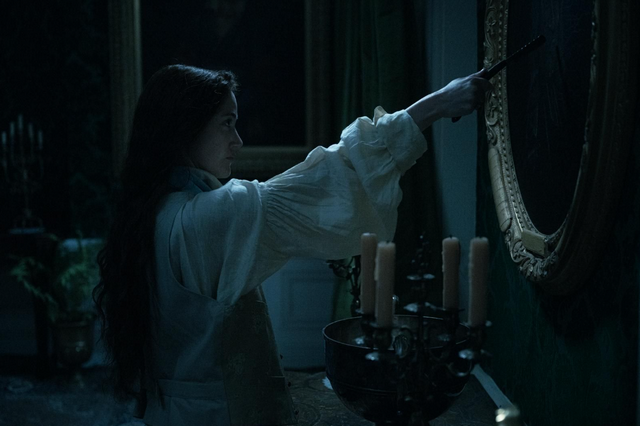
The use of candlelight is particularly exquisite. A single candle carried through a darkened hallway or up a staircase illuminates Winifred’s face while allowing the surrounding architecture to dissolve into shadow. Elsewhere, two isolated candle flames create an almost theatrical intimacy between characters, the shifting light accentuating expressions while leaving the darkness around them tantalizingly unexplored.
Equally effective is the contrast between those warm, flickering interiors and the natural light entering through the castle’s towering windows. In the Pounds family’s dining room and other grand spaces, light becomes an architectural element, emphasizing the dimensions of the rooms while reinforcing the emotional distance between the people occupying them. Shadows stretch across walls, faces emerge from darkness, and the camera frequently allows the setting to dwarf its inhabitants.
There is beauty here, certainly, but it is a beauty that never feels entirely safe.
And then Wigon and Aguilar turn conventional visual perspective completely inside out.
One particularly ingenious sequence involving a severed ear employs a distorted, almost fisheye perspective that transforms an already grotesque image into something startlingly inventive. Rather than merely presenting the horror of the moment, the camera becomes an active participant in its absurdity. Elsewhere, carefully positioned overhead compositions, unusual framing, and shifts in perspective contribute to the sensation that we are experiencing a world filtered through a profoundly unstable consciousness.
The result is a visual language that can move from elegance to grotesquerie within a single sequence without sacrificing the film’s carefully calibrated tone.
Just as essential to that visual identity is the spectacular production design of Jeremy Reed, complemented by the art direction of Adorjan Portik.
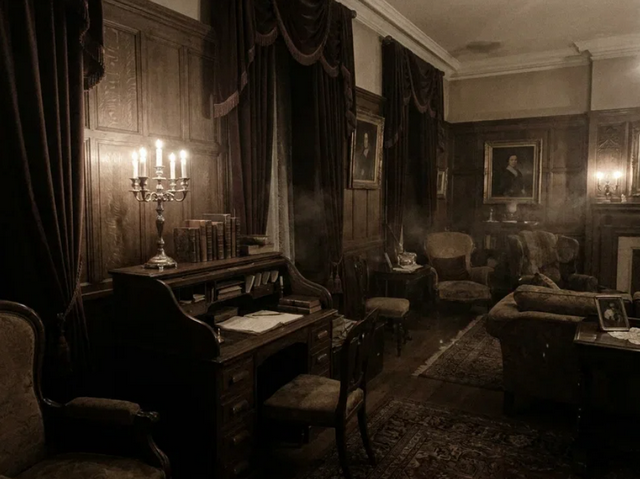
Ensor House is practically a character unto itself.
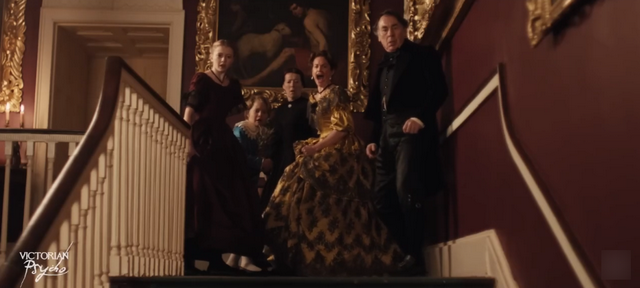
From its imposing rooms and elaborate furnishings to its wallpapers, decorative flourishes, and architectural details, the house embodies the wealth, privilege, and oppressive conventions of the society Winifred has entered. Yet there is something subtly—and sometimes not so subtly—wrong beneath all that aristocratic grandeur.
Color becomes an especially powerful storytelling tool.
Greens dominate much of the film’s visual palette, appearing in wallpapers, clothing, and decorative details. Acid greens and deep emeralds introduce an almost poisonous quality into the otherwise carefully preserved Victorian environment. Against rich blues, dark woods, and the subdued tones of the castle interiors, these greens acquire an increasingly unsettling presence.
They are beautiful colors, but their beauty carries a suggestion of corruption.
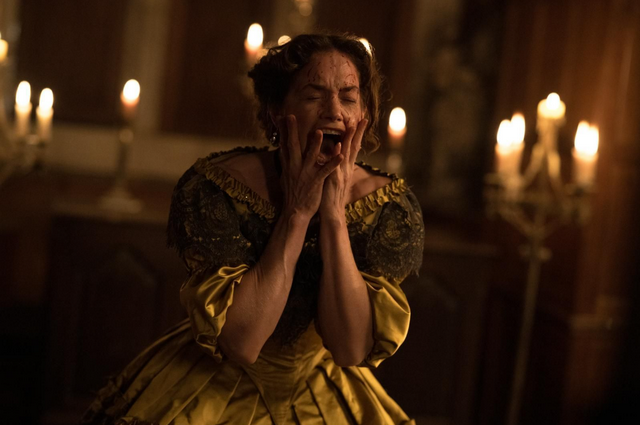
The costumes, too, become part of this carefully constructed visual vocabulary. Winifred’s clothing and the elegant garments worn by Mrs. Pounds reflect the period setting while allowing color, texture, and silhouette to suggest personality and psychological conflict. Particularly striking are the lustrous fabrics and richly saturated hues that provide visual punctuation throughout the film.
What makes Reed’s work so impressive is the balance between historical authenticity and theatrical extravagance. The rooms feel inhabited, the furnishings appropriate to their social setting, and the decorative details carefully considered. That authenticity gives Wigon the freedom to unleash increasingly outrageous events without allowing the world itself to become unbelievable.
The more convincing the setting, the more deliciously shocking its violations become.
And violations there are!
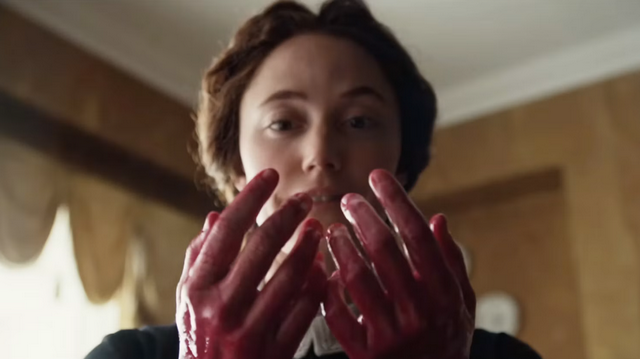
VICTORIAN PSYCHO is hardly shy about its bloodletting or its appetite for the grotesque. Yet the film’s most memorable moments are not necessarily those involving the greatest quantity of blood. They are the moments when Wigon finds a perversely elegant or unexpectedly comical way to present something horrifying.
An encounter involving an ear becomes an exercise in audacious camera placement. The unsettling intimacy of a bedroom or hallway can suddenly turn macabre. An apparently ordinary family interaction acquires a distinctly sinister undertone through Winifred’s internal commentary.
Even a formal family portrait becomes the source of a wonderfully funny visual and musical moment as Winifred imagines herself occupying a place within the aristocratic household.
That sequence is especially revealing of the film’s tonal intelligence. The humor arises not simply from an absurd image, but from Winifred’s psychology, her ambitions, and the discrepancy between the social order surrounding her and the private reality she inhabits.
Wigon understands that the most effective black comedy is often rooted in character rather than merely in shock.
And nowhere is that understanding more apparent than in Maika Monroe’s extraordinary performance.
As Winifred Notty, Monroe delivers a portrayal unlike anything we have previously seen from her. Known for her compelling work in horror, Monroe possesses an ability to suggest a complex internal life with remarkably little outward movement. Here, however, she combines that familiar inscrutability with a bold, frequently expressionistic performance that embraces the character’s peculiarities without ever reducing her to caricature. She delivers a dazzlingly demented Winifred Notty.
It is a fascinating balancing act.
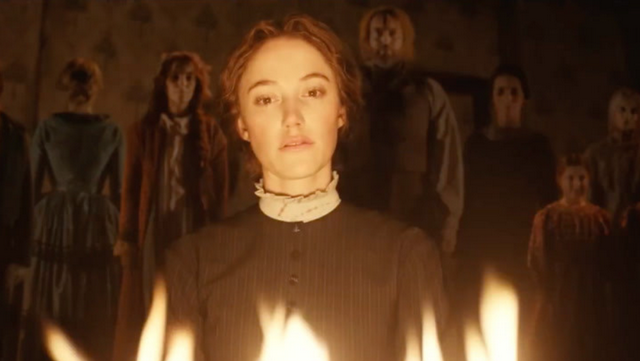
Winifred can appear perfectly composed while her thoughts reveal something monstrous. At other moments, a glance, a smile, a physical gesture, or a sudden shift in expression suggests that the carefully maintained facade is barely containing the chaos beneath.
Monroe plays those contradictions with fearless commitment.
There is an almost mischievous delight in watching her navigate the Pounds household, testing boundaries, manipulating perceptions, and behaving with an unsettling confidence that makes even her quietest moments unpredictable.
She can be frightening, absurd, calculating, and strangely captivating, sometimes within the same scene.
Most importantly, Monroe never appears to be performing at the film’s eccentric tone. She inhabits it completely. Her Winifred is the axis around which the entire demented universe turns, and Monroe’s willingness to embrace both the psychological darkness and the outrageous humor makes the character irresistible to watch.
Surrounding her is a wonderfully assembled ensemble.
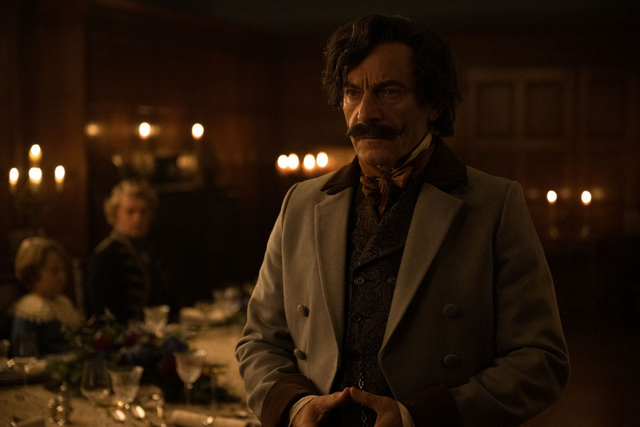
Jason Isaacs, as Mr. Pounds, brings a particularly enjoyable comic dimension to the aristocratic patriarch, finding humor within the character’s authority and social pretensions. Ruth Wilson, as Mrs. Pounds, provides another essential element of the household’s rigid social structure, her presence reinforcing the tensions beneath its polished exterior.
Thomasin McKenzie is enchanting as Nurse Lamb, bringing a distinctive energy to her encounters with Winifred, while Evie Templeton, as Drusilla Pounds, introduces an especially intriguing dynamic. There are moments when Drusilla’s behavior seems almost to reflect Winifred’s influence, creating the unsettling impression that the governess’s peculiar worldview may be finding an impressionable audience.
Each performer contributes something specific to the film’s tonal tapestry. No one feels interchangeable, and that individuality is essential to sustaining a world in which the absurd and the horrific coexist so effortlessly.
But if the cinematography, production design, and performances provide the visual and dramatic foundation of VICTORIAN PSYCHO, its soundscape is every bit as remarkable.
Composer Ariel Marx delivers a score that is as unconventional as the film itself.
Working in concert with classical selections from Beethoven, Bach, Wagner, and Vivaldi, Marx creates an aural landscape in which elegance and instability exist in constant tension. The familiar sophistication of classical music provides a fascinating counterpoint to the increasingly deranged events unfolding onscreen, while Marx’s original compositions introduce an altogether stranger musical vocabulary.
Strings play an especially important role. At times, individual plucked notes punctuate a moment of suspicion or absurdity. Elsewhere, tremulous textures and unusual instrumental timbres suggest that something is profoundly wrong beneath the apparent order of the household.
The instrumentation is particularly inspired, incorporating the viola da gamba and hurdy-gurdy, instruments whose historical associations make them especially well suited to the period setting while their distinctive sounds contribute to the film’s atmosphere of unease.
The resulting musical textures can be playful, grotesque, ominous, or strangely beautiful.
And then there is the extraordinary use of a bee drone transformed into a musical element, an inspired example of how sound can become part of the film’s psychological fabric.
Marx’s score never simply announces when something frightening is about to happen. Instead, it participates in the film’s peculiar emotional logic, sometimes amplifying the horror and sometimes making the grotesque almost absurdly funny.
The integration of the classical selections with Marx’s original music is especially effective because it reinforces the central conflict between outward refinement and inner disorder. The music itself seems to understand that Victorian elegance and utter depravity are not necessarily mutually exclusive.
Editors Dustin Chow and Lance Edmonds deserve equal praise for maintaining the film’s delicate tonal balance.
The editing is sharp and purposeful, particularly in the transitions between Winifred’s outward behavior and her interior observations. The chapter divisions create natural shifts in rhythm, while the placement of visual and musical punctuation allows individual moments of horror or comedy to register without overstaying their welcome.
Equally impressive is the handling of the voiceover. Rather than functioning as an explanatory crutch, Winifred’s narration becomes an active storytelling device, occasionally reinforcing what we see but more often complicating it. The editors understand when to let an image speak for itself, when to allow the narration to sharpen the joke, and when the collision of the two can create something wonderfully disturbing.
That precision is essential in a film so willing to move between tonal extremes.
And it is precisely this command of tone that distinguishes Wigon’s direction.
There is no shortage of films that attempt to blend horror and comedy, but too often one element undermines the other. The comedy deflates the terror, or the horror becomes so overwhelming that the humor feels misplaced. Not here.
Wigon embraces the contradictions.
The grotesque is funny because it is grotesque. The elegance is unsettling because of what it conceals. The violence is shocking, but the presentation can be so audaciously inventive that laughter becomes an almost involuntary response.
Beneath the wicked humor lies a pointed satire of Victorian respectability, class hierarchy, and the social expectations imposed upon women. Winifred’s increasingly outrageous behavior is set against a world obsessed with appearances, obedience, and proper conduct. That collision provides the film with thematic substance without burdening it with heavy-handed explanation.
Wigon trusts the visual language, the performances, and the audience to recognize the absurdities of a society whose elaborate rules of propriety can conceal so much ugliness.
And in a film that delights in exposing ugliness, that is no small achievement.
What ultimately makes VICTORIAN PSYCHO so satisfying is the confidence with which all its creative elements operate together. Aguilar’s extraordinary cinematography, Reed’s sumptuous production design, Marx’s inventively unsettling score, Chow and Edmonds’ precise editing, and Monroe’s astonishing central performance are not competing for attention. They are collaborating in the creation of a singular cinematic experience.
Every shadow, every splash of green, every strange musical flourish, every deliciously inappropriate thought from Winifred contributes to the same gloriously unhinged vision.
This is a film that understands the pleasures of Gothic horror while refusing to be imprisoned by its conventions. It is literate without being precious, outrageous without being careless, and visually extravagant without losing sight of character.
Above all, it is entertaining.
VICTORIAN PSYCHO is beautifully demented, deliciously diabolical, and wickedly, wonderfully fun. Zachary Wigon has crafted a film that invites audiences into a world of exquisite Victorian refinement, then gleefully pulls the rug out from beneath their feet.
Just watch where you step.
There may be blood on the floorboards.
Directed by Zachary Wigon
Written by Virginia Feito
Cast: Maika Monroe, Jason Isaacs, Ruth Wilson, and Thomasin McKenzie
VICTORIAN PSYCHO opens in theaters November 13, 2026.