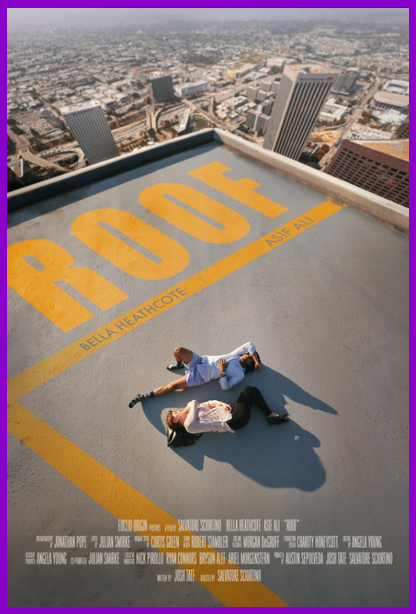
There’s a particular kind of confidence required to set an entire feature film on a single rooftop—and then ask the audience to stay there with you for 90 minutes. ROOF, making its World Premiere at the Dances With Films NY film festival, pulls off that gamble not through spectacle, but through rigor, precision, and an impressive understanding of how cinematic language can stretch a small canvas into something emotionally expansive.
Directed by Salvatore Sciortino and written by Josh Tate, ROOF traps two strangers atop a downtown Los Angeles building during a catastrophic July 4th blackout. Dev (played by Asif Ali) is a fast-talking trader who has just lost his company millions, while Mary (played by Bella Heathcote) is pregnant, stranded, and far more grounded than her unfortunate companion. With no water, no exit, and no help coming, the rooftop becomes both a physical prison and an emotional pressure cooker.
What’s striking early on is how deliberately the film resists melodrama. Rather than leaning into nonstop panic, ROOF unfolds as a carefully calibrated escalation—of heat, hunger, irritation, fear, and, eventually, connection. The script smartly reframes what could have been a one-note survival scenario into a character study about control, ego, and the slow dismantling of identity under stress.
Ali and Heathcote make for an unexpectedly compelling pairing. Ali leans into Dev’s performative confidence—money talk, status symbols, empty bravado—while quietly allowing fear and fragility to creep in. Heathcote, meanwhile, gives Mary a steady, observant presence that never feels schematic. As the film progresses, the power dynamic between them subtly inverts and then equalizes, turning what initially feels like a battle of personalities into something more human and mutual.
Much of the film’s success rests on its visual discipline. Cinematographer Jonathan Pope transforms the rooftop from a potential liability into an expressive landscape. Early scenes rely heavily on wide shots and negative space, emphasizing isolation and emotional distance. As the characters are forced into cooperation, the camera moves closer—eventually embracing extreme close-ups that linger on cracked lips, sunburned skin, and tar-stained fingernails. The effect is visceral without being gratuitous, grounding the film’s psychological stakes firmly in the body.
Color and lighting follow a similarly intentional arc. The rooftop begins in a bleached, punishing palette that reflects the characters’ emotional barrenness, gradually warming into something more cinematic as vulnerability enters the frame. Pope’s naturalistic lighting—largely relying on bounced light and minimal intervention—keeps the film feeling tactile and honest, even when the tension escalates.
Production design quietly does a tremendous amount of work. Fire hoses, vents, and a window-washing rig introduce verticality, movement, and cinematic reference points that prevent visual stagnation. These elements also carry genre associations—subtle nods to films like Die Hard and Cleaner—that give the audience familiar stakes, only to undercut them with human fallibility. This isn’t action-movie mastery; it’s improvisation under fear, pregnancy, and exhaustion.
The film’s editorial choices further elevate the material. Editor Julian Smirke prioritizes emotional rhythm over strict chronology, allowing moments to breathe or collide when they matter most. The result is a film that feels cohesive and purposeful, never locked into the rigidity that can plague high-concept indies.
Composer Curtis Green provides a score that smartly evolves alongside the narrative. Early cues flirt with near-horror unease, framing the rooftop as an ominous, threatening space, before gradually shifting toward a more lyrical, emotionally driven register. The use of live cello in the film’s later moments adds warmth and humanity, underscoring the story’s thematic pivot from survival to connection. The end-credit song, “Alive,” written and performed by Kate Grahn, serves as a cathartic release—an optimistic exhale after sustained tension.
Perhaps most impressive is how invisible much of the film’s technical labor remains. Though shot outside Los Angeles, ROOF seamlessly sells its setting through extensive yet unnoticeable visual effects work. The effort is never showy—and that’s precisely the point.
As a debut narrative feature, ROOF announces Sciortino as a director with a strong grasp of tone, collaboration, and restraint. Tate’s screenplay demonstrates a clear understanding of how to evolve a high-concept premise into something emotionally grounded without overexplaining itself. Together, they deliver a tightly controlled, thoughtfully constructed film that proves limitation can be a powerful creative engine.
ROOF doesn’t ask to be admired for its ambition—it earns it through execution. What could have been a clever experiment becomes a quietly compelling, human-scaled thriller that lingers long after the rooftop fades from view.
Directed by Salvatore Sciortino
Written by Joshua Tate
Cast: Asif Ali and Bella Heathcote
By debbie elias, 01/09/2026
ROOF premieres at Dances With Films New York on Sunday, January 18th.