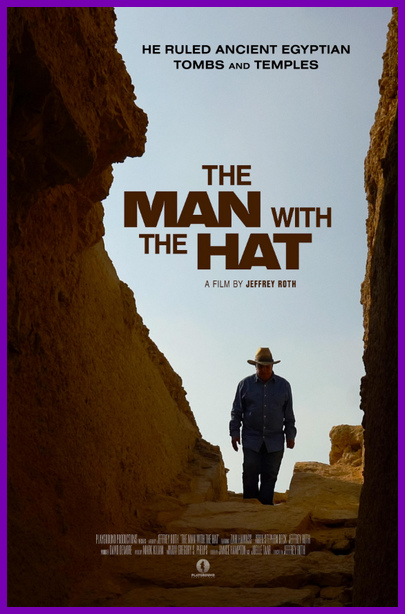
There are countless documentaries about ancient Egypt, but very few that understand the difference between studying history and living with it.
There is a quiet confidence to THE MAN IN THE HAT, a sense that it never needs to shout to justify its importance. Directed by Jeffrey Roth, the documentary unfolds not as a conventional chronicle of ancient Egypt, nor as a greatest-hits tour of tombs and temples, but as something far more intimate: a personal journey guided by one of the most recognizable figures in modern archaeology, Dr. Zahi Hawass, and shaped by a filmmaker deeply invested in the human story behind the history.
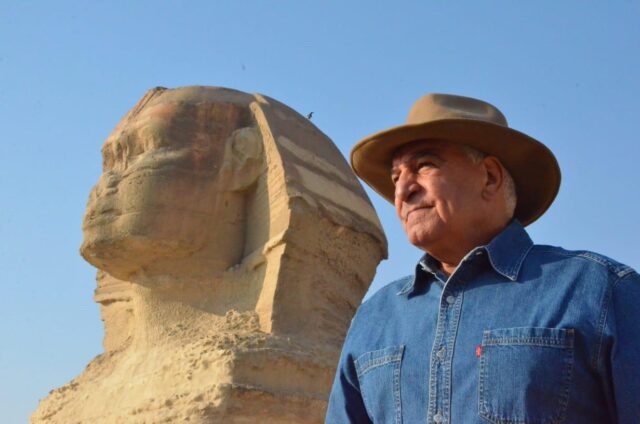
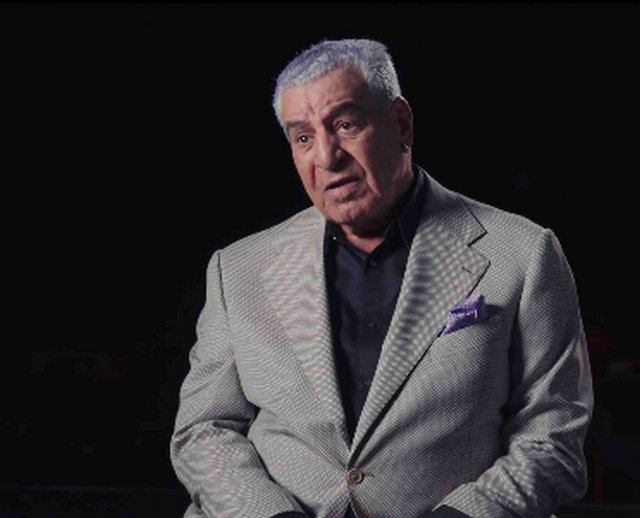
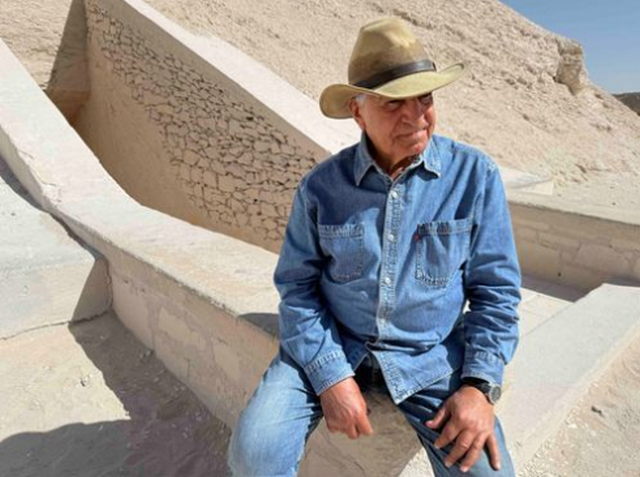
Hawass—long branded the “real-life Indiana Jones”—has spent decades serving as the public face of Egyptology, shepherding audiences from television studios to excavation sites with a mixture of authority, showmanship, and unmistakable passion. Yet Roth’s film is less interested in the myth of Hawass than in the man himself. Told entirely in the first person, THE MAN WITH THE HAT allows Hawass to lead us not only through Egypt’s antiquities but through his own life: his childhood along the Nile, his parents, his failures, his persistence, and ultimately, his sense of Egypt as something living rather than entombed.
From the opening moments, Roth establishes a visual grammar that mirrors this philosophy. Sweeping drone shots reveal ancient temples standing shoulder to shoulder with modern high-rise buildings, centuries colliding in a single frame. Egypt is not presented as a relic frozen in time, but as a country where past and present coexist uneasily—and where preservation is an urgent, ongoing act. The film contextualizes this struggle historically, noting how Napoleon’s scientific expedition marked one of the first systematic European efforts to document Egypt’s antiquities, and how the discovery of Tutankhamun’s tomb in 1922 ignited global fascination that too often led to exploitation, looting, and cultural loss.

Hawass’s guiding mantra—“Preservation, conservation, conservation”—becomes the film’s quiet thesis. Roth doesn’t underline it with editorial force; instead, he lets it echo through each sequence. Hawass speaks of the Nile as “a source of life,” of the Sphinx as “a living stone.” These are not metaphors for effect—they are beliefs. In Hawass’s worldview, antiquities are not objects but ancestors, and Egypt itself is home.
What elevates THE MAN WITH THE HAT beyond standard historical documentaries is its emotional accessibility. Hawass speaks openly about his upbringing in a family of what he proudly calls “educated farmers,” about a father who instilled in him the values of passion, honesty, and strength, and about the winding path that led him to archaeology only after failing at law and diplomacy. A formative moment—cleaning a statue with a fine bristle brush during his first job as an inspector of antiquities—becomes the spark that ignited his life’s work. Roth structures the film so that this personal awakening precedes the grand discoveries, allowing the audience to understand why these sites matter so deeply to Hawass before asking us to marvel at them.
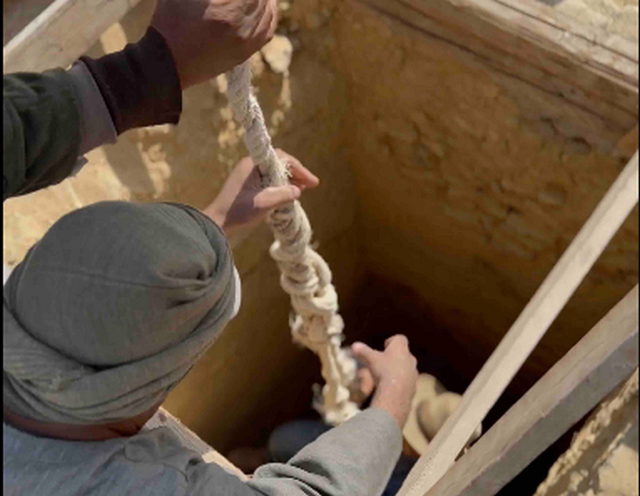
The filmmaking itself is frequently breathtaking. Descents into narrow tomb shafts—sometimes sixty feet underground—are captured with an immediacy that borders on claustrophobic, while aerial sequences of the Lost Golden City reveal its serpentine walls with architectural clarity and cinematic grace. Frequently, we are treated to new discoveries never before seen, such as “the five mummies” or a tunnel in Taposiris Magna, which Dr. Hawass had hoped would lead to Cleopatra’s tomb, or the first opening of a sarcophagus (which is fascinating to watch). Roth balances scale and intimacy with care, shifting between handheld street footage in modern Cairo, steadier movements within Hawass’s former home, and precise, patient observation of excavation work that remains strikingly analog. There are no robots here—only hands, brushes, wood blocks, and human anticipation.
(And for the record: no sarcophagus or pyramid was injured in the making of this documentary. No mummies were unwrapped, trampled upon, or otherwise disturbed.)
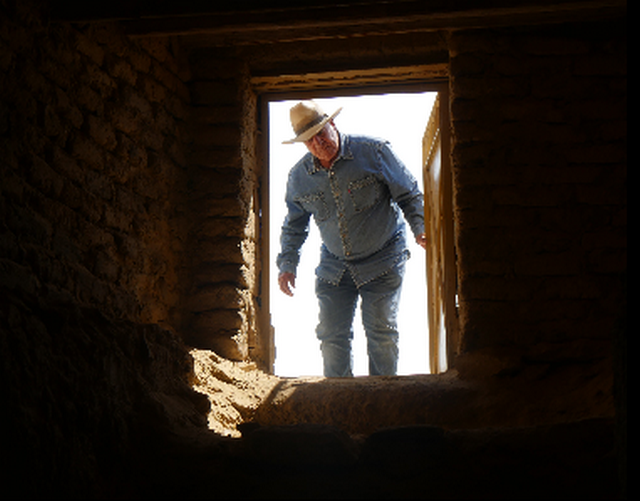
One of the film’s most powerful sequences arrives entirely by chance. While filming elsewhere in Saqqara, the crew is alerted by a local man to “mummy down there.” What follows is the discovery of what is believed to be a family of five mummies, wrapped simply in sand, without coffins or ornamentation. Roth frames the moment with poetic restraint: first showing Hawass on stage holding an image of the mummies, then cutting to the burial site itself, and later returning to Hawass discussing the image with his granddaughter. The sequence encapsulates the film’s emotional core—history not as spectacle, but as lineage, memory, and inheritance.
Roth’s independent production approach is evident throughout, and it becomes part of the film’s texture rather than a limitation. Restricted access, tight time windows—sometimes only an hour inside sites not open to the public—and severe equipment limitations force ingenuity. Small cameras, drones operated by local companies, GoPros, and even iPhones are employed to ensure coverage in spaces where reshoots are impossible. The result is a documentary that feels earned rather than polished into sterility, grounded in the physical and bureaucratic realities of working in Egypt.
The score by Mark Kilian further deepens the film’s sense of place. Recorded in Cairo with local musicians using traditional Egyptian instruments, the music never overwhelms the imagery. Instead, it breathes with it, reinforcing the film’s emotional rhythms while honoring the specificity of its setting.
Perhaps most striking is the film’s quiet humility. Roth repeatedly foregrounds the Egyptian workers who labor at these sites daily—men whose pride, expertise, and emotional investment are palpable. The dedication at the film’s end, honoring their tireless efforts to preserve their history, feels not ceremonial but sincere. (That means, stay through the credits.)
In its final moments, THE MAN WITH THE HAT reveals itself as both portrait and time capsule. It documents not just monuments and discoveries, but a fragile moment in history where access still exists, where care still prevails, and where one man’s devotion has shaped how the world sees Egypt. Roth never insists on Hawass’s legacy; he allows it to emerge organically, through presence, persistence, and belief.
This is not a documentary driven by trivia or spectacle alone. It is a film about stewardship, about roots, and about what it means to protect something that belongs not just to a nation, but to humanity. In giving voice to both the stones and the man who listens to them, THE MAN WITH THE HAT becomes something rare: a documentary that feels alive.
In listening so closely to one man who listens to stone, THE MAN WITH THE HAT reminds us that history doesn’t survive by accident—it survives because someone chooses, every day, to care.
Directed by Jeffrey Roth
Written by Jeffrey Roth and Stephen Beck
Executive Produced by Jeffrey Roth and Stephen Beck
Subject – Dr. Zahi Hawass
by debbie elias, 01/14/2026
THE MAN WITH THE HAT is available to rent or buy on 1/20/2026: https://geni.us/themanwiththehat