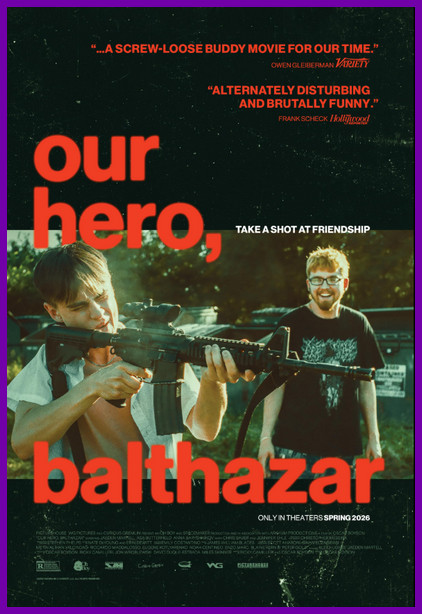
There are films that entertain, films that provoke, and then there are films like OUR HERO, BALTHAZAR—the kind that quietly unsettles you, lingers in your mind, and forces you to confront realities you might prefer to ignore.
Directed and co-written by Oscar Boyson, this is not an easy film to watch—but it is an essential one.
At its core, BALTHAZAR is a story about loneliness. Not the kind that exists on the surface, but the deeper, more insidious kind that festers beneath privilege, neglect, and the illusion of connection in a hyper-digital world. It’s about two young men—very different on paper—who are ultimately united by the same desperate need: to be seen. Balthy and Solomon are brought together online. The privileged and lonely New Yorker Balthy dreams of becoming a hero and being noticed (and yes, in part to get the attention of a girl he likes). At the same time, Solomon, a boy from the other side of the tracks in Texas, is also desperate for attention, mainly from his testosterone and bullshit-fueled father. To get attention, he uses the dark web to make threats of committing a school shooting, something that catches Balthy’s eye. Seeing Solomon as a potential savior to help achieve his own desires, Balthy travels to Texas to meet him. What happens when they connect is not only sad and terrifying, but horrific.

Jaeden Martell delivers a career-defining performance as Balthy, a young man whose wealth and upbringing have positioned him to “do something meaningful,” yet left him emotionally adrift. What’s most striking about Martell’s work here is the physicality—the calculated exhibitionism of grief and empathy. His tear-streaked videos, raw and often uncomfortable to watch, feel less like genuine emotion and more like performance… and that’s precisely the point.
This is empathy as content.
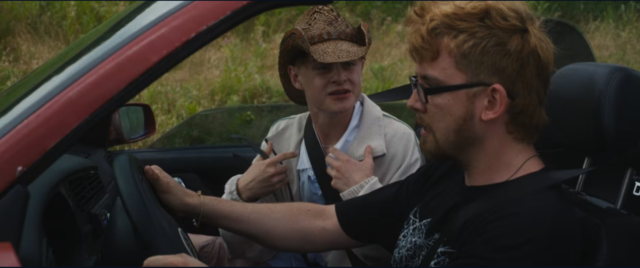
Opposite him, Asa Butterfield is nothing short of revelatory as Solomon. Stripped of the warmth audiences often associate with him, Butterfield leans fully into a frenetic, volatile energy that feels both unpredictable and painfully grounded. His rapid-fire delivery and restless physicality suggest a mind in constant motion—one fueled by frustration, neglect, and a desperate hunger for attention.
And yet, as the film unfolds, Solomon becomes something more than what we initially perceive. Once we see the environment he comes from—particularly through his relationship with his father—his actions take on a tragic clarity. What first reads as instability evolves into something heartbreakingly human.
The chemistry between Martell and Butterfield is electric, anchoring the film in a relationship that is at once authentic, uneasy, and deeply dangerous.
Boyson wisely resists sensationalizing the film’s subject matter. While the premise touches on issues of gun violence and online threats, the film never exploits these elements for shock value. Instead, it focuses on the emotional and psychological pathways that lead to those moments—the warning signs that are so often dismissed as noise in the digital void.
And that’s where OUR HERO, BALTHAZAR becomes particularly unsettling.
Because everything we see feels plausible.
The idea that someone could post something alarming online and be ignored—or worse, dismissed as attention-seeking—is no longer hypothetical. It’s reality. And Boyson taps into that reality with a steady, unflinching gaze.

Visually, the film reinforces this intimacy. Working with cinematographer Chris Messina, Boyson adopts a fluid, immersive style that keeps us in close proximity to the characters. The camera doesn’t observe from a distance—it moves with them, discovering moments as they unfold. The effect is immediate and often uncomfortable, as if we’re not just watching events happen, but participating in them.
This approach is especially effective in the film’s more emotionally charged sequences, where performances are allowed to breathe without the safety net of traditional coverage. There’s a rawness here—a sense that anything could happen at any moment—that heightens the tension without relying on conventional cinematic cues.
Production design by Steven Phelps and costuming by Emily Constantino further deepen the narrative, creating two distinct worlds that gradually begin to blur. Balthy’s polished, controlled environment contrasts sharply with Solomon’s cluttered, chaotic surroundings—until those lines begin to dissolve as the story progresses.
That visual merging mirrors the film’s thematic core: the erosion of boundaries between identity and performance, intention and consequence, heroism and harm.

Because ultimately, OUR HERO, BALTHAZAR is not about a villain.
It’s about a young man who believes he’s doing the right thing.
And that may be the most unsettling aspect of all.
Boyson doesn’t offer easy answers or moral clarity. Instead, he presents a situation that feels all too real and asks the audience to sit with it—to wrestle with the discomfort, to question their own perceptions, and to recognize just how thin the line can be between intervention and intrusion, between helping and harming.
For a directorial effort, this is an impressively confident and controlled piece of filmmaking. Boyson demonstrates a clear understanding of tone, performance, and thematic weight, crafting a film that is as emotionally engaging as it is intellectually provocative.
You can’t look away. And perhaps more importantly… you shouldn’t.
Directed by: Oscar Boyson
Written by: Oscar Boyson & Ricky Camilleri
Cast: Jaeden Martell, Asa Butterfield, Chris Bauer, Jennifer Ehle, Anna Baryshnikov, Noah Centineo, Becky Ann Baker, Avan Jogia, Pippa Knowles
by debbie elias, 03/17/2026
OUR HERO, BALTHAZAR is in theatres in New York on March 27th, and in Los Angeles on April 3rd.