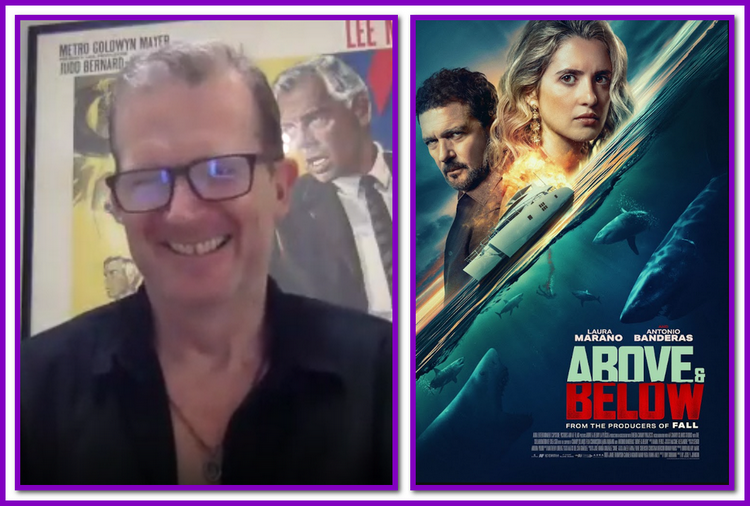
There are filmmakers who find their niche, settle comfortably into it, and spend their careers refining what they already know they can do. And then there are filmmakers like JESSE V. JOHNSON who see something that frightens them and decide that fear may be the best reason to do it.
For Johnson, ABOVE & BELOW was that film.
Known for the physicality and character-driven action of films like HELL HATH NO FURY, CHIEF OF STATION, THIEVES HIGHWAY, and THE DEBT COLLECTOR films, the former stuntman-turned-director has never been afraid to push bodies, cameras, stunt teams, and himself to their limits. But Anthony Steve Giordano’s screenplay for ABOVE & BELOW presented Johnson with something altogether different.
Water.
Lots and lots of water.
And sharks.
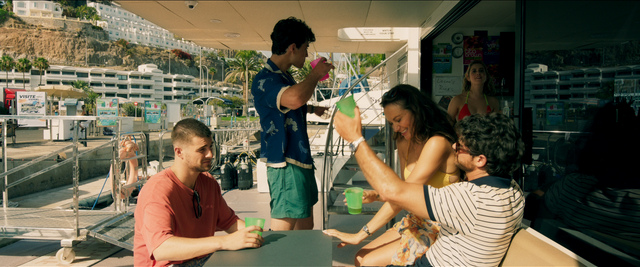
More significantly, it gave him a group of young protagonists far removed from the weathered, world-weary characters with whom Johnson generally gravitates.
Johnson was in Columbus, Georgia, shooting Thieves Highway when the screenplay arrived. Ordinarily, he refuses to read another script while making a film, preferring to remain completely immersed in the world at hand. But he made an exception. His initial reaction was unequivocal: this wasn’t a film he had any business directing.
And then he realized why.
“It took about three days to realize I was scared of doing it. I was scared of doing a film underwater. I was scared of doing a film with young protagonists. And I realized: you have to go where you’re scared to do anything interesting. To move anywhere with your life, you have to venture out of your comfort zone now and then. This was very much out of mine.”
So Johnson dove in.
The result is one of the most entertaining shark thrillers in years, a film that seamlessly melds terror, horror, action, and unexpected beauty while maintaining the physicality that has long defined Johnson’s work. But perhaps most importantly, ABOVE AND BELOW is a character-first adventure that just happens to be swimming with teeth.
ROOTING FOR THE SHARK
Johnson doesn’t approach filmmaking by genre. He approaches it through character.
“I don’t follow genres. I follow good movies and I follow directors. I don’t think of motion pictures in terms of genres. I know that’s how they exist, that’s how most people do, but the truth of the matter is you try and make a film as good as you possibly can—with characters that are interesting and motivating and well acted, and dialogue that’s electric and feels like it’s being said for the first time.”
That philosophy became particularly important with ABOVE & BELOW. Preparing for the film, Johnson watched some 60 shark and wild-animal movies and quickly discovered a recurring problem.
“If the film is a thriller, you want people to feel a sense of jeopardy for the actors in danger, and you want them to care whether they get eaten or not. A lot of the shark films I looked at, I really rather hoped all of the humans were going to get eaten by about halfway through. They were so poorly drawn. . .There is a protocol for wild-animal movies—there are a lot of them out there—and you’ve got to be careful not to copy that. I watched 60 or so of those films, and honestly, the one thing I took away was that when they really didn’t work, it was because you had no interest in the characters. Ten minutes in, you’re rooting for the shark: ‘Please just eat these people and let’s get on with it’.”
On this point, Johnson and I are perfectly aligned. With virtually every shark film I watch, I mentally designate who should be the appetizer, entrée, and dessert, who deserves to survive, and who needs to become chum as quickly as possible. With ABOVE & BELOW, I still had my candidates—Kyle, I’m looking at you—but Johnson had accomplished something too many films of this ilk forget to do.
He gave us people worth caring about.
Rather than relying solely on movies for his research, Johnson went to marine museums and aquariums and spoke with specialists about shark behavior, hunting patterns, and characteristics. What he learned from people who actually knew sharks proved more useful than anything he saw on screen.
The sharks would create the danger.
The people had to create the suspense.
REBUILDING THE BAD GUYS
One of Johnson’s most consequential changes to Giordano’s screenplay came with the antagonists. Originally conceived as 19-year-old drug dealers, they didn’t hold much dramatic interest for him. Johnson saw another possibility.
“I kept the young kids as the leads, but I thought: if I can bring in some really seasoned kind of bad guys who really add layers to these characters and do something interesting with them, this could be something I’m passionate about for eight months of prep, six weeks of shoot, and a year of post.”
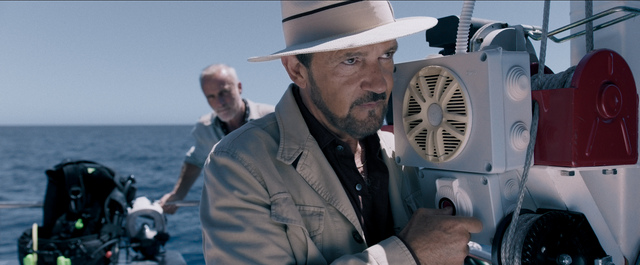
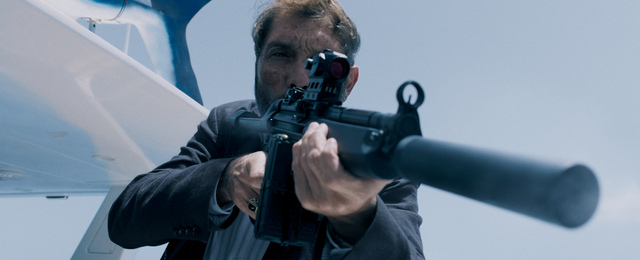
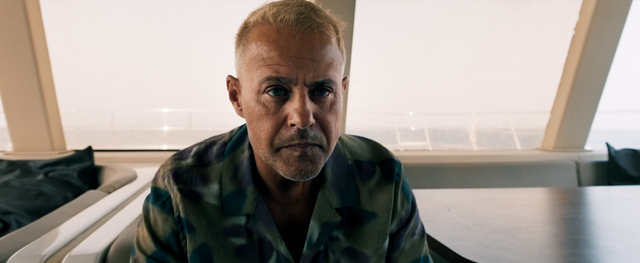
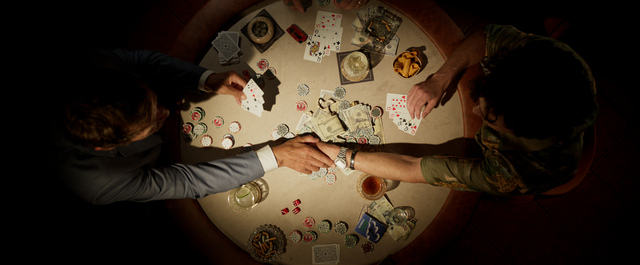
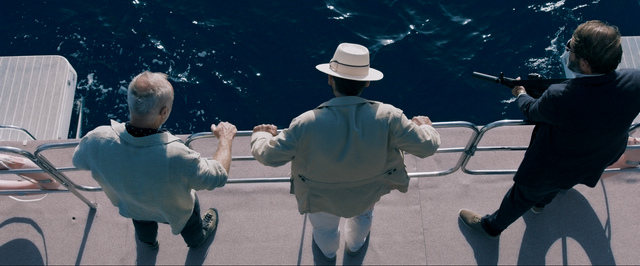
Enter Antonio Banderas, Jess Liaudin, and Louis Mandylor as Burns, Garrison, and Martin, respectively—a delicious triumvirate of villainy in which no two men operate on quite the same frequency.
For Johnson, working with Banderas was a career highlight. He had wanted to work with him for years and found the experience exceeded his expectations. Banderas immediately sensed that actors and crew members were nervous around him and went out of his way to eliminate that nervousness, creating an atmosphere without ego or intimidation.
That generosity makes Burns’ volatility on screen all the more impressive. Banderas can pivot from flippant amusement to deadly menace in an instant, while Mandylor’s wildly unhinged Martin feels almost like a younger, less controlled iteration of Burns.
Then there’s Liaudin’s Garrison.
My personal favorite character in the film—shark excepted—Garrison is the quietest of the three and perhaps the most intriguing. Taciturn and observant, he never feels like a simple henchman or muscle-bound errand boy. A glance here, the slight lift of an eyebrow there, and suddenly we’re wondering whether Garrison is really working for Burns at all.
Johnson was delighted by the response.
“I have to let Jess know. He worked very hard on this.”
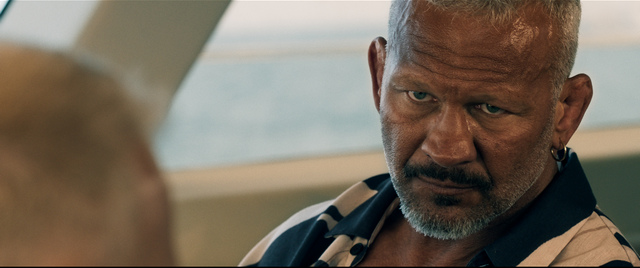
Interestingly, his seasoned bad guys initially wondered where all their customary mayhem had gone.
Each, Johnson recalled, essentially came to him asking: Where’s my psycho scene? When do I kill somebody? Where’s my machine gun? Where’s my martial arts sequence?
Johnson’s answer was simple.
Not that kind of movie, guys.
The challenge this time would be character.
MAXIME ALEXANDRE AND THE BEAUTY OF BLUE
If Johnson was venturing into unfamiliar waters, he was determined to surround himself with people whose strengths could help him navigate them.
At the top of that list was cinematographer Maxime Alexandre.
Johnson had previously worked with Alexandre on The Pendragon Cycle, but another film cemented his belief that Alexandre was the man for ABOVE & BELOW: Alexandre’s work on Alexandre Aja’s alligator thriller Crawl.
Johnson remembered watching the film theatrically and becoming so unnerved that he literally lifted his feet from the floor.
“It was so well handled that I thought he’d be perfect for this.”
He was.
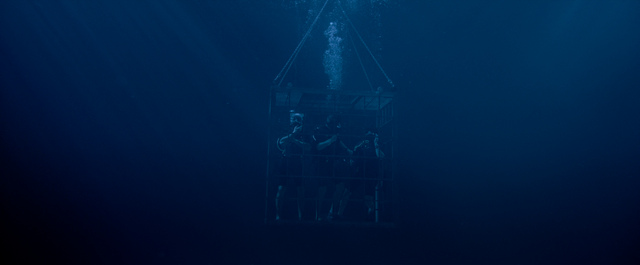
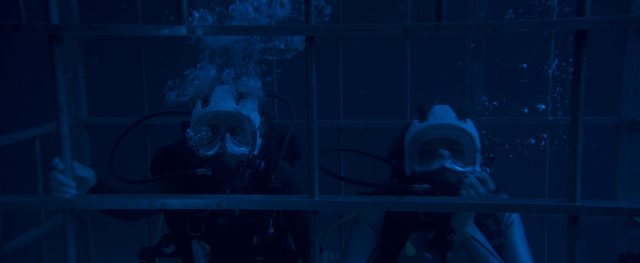
Alexandre turns the brilliant blues surrounding the Canary Islands into something simultaneously inviting and threatening. Negative space is commonly associated with darkness or blackness. Here, it is blue—beautiful, seemingly endless gradations of blue creating extraordinary depth while hiding whatever may be approaching from beyond our field of vision.
And then suddenly…
Teeth.
The collaboration also forced Johnson to relinquish some of his customary control.
Johnson meticulously prepares shot lists—the “battle plan” that allows him to move quickly through demanding schedules. Early in production, Alexandre would study Johnson’s plan and suggest another way of approaching a setup.
Initially, Johnson found that somewhat jarring.
Then something happened.
Alexandre’s ideas kept being better.
Eventually Johnson stopped resisting and started trusting.
That trust became one of the defining collaborations on the film.
THE MAN WHO PLAYED THE SHARK
Alexandre also solved one of the most difficult problems facing any filmmaker working with a digital creature: how do you get an authentic performance and accurate eyeline when your actors are reacting to something that isn’t there?
Nobody wanted frightened actors staring at an orange tracking ball.
Alexandre proposed something far more physical. A stunt diver would become the shark.
“We talked a lot about how to incorporate a diver—a stunt diver—with a motor swimming around so the actors had something to respond to. You don’t want a bunch of people trying to react to an orange ball floating through the water.”
Equipped with a propulsion device, the diver circled the actors, giving them an actual moving threat to follow with their eyes and bodies.
“At any point in this movie, the actors are reacting to something in the water that’s circling them. It was actually quite scary.”
Even bubbles mattered. Because digitally removing them would create additional effects work, the diver had to hold his breath while performing.
“He played the shark for the entire movie.”
Other stunt divers provided the physical violence of the attacks. One massive Bulgarian diver used a shepherd’s hook to grab, pull, shove, and jerk performers through the water, while additional teams operated lines from outside the tank.
The result is something audiences may never consciously identify but instinctively feel: when these characters are attacked, their bodies actually react to force.
And when they look at the shark, they look directly at it.
“TILT YOUR HEAD BACK”
But all the physical authenticity in the world means little if we can’t connect emotionally with the people experiencing it.
For Johnson, that meant one thing above all:
The eyes.
“I’ve done this long enough to know you’ve got to see the actors’ eyes. Ultimately, we’re telling stories over a fireplace—you look into the storyteller’s eyes, and that’s the story. With actors, you need to see their eyes when you’re telling a movie.”
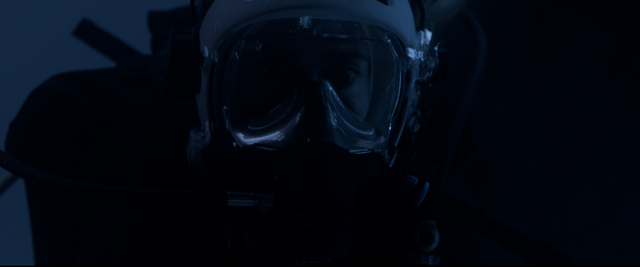
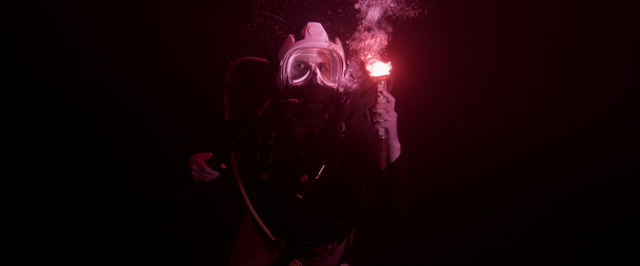
Unfortunately, diving masks created exactly the opposite effect Johnson needed, casting shadows across the actors’ eyes. Lighting options at depth were limited.
So much of Johnson’s underwater direction became one repeated instruction booming through an underwater speaker: “Tilt your head back.”
“Underwater, the masks were putting their eyes in shadow. We don’t have much lighting down there, just a little bit sometimes on the camera. So the majority of my directing underwater was: ‘Tilt your head back. Tilt your head back. We need to see your eyes and get that light in there.'”
It’s a deceptively simple detail that pays enormous dividends, particularly in the close-ups of Tatiana as fear, calculation, grief, and determination flicker across Laura Marano’s face.
LAURA MARANO TAKES THE DEEP END
Marano proved to be one of Johnson’s biggest surprises.
Tatiana was originally somewhat different on the page, but midway through production Johnson realized just how much Marano could handle.
So he kept giving her more.
“She’s been working professionally since she was six or seven years old. She knows as much as most experienced producers, not to mention actors who’ve been carrying a TV show for that many years.”
One sequence near the film’s climax perfectly encapsulates the experience.
Marano had trained extensively with a pistol for a confrontation aboard the catamaran. There was just one problem.
When they arrived at the sequence, Johnson realized that the character carrying Tatiana’s intended pistol had been killed during an earlier scene—and had fallen in the wrong direction.
The pistol was now approximately 40 feet away from where Tatiana needed it.
Continuity had spoken.
Another dead man nearby had a submachine gun.
Problem solved.
Sort of.
Johnson told Marano she would have to use that instead.
Her response?
What is it? Where do I hold it?
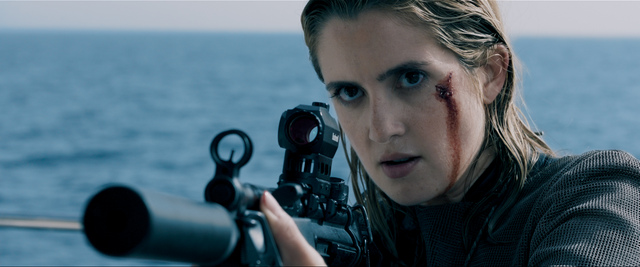
Johnson sent her to the bow with a tactical instructor. Approximately ten minutes later she returned handling the weapon, in Johnson’s estimation, like a SEAL Team operator.
Her fearlessness extended underwater.
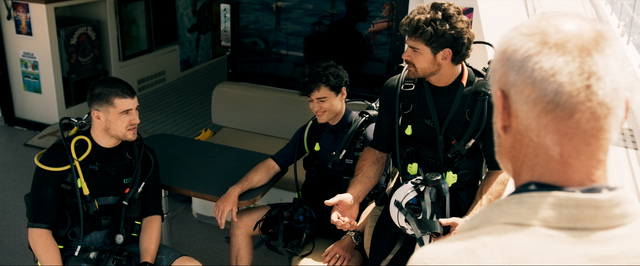
Johnson admitted he entered dive training with certain assumptions about which cast members would most readily take to the experience.
“I thought the guys would be the type A divers and the girls would be hesitant. It was the complete opposite.”
Marano was down at 30 meters before anyone else.
While some of the men struggled with equalization, popping ears, nerves, and the inherent discomfort of diving, Marano was encouraging them to keep going.
“She was the one down at 30 meters before anyone else… It was fascinating to watch.”
DYING UNDERWATER IS HARD WORK
As difficult as the action proved, Johnson discovered that some of the most technically demanding underwater sequences involved actors doing something apparently simple:
Nothing.
“The most difficult scenes were the death scenes.”
Ryan Bertroche’s Danny had to remain seated underwater with a weight harness while his oxygen source was removed and the safety diver cleared frame. Only after the resulting bubbles disappeared could the shot begin.
The actor then had to remain absolutely still while holding his breath—not even allowing bubbles to escape through his nose.
Donncha Tynan’s death as TJ was even more demanding.
Upside down and entangled underwater, Tynan had to hold position and convincingly appear lifeless while the production maintained strict control over his safety. The platform was ultimately raised to approximately 15 meters because the greater depth wasn’t providing sufficient light.
“It’s nerve wracking for them. It’s not a small thing to ask of a person. We did it slowly, we built their comfort, and when they were really ready, we rolled camera.”
And yet for Johnson, the technical achievement wasn’t the ultimate goal.
The scene still had to carry pathos.
Behind all the oxygenation, weights, rigging, safety divers, depth calculations, lighting issues, and breath-holding was something profoundly simple:
A young woman was looking at her dead former boyfriend.
Again, Johnson needed the eyes.
THEN THE REAL SHARK SHOWED UP
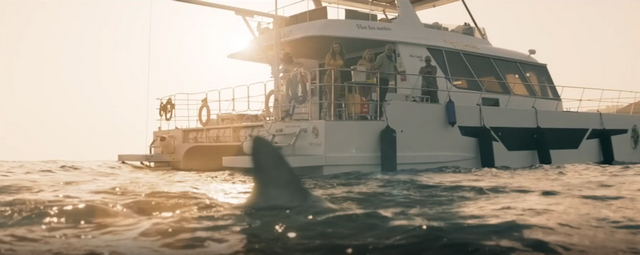
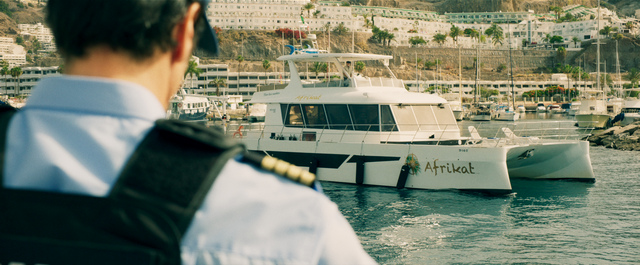
Tank work was completed at Nu Boyana Studios in Sofia, Bulgaria, but the catamaran sequences took Johnson, cast, and a stripped-down crew into open water off the southern coast of Gran Canaria.
At times, they were closer to the Sahara than to the Canary Islands.
And the water was deep. Very deep.
The volcanic geography drops precipitously beneath the surface. Johnson discovered just how precipitously when the wire securing one of the production’s shark cages snapped.
The cage disappeared.
Not sank slowly.
Disappeared.
There was no retrieving it.
Then came Louis Mandylor’s big day in the water.
And an unexpected guest.
“The day Louis had to go into the water, we were being circled by a shark. I said to the Spanish crew, ‘You promised me there were no sharks. I’ve told the crew there are no sharks down here.'”
Their response was magnificent.
“It’s not a shark, it’s a hammerhead.”
Johnson detected what he diplomatically describes as a “slight sardonic whip” in their reassurance.
The hammerhead remained around the boat for hours.
Naturally, they filmed it.
Unfortunately, their genuine shark apparently lacked sufficient production value.
“The trouble is, real sharks are not terribly scary looking things. The dorsal fin hung and folded. It looked a little like a Temu version of a shark.”
Try telling that to Mandylor.
Louis Mandylor does not like sharks.
Louis Mandylor does not particularly like the ocean.
And Louis Mandylor was about to be instructed by Jesse V. Johnson to jump into an ocean containing a very real hammerhead shark.
“I had to talk Louis into going into the water with this shark nearby. Louis doesn’t like the ocean. He doesn’t like sharks. But he did it.”
And when Johnson called cut?
“You’ve never seen anyone get out of the water so quickly.”
NU BOYANA: WHERE THE IMPOSSIBLE BECOMES POSSIBLE
For the controlled underwater work, Johnson headed to Nu Boyana Studios in Sofia and its massive, modern water tank.
The production spent approximately two weeks underwater, where Johnson quickly learned that seemingly routine filmmaking tasks can take four or five times longer than they do on dry land.
Critical to making the schedule work was Nu Boyana’s stunt operation.
Johnson praises the Bulgarian team not merely for its technical expertise but for its safety consciousness and attitude toward filmmaking.
“Nu Boyana is run very professionally, and they love filmmaking. There’s no cynicism, no jaded anger.”
Having come out of stunt work himself, Johnson is acutely sensitive to the difference between a crew that is supported and one that has been exhausted, shortchanged, or taken for granted. At Nu Boyana, he found people who were properly looked after and consequently invested in the work.
Of course, working with a former stuntman behind the camera comes with its own challenges.
“Having been a stuntman myself, I do drive stunt teams a little nuts. I like to do things I haven’t done before and push them to the very limit of what we can do.”
Safety is never negotiable. Johnson relies on stunt professionals to establish where that boundary lies.
But he intends to walk right up to it.
“I rely on them to tell me if it’s safe or not, but I will push to that line. That’s my job… I’m hired to come and make you think and use your imagination.”
MATTHEW LORENTZ AND THE GREAT SHARK MASSACRE
Once filming was completed, Johnson faced an entirely different challenge alongside longtime editor Matthew Lorentz.
There were too many sharks.
I personally dispute the possibility of such a thing.
The visual-effects budget, unfortunately, did not.
“The edit was enormous, very complex. We had way more going on underwater—probably another 50 percent more scenes with sharks.”
Eventually Johnson and Lorentz were informed that the production simply could not afford to finish everything they had planned. Their number of shark effects shots was approximately two-and-a-half times what the budget could accommodate.
Cuts had to be made.
Sharks were lost.
It was tragic.
And Johnson now believes it made the movie better.
“In the end, I think it helped. It forced us to be more inventive, to focus on the scenes that really mattered. Instead of having five subpar shots, you now have three that are really good.”
That discipline is emblematic of Johnson’s relationship with Lorentz, whose editorial instincts prioritize character, performance, and the needs of the finished film over the amount of blood, sweat, money, or time expended capturing something.
“Often that means dialogue, special effects, even stunts get lost. I’ll complain, ‘I spent two days setting that up,’ and he’ll say, ‘Watch it, you’ll see it works better without it.’ And he’s right.”
Their collaboration has grown so close that Lorentz now participates at the screenplay stage, sometimes warning Johnson that if they shoot something unnecessary, he’ll only make Johnson suffer through watching him remove it later.
So now they remove it before shooting. The script gets tighter. The movie gets tighter.
And Johnson is spared at least some editorial heartbreak.
YOU CAN ONLY BE JAWS
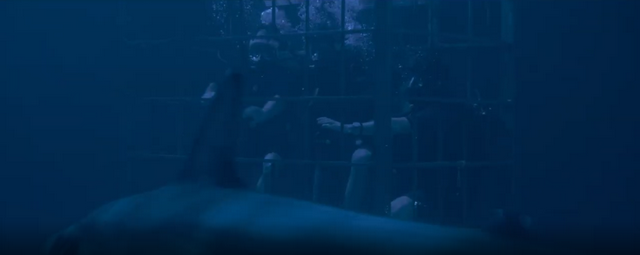
No shark movie can escape the shadow of Jaws. Johnson didn’t try.
He simply refused to imitate it.
“[Jaws] can only be Jaws, Debbie. You can’t go near that now.”
For Johnson, John Williams’ musical vocabulary is so thoroughly embedded in popular culture that anything remotely resembling it risks feeling derivative. Working with his composer, Maria Vertiz. the goal was therefore restraint: music that supports emotion and suspense rather than loudly announcing “SHARK MOVIE!”
But there was one lesson from Jaws Johnson happily embraced.
Not the shark.
The people.
“On every level, Jaws shouldn’t work, but it does because of those extraordinary characters. You’ve got a Shakespearean actor, a published author in Robert Shaw, and Dreyfuss and Scheider at the top of their game. You buy into their struggle and it becomes this Greek odyssey.”
The shark, Johnson notes, is often almost secondary—a malignant presence lurking beyond the frame.
“The one thing you can take from Jaws is that it’s about the human characters. If you can make them work and the audience worries about their jeopardy, then you have something.”
Which brings Johnson right back to where he began.
Character.
THE CORPSE THAT WENT THROUGH CUSTOMS
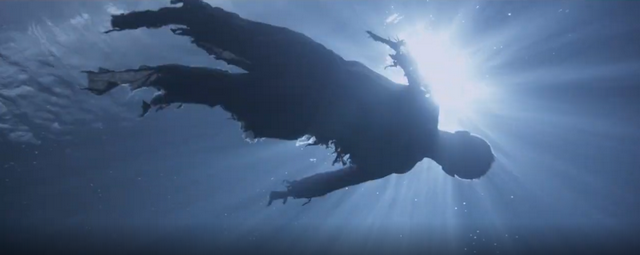
Of course, ABOVE & BELOW would not be SHARKTASTIC without some spectacularly mangled human remains.
And few are more spectacularly mangled than poor Martin after the sharks finish dining on Louis Mandylor.
The prosthetic corpse was sufficiently realistic to unsettle Mandylor himself. Walking into a fitting room and unexpectedly encountering his own mutilated body lying on a table was disturbing enough. The dummy also reminded Mandylor of his father, adding an unexpectedly emotional dimension to the experience.
But eventually the production had to transport the corpse.
Through Madrid airport.
In a ski bag.
Customs opened it.
One can only imagine the ensuing trauma as an airport employee unzipped a bag and found what appeared to be the horrifically mutilated remains of Louis Mandylor inside.
Sometimes movie magic is perhaps a little too magical.
GO WHERE YOU’RE SCARED
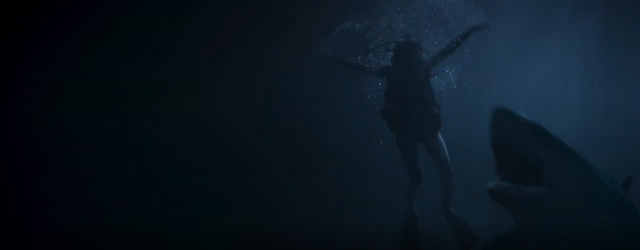
For all the sharks, blood, underwater stunt work, guns, boats, tanks, open ocean, visual effects, and disappearing cages, Johnson’s experience making ABOVE AND BELOW ultimately circles back to the realization that made him accept the film in the first place.
He was afraid of it.
And that was precisely why he needed to make it.
“It was an adventure, Debbie. I think maybe instinctively I had an idea the film was going to be an adventure, and I like adventures. I like my heart beating a little quicker than usual at times.”
He walked into unfamiliar territory armed with something far more valuable than certainty: collaborators he trusted.
Alexandre. Lorentz. Vertiz. A committed cast. Exceptional stunt and effects teams.
And the willingness to admit that somebody else’s idea might be better than his own.
“When you challenge yourself, you’re doing yourself the greatest favor, in the long term and the short term. Find yourself some great collaborators and go off into the unknown and make some great movies.”
For Johnson, that means refusing to allow the industry—or yourself—to define the boundaries of what you’re capable of doing.
“If you’re known as a horror maker, go off and do something different. If you’re known as an action guy, try something else. But make sure you’ve got the right collaborators. That’s everything.”
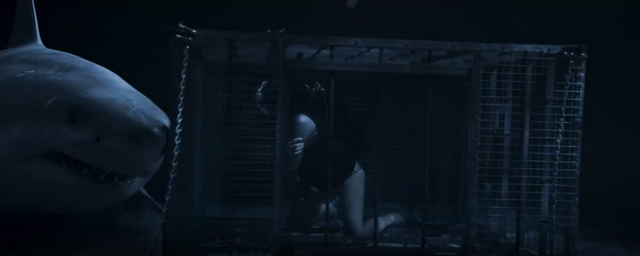
With ABOVE & BELOW, Jesse V. Johnson followed his own advice.
He went where he was scared.
He surrounded himself with people he trusted.
He dove into the unknown.
And somewhere along the way, a stunt diver became a shark, Laura Marano became the bravest diver in the group, a cage vanished into an ocean abyss, Louis Mandylor encountered his own corpse, and a very real hammerhead shark spent several hours circling the boat before being dismissed as insufficiently cinematic.
And Johnson came back to the surface having expanded his filmmaking vocabulary without sacrificing any of the character, physicality, or emotional stakes that have always defined his work.
That’s one hell of an adventure.
And one hell of a way to make something… SHARKTASTIC.
by debbie elias, exclusive interview 07/22/2026
ABOVE & BELOW is in theatres on July 29th.