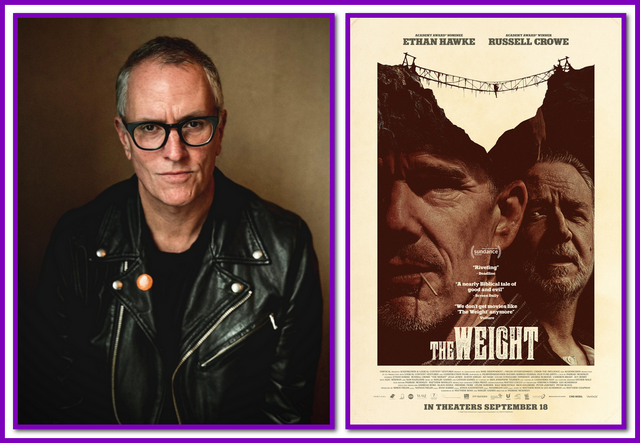
There is a moment in THE WEIGHT when cinematographer Matteo Cocco needed to capture Ethan Hawke and his fellow actors crossing a river deep in the wilderness. Director PADRAIC “PAT” McKINLEY thought he knew how they would get the shot. Bring in a crane. Poke it out over the river. Get behind the men.
Cocco had another idea. “No, no, Pat, no, no. I’m in the water.”
McKinley was understandably taken aback. “I’m sorry, you’re gonna—you want to get in the water?”
“Yes, yes. It has to be in the water.”
And into the water Cocco went.
Standing somewhere around six-foot-eight or six-foot-nine, Cocco got certified for diving, squeezed himself into a wetsuit, strapped a camera onto his shoulder and spent the day in the river behind the actors.
It is a wonderful story about the lengths filmmakers will go to get a shot. But it also speaks to something much larger about THE WEIGHT, a film in which virtually everything—on screen and behind the camera—is about endurance, conviction, freedom, friendship, and just how far one is willing to go for something, or someone, worth fighting for.
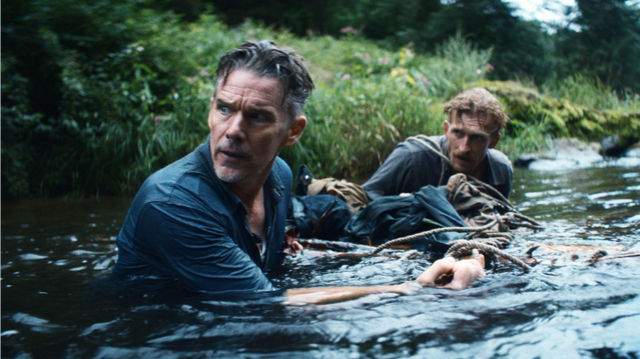
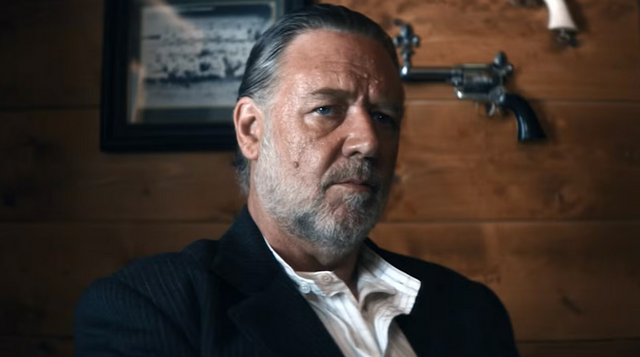
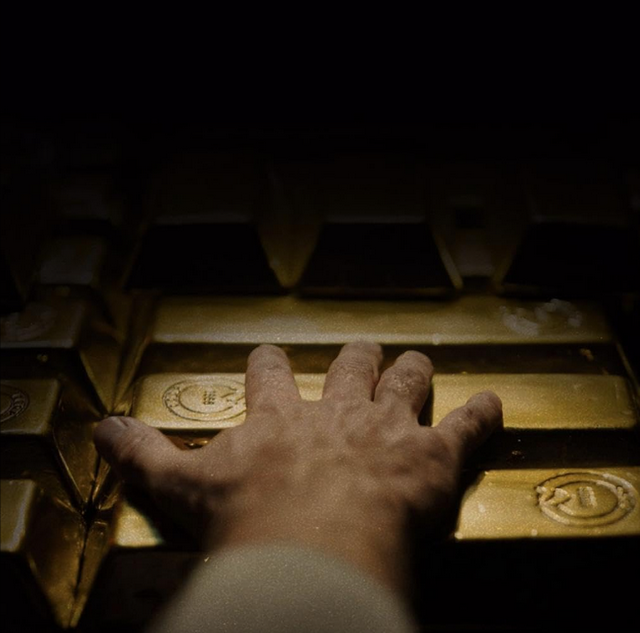
Set in Oregon in 1933 during the depths of the Great Depression, THE WEIGHT stars Ethan Hawke as Samuel Murphy, a father torn from his daughter and imprisoned in a brutal work camp where Russell Crowe’s corrupt and imposing Clancy offers him a chance at early release: help smuggle gold through miles of unforgiving wilderness.
What follows is not merely an adventure or survival story, but a testament to the human spirit and the need for personal freedom, anchored by the gut-wrenching power of a father’s love for his daughter.
Hawke is magnificent as Murphy, embodying the kind of hero rarely seen on screen today. Quiet and stalwart, he puts his head down, keeps his eye on the prize and keeps moving forward with integrity and conviction. Crowe is rock-solid shady as Clancy, while Julia Jones commands the screen with little more than a look. She needs no words.
And surrounding them is the wilderness.
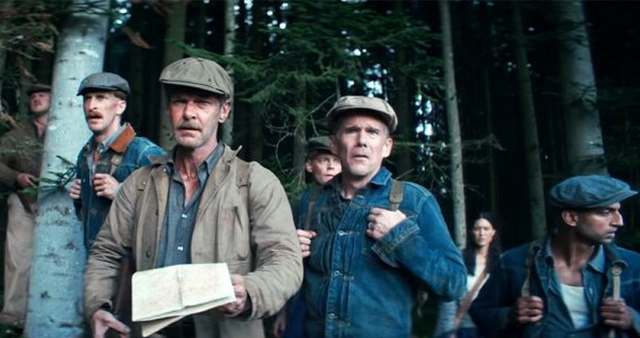
Breathtaking, beautiful and dangerous, it becomes as integral to THE WEIGHT as any character. This isn’t manicured woodland masquerading as wilderness. McKinley found his 1933 Oregon in Germany’s Bavarian Forest, an extraordinary expanse of protected land where nature is quite literally allowed to be nature—untamed and, throughout much of the National Park, free from human interference.
Today, the Bavarian Forest National Park and neighboring Nature Park form the heart of the Bavarian Forest Star Park, a 940-square-kilometer International Dark Sky Reserve where natural darkness is protected from the intrusion of artificial light. It is one of the increasingly rare places in Central Europe where the night can still truly become night.
For THE WEIGHT, that pristine quality gives the wilderness an authenticity no production designer could manufacture. By day, dense forest, uneven terrain, rivers and an environment governed by its own natural rhythms envelop Murphy and his fellow travelers.
By night, darkness is darkness.
Human beings seem very small within it.
There is also an inescapable historical resonance in McKinley finding his 1933 Oregon in Bavaria. THE WEIGHT is a story steeped in questions of power and corruption, oppression and personal freedom, playing out against the desperation of the Great Depression. Shooting that story on German soil adds an unspoken layer of irony given what was simultaneously unfolding in Germany and across Europe during the 1930s.
Finding that physical world, however, was not easy.
“We really struggled to find a place that we could make this work financially,” McKinley admits. But once Germany became the answer, “we just got the shovel and started digging.”
And therein lay another challenge. The very qualities that made the Bavarian Forest ideal for THE WEIGHT also made it a formidable place in which to shoot. Untamed terrain meant not only actors making their way through forest and water, but a crew carrying cameras, lighting, batteries and equipment into that same environment. And in a landscape internationally recognized for the purity of its natural darkness, once daylight disappeared, creating an image became an entirely different proposition.
Which makes the work of cinematographer Matteo Cocco all the more impressive.
“It just smacked me across the face when I saw Matteo’s work.”
McKinley, who came to directing after years of experience as an editor, had spent years developing a visual bible for THE WEIGHT, detailing characters and ideas for lenses and visual language. For a Depression-era story, he was adamant about avoiding the obvious visual shorthand of desaturation and sepia.
“I didn’t want it to be sepia toned. I wanted it to be somewhat saturated and feel modern,” he explains, while still embracing something equally important to him: “this 1970s aesthetic.”
When McKinley first met Cocco over Zoom, he wondered whether he might offend a cinematographer by arriving with his own thoughts about lenses.
Instead, Cocco lit up.
“He got so excited by the Bible, and then he started pitching new things at me.”
One of those ideas was to strip away much of the machinery normally surrounding a production and venture into the Bavarian Forest almost like a documentary crew.
“What if we broke off a little bit of crew that we could really go out into the forest, which treated like a little documentary crew?”
It was an inspired approach for terrain that immediately announces its difficulty on screen. Actors had to traverse it, but so did camera operators and crew carrying cameras, batteries and equipment over uneven ground and through water.
Cocco led by example.
“He does all the camera operating,” says McKinley. “He’s not only inspirational, but he’s kind of like, hey, if Matteo is doing it with a camera, everyone better shut up and just get in line.”
Cocco’s willingness to physically immerse himself in the environment was matched by Hawke, Jones and the rest of the cast, helping create the survivalist immediacy that courses through the film.
But Cocco’s imagery is about much more than physical immersion. Working with McKinley, he creates a visual grammar that evolves with the characters and their increasingly perilous journey.
McKinley, editing as well as directing, is particularly judicious about the close-up.
“I don’t believe in using close-ups per scene. I believe in close-ups as they come in sequences and chapters of a movie, or, you know, stanzas.”
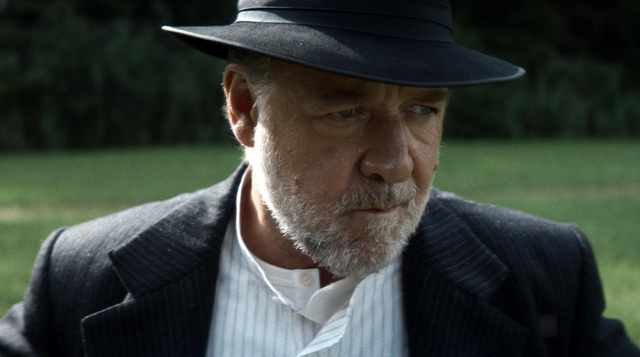
With actors like Hawke and Jones, he sees no reason to force the audience continually into their faces.
“They can play in a two-shot, and they can play in a wide shot. They can play in a medium,” says McKinley. “You don’t want to tire the audience on what they can do.”
The result is an increasingly powerful progression. Wider two-shots and group compositions allow us to absorb the men and their relationships as a whole. As their numbers dwindle and circumstances become more desperate, the camera incrementally moves inward. By the third act, compositions become tighter, rougher and increasingly unsettled.
“At the end, the reels get a little bit more psychedelic, and they get tighter and a little messier,” says McKinley, leading into a climactic fight that is “by far our closest, messiest sequence. Deliberately so.”
And then there is Jones. A single look from her can speak volumes, something McKinley and Cocco understand well enough to let the camera observe rather than announce. It is precisely because close-ups have not been exhausted that, when one comes, it matters.
But for all the careful planning that went into THE WEIGHT, some of its magic came from plans falling apart.
One of McKinley’s favorite shots in the film exists because a train station didn’t.
A late scene had originally been written around characters saying goodbye at a station, but the production couldn’t find the right location. Spending an entire shooting day traveling somewhere to capture only a couple of shots made little sense. So McKinley rewrote the scene for a period automobile.
On the page, it was simple. Murphy and the others would drive along, Rankin would muss Murphy’s hair, and everyone would share a moment of celebration.
“It was kind of like, that’s not that exciting,” McKinley admits. “I said, it’ll be cool on the day. You’ll get the point.”
Then Hawke had an idea. “Hey, what if I pass—what if we pass the cigarette along?”
McKinley immediately saw possibilities.
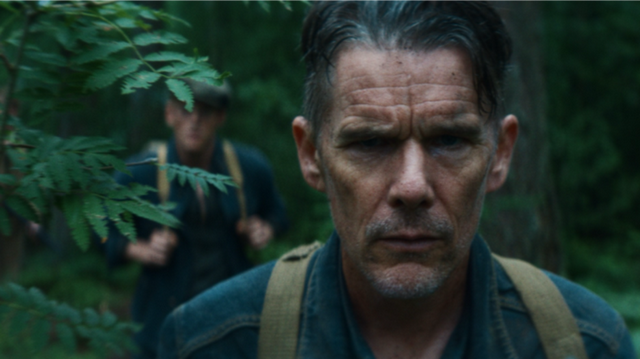
Cocco looked at the cramped automobile and suggested dispensing with conventional coverage altogether.
“Look, Pat, I think I’ve got a shot just here. We can just put it on this wide lens.”
Now they could simply watch the cigarette travel around the car.
“And start—oh, now this is getting good,” McKinley recalls.
Then came the music. Shelby Gaines, who worked on the screenplay and, with his brother Latham, composed the score, supplied what McKinley affectionately dubbed the “swaggy cue.”
The finished shot becomes a relaxed celebration among newfound allies and friends, but for McKinley it also came to symbolize something beyond the characters.
“That sums up the whole process of moviemaking and friends and the whole thing.”
And this beautifully organic moment, born from necessity and the accumulated ideas of director, actor, cinematographer and composer? “It took us 15 minutes to shoot it.”
That story may be the perfect distillation of how McKinley carried THE WEIGHT from page to screen.
Schedules got shorter. Money got tighter. Locations disappeared. Obstacles accumulated. But instead of fracturing the production, adversity drew the filmmakers together.
“All of those obstacles and what we were trying to bite off just really galvanized everybody at the end of the day,” says McKinley. “We were all on the same mission, and we were all teammates.”
More importantly, they believed in what they were making. “We believed that we could make something good if we just, you know, stuck to our guns and did our best we could.”
That conviction is reflected in Samuel Murphy himself.
Murphy keeps moving because stopping means surrendering the possibility of returning to his daughter. His journey is fueled by love, but also by an elemental need for personal freedom and the determination to retain his humanity when those with power would strip it away.
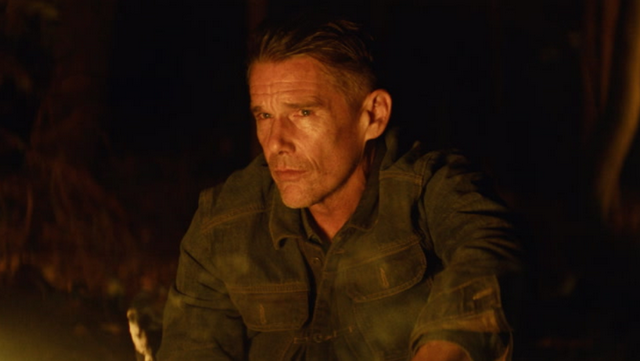
McKinley sees those themes of power, corruption and greed—and the divide between those who wield power and those who find themselves “on the short end of the stick”—as anything but relics of 1933.
“There’s these themes that are all too still too relevant today.”
But if Cocco’s cinematography gives THE WEIGHT its physical immediacy and Hawke gives it its emotional center, another remarkable element gives the film its pulse.
The score.
McKinley knew from the outset that he wanted music used sparingly. Rather than wallpapering scenes with score or instructing audiences how to feel, he wanted music to arrive with purpose.
“There’s going to be 20 minutes of score, you know, 18 or 21 or something like that, maximum in it. And every time it comes on, I want it to have full impact.”
Nor did he want the score merely repeating an emotion already supplied by performance or image.
“I don’t want it to be playing a first emotion or a second emotion or tertiary emotion, to a certain extent. I wanted it to be playing something else. Maybe it’s the wilderness or something like that.”
Gaines proved an inspired choice.
McKinley had already been listening to experimental art performances by Shelby and Latham Gaines in which the brothers invented instruments from such unlikely objects as doors and coffee tables. That same organic experimentation found its way into THE WEIGHT. “Our synthesizer is actually a child’s bow and arrow that he’s blowing through and synthesizing through a machine.”
Rather than supplying McKinley with a rigidly constructed conventional score, Gaines gave him large musical suites that allowed the director to return to his editorial roots, selecting, combining and manipulating pieces against the imagery.
“He gave me giant suites, and I was able to go back to my original roots and just music edit in the truest form. This piece, and I’ll mesh it with that piece, and create this score.”
Because music is used so selectively, sound design becomes even more essential to the film’s emotional and dramatic construction.
Working closely with co-editor and sound designer Matthew Woolley and the sound team, McKinley could build tension and dynamics through everything from the clanking of backpacks to the changing relationship between thunder and lightning.
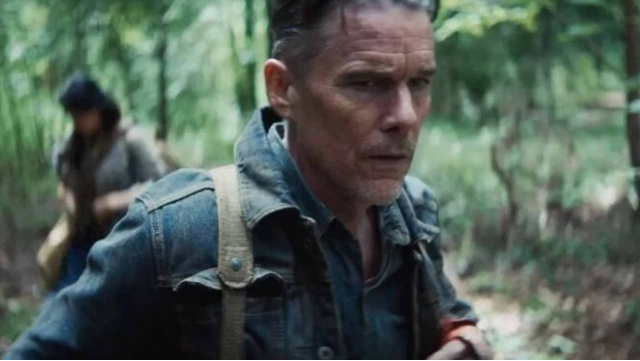
During Olson’s murder, the approaching storm itself becomes part of the storytelling.
“The thunder is out of sync with the lightning. The storm’s off in the distance, and as the intensity rises and we get into the meat of the murder, the lightning and the thunder crashing are all together, and then the storm drifts away as we dissipate out of the scene.”
It is meticulous work designed not necessarily to be noticed, but felt.
The same is true of the film’s opening. “The first shot starts in mono and expands to Atmos as the car gets closer and closer.”
And then there is re-recording mixer Martyn Zub of Formosa Group.
Anyone familiar with Zub’s work knows the level of sonic artistry his name in the credits promises, and THE WEIGHT does not disappoint. For McKinley, however, Zub brought something even more important to the mixing stage than technical expertise: trust.
“Marty is like one of our really good friends as well, and I think he’s the best mixer and one of the best sound designers in the world.”
Their relationship has long since moved beyond simply working together. “He’s like literally—I hang out with him, you know, twice a week. He lives right down the street, and we’re just friends first and foremost from business, but we’ve well surpassed that, and we’re just friends.”
McKinley was adamant about bringing Zub into the finishing process, with the final mix taking place in Berlin. There, the individual layers of THE WEIGHT—the environmental sound, the carefully designed dynamics, the sparse and experimental score, dialogue and the almost tactile sounds of men moving through the wilderness—could finally become one cohesive sonic landscape.
For a film so dependent upon the sensation of isolation and immersion, that work is critical. The Bavarian Forest does not merely need to be seen; it needs to surround us. Every footstep, backpack clank, distant storm and shifting atmospheric element helps place the audience alongside Murphy and the others. And when the sound field itself can move from mono into Atmos, space becomes another storytelling tool.
For McKinley, post-production became the place where all of those individual ingredients could finally be cooked into the finished meal.
With Woolley alongside him in editorial, Shelby and Latham Gaines supplying their unconventional musical palette, Cocco shaping the grade and texture of the image, and Zub helping bring the sonic elements together on the Berlin mixing stage, McKinley found himself surrounded by the people he trusted to take THE WEIGHT across the finish line.
“All of a sudden, all of that end stuff, cooking the meal, you know, the final ingredients and presentation of it, became this little crew of assassins.”
After the inevitable compromises and difficulties of production, that team gave McKinley confidence. “No matter what we failed at during the shooting process, I’m going to be able to overcome.”
Not disguise. Not merely repair. Overcome.
And in doing so, McKinley and his collaborators found a way to give THE WEIGHT the technical polish its story deserved without polishing away its humanity.
“At the end of the day, we’re going to be able to put an immense level of professionalism on it,” McKinley says. “Those guys were able to come out and really put their souls into it, and they did.”
Therein lies the beautiful symmetry of THE WEIGHT.
Samuel Murphy carries the weight of a father’s love. He carries the need to regain his freedom, the responsibility of getting back to his daughter, and the moral burden of deciding how far he is willing to go without surrendering the man he is. McKinley and his filmmaking team carried a different kind of weight: shrinking schedules, tightening finances, difficult locations, unforgiving terrain, physical exhaustion and the thousand compromises inherent in independent filmmaking. Neither journey is accomplished alone.
Perhaps that is why McKinley so naturally describes his actors as a band and his crew as teammates. THE WEIGHT may be driven by one man’s determination to get home to his daughter, but both the story and the story of its making ultimately become testaments to what people can endure when conviction is matched by trust.
Sometimes that means putting your head down and continuing through the wilderness.
Sometimes it means abandoning the train station and finding a better scene inside a cramped old car.
And sometimes it means being six-foot-nine, strapping a camera to your shoulder and walking straight into a Bavarian river because that’s where the shot belongs.
by debbie elias, exclusive interview 09/02/2026
THE WEIGHT is exclusively in theatres on Seotember 18, 2026.