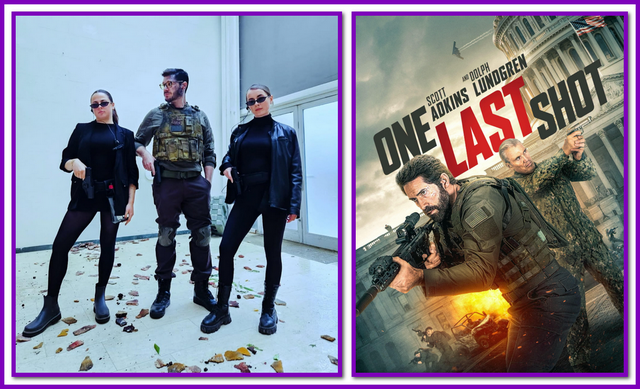
Jake Harris looks like hell.
Beaten, battered, bruised and bandaged, the Navy SEAL we first met in ONE SHOT barely looks capable of climbing out of the vehicle delivering him into ONE LAST SHOT, let alone saving the world yet again. His face carries the damage of everything that has come before, his body looks ready to surrender, and even the seemingly indestructible Scott Adkins appears as though one good shove might finally put him down.
Except Jake Harris doesn’t go down.
There is a reason for the physical wreckage. Director JAMES NUNN and screenwriter Jamie Russell have constructed their ONE SHOT TRILOGY not as three isolated adventures but as one virtually continuous story. ONE MORE SHOT begins roughly twelve hours after the events of ONE SHOT, while ONE LAST SHOT picks up only hours after the second film. Jake hasn’t gone home. He hasn’t slept off his injuries. He hasn’t healed. He’s simply kept going.
“It’s all intentional,” explains Nunn. “The mantra in these movies has always been that we play it for real time, and after 90 minutes Scott can barely breathe because he’s been through so much. And just the culmination of him doing it twice and entering the third movie was that exact sense of, like, he needs to be absolutely knackered to complete his arc.”
And completing Jake Harris’s arc is precisely what ONE LAST SHOT does.
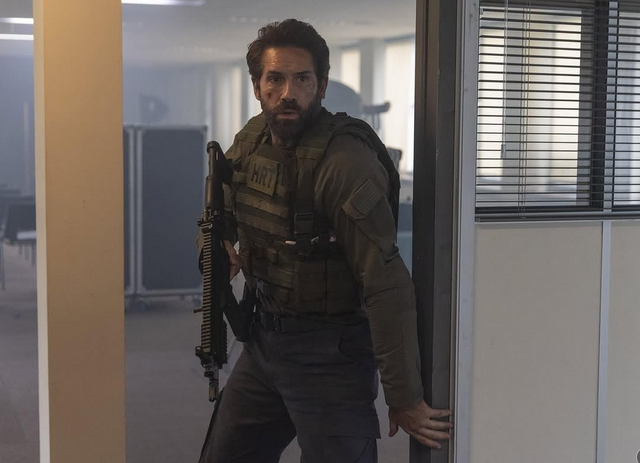
This time, however, Nunn isn’t interested only in discovering how much more punishment Jake—or Adkins—can physically endure. After six films together, director and star are digging beneath the action hero’s battered exterior and exposing something we have rarely seen from Jake Harris before: vulnerability.
“I think the thing is, me and Scott have made six movies now,” says Nunn. “He’s very happy to be kind of vulnerable around me and on camera for me. And I think, you know, we wanted that in our growth of filmmaking together. We wanted to push him to a new place that we hadn’t done before.”
That new place is as emotional as it is physical, thanks in large part to Elliot Carter, played by Stephen Cree. Carter and Jake were once brothers-in-arms. Now Carter has gone rogue, Ella Torres is in danger, nuclear weapons are in play, and Jake is faced with the possibility that stopping the threat may require killing a man who once stood beside him.
For Nunn, that brotherhood is critical to understanding the conflict.
“There are some really lovely emotional beats in this action. It’s obviously an action movie first and foremost, but there is some real drama and real brotherly connection in the way that there is in the military.”
He points to one of Carter’s lines as distilling the dilemma: “Who are you loyal to—the men sending you to die, or the man standing next to you?”
“They’re brothers, basically,” says Nunn. “Or they were.”
Complicating matters is that Carter isn’t written as a conveniently irredeemable villain. His grievances have enough validity that even Nunn can find himself momentarily persuaded by them.
“He’s a very complex moral role for an actor,” Nunn says. “He got to be a bad guy, but also a good guy, because morally his argument isn’t necessarily incorrect from a certain standpoint.”
Then comes the problem.
“He tries to convince Scott to come to the dark side. Even when I watch him, I think, ‘Oh no, he’s talking a lot of sense. Like, yes, this all makes sense. But hang on a minute, he is also doing some pretty bad things.’ So he’s taken it to a very extreme level.”
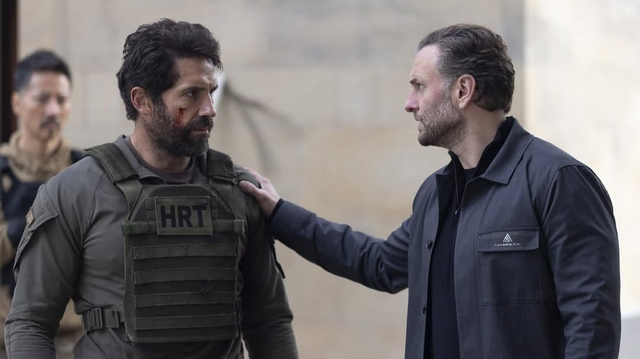
Nunn offers a useful cinematic touchstone: Ed Harris’s General Hummel in The Rock, another antagonist whose methods become indefensible even as the grievance underlying them retains a degree of moral weight.
Cree was also a reunion for Nunn. The two had worked together on Nunn’s first feature, Tower Block, in 2012, and had been looking for an opportunity to collaborate again. Carter provided it, although casting opposite Adkins presented an unusual requirement. Nunn needed more than a strong dramatic actor. Whoever played Carter eventually had to be physically credible fighting one of contemporary action cinema’s most accomplished performers.
Cree is not a martial artist.
Nunn knew that. He also knew Cree.
“I knew he would get involved and not be afraid of the challenge,” he says. “Not only does he bring an incredible drama performance, but he also, through his admiration for the franchise and his admiration for Scott, absolutely committed to making those action sequences feel very violent and very real and visceral.”
More importantly, Cree brings Carter’s relationship with Jake into the fights themselves.
“It’s not just exquisite dancing, you know, fighting and stuff. It’s also very raw and guttural and brotherly.”
That distinction matters. By the time Jake and Carter finally come together physically, they aren’t two anonymous action figures exchanging blows. Every punch carries the history between them.
But Carter isn’t the only person forcing Jake to reconsider where his loyalties lie. Dolph Lundgren’s Admiral Mulholland initially appears to represent the authority Jake should be able to trust, only to issue orders that introduce another layer of moral uncertainty. Jake is therefore squeezed between two men who each believe circumstances justify what they are asking of him.
Then there is Ella Torres, played by Hannah Ware. Once Jake’s newly assembled SEAL team is decimated, finding and protecting Torres becomes the film’s driving imperative. Carter needs her biometrics to access the nuclear codes, and Jake needs to reach her first.
Ware impressed Nunn immediately.
“She’s fantastic,” he says. “Totally understood the assignment.”
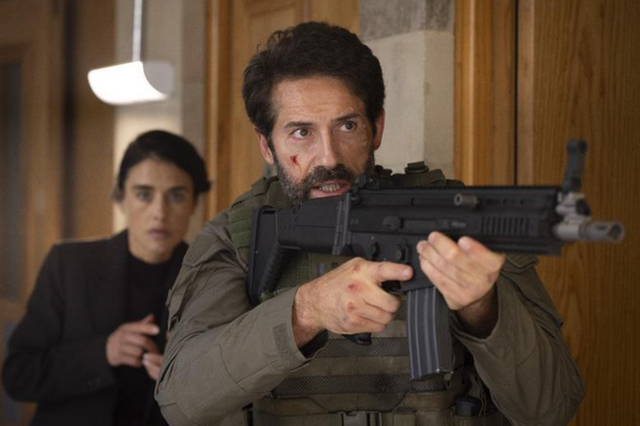
Just as importantly, Nunn never feels compelled to manufacture a romance between Torres and Jake. Jake’s wife, played throughout the trilogy by Jill Winternitz, remains an emotional presence in the film, including a harrowing phone call that deliberately echoes one of the most wrenching sequences in ONE SHOT. Nunn wanted the third film to recapture the emotional intensity of that earlier moment, this time by threatening not merely Jake’s mission but the family waiting for him at the end of it.
Torres also allows ONE LAST SHOT to change its action vocabulary. The film becomes an increasingly tense cat-and-mouse game through tunnels, hallways, stairwells and rooms as Torres hides and Jake hunts for her while Carter’s mercenaries close in. Once the action spills outdoors, walls and corners can no longer provide cover. Exposure becomes its own danger.
And all of it has to function within the visual language Nunn established with the first ONE SHOT.
For ONE LAST SHOT, Nunn brought in cinematographer Joseph Fitzgerald, whom he had met when Fitzgerald handled second-unit cinematography on Wildcat. Fitzgerald’s background as a camera operator proved particularly valuable for a franchise in which camera movement isn’t merely decorative; it is fundamental to the storytelling.
“He comes at it from a camera-operator perspective,” Nunn explains. “So we were able to talk language and on a very technical level about the equipment we were using.”
And this time they changed that equipment.
The first two films were photographed with the Sony Venice. For ONE LAST SHOT, Nunn and Fitzgerald moved to the Ronin 4D.
“We took a chance on a different camera just to push the technology,” says Nunn. “On this one there’s more traveling than in the other movies. The other movies we kind of just circle on the same location, whereas on this one we’re actually covering ground.”
And cover ground they do.
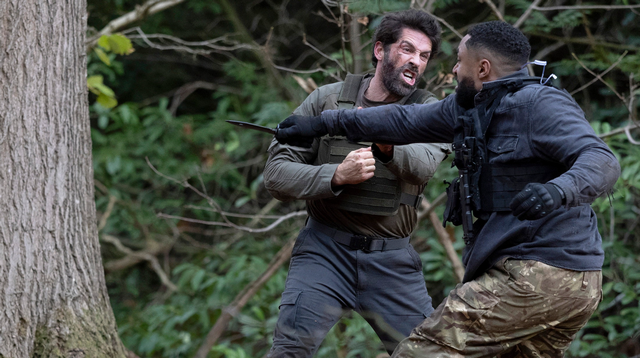
“We have to get through the woods, get through this entire house. Then we have running, and then we get on vehicles, and then we do some more running, and then we’re jumping onto boats, and then we’re in the water, and then we’re fighting in boathouses.”
The Ronin 4D gave them the mobility to keep the visual conceit alive through all of it, including the ability to move the camera with vehicles in ways the Venice would not have allowed them to accomplish as easily.
Fitzgerald also keeps the camera frequently over or just behind Jake’s shoulder, giving us Jake’s view of what lies ahead while denying us certainty about what might be behind him. When Jake brings up the rear of the team, the frame widens enough to take in the men ahead and the environment around them. It’s a deceptively simple visual strategy that places the audience within Jake’s limited field of knowledge and lets uncertainty fuel the tension.
That pays off spectacularly when Jake finally gets behind the wheel of a Jeep, pursued through the woods under gunfire with the camera riding alongside him and hostile vehicles moving into view.
Naturally, Adkins did his own driving.
“Scott did all his own stuff as usual,” laughs Nunn. “Scott was having fun, as you can imagine, driving around the woods with a camera hanging on the front of the vehicle. I think he felt pretty heroic.”
After two films and change spent running, fighting and carrying weapons, it was also something of a vacation.
“He actually said that was his easiest day,” Nunn says, “and I think it’s because he was sat down.”
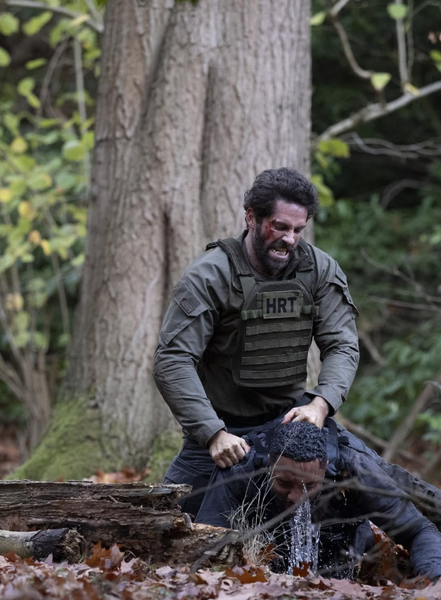
The film’s principal location gave Nunn and Fitzgerald another gift. Shooting outside London, they found an actual residence that almost appeared purpose-built for the movie: a centuries-old Georgian house connected to a starkly modern structure that Nunn describes as resembling a “CIA block.”
It was so perfect that Nunn worried audiences might assume it was a set.
“Hand on heart, it’s an actual real location.”
Rather than force an existing screenplay into the building, Nunn and Russell adapted the screenplay to what they had found.
“We obviously rewrite once we’ve got the location. We rewrite the script around the location, so that’s also why it feels purposeful. We design it as such, exactly the same as the airport.”
That purposeful geography becomes particularly important during one of the film’s standout sequences. A member of Jake’s SEAL team is trapped on a pressure-sensitive explosive while mercenaries occupy the upper level of the building, firing down on the team below. Jake is crouched alongside a staircase attempting to defuse the device. He can’t simply run. He can’t abandon the man. And the enemy literally holds the high ground.
Cinematography establishes the multiple levels of danger; editor Richard Blackburn makes them collide.
Blackburn, who previously worked with Nunn on Hungry, maintains a rapier pace throughout One Last Shot, but speed never comes at the expense of geography. The pressure-bomb sequence is a master class in escalating simultaneous threats: Jake and the explosive, the immobilized SEAL, the team pinned down below and Carter’s mercenaries firing from above. Yet we always know where everyone is and understand what is at stake.
Nunn also makes certain that the SEALs accompanying Jake register as individuals before the body count starts climbing.
“It’s important to me that the majority of the characters in the movie are well-rounded, and you remember them,” Nunn says. “If they die or pass away, they had personalities.”
The decision also returns the trilogy to something Nunn loved about the original ONE SHOT: being embedded with a team.
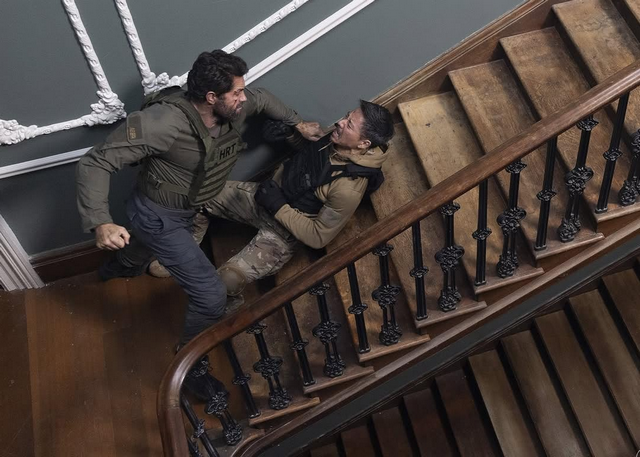
“We had less of a team in movie number two. So with number three, I wanted to get back to having a team and being part of that team. The camera suits the sense of being part of that team, bobbing, walking alongside them. That was intentional—to try and make you care about the Navy SEALs.”
Jake’s position within that group is equally important. Mulholland has assembled the team; Jake has been dropped into it. They don’t know him. He doesn’t know them. Trust isn’t automatic.
And because the camera so frequently rides with Jake, neither is ours. As Jake learns who these men are, so do we.
There is also a different kind of continuity behind the scenes. Austin Wintory returns to score the third film, having composed the previous two films as well as Nunn’s Hungry. Yet the score in ONE LAST SHOT often works almost invisibly beneath the action and emotion rather than announcing itself.
When told that the film’s tension was so consuming that his music almost disappeared into the experience, Nunn laughs.
“Well, hopefully that’s a compliment. Hopefully it just was a perfect synergy, and what Austin had done was accentuating your feelings as opposed to standing out above and screaming on top of the movie—being more of a complement to the movie.”
For Nunn, Wintory remains “the perfect guy for these movies.”
The same sense of culmination applies to the trilogy as a whole. Nunn views the films almost as three acts of a single story.
“If you look at it in the traditional script sense, it’s sort of Act One, Act Two, Act Three,” he says. “That’s the way to look at them as one.”
Put together, he estimates, they make “a fun kind of four-and-a-half-hour ride.”
And then, after three movies of Jake Harris running, fighting, shooting, bleeding and repeatedly saving people who have a disturbing habit of placing themselves in need of saving, Nunn finally lets him stop.
The physical battle with Carter reaches its end. Mulholland’s true colors have been exposed. Torres is safe. The immediate threat is over.
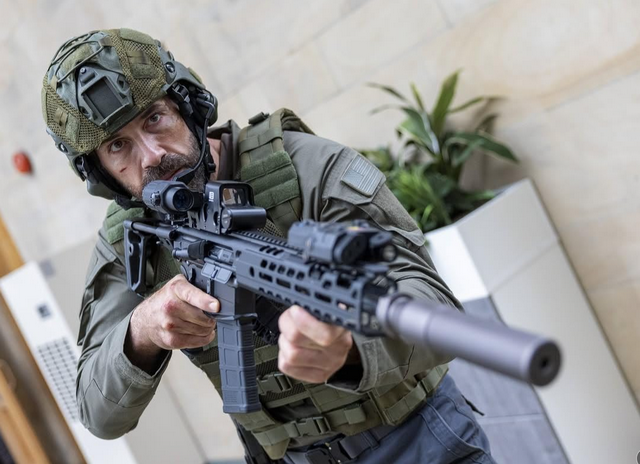
Jake sits beside the water.
For once there is nowhere he has to run, nobody he has to chase and no gun he needs to raise.
He calls his wife.
He tells her he’s coming home.
It’s an unexpectedly quiet final image for an action trilogy built around relentless movement, but perhaps the only appropriate one. Nunn and Adkins began ONE LAST SHOT with a man so battered that merely getting out of his seat looked like it might be Jake Harris’s greatest challenge.
They end it with Jake finally giving himself permission to stay in one.
And as Nunn closes the book on Jake Harris, at least for now, he has a rather important homecoming of his own awaiting him.
“My next project is my second son, who’s due in three weeks,” he says.
Filmmaking, however, isn’t going away. Nunn has already written two films he hopes to make next year. And then there is that other possibility lurking out there—one involving a certain very large, very hungry hippopotamus.
Asked whether audiences might someday get a sequel to Hungry, Nunn admits the idea is there, although no call has yet come giving him permission to make it.
“I’ve got an idea for Hungry Two, or Hungrier, or Hungry Hungry, as whatever people would like to call it,” he says. Hungrier?
“I like Hungrier.”
For now, though, both director and hero have earned a little time at home.
After three films, Jake Harris has saved the world enough.
James Nunn has a son to welcome.
And eventually, perhaps, he’ll get Hungrier.
by debbie elias, exclusive interview 09/17/2026
ONE LAST SHOT is available on DVD and Digital on September 22, 2026.