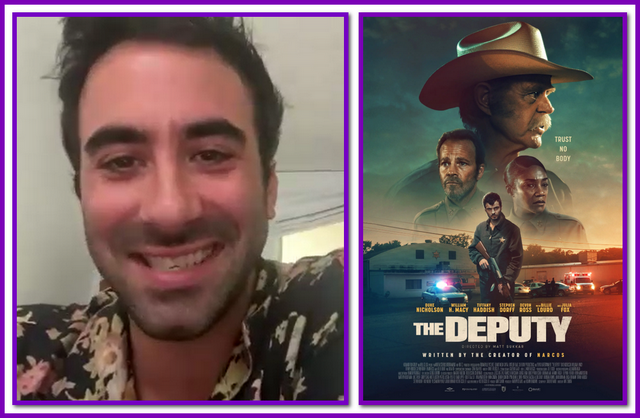
When director Matt Sukkar first saw the title THE DEPUTY, he thought he knew what kind of movie his manager had sent him. He wasn’t particularly interested.
It was November 2022. Sukkar was trying unsuccessfully to get another film made when his manager began repeatedly asking, “Have you read THE DEPUTY yet?” Written by Carlo Bernard and based on the novel by Victor Gischler, the title suggested something far more conventional than what Sukkar was looking for.
“I was like, ‘I don’t know if I’m trying to make, like, a cop movie,’” he recalls. Eventually, he opened the script.
Within pages, the movie he had imagined disappeared.
“I realized that it was completely different from my expectation, and that it was really about this incredible character that was super unpredictable. And what I really saw from the beginning was that I had an opportunity here to make a movie that reminded me of a lot of 1970s crime movies where genre movies were allowed to be character movies.”
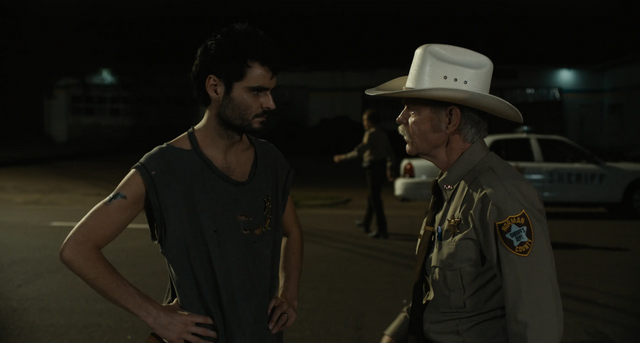
For a first-time feature director, that opportunity would prove irresistible. And at the center of it was Toby Sawyer, the slovenly, apathetic, cigarette-smoking part-time deputy whose hellacious night becomes as much an investigation into himself as into what’s happening around him.
Sukkar already knew who Toby should be. Duke Nicholson.
The two had been friends for years and had wanted to find something they could make together. Nicholson may carry one of cinema’s most recognizable surnames as the grandson of Jack Nicholson, but Sukkar wasn’t looking for a piece of Hollywood lineage. He was looking for Toby.
“I’ve never really pictured anyone but him for Toby,” says Sukkar.
Getting others to share that vision wasn’t quite as easy. Sukkar was preparing to direct his first feature. Nicholson was still essentially an unknown actor. The combination made financing and casting “an uphill battle.” But Sukkar held firm.
And watching THE DEPUTY, it’s difficult to imagine anyone else as Toby. Nicholson doesn’t merely play the character’s transformation; he wears it.
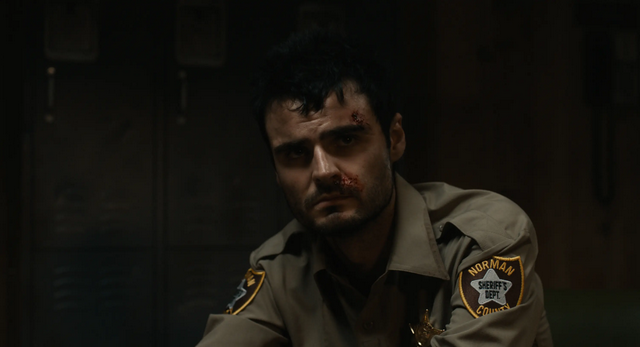
Initially disheveled and seemingly indifferent to the responsibilities of his position, Toby gradually begins to change as circumstances force him to step up and start doing the job. The uniform goes on. The shirt gets tucked in. His physical bearing changes. He begins following clues and making decisions. Responsibility starts replacing apathy.
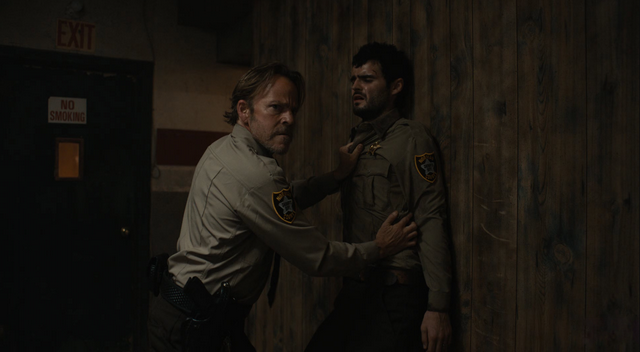
Eventually that uniform becomes bloodied and fellow deputy Amanda Jackson tells him to change his damn shirt. Toby puts on a jacket instead. Then he proudly places his badge on the outside.
The man is finally beginning to look like the deputy he has spent the night becoming.
But Nicholson isn’t carrying the night alone.
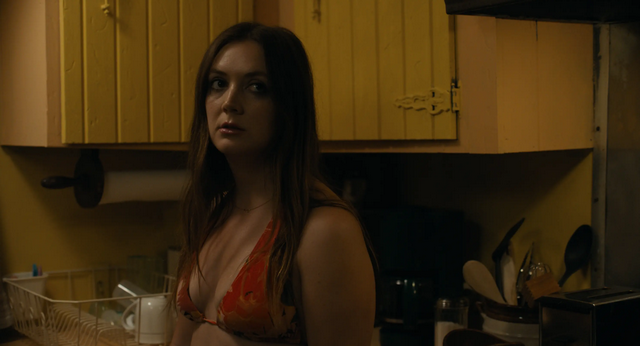
Sukkar surrounds him with an eclectic ensemble including William H. Macy, Stephen Dorff, Tiffany Haddish, Billie Lourd, Julia Fox and Colleen Camp. Rather than casting everyone within an expected tonal range, Sukkar deliberately sought personalities who might seem slightly surprising together.
“I really wanted people who are unexpected and who would also make the town feel populated by real characters. And I think that Macy, Haddish, Dorff, Billie, Julia all have incredibly distinct energies, and I love the idea of putting those personalities together in the same tonal box that fit this kind of weird town.”
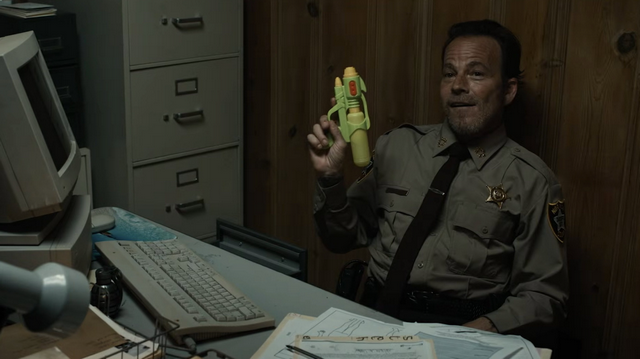
For Sukkar, working with Macy was particularly meaningful. “A huge hero of mine,” Macy brought what Sukkar calls an “incredible specificity and history” to Sheriff Krueger—along with one of the film’s funniest visual gags when the sheriff attempts to go incognito in a tropical Hawaiian shirt.
In a tiny Texas border town.
As Sukkar dryly explains, “That was the character’s attempt at being incognito.”
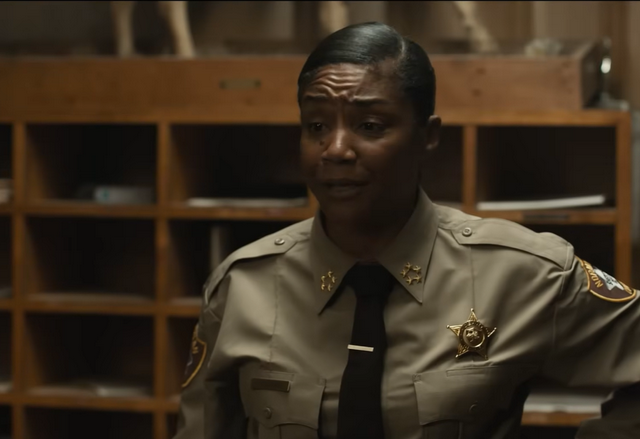
And then, approximately an hour into the film, Tiffany Haddish arrives.
As Amanda Jackson, Haddish is all business, a law enforcement professional who walks into a situation involving Toby, guns, blood and dead bodies and quite reasonably decides to lock him up until she figures out exactly what the hell has happened.
But Haddish also changes the energy of the film the moment she appears. That was precisely the idea.
“Energetically we needed someone that was full of life and light to come in and kind of steer the course of the film from that point on, which was why I thought of Tiffany. She’s just so buoyant and has so much positive, fun energy.”
Sukkar wasn’t interested in stripping Haddish of her personality simply because Amanda carries a badge.
“I think there’s no reason why a sheriff’s deputy couldn’t also have that energy, but still take their job seriously and still care about doing it right. Just because you’re in a serious profession doesn’t mean you can’t have a personality. I think that’s what makes the character feel real.”
Interestingly, THE DEPUTY was shot before Haddish took on another dramatic law-enforcement role as an FBI supervisor in Brando Benetton’s The Girl in the River. Sukkar had already recognized the possibilities of putting that familiar Haddish energy into an unexpected dramatic context.
And it wasn’t merely her performance that changed the atmosphere.
“All I can think of when I think about her is light,” Sukkar says. “The moment she came on set, it was like a completely different vibe.”
On a film built around grueling night shoots, that mattered.
“She was cracking jokes and just so much fun to be around. These are night shoots. This is grueling. This is exhausting. So having good, fun people around really helps everybody have a smile on their face while they’re doing hard work.”
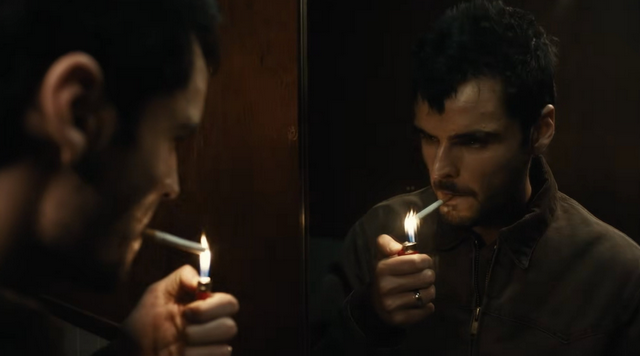
That mixture of seriousness and humor also extends to Toby. The man cannot stop smoking.
Krueger tells him to put it out. Billy Banks tells him not to smoke. And after Amanda has finally listened to Toby’s seemingly impossible account of what has happened and decided she believes him, Toby lights up again. Her reaction is immediate. He’s not smoking in there.
It’s a seemingly insignificant recurring character detail, but one Sukkar uses both to humanize Toby and to release some of the pressure that has been accumulating throughout his increasingly disastrous night.
“I always wanted there to be funny moments, but I never wanted it to take away from the realities that this is a very difficult experience for his character. The eccentricities of the town and the characters can provide amusing distractions, but the overall is high stakes and high energy and intensity.”
Editor Javier Velasco proves invaluable in finding precisely where those releases belong, letting a laugh give Toby—and us—a moment to breathe without deflating the tension.
But one of the most striking things about THE DEPUTY isn’t what Sukkar puts into the film. It’s what he takes away.
Human sound.
Working with cinematographer Alejandro Lalinde and supervising sound editor Lawrence Everson, Sukkar creates a world enveloped by darkness and isolation. Much of the story unfolds over the course of one night, with Lalinde’s cinematography bathing that night in gorgeous inky blue-blacks while practical sources puncture the darkness. Sonically, Sukkar wanted something that initially sounds contradictory. He wanted isolation to be loud.
And apparently that required finding exactly the right cricket.
“The most important thing that I wanted were the bugs. It’s a hot summer night, and so in the South, it’s disgusting, muggy, and it’s full of crickets.”
Sukkar estimates he listened to about 30 different cricket sounds before finding the one.
“I wanted it to feel super isolated but loud—like, no sounds of humans. Any time there was a car noise, we had to go cut it out.”
That absence is essential to both mood and story. This place has to feel sufficiently remote that outside help isn’t simply five minutes away. Cell phones are useless. Landlines have been disabled. The ordinary sounds of civilization have largely vanished.
What’s left is Toby. The darkness. And nature refusing to shut up.
Composer Daniel Vildasola’s score grows organically from that stripped-down sonic world.
Sukkar knew early that he wanted a recurring theme but didn’t want an elaborate instrumental palette overwhelming the simplicity of the film’s soundscape. Instead, he and Vildasola built primarily around three guitars, allowing the same thematic material to take on different textures as Toby’s night unfolds.
“I knew really early that I wanted there to be a theme, like a recurring theme track that comes up. And we have the one that plays in different types of guitar. There are three guitars used. There’s one more traditional acoustic. There’s one that’s a rubber-string acoustic, and then there’s an electric that plays, like, in the car crash scene.
“Those just felt like the right instruments. We also tested out a lot of guitars, and those were the ones that I just kind of felt like instinctually were correct for the world building.”
As the stakes rise, however, Sukkar and Vildasola allow the musical vocabulary to expand ever so slightly.
“There are moments where we bring string instruments in. There’s cello played by Sam Hall, and that comes in when the stakes are raised. And then there’s some violin that was actually played by my mom, who’s a violinist, that comes in in a couple points in the film as well. But those were the only instruments. I just wanted strings, guitar, and those three instruments were the only ones we used.”
Even the percussion isn’t necessarily what it seems.
Listen closely and what sounds like drumming is actually someone banging on the guitar itself. When I tell Sukkar that’s exactly what I thought I was hearing, he laughs.
“Exactly. You’re dead on. It was just banging the guitar. Just to kind of create some weird, unusual noises that I think helped align with the simplicity of the soundscape, but also bring some unexpected elements.”
Unexpected elements seem to suit Sukkar.
An unconventional lead.
A comic actress bringing dramatic authority to a deputy while retaining the personality audiences know.
A sheriff hiding in a Hawaiian shirt.
Thirty crickets competing for one job.
A guitar functioning as both melody and percussion.
And beneath all of it, a genre movie that Sukkar never wanted to treat as merely a genre exercise.
That’s what attracted him to those 1970s crime films in the first place: genre movies were allowed to be character movies.
THE DEPUTY gives him the opportunity to put that philosophy into practice.
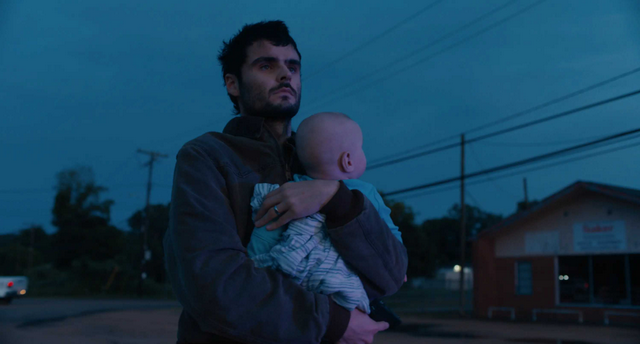
For most of the night, Toby has no choice but to confront what’s happening largely on his own. We discover things as he does. Each new clue forces another decision. Each decision demands slightly more of a man who, when we first meet him, seems determined to give as little as possible. And slowly, almost imperceptibly, the screw-up starts disappearing.
By the time the darkness begins giving way to the pale blues and pinks just before sunrise, Toby Sawyer has spent the night earning something more important than answers. He’s earned the badge he’s wearing.
For Sukkar, making THE DEPUTY produced a more pragmatic lesson.
Asked what he learned about himself while directing his first feature that he can carry into the next one, he doesn’t hesitate: “Always be ready to change things at the last minute, and always have an answer for every question.”
Two shorts, three music videos and now one feature into his directing career, Matt Sukkar undoubtedly has more questions ahead of him.
But with THE DEPUTY, he’s made one hell of a first-feature calling card.
by debbie elias, exclusive interview 09/18/209026
THE DEPUTY is in Theatres, On Digital and On Demand on September 25, 2026