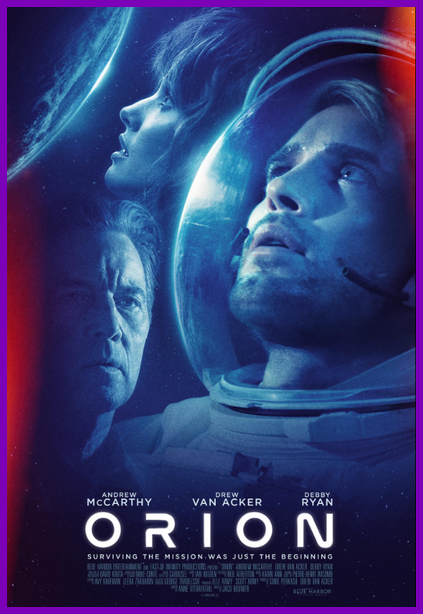
There are films that give an audience information and then ask us to determine what it means. And then there is ORION, a riveting, intelligent, meticulously crafted psychological sci-fi thriller from director Jaco Bouwer that does something much more interesting: it gives us extraordinary amounts of detail while deliberately withholding the information necessary to understand that detail.
More detail. Less information. That is the visual, aural and thematic language of ORION.
Written by Anne Vithayathil, ORION stars Drew Van Acker as Apollo, the sole surviving astronaut of a disastrous space mission who has returned to Earth with no memory of what happened to his crew or how he survived. Sequestered in a stark interrogation facility, Apollo is questioned by Jim Lee (Andrew McCarthy), a seemingly genial interrogator charged with helping him reconstruct the missing pieces of his memory. Debby Ryan enters the equation as Mary, someone with an emotional connection to Apollo and another piece of an increasingly perplexing puzzle.
And that is about all anyone should know going in.
ORION is a film of discovery, but Bouwer isn’t interested merely in springing twists or hiding answers until the screenplay decides it is time for the audience to know them. He is interested in how we acquire information—through language, memory, sight, sound, gesture, perception and assumption—and how easily each of those can betray us.
The result is a film about communication that communicates most powerfully without words.
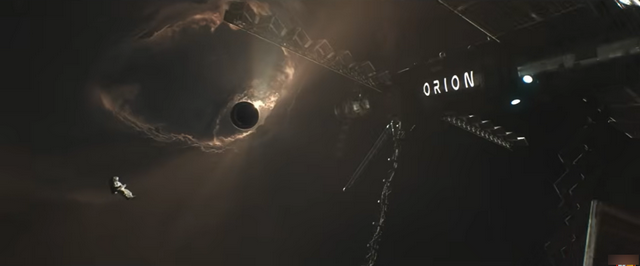
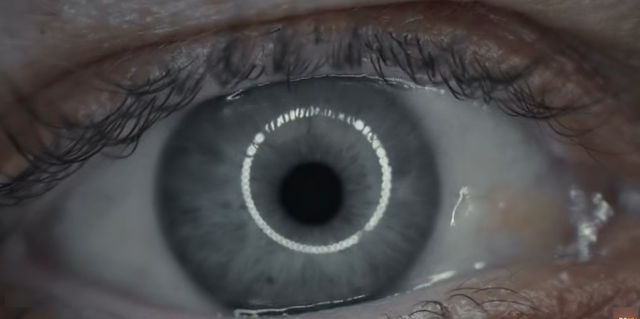
Bouwer wastes no time establishing that idea. Working with cinematographer David Kruta and editor Ian Holden, he immediately throws us into extreme close-ups and macro imagery, notably that of an eye. It is a brilliant visual contradiction. The closer Kruta’s camera moves, the more detail we can see—and the less context we have for understanding what we’re seeing.
As Apollo awakens, rises from a slab and attempts to orient himself, Bouwer refuses to orient us. There is blackness. There are fragments. There are surfaces. There are isolated details. Camera movement is slow and deliberate while the voice coming through an intercom is equally measured. We are looking, but not yet seeing. Listening, but not yet understanding.
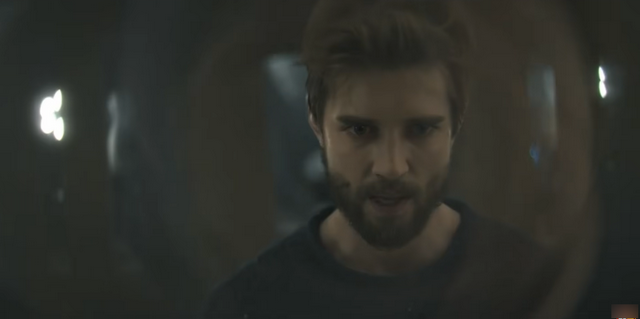
That visual strategy continues throughout the film as Kruta and Bouwer make bold use of macros and ECUs, frequently pushing so tightly into Van Acker’s face that an eye, a blink or the smallest muscular response becomes its own landscape. And rather than use close-ups merely as emotional punctuation, they make them integral to ORION’s narrative grammar. The frame gives us access to Apollo’s minutest reactions while denying us the wider physical or psychological picture.
Even geography becomes unstable.
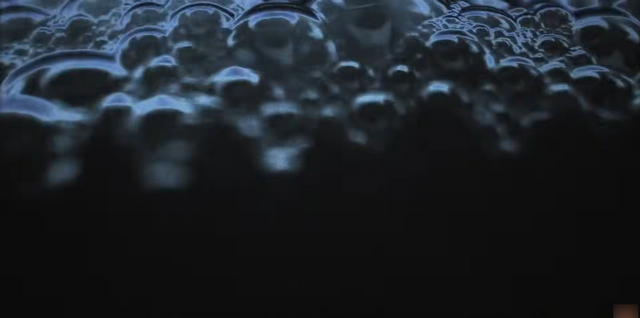
Frames rotate. Images turn upside down. Dutch angles appear where one might conventionally expect them, and then Bouwer and Kruta take the idea further, employing unusual dutching within extreme close-ups themselves. Holden’s editing works in concert with that imagery, fracturing spatial certainty without allowing the film to become visually incoherent. In one particularly effective sequence involving what may be a physical disturbance, we are not handed the expected establishing image telling us precisely what is happening and where. Instead, we experience its effects through objects, movement, sound and isolated visual information.
We know something is happening. We simply don’t possess enough information to name it with certainty. And that distinction is everything.
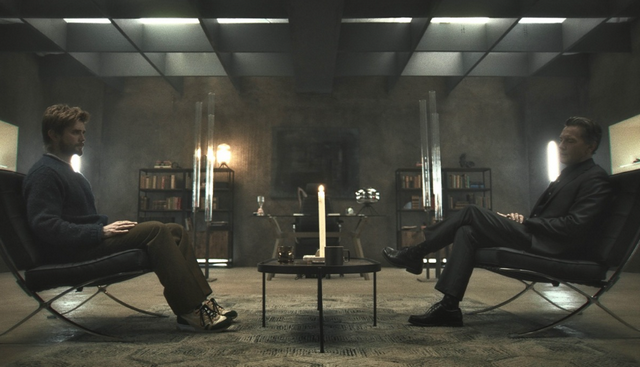
Production designer Mike Conte carries the same philosophy into Apollo’s physical environment. Concrete gray dominates the interrogation space, creating something institutional but strangely indeterminate. The environment is functional without being comforting, specific without becoming familiar. Color deprivation is so pronounced that when color does appear, we notice it. Objects that might otherwise be production-design dressing suddenly acquire visual weight simply because the eye has been starved of chromatic distraction.
Nothing need leap up and announce, CLUE! Bouwer has conditioned us to look.
Nowhere is his use of negative space more unnerving than in his treatment of Ryan’s Mary. At one point, she is positioned beyond glass against what appears to be absolute black—not blue-black, not shadow, not darkness containing barely perceptible texture, but a seemingly bottomless absence of visual information. With Ryan isolated against it, the eye has nowhere else to go.
And then the imagination begins filling in what the camera refuses to provide. Is there something behind her? Could there be? What exists beyond what we can see? The answer almost becomes irrelevant because the negative space has already done its job. Bouwer has transformed nothing into something threatening. The eye sees nothing, so the imagination supplies everything.
That makes ORION’s shifts into Apollo’s fragmented recollections all the more striking. The visual vocabulary opens. Light changes. Color appears. Skin takes on warmer, more recognizably human tonality. The contrast with the concrete desaturation of the present is immediate, but Bouwer is too clever to allow visual warmth to equal certainty. These are memories—or what Apollo believes to be memories—and memory is no more inherently reliable than anything else in this film.
An especially fascinating piece of craft information came from producer Sunil Perkash, who revealed during my conversation with him and Van Acker that Kruta used original lenses associated with SOLARIS for those flashback sequences. It isn’t merely a delicious bit of cinematic trivia. Within ORION’s carefully differentiated visual worlds, the choice adds another textural layer to passages involving space, recollection and uncertain perception. But as accomplished as ORION is visually, close your eyes and the film is still talking to you.
Sound is not an accessory here. Sound is language.
Re-recording mixer Ron Prent and supervising sound editor Thomas James create a sonic world built from timbres, frequency, decibel levels, unfamiliar tonalities, vibration, texture and silence. Composer Pierre-Henri Wicomb wisely doesn’t smother that work beneath an omnipresent score. His restraint gives the film room to breathe—and, more importantly, gives us room to hear. At times, the absence of sound becomes as expressive as its presence.
Silence in ORION is observational. It allows us to watch people thinking. It makes us conscious of movement, breathing and hesitation. It also heightens our sensitivity so that when another sound enters the mix—a mechanical tone, a vibration, an unfamiliar frequency—we instinctively lean toward it. Bouwer is effectively retraining our ears.
Early in the film, certain sounds register primarily as sensations. We don’t necessarily understand their significance; we experience them. As Apollo attempts to piece together fragments of memory and meaning, however, the audience starts doing something similar. We begin recognizing patterns. We become more attentive to sonic relationships. What initially feels foreign begins to suggest structure.
Sound ceases to be merely something we hear. It becomes something we try to read.
That is why Wicomb’s restraint is so important. A more aggressive score could tell us too much—when to fear, when to relax, when to mourn, when to suspect. ORION is built around uncertainty, and Bouwer has little interest in providing an emotional answer key. Prent and James instead give the audience a sonic environment through which to navigate, one that becomes increasingly layered and visceral as the film progresses. Perkash confirmed just how central that sonic construction was to the production, while Van Acker spoke of sound itself as something he experiences viscerally, through tone and vibration.
And then there is Van Acker.
Because Kruta’s camera spends so much time extraordinarily close to Apollo, Van Acker has nowhere to hide—and wisely makes no attempt to perform outwardly for it. This is an intensely internal performance.
We watch thoughts rather than declarations. Confusion, suspicion, fear and recognition move through his eyes before they necessarily reach his voice. Stillness becomes active. Breathing matters. Hesitation matters. A flicker matters. The tiniest physical adjustment can become dialogue because Bouwer and Kruta have created a visual environment in which every blink can speak. That makes Van Acker the ideal center for the film. Apollo is trying to determine what he knows, what he remembers, what he believes and what he can trust, while Van Acker resists giving us easy emotional signposts. He allows uncertainty to remain uncertainty.
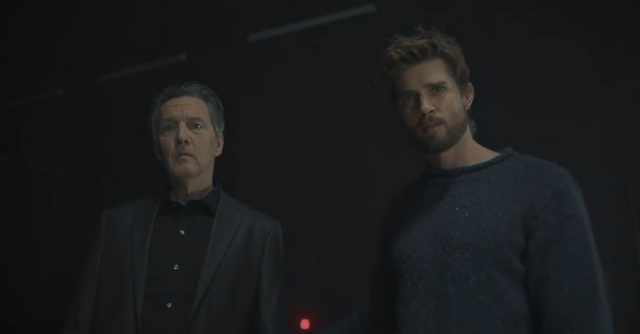
Playing opposite him, Andrew McCarthy does something deliciously different as Jim Lee. McCarthy weaponizes genial familiarity.
There is something instantly approachable about his presence, something conversational and seemingly reassuring, and Bouwer understands exactly what audience familiarity with McCarthy brings into the room. But watch him. A pursing of the lips. A hand moving toward the chin. A pause. A look held perhaps a fraction longer than expected. His physical behavior begins undermining the reassurance of his manner. The effect is wonderfully disconcerting.
Apollo needs information from Jim. We need information from Jim. But ORION has already taught us that information and truth are not necessarily synonymous.
Van Acker himself noted that much of what happens between the two men is communication without words, despite words ostensibly being central to their exchanges. That paradox becomes one of the film’s richest pleasures. Listen to what is being said, certainly—but watch what happens in the spaces surrounding those words.
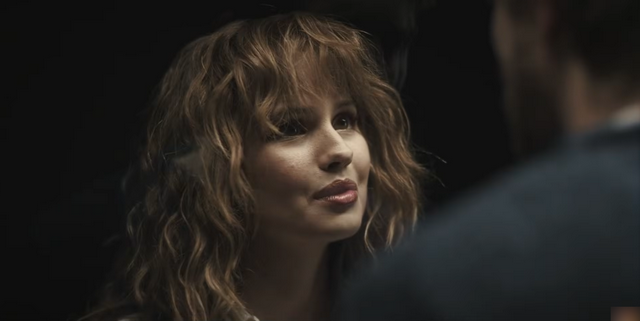
Ryan has less screen time, but Bouwer makes her presence count. Her scenes bring another emotional dimension into Apollo’s claustrophobic world while simultaneously expanding the questions surrounding him. And because her most striking imagery is so controlled—particularly that terrifying use of black negative space—Mary feels both emotionally immediate and visually separated from him. Again, Bouwer is communicating through space. Again, the image says something the dialogue does not have to.
All of these elements could easily have resulted in a film drowning in its own cleverness. They don’t, largely because Bouwer exercises remarkable precision. He knows when to withhold and when to release, when to push inward and when to allow the visual field to expand. Vithayathil’s screenplay provides the intellectual puzzle, but Bouwer refuses to let ORION become merely a screenplay-driven “gotcha” exercise.
The filmmaking itself participates in the puzzle.
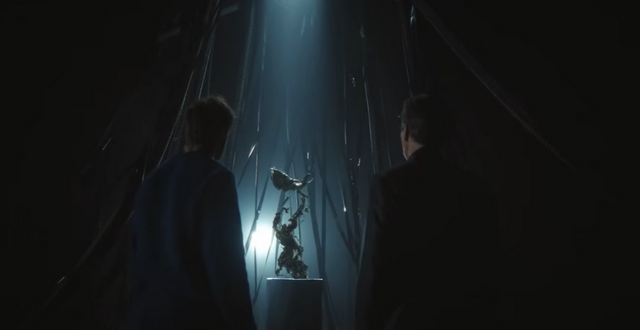
Kruta’s cinematography doesn’t simply photograph uncertainty; it creates it. Holden doesn’t merely assemble scenes; his editing controls our access to orientation and information. Conte doesn’t merely build attractive sets; his production design establishes a world in which texture, color and emptiness carry meaning. Wicomb, Prent and James don’t merely accompany the images; they give the film another vocabulary altogether. And the performances don’t explain any of it for us.
That cohesion is what elevates ORION.
It is also why the film feels designed for a second viewing. Not because the first viewing is incomplete, but because understanding changes observation. Once we possess information we didn’t have before, an expression may read differently. A pause may acquire another dimension. An object may no longer seem incidental. A visual choice that initially registered subconsciously can suddenly become conspicuous. The information was there. We simply didn’t know how to read it yet. That is a far more satisfying proposition than a movie that merely conceals a card and triumphantly flips it over at the end.
ORION asks us to participate.
It asks us to listen with our eyes and see with our ears. It asks us to question whether memory is truth, whether perception is knowledge and whether language is confined to words. Most importantly, it trusts the audience enough not to translate every image, sound, silence or gesture for us.
Apollo is trying to remember enough to understand what happened. Bouwer is asking whether we can observe closely enough to understand what is happening. And somewhere between those two questions, ORION finds its language.
Pay attention. It’s talking to you.
Directed by Jaco Bouwer
Written by Anne Vithayathil
Cast: Drew Van Acker, Andrew McCarthy, and Debby Ryan
by debbie elias, 09/24/2026
ORION is in theatres on October 2, 2026.