There are words. There are silences. There are gestures and glances, sounds and vibrations, colors and shadows, things remembered and things perhaps misremembered. And then there are all those infinitesimal moments in between, where what isn’t said may communicate far more than anything that is.
That is the language of ORION.
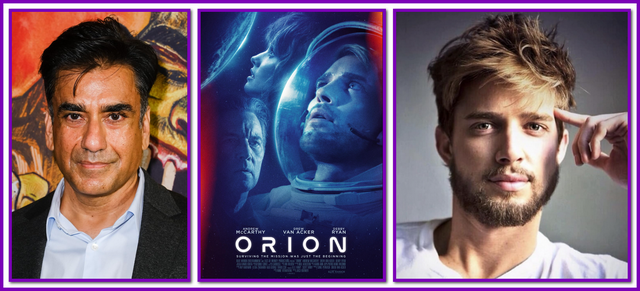
Directed by Jaco Bouwer from a screenplay by Anne Vithayathil, ORION stars Drew Van Acker as Apollo, the sole surviving astronaut of a disastrous mission who returns with no memory of what happened to his crew. Working with an interrogator named Jim Lee, played by Andrew McCarthy, Apollo must attempt to recover those memories and determine what happened during the mission—and what may have returned with him.
To say much more would rob ORION of one of its greatest pleasures. This is a film that wants you to question what you see, what you hear, what you remember and what you think you know. It is a puzzle designed not merely to be solved, but reconsidered.
And it is the first film producers Sunil Perkash and Drew Van Acker have developed together entirely from the ground up.
Perkash and I have spoken before. Van Acker and I had once, almost seven years ago. But when the opportunity arose to speak with the filmmakers about ORION, there was never any question in my mind that these were the two people I wanted—and, unusually for me, I wanted them together.
As Perkash laughingly notes, severing the proverbial hip joining the two men has proved impossible.
“It’s been nine years,” he says of their partnership. “This is the first one we developed from scratch, from the beginning, from zero to realization.”
For Van Acker, that makes ORION “our baby.” And what a baby it is.
A LANGUAGE WITHOUT WORDS
Among the many striking elements of ORION is the paradox at its center. This is a film deeply concerned with language and communication, yet some of its most eloquent communication occurs without a word being spoken.
Van Acker spends much of the film opposite McCarthy, two men in a room talking. In less assured hands, the inherent visual limitations of that construction could prove deadly. Van Acker rejects the notion that conversation itself is cinematically boring.
“I think it’s only boring if there’s boring people or they’re talking about boring subjects,” he says. More importantly, “a lot of what we talk about and what we’re doing in the film is communicating without saying words, even though the words [are] the whole gist of what we’re trying to get across.”
That distinction is crucial.
ORION is a film about communication that communicates most powerfully without words.
There is observational silence. Deliberate movement. Hesitation. A shift of the eyes. The slightest change in posture. Bouwer allows the camera to watch those moments rather than rush past them, making everything unsaid part of the conversation between the film and the audience.
Van Acker’s connection to that idea is intensely personal. During the film’s development, he was going through what he calls a period of “self-discovery,” examining who he was, what made him tick and how he could grow. He and Perkash had also spent considerable time discussing truth, reality and perception.
“One thing I’ve grown to learn is that—and this is kind of what the takeaway of the movie for me is—is that there can be multiple truths at the same time,” Van Acker explains. “It doesn’t mean one is correct or one is incorrect, or right versus wrong. You can be living your truth and I can be living mine.”
For Van Acker, cinema provides a way of exploring those different perceptions and, potentially, encouraging empathy without climbing onto a podium to lecture an audience.
ORION doesn’t lecture. It observes.
WHEN SOUND BECOMES LANGUAGE
And it listens.
Sound is not an accessory in ORION. It is another language.
Listen to the film’s varying timbres and decibel levels, its unfamiliar tones and vibrations, its carefully layered sonic textures and, equally important, the spaces where composer Pierre-Henri Wicomb’s restrained score steps aside and allows sound itself to carry the experience. Re-recording mixer Ron Prent and sound editor Thomas James create a sonic environment that can be felt as much as heard.
Van Acker understands that distinction instinctively.
“I am very visceral,” he says of his own moviegoing experience, citing INTERSTELLAR and particularly the physical effect of its sound. “The one thing I remember most from that movie was the way that the sound made me feel—the vibrations…the tones that he would use. It just moved me in a way that sometimes the visual doesn’t.”
Perkash is particularly proud that ORION was shot and completed in Syracuse, including its post-production work. At the end of the sound mix, he recalls Prent telling him that working on the film had been “one of the greatest pleasures” he’d experienced and had profoundly moved him.
For Perkash, that reaction gets to the heart of independent filmmaking. Limited resources require more than technical proficiency; they require artists who care deeply about what they’re creating.
“You do something people love what they’re working on because you’re not paying a lot,” he says. “You have a budget you’re working with.”
And Bouwer layers yet another form of communication into the film through a small detail Perkash gleefully identifies as an Easter egg: at one point Apollo uses an instrument associated with those who cannot hear, signing into it to generate sound.
“Creating even different layers of communication,” Perkash says. Precisely.
In ORION, sound is never simply sound. Silence is never merely the absence of it.
$100 MILLION, $100 AND HUMAN INGENUITY
The same philosophy extends to the film’s visual world.
Production designer Mike Conte and Bouwer designed the sets from scratch, with the production built and shot onstage in Syracuse. According to Perkash, Conte digitally mapped the stage and knew its specifications down to the smallest detail. Working outside Manhattan also stretched the film’s resources dramatically; Perkash says comparable production design there could have cost twice as much.
And then there were the favors. Even the sleek furnishings, Perkash reveals with delight, were designer knockoffs.
But Van Acker sees the film’s limited resources as a creative advantage rather than an artistic handicap.
“If I say to somebody on the street, ‘Here’s $100 million, go make something creative,’ I virtually would say to you that anybody you stop could do that,” he says. “But if I said, ‘Here’s $100, go make me something insanely creative and unique,’ I don’t think a lot of people could do that.” One day on set crystallized that philosophy.
Faced with budget and visual-effects concerns over a particular shot, cinematographer David Kruta and Bouwer disappeared. Roughly half an hour later, they returned with an improvised solution involving a battery pack beneath a table, vibrating sand and flickering light.
Cost: essentially nothing.
Effect: precisely what they needed.
“No one would know the difference,” Van Acker says.
The production also used no AI, something he is particularly proud of. What ORION relied upon instead was something increasingly precious: human ingenuity.
Perkash puts it plainly. They wanted to use “the art of filmmaking to tell a story versus just throwing money” at it.
Having worked on studio pictures, including Salt, he has a rather useful unit of measurement for the difference. “One day on Salt was the budget of our entire film.”
Necessity may be the mother of invention, but invention still requires people capable of answering necessity. Perkash and Van Acker surrounded themselves with those people.
LIVING BEHIND APOLLO’S EYES
One of those crucial creative relationships was between Bouwer and Van Acker.
Van Acker is onscreen for the overwhelming majority of ORION, much of it within confined spaces. Before McCarthy and Debby Ryan arrived, Van Acker and Bouwer came in a week early and blocked every scene.
For Perkash, that advance work gave the production an enormous head start. Bouwer already had an unusually complete vision of the film. His original lookbook, Perkash recalls, bears an uncanny resemblance to what eventually appeared onscreen.
For Van Acker, however, the preparation involved something even more delicate: determining exactly how much Apollo should communicate at any given moment. An actor knows the entire screenplay. The character does not.
“You have to try and live each moment as if you don’t know where the future is going,” Van Acker explains.
He and Bouwer divided Apollo’s journey into three or four sections and calibrated the performance accordingly. How much should appear behind the eyes? Was a flicker suggesting too much? Too little? Should a moment be pulled back or pushed farther? The objective wasn’t to choreograph a performance into sterility. In fact, Van Acker says they deliberately concentrated on beats rather than endlessly discussing “performance.” That distinction becomes especially important within a contained environment. Neither actor nor camera can simply wander around a room to manufacture activity. Every movement has to mean something.
And sometimes an annoyance becomes an asset.
Van Acker wore a contact lens that, he admits, drove him crazy. Rather than fight the irritation, he and Bouwer incorporated the tiny involuntary flickers it produced into Apollo. “We wanted to use that for the performance.”
Kruta’s camera is close enough for us to see it. Sometimes extraordinarily close.
The macros and extreme close-ups throughout ORION turn eyes, skin, objects and tiny physical responses into landscapes. We are given enormous visual detail while simultaneously being denied the wider context that might explain it. More detail. Less information. And that makes Van Acker’s extraordinarily internal performance essential. Apollo cannot hide from Kruta’s lens. Neither can Van Acker. Every blink can become dialogue.
WHAT LIVES IN THE BLACK
Contained filmmaking also demands that every inch of the frame earn its place.
Perkash and Van Acker credit Bouwer’s background in South African theater with helping shape his extraordinary sensitivity to texture, space and color. And one of ORION’s most powerful visual choices is barely a “thing” at all. It is blackness.
During scenes involving Debby Ryan’s Mary, the darkness surrounding her isn’t blue-black or textured darkness that permits the eye to search for reassuring environmental information. It is absolute, flattened black. Ryan seems suspended within nothingness. Negative space becomes psychological space. The eye sees nothing, so the imagination supplies everything.
Van Acker sees production design of that kind as an enormous gift to an actor because the environment itself begins doing dramatic work. Perkash describes Bouwer as obsessive about colors and textures, someone who “lives inside the world” of the film.
That precision becomes particularly striking because ORION carefully controls when color is permitted into that world. The central environment is dominated by gray concrete and deprivation. Against that austerity, objects possessing color acquire disproportionate significance. A Russian nesting doll, for example, immediately demands attention simply because it refuses to disappear into the surrounding gray. Then the film’s flashbacks introduce a radically different visual vocabulary—brighter light, warmer flesh tones, richer color.
And Perkash drops one extraordinary piece of cinematographic information: according to him, “our DP used the original lenses that were used to shoot Solaris for those flashbacks.”
Whether a memory can be trusted is a question ORION reserves for its audience.
But the image itself has already told us that we’ve entered another language.
PRODUCER INSIDE. PRODUCER OUTSIDE.
Van Acker’s relationship with ORION is unusual because Apollo occupies so much of the film while the actor playing him is also one of its producers.
Can he ever actually remove that producer’s hat when the camera rolls? “Yes and no.”
“I wouldn’t be able to do that on my own but but it’s one of those things where if I had a lot of dialog, and there’s a lot of layers to Apollo and I take what I do very seriously, there’s that point where the emails are firing in…we lost the location, or we lost the lighting, or the air conditioning has broke down, or where’s the money for this. And I would say to Sunil, as much as I do care about this, I have, you know, eight pages I gotta focus on. Is there a way you can just like blind ‘cc’ me, or I have to like mute my emails or something? So we had a little bit of a formula where I could just not be a part of all that, and Sunil being Sunil would just kind of feather in little details that he felt like I needed to to be a part of. But outside of that, he would kind of keep me in the dark with things that he knew I’m not as good at as he is.”
When Van Acker needed to concentrate on Apollo, Perkash became his firewall, filtering the production noise and passing along only those things his partner genuinely needed to know.
Van Acker readily admits that Perkash handles the “pressure cooker” of physical production better than he currently does. Perkash, in turn, understands Van Acker well enough to know what information to let through and what to keep away.
Listening to them describe the process, I realized something. The two men had developed their own language. Information simply seemed to pass between them almost through osmosis.
“You’re absolutely right,” Van Acker says when I put that proposition to him. “Whatever the dynamic is, it seems to…find a way to work.” Perkash describes it as a “weird synergy.”
Drew is inside the film. Sunil is outside the film. And each has a vantage point the other doesn’t.
That doesn’t mean producer Van Acker completely disappears. Perkash remembers discussions about the inability to afford a snow machine and the decision to create the required snow digitally. Then Van Acker saw the finished effect. “We should have gotten a snow machine.” Some languages apparently include “I told you we should have spent the money.”
“I CAN TRUST THIS PERSON WITH WHERE MY HEART IS”
The shorthand wasn’t created on ORION.
It began nine years ago on LIFELIKE, when Perkash was producing and Van Acker was starring. They didn’t know one another.
Van Acker soon discovered, however, that he kept going to the producer to discuss things actors don’t necessarily bring to a producer: character, story and creative choices.
Perkash had the filmmaking knowledge and experience Van Acker expected from a producer, but something else surprised him. He found someone whose interest in the art wasn’t secondary to the financing.
“He had such a vast knowledge of film and also experience, but then also a deep care and passion for the art and the creativity versus the financial side of producing,” Van Acker recalls. For him, Perkash was “a creative first.” And that led to something considerably more important than shared taste. Trust.
“I can trust this person with where my heart is on the creativity side.”
Their collaboration continued through SPY INTERVENTION and LAST SURVIVORS, eventually bringing them to ORION and the partnership they have today.
The friendship?
Van Acker pauses. “I’m still working on it.” There it is. Nine years of trust destroyed in four words.
Perkash, somehow recovering from the hilarity of this emotional devastation, points to the things they actually share: a love of movies, interesting conversations, food, cocktails and a determination to keep raising the creative bar. “Both of our jobs [are] to keep the other…pushing each other to be the best we can be.” The dinners and cocktails probably don’t hurt.
RAISING THE BAR
ORION isn’t intended as a one-off experiment.
Perkash and Van Acker have multiple projects in development, including several they are building from scratch. They also recently wrapped CAROLINE, a project that came to them rather than originating with them, but which they quickly embraced. What matters isn’t adherence to a single development model. It’s the kind of film they want their partnership to represent.
“We want to just be doing things that nobody else is doing,” Perkash says.
During development, they heard suggestions that ORION should lean harder into horror. They resisted. “Everyone else is doing horror.”
Perkash has encountered versions of that pressure before. He points to ENCHANTED and SALT from his studio years—films whose concepts resisted easy conventional wisdom—as examples of the creative risks that interest him. Independent filmmaking now offers him and Van Acker an opportunity to pursue similarly unconventional ideas on their own terms.
“We want to build this brand and build films that are eventually a little bit bigger, but keep that unique quality to them,” he says. “We just want to be different. Explore ideas and thematics that interest us.”
For Van Acker, that process has become more than an extension of acting. It may be where his heart lies.
He loves developing material. He loves finding directors, watching their work, determining whether a filmmaker is right for a particular project, talking casting, financing and budgets, and then watching all those disparate pieces gradually become a movie. He has no intention of abandoning acting. Other roles continue to interest him, particularly those that take him into unexplored territory. But producing gives him something different: the opportunity to participate in the entire act of creation.
“I really, really enjoy the process of watching it all unfold and being a reason that it all unfolds…from top to bottom.”
THE JIGSAW
Perkash calls ORION a “jigsaw puzzle.” That’s apt, but perhaps incomplete.
A conventional puzzle rewards you when the pieces finally lock into their designated positions. ORION is more mischievous. Even as pieces begin fitting together, it keeps asking whether you have been looking at them correctly in the first place.
Bouwer and Kruta deliberately withhold establishing information. Extreme close-ups show the effect of an event on objects within a room without necessarily giving us the geography we instinctively want. Frames rotate. Angles destabilize. Space becomes difficult to read. And Van Acker delights in the questions that creates.
“Why is there an earthquake? What is this? Is it an earthquake? How far down are they? Are they on the surface? What country are they in? What planet are they in? Is this even an earthquake?”
Perkash returns again to one of the ideas that has fascinated him across his work: “What is reality? What is truth?”
Van Acker talks about the possibility of two truths existing simultaneously. Perkash takes it one step further. “Sometimes none of the truths are truths. It’s all false.”
Which is why ORION is designed not only to sustain a first viewing but invite another.
Perkash believes the performances by Van Acker, Ryan and McCarthy reveal additional nuances once the audience possesses information it didn’t have the first time. Van Acker has already heard about viewers discovering small character “Easter eggs” on a subsequent viewing.
Nothing needs to be shouted. The information was there. You simply didn’t know how to read it yet. And perhaps that’s the most fitting achievement for the first film Sunil Perkash and Drew Van Acker have built together from nothing.
For nine years, the two men have been developing a creative shorthand founded on trust. One knows when to push. One knows when to shield. One works from inside; the other can see from outside. They argue, joke, eat, drink, develop, produce and apparently remain incapable of severing that troublesome hip.
Together they made a film fascinated by the inadequacy of words.
A film in which an eye can speak. Blackness can speak. Color can speak. A vibration can speak. Silence can speak.
And perhaps ORION works because the two men who developed it already understood something fundamental about communication: Sometimes the people who understand each other best don’t need to say very much at all.
by debbie elias, exclusive interview 09/23/2026
ORION is exclusively in theatres on October 2, 2026.