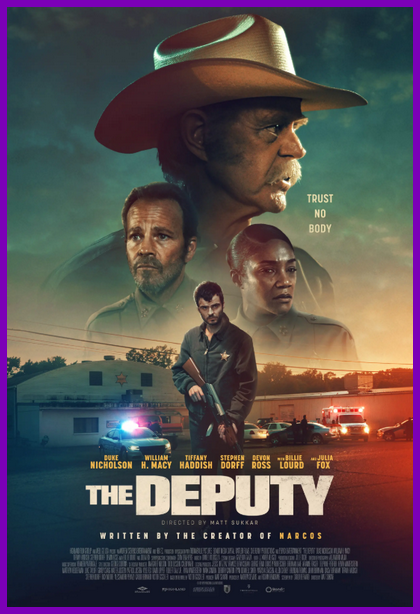
There are deputies who wear the badge. And then there are those who earn it.
When we first meet Toby Sawyer (Duke Nicholson) in director Matt Sukkar’s THE DEPUTY, he falls decidedly into the former category—and barely even that. A slovenly, cigarette-smoking part-time deputy in a tiny Texas border town, Toby appears to regard his uniform with about as much commitment as he does everything else in his life. He’s unkempt, unmotivated and seemingly content to let someone else shoulder the responsibilities that come with the badge pinned to his chest.
Then one long, very bloody night changes everything.
Written by Carlo Bernard and based on the novel by Victor Gischler, THE DEPUTY is ostensibly a crime thriller, complete with dead bodies, missing evidence, corruption and an increasingly desperate man trying to determine whom he can trust. But Sukkar’s feature directorial debut works best when viewed as a character study wrapped inside the trappings of a genre film. The mystery gives Toby something to solve. The night gives him someone to become.
And Duke Nicholson is a revelation.
Yes, Nicholson is the grandson of Jack Nicholson, but forget the family tree. What matters here is what Duke puts on the screen. He gives Toby an initially shambling physicality that gradually changes almost imperceptibly as responsibility starts replacing apathy. His attention sharpens. His posture changes. He begins following clues rather than waiting for answers. Decisions become his to make and, increasingly, he makes them.
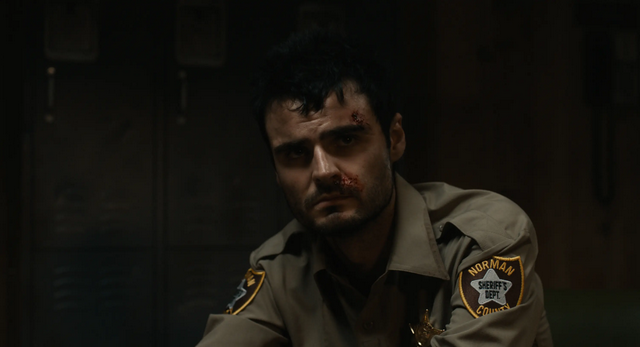
Even Toby’s uniform becomes part of the performance.
The shirt gets tucked in. He starts looking like someone who might actually belong inside it. Eventually, after the night’s escapades have left his only uniform shirt torn and covered in blood, fellow deputy Amanda Jackson (Tiffany Haddish) tells him to change his damn shirt. With no replacement, Toby does the next best thing and covers it with a jacket.
Then he deliberately places the sheriff’s badge on the outside. The jacket is necessity. The badge is choice. And the badge hasn’t changed. The man wearing it has.
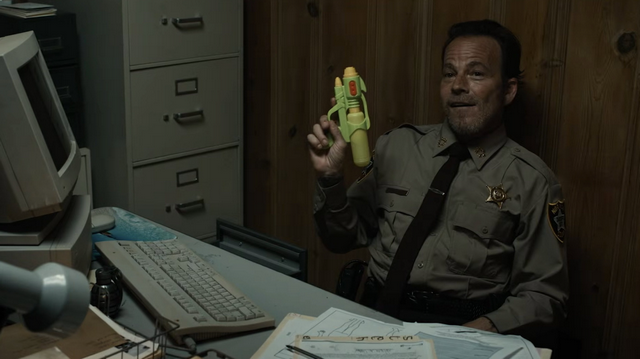
That distinction becomes even more interesting when Toby is placed against full-time Deputy Billy Banks, played by Stephen Dorff with the particular brand of cocky arrogance he can deliver with seemingly effortless ease. Banks already has the position and behaves as though that’s sufficient. A skin magazine and a kid’s plastic blaster filled with ammonia for shooting at stray dogs share space in his desk drawer, seemingly throwaway details that tell us plenty about Banks before that ridiculous little toy becomes unexpectedly important to Toby later in the night.
Banks has the job. Toby earns the title.
William H. Macy adds another wonderfully eccentric note as Sheriff Krueger, bringing his singular brand of specificity to a man whose idea of going incognito involves donning a tropical Hawaiian shirt in a tiny Texas town. Subtle, it isn’t. Funny, it absolutely is. But as with so much of the humor in The Deputy, it never becomes broad enough to fracture the increasingly dangerous world surrounding Toby.
And then, about an hour into the film, Tiffany Haddish walks in and changes the energy completely.
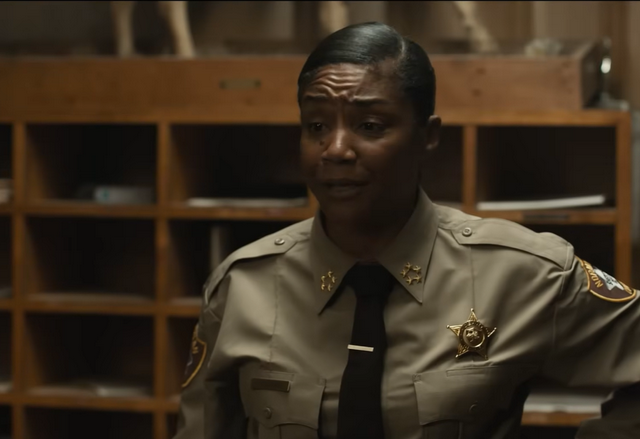
As Deputy Amanda Jackson, Haddish arrives facing a bloody Toby, guns, dead bodies and a story that sounds preposterous enough that locking him up seems like the only sensible response. But Amanda listens. She assesses. And when the evidence starts making its own argument, she adjusts. Haddish is terrific.
There’s authority here without sacrificing the personality and spark that make her such an engaging screen presence. Amanda can believe Toby’s story and still tell him he’s not smoking in her station. She can take the situation deadly seriously without suddenly becoming humorless. Haddish finds that balance naturally, bringing an infusion of light into a movie that has spent most of its running time enveloped in darkness.
And what beautiful darkness it is.
Cinematographer Alejandro Lalinde embraces the film’s extensive night work, bathing the landscape in rich, inky blue-blacks rather than allowing darkness to collapse into an indistinguishable murk. Practical light sources carve faces and spaces from the night, while the isolation of the town becomes increasingly palpable. This isn’t darkness designed merely to conceal. It’s darkness with depth and texture.
Just as important is what we hear inside it.
The soundscape is one of THE DEPUTY’s strongest technical achievements. Cell service is useless. Landlines are unavailable. Human civilization seems increasingly far away. Passing vehicles and the reassuring noises of ordinary life are largely absent.
But silence here is never truly silent.
Insects fill the night. Crickets become almost oppressive in their constancy. Nature surrounds Toby even when another human being doesn’t, creating the peculiar sensation of an environment that is simultaneously empty and very much alive.
The result is isolation that somehow feels loud.
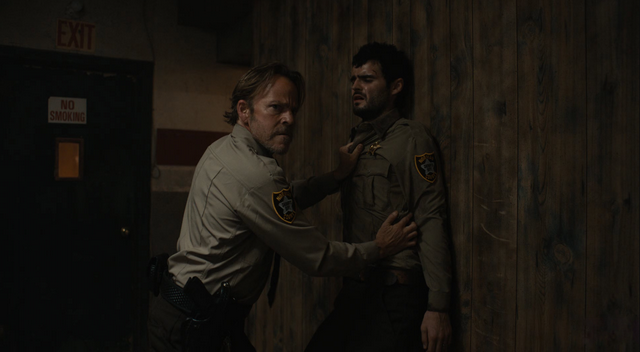
Composer Daniel Vildasola understands that the last thing this world needs is a score constantly announcing itself. Working primarily with three distinct guitars—a traditional acoustic, a rubber-string acoustic and an electric—the music remains spare and tactile, allowing variations in texture to accompany Toby’s increasingly perilous journey. Strings enter selectively as the stakes intensify, with cello and violin adding emotional weight without overwhelming the sonic austerity already established.
Even what sounds like percussion isn’t necessarily percussion. At points, the rhythmic thumping comes from the body of an acoustic guitar being struck, an inspired choice that allows the score to build urgency without introducing an instrument that might feel foreign to the musical vocabulary of the film.
The marriage between sound design and score is particularly effective because both understand restraint.
So does editor Javier Velasco.
Velasco keeps the tension moving while recognizing precisely when Toby—and the audience—needs a release valve. One of the funniest is also one of the simplest: Toby cannot stop smoking. Everyone tells him to put the damn cigarette out. Sheriff Krueger. Banks. Eventually Amanda. The gag keeps resurfacing, never overstaying its welcome, providing a few seconds of breathing room before the night tightens around Toby again.
Those seemingly minor details are where THE DEPUTY frequently shines. Sukkar and Bernard populate this strange little world with eccentricities without turning its inhabitants into caricatures. Humor emerges from character rather than being grafted onto the story simply because somebody decided the audience needed a laugh.
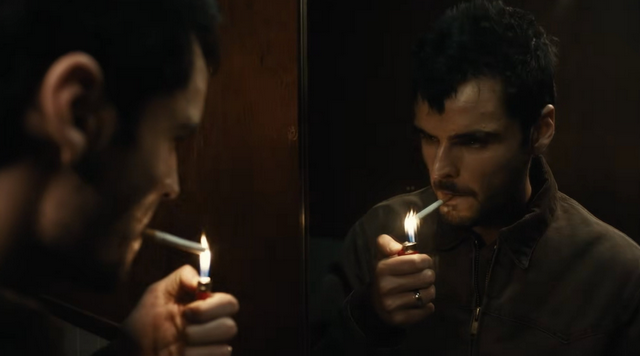
And through all of it, Nicholson keeps Toby grounded.
That’s essential because THE DEPUTY ultimately depends less upon whether we can solve its mystery than whether we believe this particular man could survive it and emerge changed by the experience. Nicholson never suddenly flips a switch from screw-up to hero. Toby earns his evolution incrementally, frequently while scared, confused, exhausted or bleeding. That’s what makes him interesting.
Courage isn’t particularly impressive when the person exhibiting it has nothing to overcome. Toby has plenty.
The film wisely lets us experience much of the night alongside him. Information arrives when Toby gets it. A clue leads somewhere—or doesn’t. Someone who should be trustworthy becomes questionable. Someone initially regarded with suspicion may prove otherwise. The increasingly convoluted circumstances force Toby to stop reacting and start thinking.
More importantly, they force him to start choosing.
And every choice carries him a little farther from the man we met at the beginning.
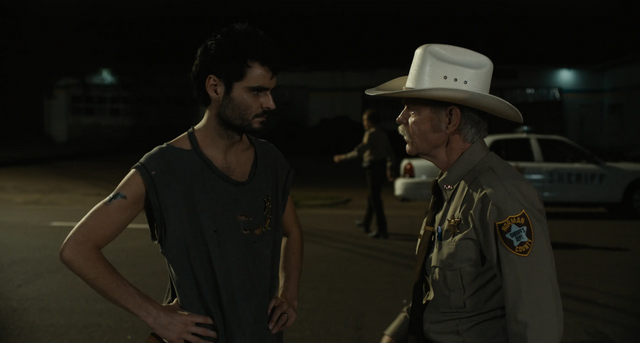
That’s where Sukkar’s feature debut impresses most. He understands that all the crime-thriller machinery in the world means very little if we don’t care about the person caught inside it. His genre elements serve character rather than the other way around. And while not every mystery beat carries equal weight, the emotional trajectory remains clear because Toby’s does.
By the final stretch, that uniform no longer feels like a costume he’s been permitted to wear. It fits. And then comes the dawn.
After spending so much of the film submerged in deep blues and blacks, Lalinde’s camera catches that extraordinary transitional light just before sunrise. The darkness begins to soften. Blues become lighter. Pink starts edging into the sky. It’s visually beautiful, but by this point it means something more.
Toby Sawyer has spent an entire night walking through darkness—literal and otherwise. He’s been bloodied, frightened, betrayed and forced to accept responsibilities he once seemed perfectly happy to avoid.
One of those responsibilities comes with a badge. The other is waiting for him at home.
Toby’s infant son has been abandoned by his mother, played by Billie Lourd, and by night’s end even the child’s paternity has been thrown into question. Toby doesn’t care. Whatever uncertainty may surround biology, there is none in Toby’s mind about who his son is—or who his father will be.
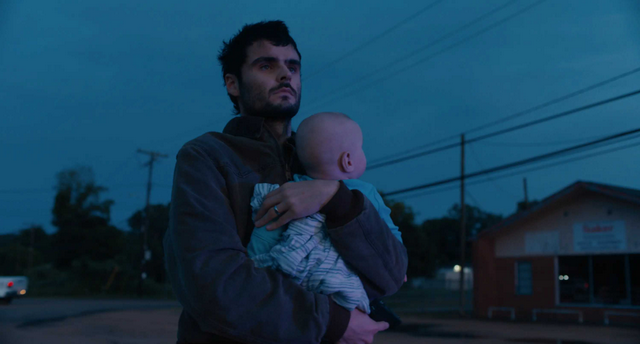
And Sukkar saves his most beautiful image for last.
Toby gathers his infant son into his arms, holds him close and walks into the morning light.
Somewhere during this long night, the part-time screw-up disappeared. In his place stands a man finally willing to accept responsibility for both the badge on his chest and the child in his arms.
Banks has the job. Toby has earned the title.
It truly is darkest before the dawn. And Deputy Toby Sawyer’s dawn looks beautiful.
Directed by Matt Sukkar
Written by Carlo Bernard based on the novel by Victor Gischler
Cast: Duke Nicholson, William H. Macy, Tiffany Haddish, Stephen Dorff, Billie Lourd, Julia Fox
by debbie elias, 09/15/2026
THE DEPUTY is in Theatres, On Digital and On Demand on September 25, 2026.