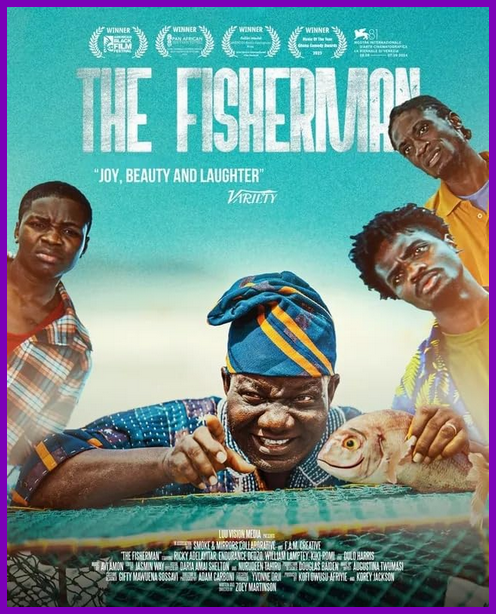
Sometimes the best life advice comes from the most unexpected places.
In writer/director Zoey Martinson’s THE FISHERMAN, it comes from Koobi, a dead fish who starts talking to Atta, an aging Ghanaian fisherman whose world is changing much faster than he would like.
Enchanting, charming, funny, sweet, and filled with an infectious sense of joy, THE FISHERMAN is deceptively simple in its storytelling. Beneath the laughter—and there is plenty of it—Martinson explores family, identity, aging, environmental change, the value of tradition, and the necessity of progress without ever turning any of those ideas into a sermon. Instead, she gives us a stubborn fisherman, three young associates, a journey to Accra, and one very opinionated fish.
And somehow, it all works.
Ricky Adelayitar is beyond fantastic as Atta, a man who has spent his life fishing and sees little reason why either he or the world around him should suddenly start doing things differently. Adelayitar needs little dialogue to tell us precisely what Atta is thinking. A grimace, a glare, the set of his shoulders, a suspicious side-eye—his body language and facial expressiveness are comedy gold.
But there is warmth beneath Atta’s irascibility, and Adelayitar allows it to emerge gradually rather than announcing a transformation.
That becomes particularly important once Atta finds himself traveling with his “young associates” as he calls them, Shasha, Kobina and Emmanuel. The generational divide initially provides plenty of humor, but Martinson is interested in something richer than young-versus-old. Neither generation possesses everything it needs. Atta has knowledge and experience, but he must learn that tradition cannot survive merely by demanding that nothing change. The younger generation is more adaptable, but adaptability without the benefit of experience can leave its own gaps. They need one another.
And then there is Koobi.
The moment that fish starts talking, THE FISHERMAN could easily have capsized under the weight of its own conceit. Instead, Koobi becomes its secret weapon. Voiced by Dulo Harris, who breathes humor, sarcasm and sheer fun into every utterance, Koobi is a wonderfully unlikely foil for Atta. Harris gives him a personality big enough to spar with the irascible fisherman while never overwhelming the inherent absurdity of their conversations.
The humor also works because Martinson wisely resists turning Koobi into an overly animated cartoon creation. His restrained VFX maintains enough of the reality of an actual fish that Atta carrying on earnest conversations with him becomes even funnier.
Watching Atta make Koobi a comfortable little bed and tuck his fins beneath the covers is worth the price of admission alone. Yet Koobi gradually becomes something more than the source of some of the film’s biggest laughs. In a story concerned with tradition, progress and the inevitability of change, this unlikely piscine philosopher reminds us that holding onto something doesn’t always mean keeping it exactly as it was.
What matters is what we carry forward.
Martinson finds that same balance visually.
Cinematographer Adam Carboni captures the beauty of Ghana without reducing it to picturesque scenery. The light has texture. Haze softens the mornings while golden hour wraps the coastal fishing community in warmth. Reds, yellows and golds dominate, punctuated with vibrant blues and greens and the aqua expanse of the sea. Ghana isn’t merely where THE FISHERMAN happens; its colors, light, rhythms and people are part of the film’s cinematic language.
The result is a sumptuous visual feast.
Particularly striking is a moonlit conversation between Atta and the Boat Chief. Carboni’s imagery gives the scene an almost contemplative stillness, while editor Jasmin Way moves between the men as they are now and memories of who they once were. Past and present exist together, beautifully reinforcing a film in which moving forward never requires pretending that what came before no longer matters.
Way’s editing throughout is equally deft. Comedy lives and dies by timing, and THE FISHERMAN knows when to hold a reaction, when to cut away and when to let Adelayitar’s face finish the joke. The pacing remains buoyant even as the journey grows more reflective.
And Way’s musical instincts dovetail beautifully with Avi Amon’s score. Drawing inspiration from Italian comedy scoring while incorporating West African instrumentation, Amon creates a musical personality that is playful and culturally grounded, complementing rather than overwhelming the film’s humor and heart.
Sound also becomes part of Martinson’s tonal balancing act. The bustle of Accra, the quieter coastal environment, music, voices and Koobi himself help delineate the worlds Atta moves through without making them feel disconnected from one another. This is one journey, even as its landscape and rhythms change.
And change is ultimately what THE FISHERMAN understands best.
Climate and coastline are changing. Technology is changing how knowledge passes between generations. Young people are searching for their place. Older people are confronting the possibility that the world may no longer need them in precisely the way it once did.
But Martinson never equates change with obliteration.
Atta’s journey isn’t about rejecting his old ways and embracing everything new. Nor does the film romanticize tradition to the point of suggesting that progress is inherently destructive. The more interesting possibility lies between those poles: tradition survives when its wisdom can be carried forward, and progress gains meaning when it understands what came before.
That idea reaches its most affecting expression through Adelayitar.
As Atta’s relationship with his young companions deepens, his understanding of what it means to be an elder changes as well. Respect is no longer merely something owed to him because of age. It becomes something he gives back through encouragement, experience and the ability to recognize worth in young people who temporarily cannot see it in themselves.
And Adelayitar plays every beat of that evolution beautifully.
There is no grand announcement that Atta has changed. No flashing sign pointing toward a character arc. We simply begin noticing that the man we’re watching isn’t quite the same man we met.
Perhaps that is Martinson’s most perceptive observation.
Change rarely announces itself while we’re living through it. Sometimes we only recognize it when we look back and realize how far we’ve traveled.
THE FISHERMAN makes that journey with an abundance of humor, humanity and visual beauty, but above all, it leaves you with joy. Not manufactured uplift. Not sentimentality. Joy—the kind that comes from watching people discover that generations needn’t be adversaries, that traditions needn’t disappear simply because life moves forward, and that something beloved can remain part of us even when its form inevitably changes.
And if it takes a stubborn fisherman and a wisecracking dead fish to teach us that lesson? So be it.
Listen to Koobi. The fish knows what he’s talking about.
Written and directed by Zoey Martinson
Cast: Dulo Harris (voice of Koobi the Fish), Ricky Adelayitar, Endurance Dedzo, William Lamptey, Kiki-Romi, Adwoa Akoto, Papo Osei
by debbie elias, 09/15/2026
THE FISHERMAN is available digitally on September 29, 2026.