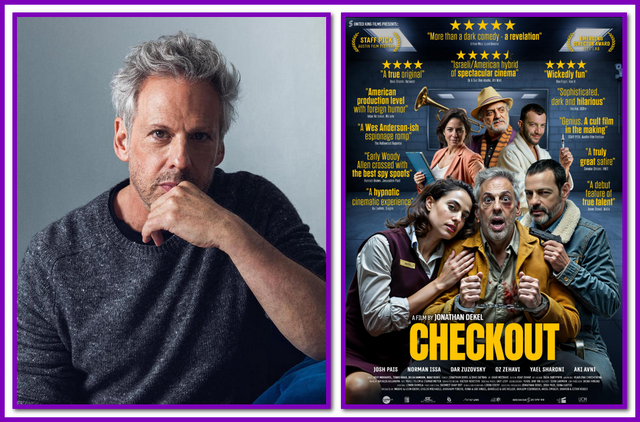
Imagine being an actor preparing to play a Mossad operative and discovering that your training involves sitting in the food court of a New Jersey shopping mall, wearing sunglasses, waiting for a stranger to approach you after you’ve given a prearranged signal. Your first assignment? Convince a shoe salesman to rearrange his store’s window display without attracting attention.
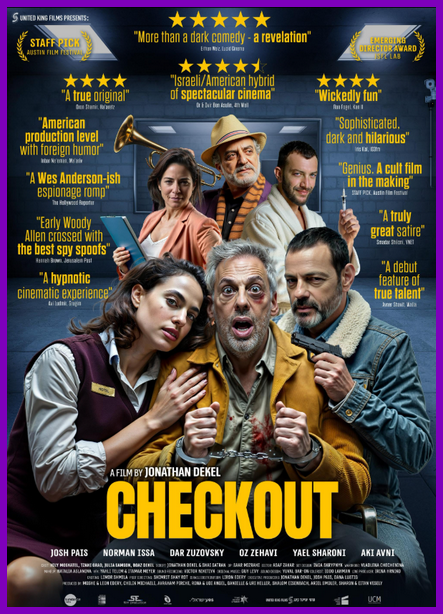
For actor JOSH PAIS, that was just the beginning of his preparation for CHECKOUT, writer/director Jonathan Dekel’s wildly inventive Israeli dark comedy, satire, and espionage thriller about a Mossad agent whose desire to become a legendary spy may be his greatest liability.
And as Pais discovered, being a spy isn’t necessarily about high-speed chases, sophisticated weaponry, or the glamorous world of James Bond. Sometimes it’s about persuading a stranger that an old-school pair of Puma sneakers deserves a place of honor in a store window. It’s also about being invisible.
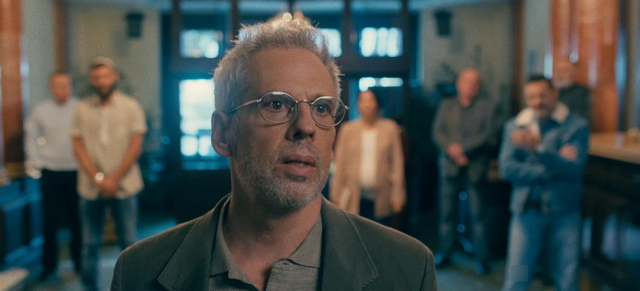
For Pais, whose eclectic career encompasses films including TOUCHY FEELY, ARBITRAGE, ADVENTURELAND, and TEETH, along with television appearances in LAW & ORDER, LAW & ORDER: SVU, MANIAC, RAY DONOVAN, and even STAR TREK: DEEP SPACE NINE, CHECKOUT offered an opportunity unlike anything he’d previously encountered. As Dov, a Jewish-American New Yorker who has spent years working for the Mossad with little recognition to show for it, Pais moves effortlessly between vulnerability, bravado, desperation, deception, comedy, and increasingly troubling behavior.
On the day he’s ordered to retire, Dov becomes convinced that the world’s most wanted terrorist has checked into the Turkish hotel he’s been surveilling. Ordered to stand down, he refuses, determined to prove himself and finally become the legendary operative he always imagined he would be. But there’s a catch.
Everything we’re watching is filtered through Dov’s recollections as he undergoes a debriefing by skeptical Mossad investigators. His account of events is repeatedly interrupted, questioned, and altered, with his interrogators literally entering the scenes he’s describing. Past and present collide, characters and circumstances shift, and the reliability of Dov’s storytelling becomes increasingly suspect. For Pais, it was precisely this unconventional narrative structure, combined with the psychological complexity of the character, that made CHECKOUT irresistible.
During our conversation, Pais enthusiastically explored his real-life spy training, the challenges of navigating Dov’s constantly shifting reality, filming in Odesa, Ukraine, during the height of COVID, his extraordinary creative partnership with co-star Norman Issa, and the artistic philosophy that continues to inspire him after decades in the business. And through it all emerges a recurring idea: the most exciting discoveries often happen when an actor is willing to abandon certainty and embrace the unknown.
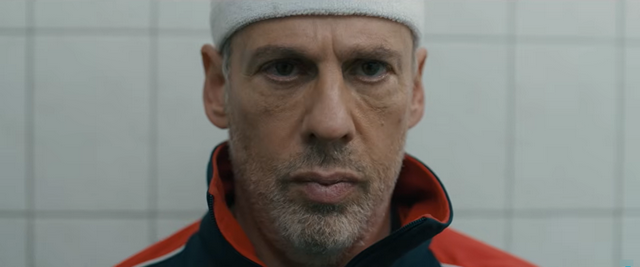
Not Exactly James Bond
For Pais, CHECKOUT began with an unexpected offer from writer/director Jonathan Dekel. “Literally, Jonathan Dekel, who brilliantly directed the film, he reached out to me and he said, ‘I have this project and I think you would be perfect for it.'”
“It was just a straight-up offer, and he started explaining it to me. And, for people that haven’t seen it yet, it’s got a very unique and brilliant story structure where the present and the past are colliding constantly.” But understanding the screenplay proved considerably more complicated than accepting the role.
As Pais read the screenplay, he found himself struggling to comprehend how the different realities were supposed to coexist. “To read a script where I’m following this character, and all of a sudden there’s people in the room that are not in the scene, to understand what is happening, to read the script, I was so confused. And it took a while to really understand.”
The film’s conceit places Dov in the uncomfortable position of simultaneously experiencing his memories and defending them against the investigators challenging his version of events. “My character is telling a story, reliving a story of him tracking down a terrorist, and at the same time he’s being interrogated. And the interrogators just enter into a scene as I’m dealing with this terrorist, and I have to then navigate them and then get back into the scene.”
The structure demands extraordinary flexibility from Pais, who must negotiate shifting emotions, competing versions of events, and the increasingly blurred distinction between what actually happened and what Dov wants others to believe happened. But beyond the narrative ingenuity, Pais was fascinated by the film’s examination of the psychological realities of espionage.
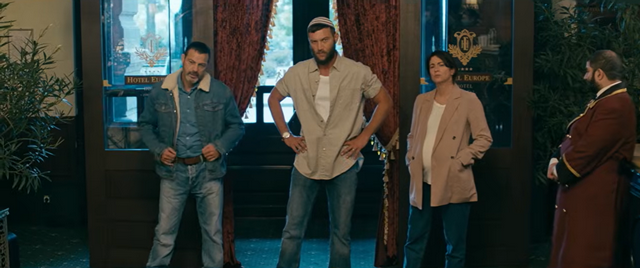
“What really caught me about this was, we have such an idea from Hollywood about what a spy is—that it’s James Bond, super cool, doing all kinds of badass things.” The reality, he discovered, could be profoundly different.
“As I began to learn about what it’s really like to be a spy, you’re sent on location, you have to pretend you’re someone else, and a lot of times these spies are planted all over the world, and they just have to stay there.” For some operatives, the excitement they imagined when entering the profession never materializes. “If you see something, report it back. And a lot of times, they don’t see anything, and they start to fall apart psychologically because they’re in a distant land. They have to pretend to be someone else for an extended period of time.”
That isolation becomes particularly devastating when measured against the expectations that originally drew them to the profession. “They realize they went into it for the James Bondness of it all, but it doesn’t turn out that way.” For Pais, this disconnect between fantasy and reality provided the emotional foundation for Dov. “That was so fascinating to learn about, what happens to these spies. And that’s a story that I don’t think has been told before either.”
And then there was the possibility that Dov’s increasingly desperate pursuit of a suspected terrorist might be driven by something other than professional instinct. “Is my character starting to lose his mind as he tracks this terrorist? Is this guy really a terrorist? Or is my character hoping that he is, and then acting as if he is? And maybe he is.” It was that uncertainty that made the character so compelling.
“All those elements were just so intriguing to me.”
Your Mission, Should You Choose to Accept It: The Short Hills Mall
Of all the stories Pais shared about preparing for CHECKOUT, none was more unexpected—or more entertaining—than his encounter with a man introduced to him as an active Mossad operative at the Short Hills Mall in New Jersey.
“Jonathan Dekel said, ‘I’ve set up a meeting with you with an active Mossad agent at the Short Hills Mall.’ And I was like, ‘What? What are you fucking talking about?'” Pais received a photograph identifying a particular table in the mall’s food court, along with instructions specifying when to arrive and how to signal his contact. “I was told, wear sunglasses, sit at the table, and when you are ready to interact with this spy, this real spy, lift your sunglasses up to your forehead, and then he will come and sit with you.” The experience was already beginning to feel like something out of an espionage thriller.
“So I did that, and this gentleman sat in front of me. And to describe him, he was the most ordinary, non-flashy, most kind of forgettable guy in how he looked. Like he could have just been any guy walking through the mall, and you just wouldn’t notice him.” That unremarkable appearance immediately made an impression on Pais. “I found that really interesting.”
When Pais asked about the man’s training, he received an unexpected response. “Well, we’re going to do training exercises in a few minutes.” Before Pais could fully process what was happening, he was given his first mission. Across the food court was a sneaker store whose front window displayed brightly colored contemporary footwear. Pais was instructed to enter the store, select a pair of sneakers, and convince a salesperson to replace one of the shoes in the window with his selection. And he had to accomplish this without making a scene or attracting attention.
For an actor learning the art of sneaking around, where better to begin than a sneaker store? “I was like, ‘What?’ He said, ‘Go do it.'” Pais entered the store and began studying both the merchandise and the employees. “Just initially walking around in this sneaker store and knowing that I was on a mission like that started to do something to me. It started to make me see what this could be like.” Then he spotted a pair of old-school leather Puma sneakers. “I looked around at the different salespeople and I picked who I thought might be the most malleable.” Approaching the salesman, Pais invented a story about his son, claiming the boy was about to meet him at the store and had always dismissed those particular sneakers as hopelessly uncool. “I told the guy, if you could put this in the window, then when my son comes and I show him that this sneaker is being featured and that it really is cool, my son would really think I was a cool dad.” The salesman bought the story. “He couldn’t resist. And so he went and did it. The salesperson took my sneaker and put it in the window.” Mission accomplished!
But not every assignment ended in success. “There were other missions that I did in the mall, all different kinds of things. That was my most successful one, and some of them I failed because I drew too much attention to myself in trying to get something done.” The failures proved just as valuable as the successes. “That was really interesting in terms of being like, how do I get something done and also be somewhat invisible?” It was an extraordinary lesson in the subtleties of manipulation, observation, and the psychological demands of remaining unnoticed.
“Somehow that really began to inform me about what it could be like to actually be a spy.” And all of it happened in a shopping mall. “Yeah, with a real spy.”
Dov: A Man of a Thousand Disguises and a Thousand Doubts
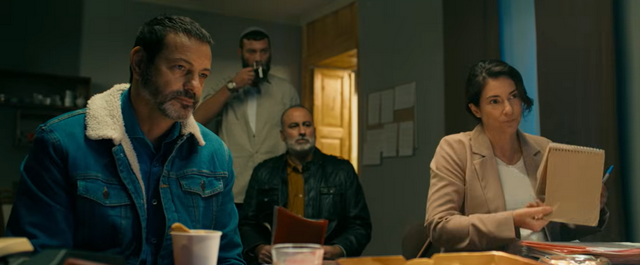
One of the great pleasures of watching Pais in CHECKOUT is observing the almost instantaneous changes in Dov’s demeanor.
At one moment, he’s confident, assertive, and apparently in complete control. The next, he’s anxious, insecure, vulnerable, or downright buffoonish. His carefully constructed personas shift according to circumstance, and the audience is never entirely certain which version of Dov is authentic. The film’s nonlinear storytelling compounds that uncertainty. We move through different locations and time periods, from Lebanon and Gaza to the West Bank and Istanbul, with Dov appearing to inhabit these competing timelines almost simultaneously. And throughout, his interrogators challenge his recollections, creating a constant tension between performance and reality. For Pais, navigating these shifts required a particular kind of discipline.
“I loved doing it, and I don’t know, I can’t say it was hard, but I had to be on point.” That meant resisting the temptation to arrive on set with every emotional beat already determined. “I had to be so, as I always strive to be, absolutely present as an actor, and to resist the temptation to present what I came up with yesterday, what I came up with the day before filming the scene.”
Preparation was essential, but so was the willingness to respond to whatever emerged in the moment. “To really surrender to the moment after extensive training and understanding the character and actual spy training.” Pais found that this openness allowed Dov’s constantly shifting emotional states to develop naturally. “I just had to be incredibly receptive, and it kind of took its shape.”
The result is a performance in which Dov can appear to be manipulating everyone around him while simultaneously revealing just how little control he may have over his own circumstances. And the question of whether Dov is an unreliable narrator, a desperate man losing his grip on reality, or an operative whose instincts are being unfairly dismissed remains tantalizingly unresolved. For Pais, those uncertainties were not obstacles to overcome. They were opportunities to explore.
Nine Days of Isolation in Odesa
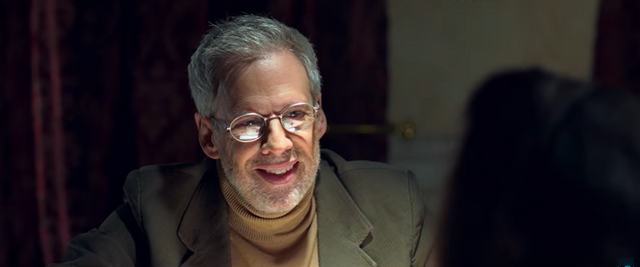
If the challenges of portraying Dov weren’t already substantial, the circumstances surrounding the production introduced another extraordinary complication. CHECKOUT was filmed in Odesa, Ukraine, during the height of COVID. Pais recalled that the production had approximately a week of preparation before principal photography was scheduled to begin, including work on the film’s physical confrontations.
Then, on the very morning shooting was supposed to start, everything changed. “I got a call at five a.m. saying, ‘Oh, there’s something with your test.’ And it turns out I got COVID.”
Because Pais appears throughout the film, production couldn’t simply proceed without him. “The whole thing had to get shut down, and I was stuck in a hotel room in Odesa, Ukraine, for nine days. I couldn’t leave the room.” The experience was physically and psychologically difficult, but it also produced an unexpected connection to his character. “In a sense, that isolation was a blessing in that it mirrored what this character is going through, that intense isolation, that intense being stuck somewhere.” The enforced solitude gave Pais time to immerse himself even more deeply in Dov’s psychological world.
“When I wasn’t kind of knocked out, I was just immersing deeper and deeper into the script. So I really had it very rooted in me.” By the time production resumed, Pais felt that the experience had transformed his relationship with the character. “Somehow when we started filming, I was so raw from all of that. I had a strong sense of the character in my body.”
That physical and emotional understanding proved invaluable when negotiating Dov’s rapid changes in demeanor. “Those transitions were just very, very organic to the moment. I invited those things to happen, but I didn’t force them to happen.” For Pais, the fluidity of the performance came from allowing the different emotional realities to emerge rather than imposing them. “You feel the fluidity of this character, that he’s feeling this, and then he’s feeling that, and then he’s pretending to be a certain way, but then you see what’s really underneath.”
Filming in Ukraine also brought an awareness of the country’s increasingly precarious circumstances. Pais recalled asking a driver about Vladimir Putin and receiving a troubling response concerning Russian military activity in the region. It was yet another layer of uncertainty surrounding a production already navigating pandemic restrictions and the challenges of an international cast. And despite the screenplay’s elaborate movement through time, the film was not shot chronologically. “No. Not really. A lot of it was dependent on other people’s schedules.”
As the only American in a cast whose other principal performers were traveling from different countries, Pais needed to be prepared to move freely between Dov’s competing realities. But the nine days of isolation had given him an unexpected advantage. He knew the character and the script so intimately that the shifting timelines no longer posed the same challenge.
A Cinematic World of Color, Light, and Intrigue
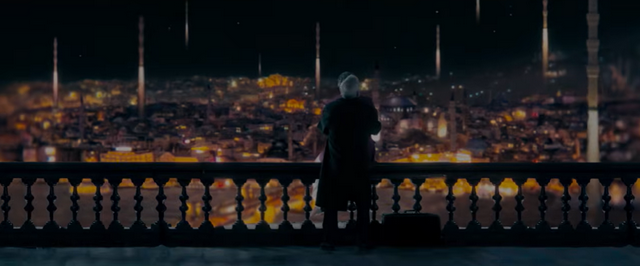
Beyond its narrative ingenuity and Pais’s remarkably fluid performance, CHECKOUT is a visual feast, with cinematographer Saar Mizrahi and the production design creating a richly textured world that is as captivating as the story unfolding within it.
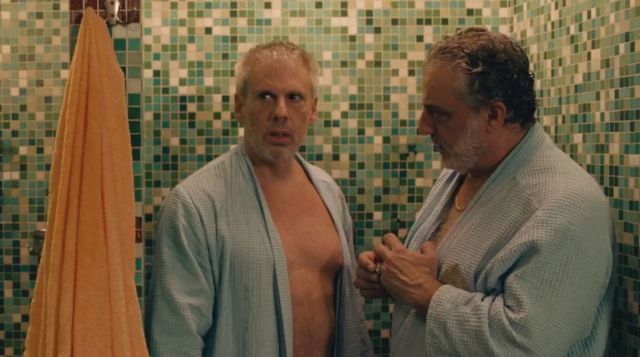
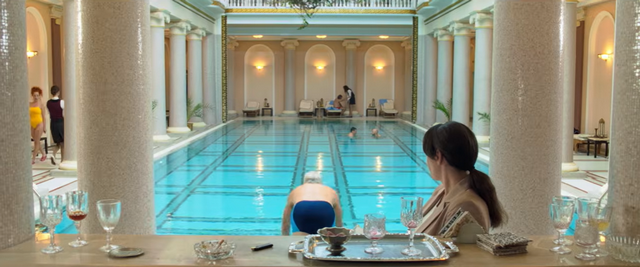
The Turkish hotel’s pool area, with its striking green mosaic tiles and walls, establishes an immediate visual allure, while carefully orchestrated color and lighting transform individual locations into distinct cinematic environments. The nighttime balcony scenes are particularly beautiful, with city lights providing a glittering backdrop to the increasingly surreal encounters between Dov and Amal. And then there is the sauna, bathed in an intense red-orange wash that transforms an already outrageous confrontation into something almost otherworldly.
Pais was every bit as enthusiastic about the film’s visual accomplishments as he was about the performances and storytelling. When our conversation turned to the nighttime balcony sequence, he immediately seized upon it as a personal favorite. “I think that might be my favorite scene. You know, just like, what a great situation. You know, like a spy who thinks he’s zeroing in on a terrorist, and the terrorist gets him high on LSD. You know, and they’re tripping together. I love that scene.” It’s a marvelous intersection of cinematic beauty, absurdist comedy, and unexpected intimacy.
The visual splendor of the setting stands in delicious contrast to the increasingly bizarre circumstances, while the shifting relationship between Dov and Amal gives the sequence an emotional resonance beyond its humor. And it is precisely that combination of visual invention, performance, and tonal unpredictability that makes CHECKOUT such a distinctive cinematic experience.
Dov and Amal: The Spy, the Suspected Terrorist, and an Unexpected Friendship
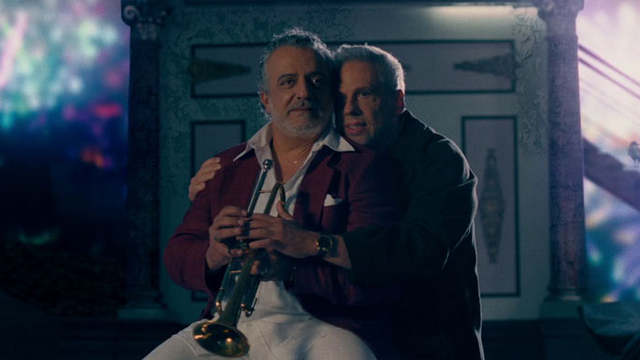
Among CHECKOUT’s many memorable sequences, the evolving relationship between Dov and Amal, played by Norman Issa, provides some of the film’s most surprising emotional and comedic moments.
Amal is the man Dov believes to be a wanted terrorist. Yet as the two spend time together, their interactions become increasingly intimate, absurd, and unexpectedly tender.
One extraordinary nighttime balcony sequence finds the men sharing hash and LSD, with Amal playing a saxophone as its music fills the night air and Dov experiences increasingly surreal hallucinations. Against the gorgeous backdrop of the city lights, the saxophone adds another layer of intimacy and unexpected beauty to a scene that is simultaneously hilarious, hallucinatory, and surprisingly tender. The scene is both visually and aurally striking, as the supposed hunter and his quarry abandon their expected roles and enter a strange emotional territory. For Pais, it was a favorite moment.
“I think that might be my favorite scene. What a great situation. A spy who thinks he’s zeroing in on a terrorist, and the terrorist gets him high on LSD. And they’re tripping together. I love that scene.” But what makes the sequence particularly effective is the believable bond between the two performers.
That chemistry didn’t emerge from an extensive conventional rehearsal process. Quite the opposite. When Dekel suggested rehearsals, Pais proposed a different approach. “I said, let’s not rehearse. Let’s just hang out.” There were practical exceptions, particularly the elaborate sauna fight, which required careful physical preparation. But for the dramatic relationship between Dov and Amal, Pais wanted something more spontaneous. “Let’s just hang out and get to know each other.” The suggestion initially made the first-time feature director nervous. “He trusted me.”
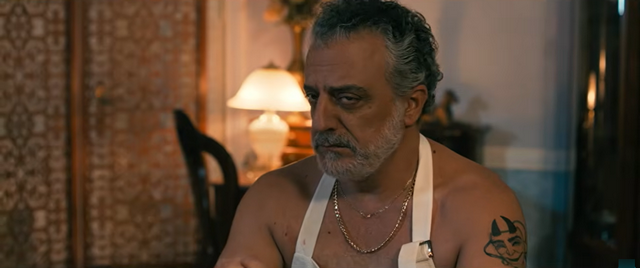
Pais and Issa quickly discovered that they shared both professional experience and an instinctive understanding of the relationship their characters would develop. “Norman and I, he’s a spectacular actor, but we just bonded because we knew the journey that we were both going on.” Their objective was to avoid becoming locked into predetermined interpretations of individual scenes. “We completely trusted each other, and in a sense didn’t let one another fall into an idea of the scene.”
Instead, they committed to discovering the relationship while the camera was rolling. “We were so committed to creating the dynamic in the moment that the camera was running, and not come in with something preconceived.” For Pais, that kind of collaboration represents the ideal acting experience.
“That’s my dream, working with actors, to get to a place where we know we’re ready, but we’re also going to be open to the unknown.” And he believes that willingness to embrace uncertainty can transform the creative process. “I feel more and more like with this art form, it becomes magnificent when the director, the actors, and maybe everybody on the crew, in a sense, is willing to step into the unknown.” Because that is where the unexpected discoveries happen. “Within the unknown, that’s where creativity emerges. That’s where something spontaneous emerges.”
The circumstances of filming in Ukraine also contributed to the actors’ relationship. “We were both in Ukraine, which we had never been, and so that instantly bonded us. And we just happened to really like each other.” The result is a relationship that gradually transcends the expected conventions of the espionage genre.
Dov’s growing affection for Amal complicates his mission, his judgment, and ultimately his understanding of himself. And that emotional connection becomes particularly significant as the film moves toward darker territory.
Learning to Trust: Josh Pais and Jonathan Dekel
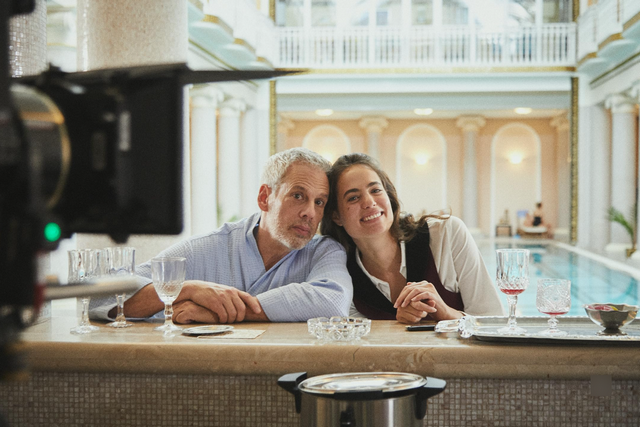
Pais’s commitment to spontaneity extended beyond his relationship with Issa. It also shaped his collaboration with director Jonathan Dekel, who was making his feature directorial debut. Pais recognized something familiar in the filmmaker’s initial approach. “I’ve worked with a lot of first-time directors that they want to really lock it in and grab and feel secure.”
During the first days of production, Dekel would frequently approach the actors after each take with a notebook full of observations. “After every take, he would cut; he would come up to me with a little pad with notes.” Pais appreciated the director’s attention but encouraged him to recognize that constant intervention wasn’t always necessary. “I said, these are great, and just know that we are, with each take, doing our best to make it come to life, and to just trust us.”
He wasn’t suggesting that the director relinquish creative authority. Rather, he wanted Dekel to feel comfortable allowing the actors room to explore. “If there is definitely a note that you feel strongly about, unquestionably tell us. But let go of a sense of, as a director, your obligation is to constantly give notes.”
For Pais, the distinction between directing and overdirecting can have a profound effect on performance. He has observed that experienced filmmakers often understand when to step in and when to let the actors work. “The more experienced directors, they tend to trust the actors.” And that trust creates an atmosphere in which performers feel free to take risks. “It just creates a beautiful…and they end up getting what they want, and we feel, as actors, free to bring what we have.”
Over the course of filming, Pais and Dekel developed their own creative rhythm. “It was an evolution, me and Jonathan finding our way of working together. And we really found something special.” For Pais, the experience reinforced his belief that genuine collaboration depends upon preparation, mutual respect, and the courage to allow something unexpected to happen.
Romance, Karaoke, and a Sauna Full of Headbutts
Of course, CHECKOUT isn’t all existential anxiety and philosophical reflection. It’s also a film that allows Pais to indulge in an astonishing range of comic, romantic, and physical situations.
There’s Dov’s relationship with Eden, the hotel bartender played by Dar Zuzovsky, whose warmth and openness offer him a glimpse of something beyond his obsessive pursuit of professional glory. Their interactions are particularly poignant because Dov’s affection is complicated by the lies he tells and the identities he assumes. For Pais, the connection with Zuzovsky came naturally.
“She’s amazing. Dar Zuzovsky. She’s just spectacular.”
The two actors developed an immediate rapport. “We just clicked. She’s such a beautiful person in every way, and it was just effortless to have my character fall in love with her, even though he was restraining himself.” That restraint gives their relationship an unexpected sweetness, particularly during a karaoke sequence in which the film briefly allows Dov’s emotional vulnerability to come to the surface.
And then there’s the sauna.
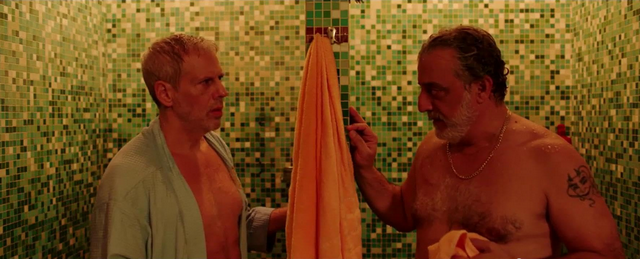
Bathed in an intense red-orange glow, the sequence begins with absurd banter and escalates into an extraordinary physical confrontation involving Dov, Amal, and the increasingly intrusive investigators. Pais laughed as he recalled the unusual choreography. “An unbelievable fight sequence in a sauna. It was like a fight sequence of all headbutt fighting.”
The combat required a distinctly different physical vocabulary from the polished action choreography audiences might expect in a conventional espionage thriller. “It was all like wrestling, or we were smashing our heads into one another.”
Between the sauna fight, the balcony hallucinations, the karaoke, the romantic complications, and the constant shifts in identity, CHECKOUT gave Pais an opportunity to explore virtually every aspect of his abilities as a performer. “I got to do everything in this role.” When asked whether he expected another part offering such an extraordinary range of experiences, his response was immediate.
“One can only hope. One can only hope.” And there was genuine gratitude in his voice. “This was a spectacular opportunity for me.”
The Need to Be Significant
Beneath CHECKOUT’s comedy, espionage intrigue, and elaborate narrative construction lies a surprisingly serious examination of ambition, ego, and the human desire for recognition.
For Pais, that is ultimately what makes Dov such a fascinating character. “On some level, it’s about a guy who wants to be significant. He wants to be important. He wants to be acknowledged by his peers, who are fellow spies who look down on him.”
Dov has devoted much of his life to an organization and a profession that have failed to deliver the recognition he desperately craves. Now, facing retirement, he sees what may be his final opportunity to prove himself. But that desperation carries dangerous consequences.
“It’s his desire or compulsion to be significant that leads him astray, in a sense, that leads him to do things that, even though it is a comedy, Dov does some dark stuff.” His relationship with Amal becomes especially complicated when viewed through that lens. The man Dov believes to be a terrorist may also be someone with whom he has formed a genuine emotional connection. Yet Dov’s need for professional validation threatens to override the humanity of that relationship.
Pais sees the character’s dilemma as part of a much broader human struggle. “If sometimes we have an idea of what we want or have an idea of what success would be or significance would be, I see it—I hope I catch it in myself—but I certainly can see it in other people.”
That need for recognition can become destructive when it overwhelms everything else. “That need to be significant can override and almost destroy a life because you have this narrow view of what we should be doing.”
For Pais, exploring that possibility gave the film a purpose beyond entertainment. “That part of it was interesting to me to tell.” And it reflects something he looks for in all his projects, regardless of genre or format. “Even if I’m playing a really dark character, what’s the positive in this?” When he discovers that deeper connection to the material, the creative process becomes more meaningful. “Then everything syncs up for me.”
Beyond CHECKOUT: THE ROMAN and the Joy of Collaboration
Pais’s enthusiasm for CHECKOUT is matched by his excitement about his current television work, including the Netflix series THE ROMAN, produced by Martin Scorsese. Set in the contemporary world of a casino, the series features an ensemble that includes Oscar Isaac, Vincent D’Onofrio, Kate Mara, Alec Baldwin, and Betty Gilpin.
For Pais, the scale of the production is extraordinary. “Most TV shows that I work on, and that all of us work on, in terms of sound stages, there’s usually one, maybe two sound stages.” THE ROMAN, however, occupies an entirely different scale. “For this, there are seven sound spaces.” The production has constructed an enormous casino environment in Greenpoint, Brooklyn, with exterior filming taking place in Las Vegas. “When you’re in it, you’re in a casino.”
Pais described the series as a contemporary ensemble drama with an expansive world and richly developed characters. “It’s epic. It’s such a big story and so many rich characters. It almost has a slight SOPRANOS feel, but it’s very contemporary.”
At the time of our conversation, he didn’t know when the series would premiere. But beyond the production’s size and impressive ensemble, Pais was particularly interested in the creative environment. He recalled working with directors who understood that actors sometimes needed the freedom to discover a scene without constant notes or interruption. It was another example of the artistic trust he had come to value so deeply.
And when asked whether he preferred working in television or feature films, Pais made it clear that format was never the determining factor. “It’s all about the character and the story. And the people involved.” What matters is finding material that offers something worth exploring. “I just love interesting stories. I know it’s so cliché for an actor to say, but that really is the draw.”
For Pais, the question isn’t whether a project belongs on the big screen or the small screen. It’s whether the character, the collaborators, and the story offer an opportunity to discover something meaningful.
The Gift of Acting: Stepping Into the Unknown
After decades of performances across film, television, and theater, Josh Pais remains remarkably enthusiastic about his craft. And perhaps the most revealing moment of our conversation came when I asked what acting continues to give him—what gift the profession offers that keeps him returning to the work. His answer was immediate, deeply personal, and filled with the same excitement that animates his performance in CHECKOUT.
He recalled a recent film project with Sarah Silverman, describing the joy of creating an unexpected dynamic with another performer. “We just had so much fun and created this whole dynamic together. It’s a peak experience.”
For Pais, acting at its best resembles a dance between creative partners who are fully committed to the moment but have no predetermined idea of exactly where it will lead. “It’s like to step into a dance, in a sense, and you don’t quite know where it’s going to go, but you’re fully committed, and you’re not going to back down.”
That sense of discovery is what continues to inspire him. “That is such a rich experience for me because I just feel like I’m creating with my whole being, and that’s really kind of what turns me on and what my life is about.”
And despite his extensive experience, Pais doesn’t approach a new project with the assumption that he already knows everything he needs to know. Quite the opposite. “Every project that I go into, I do feel like a beginner.” He believes that past success can never substitute for being fully present in the work at hand. “You can’t really rely on anything in the past. You have to show up and discover what’s the music of this thing that we’re letting unfold together.”
That willingness to begin again requires enormous trust, particularly in the high-pressure environment of film and television production. “That’s just, on some level, the hardest thing in the world to do, to be present and fully trusting in the unknown in a high-pressure situation.”
And yet, for Pais, the difficulty is inseparable from the reward. “On some levels, it’s always like, why am I doing this? There’s nothing harder. But there’s also nothing for me as delicious.”
It is a philosophy that connects directly to everything he experienced making CHECKOUT. The real-life espionage training that taught him the importance of remaining invisible. The nine days of isolation in Odessa that deepened his understanding of Dov. The spontaneous discoveries made with Norman Issa. The evolving creative trust between actor and director. And the willingness to allow a character’s contradictory emotional realities to emerge without forcing them into a predetermined pattern.
For Josh Pais, acting is not about repeating what has worked before. It’s about remaining curious enough, courageous enough, and open enough to discover something new.
“I’m just always striving to get better at my craft. That’s what keeps me going, and it lights me up.” And after all these years, that light shows no sign of dimming. “I feel like more lit up than ever, honestly.”
by debbie elias, exclusive interview 10/14/2026
CHECKOUT is on digital October 16 on Amazon, Apple TV, Google Play, YouTube Movies, and Cable On Demand.