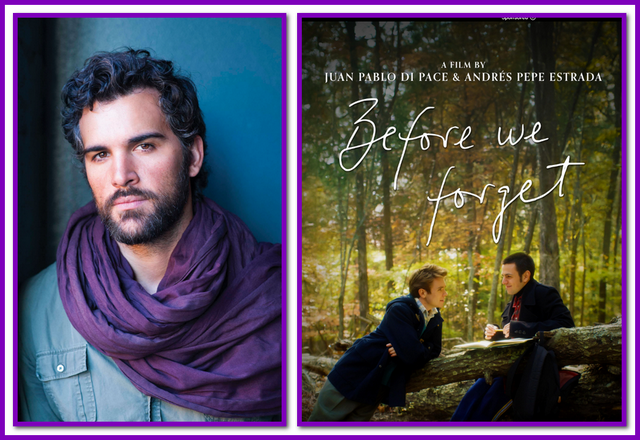
Calling BEFORE WE FORGET JUAN PABLO DI PACE’s feature directorial debut is technically accurate, but it doesn’t quite tell the story. After decades spent moving among acting, dance, music, theatre and film—and directing shorts and music videos along the way—Di Pace didn’t arrive at his first feature still searching for an artistic vocabulary. He arrived with one.
And with BEFORE WE FORGET, co-written, co-directed and co-edited with longtime collaborator Andrés Pepe Estrada, Di Pace puts every part of that vocabulary to work.
An intimate and visually exquisite meditation on love, memory, identity and the seductive pull of nostalgia, BEFORE WE FORGET moves between the present-day life of Argentinian filmmaker Matias, played by Di Pace, and the memories of his teenage years at an international boarding school in Italy, where friendships, family and the overwhelming experience of first love helped shape the man he would become. Twenty-five years later, those memories are anything but finished with him. For Di Pace, neither was the film.
“When you have something inside you for years, and you need to do something about it, I think that’s what this movie is,” he tells me. “It wasn’t a film that was just on a whim or something just to make a first film, but it was a film that I guess I needed to get out.”
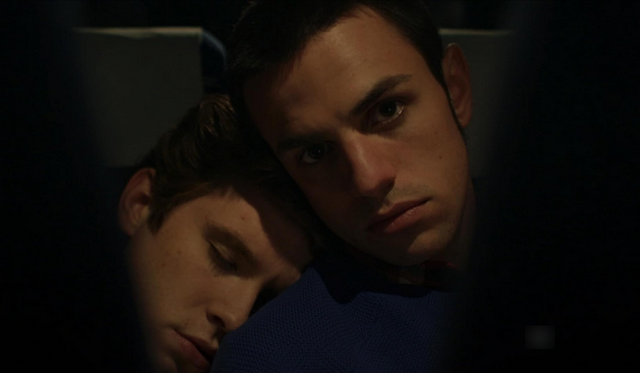
That long gestation may explain the extraordinary specificity evident in virtually every frame. Di Pace was in his early forties before making the leap into feature directing, and rather than approaching the process tentatively, he and Estrada immersed themselves in every detail. “Every detail of the film was decided, from the color of the shirt of a background artist to what note should the cello play in this specific part.” For Di Pace, that degree of decision-making wasn’t a burden. It was part of the attraction.
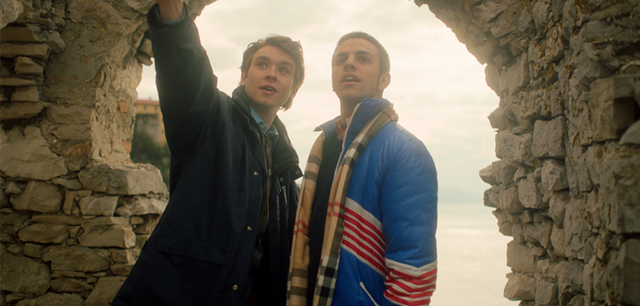
“I loved having that amount of sort of decision-making in the process with my co-director Andrés Pepe Estrada,” he says, also singling out cinematographer Devin Doyle, with whom he had previously worked. “I recognized what an artist he is. So the photography, the locations—I mean, the light in northern Italy is just to die for, and you really see that.” You do.
Working with Doyle, Di Pace and Estrada essentially create two visual worlds within one film. The past, particularly Matias’ years at school, is expansive, softly illuminated and alive with color. The present is cooler, grayer, tighter and increasingly claustrophobic, reflecting a man attempting to finish a film while remaining emotionally caught within the memories that inspired it. As Matias begins finding his way through those memories rather than merely living inside them, the visual world begins to breathe with him.
But BEFORE WE FORGET does more than move between two time periods. Its editing mimics the peculiar behavior of memory itself. Images arrive in flashes. Photographs become emotional triggers. A face, place or fragment from the past suddenly intrudes upon the present. For Di Pace, one of the keys to unlocking that structure was something far more tactile than a digital timeline: the old-fashioned family photo album.
“It really was about opening a photo album. You know, we used to have those where you put the actual photos in the album with, like, train tickets and stuff.” He remembers how a single photograph can release much more than a visual memory. “In each picture you see a scene, and you get immediately, when you see a picture, you might remember a smell or a sensation or a conversation that was happening during the time in that picture.”
That sensation became one of the governing ideas behind BEFORE WE FORGET. Although Di Pace incorporated experiences from his own life, he is careful not to call the film autobiographical. Instead, memory provided raw material that could be reshaped into something larger.
“I always say it’s not an autobiographical film, but I did take events from my life, and I kind of reworked and rethought them and created around them.”
The specificity of those memories ultimately serves something universal: that almost indescribable enormity of first love and the way an experience at seventeen can remain emotionally present decades later. “Not everyone went to a boarding school in Italy and fell in love with their best friend,” Di Pace laughs, but he hopes the film evokes “that nostalgic moment of when you’re 17 and you’re in this place, either physically or emotionally, that is unexplainable.”
Yet Di Pace and Estrada were equally interested in what remains unexplained.
“There’s the poetic tier, the aesthetic tier. There’s what is said in the text, but then there’s what is not said in the subtext.”
Estrada, an accomplished editor in his own right, had articulated an idea early in the process that became something of a guiding principle: the films that stay with him are those that leave him asking questions. “Never give an answer to an audience,” Di Pace recalls. “And I think that sums up BEFORE WE FORGET a little bit, because I really, really went with that. I like this because it’s like my favorite films. They don’t tell me how to think.”
Among those unanswered questions are ones involving not only romantic love, but parental love. Di Pace calls the film a love letter to his parents, and nowhere is that felt more powerfully than in the relationship between young Matias and his mother, Roma, played by Araceli González.
There is a scene between mother and son following Christmas that I will not describe—and neither will Di Pace. Some moments deserve to remain untouched until an audience encounters them.
“You might want to bring some tissue,” he warns. He isn’t kidding.
González gives the scene an extraordinary emotional honesty, something made still more personal by the fact that Roma was inspired by Di Pace’s own mother, Martha Mineri. “That character is based on my own mother,” he reveals. “My mother was the art director and the costume designer of the film, so it was a bit of a family affair. But to have Araceli play her so to the T, because that’s exactly what my mom is like, it was kind of unbelievable.”
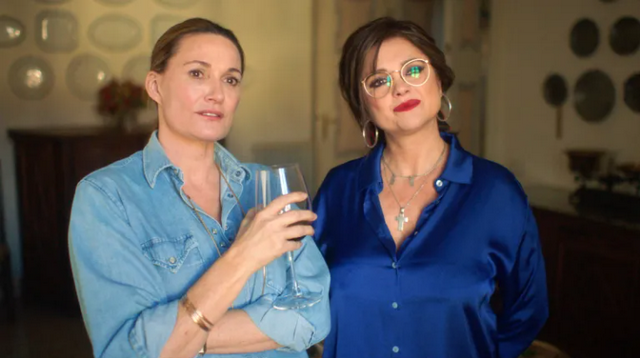
That familial connection quietly extends the film’s exploration of memory beyond its narrative. Di Pace wasn’t simply recreating fragments of remembered experience; his own mother was helping determine the physical world and clothing through which those memories would be expressed.
And then there is music.
A musician himself, Di Pace doesn’t regard a score as something applied after the emotional work has been completed. For him, it is another storytelling language. “Music to me sometimes is way more important than words in movies,” he says.
Working with Icelandic composers Kjartan Holm and Sindri Mar Sigfusson, Di Pace found what he describes as a “dreamy, yet symphonic, yet whimsical quality,” while Italian composer Dorian Dionisi contributed songs and pieces heard throughout the film, including a recurring tango theme. “The music is a narrator,” Di Pace says.
But narration, in this instance, does not mean emotional instruction. “Never use music to tell people how to feel, but to sort of suggest and also give them something unexpected as well.”
The same attention extends to the soundscape, where ambient life within the school, voices, nature and environmental textures are carefully layered beneath and around the score. It is another component of a film in which Di Pace and Estrada wanted no element to feel arbitrary.
“Everything, everything, everything pays off when you’re specific about all the elements,” Di Pace says.
That insistence upon specificity leads Di Pace to a subject about which he is particularly passionate: maintaining a singular artistic voice. “I wanted Andrés’ and my voice to be one voice throughout in every single decision.”
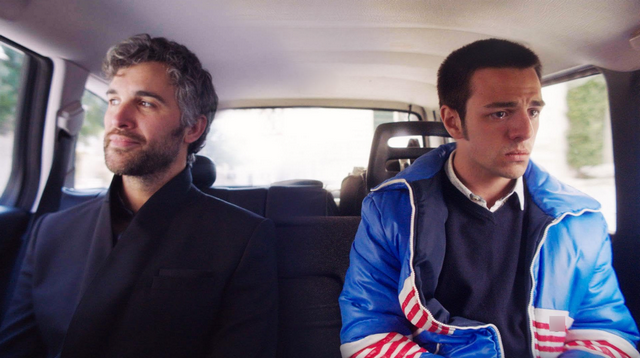
And among those encouraging Di Pace and Estrada to protect that voice was one of BEFORE WE FORGET’s executive producers, the late Norman Lear. “Make sure you make the film you want to make,” Di Pace recalls Lear telling them.
It was deceptively simple advice from a man who knew something about preserving a creative voice—and advice that Di Pace took to heart. For an actor accustomed to contributing a performance and then surrendering control over how that performance is ultimately shaped, becoming a filmmaker changed the equation. “Actors don’t get to decide,” Di Pace says. “You get to have opinions, and you could suggest, but at the end of the day, your work gets edited.” Not this time.
“As a filmmaker, I did not want that at all. I was like, ‘No, no, no, no, no. This is going to be exactly what’s in our mind.’” The result, he says, leaves him “incredibly satisfied and proud because we were able to do that.”
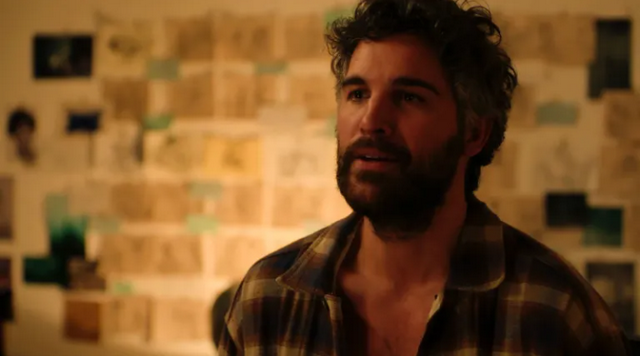
There is, however, an intriguing paradox in Di Pace’s insistence upon creative control. To give his own performance as the adult Matias the freedom it needed, he had to relinquish that control completely. Before shooting, he established a rule with Estrada. “When I’m on set playing Matias, I am your actor.”
That meant no monitoring the camera, no worrying about the lights and no attempting to direct himself while simultaneously inhabiting the character.
“I didn’t want to see what was going on on camera. I didn’t want to hear what they were doing with the lights or anything like that.” Instead, Di Pace told his co-director, in essence, I’m yours.
“You do whatever you want. Tell me where to stand.” Far from finding that surrender frightening, he found it liberating.
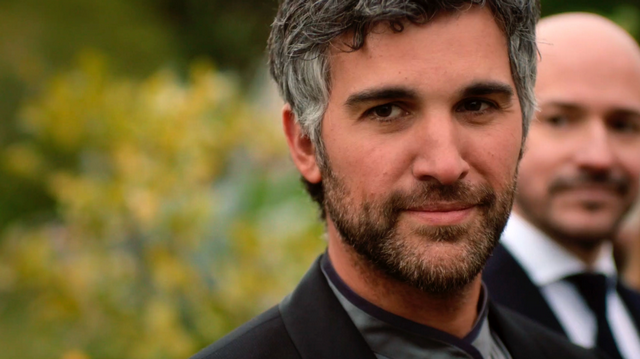
“My brain was overloaded with responsibility throughout, so it was a little bit of a respite. It was a bit of a breathing out when I was onscreen.”
And because Matias was a character Di Pace had carried through the writing process and whose emotional terrain was particularly close to him, inhabiting him proved unexpectedly natural.
“It was surprisingly easy. I think I had way harder times playing other roles than Matias. Maybe because I’m very close to Matias anyway.”
That ability to surrender one hat while wearing so many others may be one of the more important lessons of BEFORE WE FORGET. Co-writing, co-directing, co-editing and starring in a first feature meant Di Pace wasn’t simply learning how to frame a shot or communicate with actors. He was learning how to withstand the relentless decision-making that comes with responsibility for an entire film.
And filmmaking, he discovered, produces fires. Lots of them.
“I learned to kind of categorize the different fires and degrees of fires that happen,” he says. Some can wait. Others cannot. Weather changes. Plans collapse. Decisions pile upon decisions. Anxiety becomes part of the job. “You are answering a lot of people, and you are having to make decisions all the time.”
Di Pace compares directing a movie to going to war—not because of combat, but because both require strategy, adaptation and an ability to respond when circumstances suddenly change.
For his next film, he knows one lesson from BEFORE WE FORGET will follow him: manage the anxiety, identify which fire needs extinguishing first and keep moving.
“That’s a big lesson in prioritizing tension,” he says, “and hopefully turn tension into beauty, which can be done.”
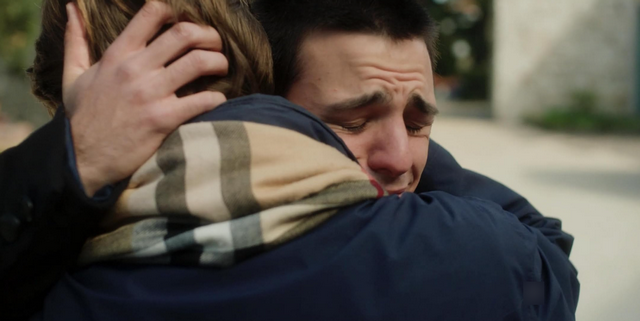
With BEFORE WE FORGET, Juan Pablo Di Pace already has.
And perhaps that is what makes this particular feature debut so striking. Di Pace may have waited until his forties to direct his first feature, but he didn’t spend those years waiting to become a filmmaker. He was accumulating the pieces—performance, movement, music, rhythm, image, emotion and memory—that he and Andrés Pepe Estrada would ultimately bring together with a singular voice.
Some stories need time before we’re ready to tell them. And some memories need time before we understand what they’ve been trying to tell us.
by debbie elias, exclusive interview 09/24/2026
BEFORE WE FORGET is streaming on October 20th on AppleTV, Prime Video, and other platforms.