
By debbie lynn elias
There is an art to playing crazy. And then there is the art of playing crazy without ever letting the character know she’s crazy. For Rachel Dratch, that distinction is at the heart of her deliciously offbeat performance as Antoinette Funk in writer/director Jason Laurits’ LOVES COMPANY, a wickedly funny comedy about loneliness, celebrity worship, misplaced affection, and the dangers of meeting your idols. Or, in Antoinette’s case, bringing one home from the Florida Everglades.
Best known for her seven seasons on SATURDAY NIGHT LIVE and a seemingly endless parade of unforgettable comic creations, including the perpetually pessimistic Debbie Downer, Dratch has long demonstrated an extraordinary gift for finding humor in the peculiarities of human behavior. But with LOVES COMPANY, she takes that gift in a slightly different direction, delivering a performance that is simultaneously outrageous, understated, unsettling, and surprisingly sympathetic.
Because Antoinette Funk may be a woman whose house is overflowing with decades-old possessions, whose porch is practically buried beneath an army of stuffed elephants, and whose emotional well-being depends upon a washed-up television personality named Blake de Troy, but there’s something very real beneath all that eccentricity.
And Dratch knows it.
“I think it was a little off the beaten path of what I usually do,” Dratch explains of her attraction to LOVES COMPANY and Antoinette. “Even though I love doing big broad comedy and SNL-style stuff and sitcoms and that kind of thing, this was a little bit more—well, definitely still a quirky and extreme character, but in a kind of a more subtle tone, if you will.”
It’s an intriguing distinction. For all the absurdity of Antoinette’s circumstances, Dratch recognized that the character required an emotional foundation strong enough to support the comedy.
And therein lies the secret to Antoinette Funk.
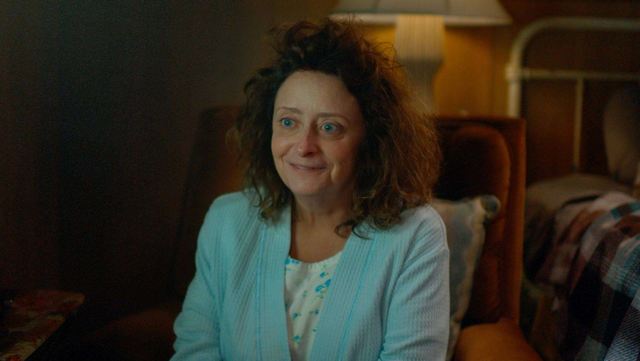
THE WOMAN BEHIND THE MADNESS
In LOVES COMPANY, Antoinette is a lonely Florida woman whose world revolves around memories, family grievances, and her unwavering devotion to Blake de Troy (Jack Plotnick), a flamboyant former television personality whose glory days are long behind him.
When Blake crashes his car in the Everglades, Antoinette believes fate has finally delivered the one person capable of making her life complete. Blake, on the other hand, is considerably less enthusiastic about the arrangement.
With a premise that playfully evokes MISERY, Laurits turns the familiar celebrity-and-obsessive-fan relationship into something considerably more absurd. But unlike a conventional tale of captivity and terror, LOVES COMPANY finds its humor in the emotional shortcomings of both characters.
Antoinette wants someone to love. Blake wants someone to adore him. Neither is particularly equipped to recognize what the other actually needs.
For Dratch, the challenge isn’t simply to make Antoinette funny. It’s to make her behavior understandable within the reality of her own world. That requires a certain restraint.
Rather than approaching Antoinette as a collection of exaggerated comic mannerisms, Dratch allows her peculiarities to emerge from the character’s circumstances, disappointments, and unquestioning belief in the fantasy she has constructed around Blake. Antoinette doesn’t see herself as ridiculous. She sees herself as someone who has finally been given a chance at happiness. And the more seriously Dratch takes that conviction, the funnier the situation becomes.
“Even though it does go to some extreme places, she had to be sort of real, for lack of a better word, even though she also has her issues.”
It’s that insistence on reality that makes Dratch’s approach so effective. Antoinette’s circumstances may be absurd, but her feelings are not. The character doesn’t need to recognize the ridiculousness of her situation for the audience to find it funny. In fact, the more sincerely she believes in her own version of events, the more wonderfully uncomfortable—and hilarious—the comedy becomes. It’s a fascinating contrast to the broader sketch-comedy performances for which she is so widely recognized. Where a character like Debbie Downer finds humor in the collision between her own perspective and the reactions of everyone around her, Antoinette’s comedy often comes from the distance between what she believes is happening and what the audience can plainly see.
The underlying principle, however, is much the same: a character who inhabits her own peculiar reality with absolute conviction. And while Dratch has an academic background in psychology, it is her own description of the acting process—not any presumed connection to her studies—that offers the clearest insight into her approach. Antoinette must feel real; even when absolutely nothing around her seems remotely normal.
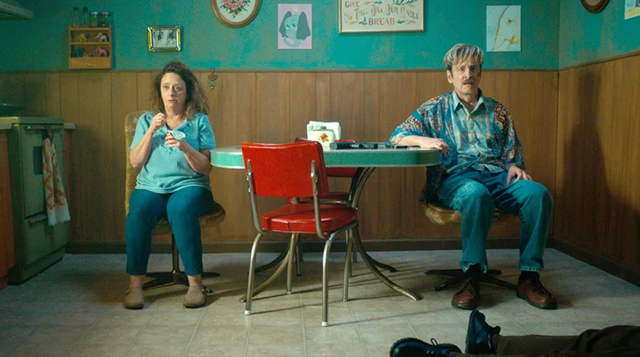
RACHEL DRATCH, JACK PLOTNICK, AND THE PERFECTLY IMPERFECT PAIRING
Of course, Antoinette’s reality becomes considerably more complicated once Blake de Troy enters her home. Played with gloriously theatrical excess by Jack Plotnick, Blake is a relic of an earlier entertainment era, a man whose flamboyant television persona has become inseparable from his sense of self. Antoinette sees the personality she remembers from television. Blake sees an opportunity to be worshipped. Neither sees the other particularly clearly.
For Dratch, the dynamic between the two characters was already firmly established in Laurits’ screenplay.
“I think that was a lot about the writing because Jason Laurits, the writer-director, wrote these two crazy characters,” she says.
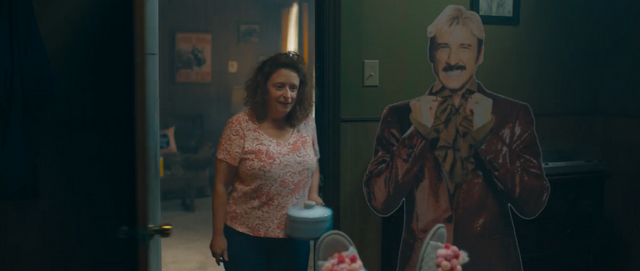
She describes Blake as a personality reminiscent of the legendary Paul Lynde, a larger-than-life entertainer whose television appearances made him instantly recognizable to generations of viewers.
“Blake plays this sort of Paul Lynde type, this really over-the-top guy that Antoinette thinks has it all. He’s so funny. He’s the perfect gay best friend.”
But the fantasy quickly begins to unravel. “Then she finds out that he’s not at all what he seems.”
It’s an essential observation, because the relationship between Antoinette and Blake is built upon a fundamental misunderstanding. She has fallen in love with a television persona, not the actual human being behind it. And the real Blake is a demanding, self-absorbed, increasingly volatile man whose dependence on attention is every bit as consuming as Antoinette’s need to give it.
For Dratch, having Plotnick as her scene partner made those escalating discoveries all the more entertaining.
“It was kind of easy to play when you’re looking at Jack being, like, crazy-eyed and losing his marbles, let’s say, in front of your eyes. So I think that’s a testament to the writing.”
And a testament to the chemistry between two performers who understand that comedy isn’t simply about delivering a funny line. It’s about listening, reacting, and allowing one character’s behavior to provoke something unexpected in the other.
Dratch’s comparatively grounded performance gives Plotnick’s extravagant Blake something to collide with. His increasingly outrageous behavior, in turn, exposes the fragility of Antoinette’s carefully maintained fantasy. It’s a comic partnership built on contrast, timing, and the willingness of both actors to inhabit their characters completely.
WHEN THE SCRIPT IS SO GOOD, YOU DON’T NEED TO IMPROVISE
Given Dratch’s extensive background in improvisational comedy, including her work with The Second City and SATURDAY NIGHT LIVE, one might reasonably expect a filmmaker to invite her to improvise freely. Laurits did exactly that. But Dratch makes an interesting point about the relationship between improvisation and strong writing.
“Yeah, he did,” she says of Laurits allowing the actors latitude to explore beyond the script. “If we had any ideas—it’s funny, though, because I think when something’s really well written, sometimes I don’t have any extra ideas.”
She laughs at the notion of trying to improve something that already works. “There wasn’t a lot that I felt like, ‘Oh, I got something better for this.’ But he did let us kind of go off if we wanted to and make our own stuff, or do another take that’s a little bit different. So yeah, there was room for improvising.”
It’s a revealing compliment to Laurits’ screenplay, particularly coming from a performer whose career has been built in part on the ability to generate comedy spontaneously. It also speaks to the discipline underlying Dratch’s work.
Improvisation isn’t necessarily about changing the words. Sometimes it’s about discovering a different reaction, finding a slightly altered rhythm, or allowing a moment of silence to do the work of an entire speech.
And in LOVES COMPANY, where so much of the comedy depends upon the interplay between Antoinette’s expectations and Blake’s behavior, those subtle variations can be invaluable. The actors have room to explore, but the screenplay provides a sturdy foundation. For a film that balances broad absurdity with moments of genuine emotional vulnerability, that balance is essential.
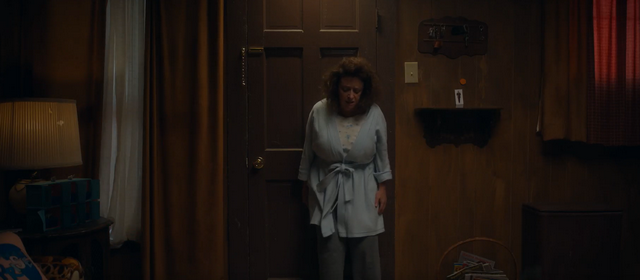
A CHARACTER BUILT FROM THE HAIR DOWN
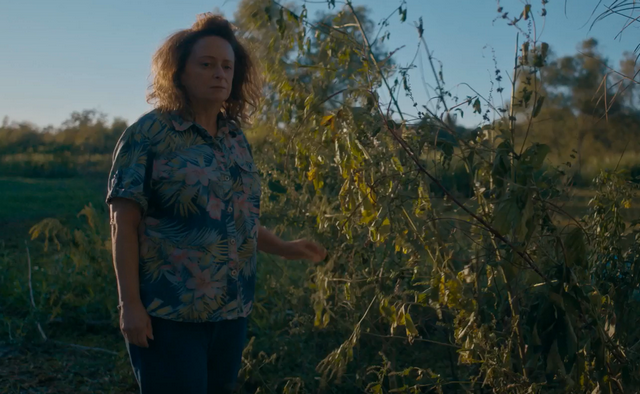
Of course, inhabiting Antoinette Funk involves considerably more than understanding her emotional motivations. There’s the matter of how she looks. And Antoinette is most definitely not a woman who spends her mornings contemplating the latest fashion trends. With her dated clothing, practical footwear, and spectacularly teased hair, she appears to have stepped out of a world that stopped changing decades ago.
For Dratch, those physical details were enormously important in discovering the character. “Definitely the hair and the costumes helped a lot for this,” she explains. “There’s that thing as an actor where sometimes, as soon as you put on the shirt or the shoes or see the hair, it’s like, ‘Oh, this does 90% of the work for me.'”
It’s an observation that goes directly to the collaborative nature of filmmaking.
A costume isn’t simply something an actor wears. It can reveal how a character sees herself, how she moves through the world, what she values, and what she has stopped caring about. And sometimes the smallest detail can unlock an entire performance.
“You can look at a person for a split second and be like, ‘Oh, that’s who that person is.’ And that’s what the costumes and hair did.”
Working with costume designer Wendy Talley, Dratch found Antoinette’s identity in clothes that were comfortable, familiar, and utterly unconcerned with glamour. Antoinette has spent much of her life caring for others, and her wardrobe reflects a woman who has long since stopped dressing to impress anyone. Dratch, however, couldn’t resist laughing at the finished result.
“Definitely not my most glam role. When I saw it on screen, I was like, ‘You know, maybe a little eyeliner next time.'”
But she immediately acknowledges the reason behind the transformation. “We were going for reality here.”
And reality, in Antoinette’s world, includes one truly magnificent hairstyle. A hairstyle so aggressively teased that it almost seems to deserve its own screen credit. Surely, one might think, that had to be a wig. Not so. “It was my hair that they teased,” Dratch reveals.
And fortunately, the transformation wasn’t permanent. “It was okay. It went back to normal.”
Getting it to those extraordinary heights, however, required some serious effort. “Quite a bit,” she laughs when asked about the amount of hairspray involved, “plus a lot of comb teasing kind of thing.”
It’s a wonderfully funny anecdote, but it also underscores how fully Dratch embraced the character’s physical identity. The hair isn’t an accessory to the performance. It’s part of the performance.
A HOUSE THAT TELLS ANTOINETTE’S STORY
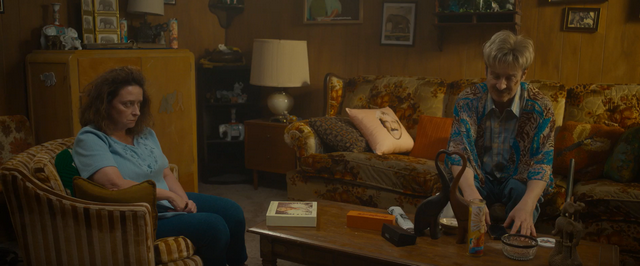
Then there is Antoinette’s house. A family home seemingly preserved in another era, filled with old furnishings, accumulated possessions, television memorabilia, and an almost astonishing number of elephants. Stuffed elephants. Elephant decorations. Elephants everywhere. And outside, an entire menagerie of stuffed pachyderms zip-tied to the porch railings, creating a welcome that is equal parts whimsical, bizarre, and vaguely unsettling.
Working with production designer Sara Nyquist and the film’s design team, Laurits created an environment that reflects Antoinette’s emotional circumstances. She is a woman surrounded by the past, living among the remnants of a family history that she has never quite escaped.
For Dratch, stepping into that environment was another essential part of becoming Antoinette.
“The house, it kind of just—it’s like playing make-believe as a kid,” she explains. “You’re walking through the house, you know who you are, kind of thing.”
It’s a simple statement with considerable significance. The environment allows the actor to respond instinctively to the world around her. The objects have meaning. The rooms have history. The character belongs there.
And because Antoinette belongs in that house, her eccentricities become less like isolated comic inventions and more like natural extensions of the life she has built. The elephants may strike everyone else as ridiculous, but to Antoinette they are simply part of home.
And when Blake enters that home, the clash between his carefully cultivated celebrity identity and her deeply personal, cluttered existence becomes another source of comedy.
The production design isn’t merely a backdrop for the performances. It helps tell the story.
And Dratch’s appreciation of that immersive environment reveals just how much an actor can draw from the work of the artisans surrounding her.
ALWAYS LOOKING FOR THE FUN
For all the oddities of Antoinette Funk, the role fits comfortably within Dratch’s broader philosophy about the projects she chooses. Quite simply, she wants to have fun.
“I love doing theater. I love doing something just fun. I look for the fun,” she says. “I don’t really look for anything heavy drama. It’s just not my thing.”
That preference has taken her through an extraordinarily varied career, from sketch comedy and sitcoms to feature films, voice acting, commercials, and musical theater. And she continues to seek out opportunities that allow her to explore different kinds of comic performance.
“I love musical theater,” she says, before mentioning her work on A MAN ON THE INSIDE with Ted Danson. “I just shot some episodes of Man on the Inside with Ted Danson. That was really fun because that was another sort of quirky, more comic character.”
Her recent theatrical work has been equally rewarding.
After spending seven months in the world of THE ROCKY HORROR SHOW, Dratch speaks enthusiastically about playing the Narrator, a role that allowed her to guide audiences through one of musical theater’s most gloriously eccentric experiences.
“The Narrator in Rocky Horror, is not like ha-ha funny the whole time, but she’s guiding the—she’s kind of steering the ship in this fun, crazy world.”
And for Dratch, the immediate connection with an audience is something film and television simply cannot duplicate. “There’s nothing like the live audience there. So looking to do more of that, even though the schedule can be pretty rough.”
But the demands of live theater haven’t diminished her enthusiasm. “I’m just looking for the fun.”
It’s a philosophy that also extends to voice acting, another area in which Dratch has found considerable creative freedom.
Discussing her role in the upcoming animated project HEXED, she describes a small but enjoyable part. “I actually have a little cameo role, but I’m excited to see it. It was a lot of fun to do. I’m playing a little witch!”
And voice work has its own very practical advantages. “I like doing voices, too. You can just show up in your sweatpants, as they say.”
For someone who has spent a career transforming herself into wildly different personalities, the opportunity to create a character without worrying about wardrobe or makeup must occasionally feel like a luxury. Although after the hair-raising experience of playing Antoinette Funk, one can certainly understand the appeal.
FROM ANTOINETTE FUNK TO PATTY — WITH A LITTLE TIME WARP IN BETWEEN
Dratch’s next theatrical adventure will take her into an entirely different world when she appears as Patty in YOU’RE A GOOD MAN, CHARLIE BROWN at New York’s City Center in February.
“Actually, I’m doing another musical in February, You’re a Good Man, Charlie Brown, at City Center for a very quick run,” she says.
And she’s looking forward to joining the small ensemble. “It’s gonna be fun. It’s only six people in the cast.”
From the loneliness of Antoinette Funk to the beloved comic-strip universe of Charles M. Schulz, it’s another example of the range of characters Dratch continues to embrace.
But before leaving the subject of musical theater, there’s one all-important question that simply demands an answer.
After seven months performing in THE ROCKY HORROR SHOW, just how well did Rachel Dratch learn the Time Warp? “Oh, pretty well because I had to do it in the curtain call,” she laughs.
And, as the Narrator, she had a particularly memorable contribution. “OF COURSE, my part in it is to say, ‘It’s just a jump to the left.’ So I got to participate in the Time Warp every night.” And when the curtain call arrived, everyone joined in. “We all did the Time Warp together, so that was fun. I got to participate.”
It’s a delightful glimpse into the joy Dratch finds in performance, whether she’s standing before a live theater audience, recording a voice in a studio, or disappearing into the peculiar world of Antoinette Funk. Because for all the different characters she has played, the common thread remains her affection for comedy and the people who inhabit it.
And with LOVES COMPANY, Rachel Dratch reminds us that some of the funniest characters are also the ones who most desperately want what everyone else wants: to be seen, to be appreciated, and to have someone with whom to share their lives.
Antoinette Funk may have a hundred elephants on her porch, a house full of memories, and a celebrity obsession that takes her into some spectacularly questionable territory. But beneath the eccentricity is a woman searching for connection.
Rachel Dratch makes us laugh at Antoinette’s circumstances without losing sight of the person living inside them. And that’s the real magic of the performance.
After all, comedy doesn’t always require a character to recognize the absurdity of her own existence. Sometimes it simply requires an actor who understands her well enough to let the rest of us recognize it.
And if all else fails, there’s always the Time Warp. Just a jump to the left.
exclusive interview 11/04/2026
LOVES COMPANY is available On Digital and On Demand on November 10th.