By debbie lynn elias
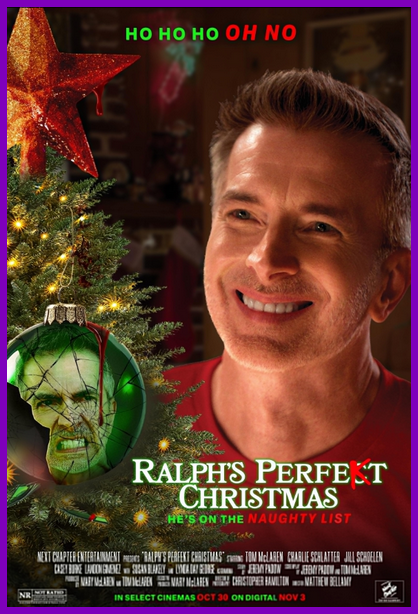
Ho! Ho! Ho! Hold on to your Santa hats! Just when you think you’ve seen every possible variation on the Christmas movie, along comes RALPH’S PERFEKT CHRISTMAS, a delightfully demented holiday offering that takes the familiar trappings of Christmas cheer, tosses in a generous helping of cinematic nostalgia, adds a little marital discord, a washed-up child star, some questionable decision-making, and a roll of duct tape, and then proceeds to turn the holiday season on its head. Written by Jeremy Padow and Tom McLaren, directed by Matthew Bellamy, Mary McLaren, and Tom McLaren, and starring McLaren himself, RALPH’S PERFEKT CHRISTMAS is a dark comedy that gleefully dances along the edge of absurdity before taking a decidedly unexpected turn into horror territory. And what a twist it is!

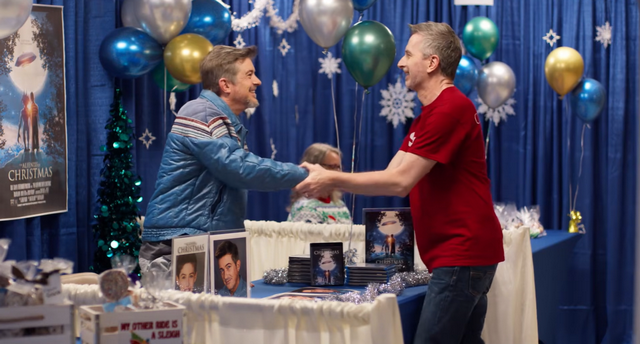
Meet Ralph Bailey. Ralph loves Christmas. No, really. He LOVES Christmas. Not just on December 25th, but 365 days a year. Christmas movies, Christmas decorations, Christmas music, Christmas clothing, Christmas everything. For Ralph, Christmas isn’t merely a holiday. It’s a way of life. And at the center of his Christmas universe is his all-time favorite movie, “The Alien Who Saved Christmas”, a fictional holiday classic starring former child actor Kurt Fields.
Unfortunately, Ralph’s devotion to all things Christmas hasn’t exactly worked wonders for his marriage to Heather (Jill Schoelen). Determined to win back his wife and restore his family to what he believes is its rightful state of holiday bliss, Ralph concocts a plan involving Kurt Fields (Charlie Schlatter). It’s a plan that might make perfect sense in Ralph’s Christmas-obsessed mind but raises more than a few eyebrows for everyone else.
And that’s where the fun really begins.
What makes RALPH’S PERFEKT CHRISTMAS such an unexpected treat is the way it embraces the traditions of classic Christmas cinema while simultaneously playing with, and ultimately upending, our expectations of the genre. The film is positively overflowing with affectionate references to beloved holiday movies, beginning with the Bailey family name, an unmistakable nod to George Bailey of It’s a Wonderful Life. Look a little closer and you’ll find Elizabeth Lane and John Sloan from Christmas in Connecticut, Susan Walker from Miracle on 34th Street, and other carefully placed cinematic Easter eggs that make this a veritable treasure hunt for movie lovers.
These aren’t simply throwaway references. They are integral to the film’s personality, reflecting Ralph’s obsessive attachment to an idealized vision of Christmas and the filmmakers’ own affection for the movies that have become part of our collective holiday memories.
And the casting!
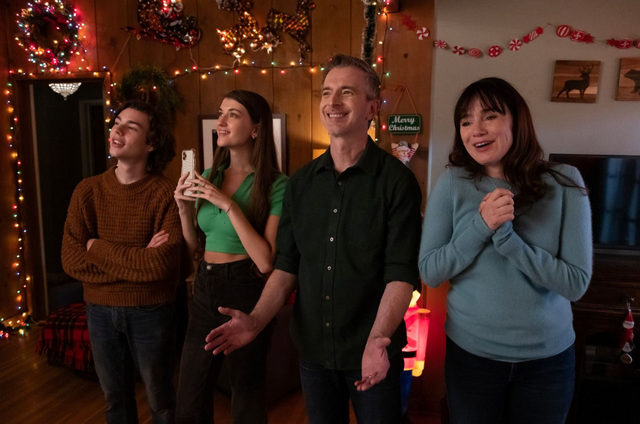
Tom McLaren surrounds himself with an ensemble that is as much a celebration of film and television history as it is an exercise in finding the right performer for each role. Jill Schoelen brings warmth and emotional grounding to Heather, while Casey Burke and Landon Gimenez round out the Bailey family as Bridget and Tommy. Charlie Schlatter is particularly entertaining as Kurt Fields, wisely avoiding the obvious caricature of a bitter, washed-up former child star. Instead, Schlatter gives Kurt a likable, almost disarming quality that makes his interactions with Ralph all the more engaging.
Susan Blakely is a comedic delight as Kurt’s agent, Diane Bryce, while Lynda Day George makes a welcome return to the screen as Grandma, bringing with her an infectious smile and an effortless charm. Nicholle Tom and Trevor Lissauer add to the fun, as do the wonderful Marta Kristen, Angela Cartwright, and Bill Mumy.
Yes, that’s right. The three Robinson children from the original Lost in Space are reunited on screen! And what better movie for their reunion than one revolving around The Alien Who Saved Christmas?
For those who grew up watching the Robinson family travel through the cosmos aboard the Jupiter 2, this is an especially delightful treat. And eagle-eyed viewers should pay close attention to the poster artwork for Ralph’s favorite film. The Easter eggs don’t stop with the cast.
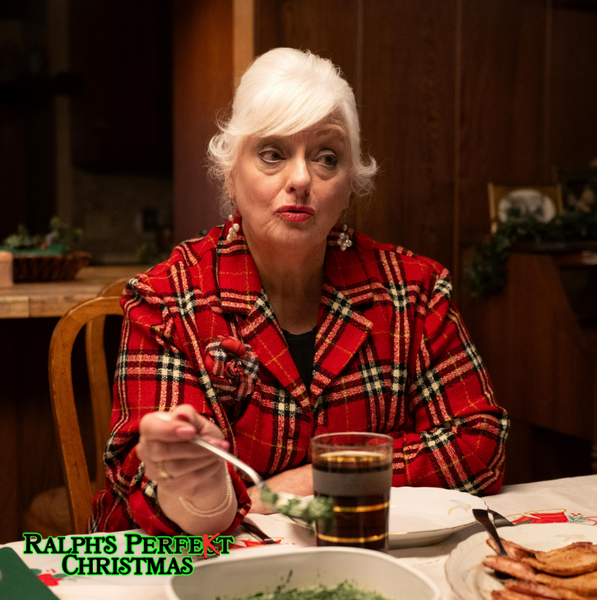

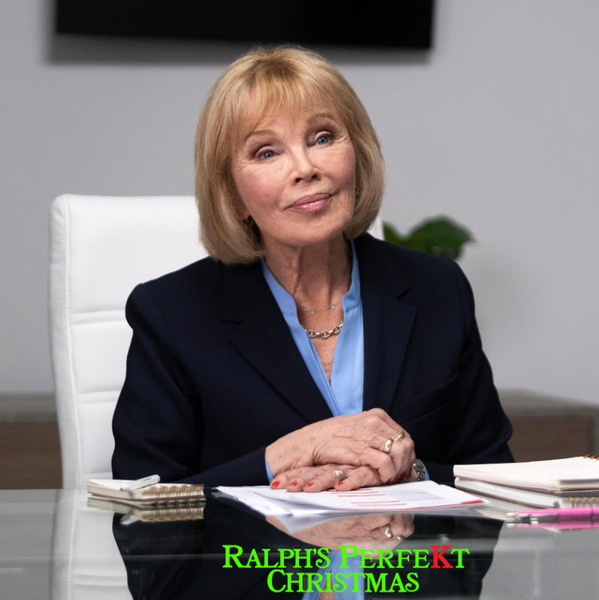
Equally entertaining are the details tucked into the production design. Take a good look around Diane Bryce’s office, where posters inspired by Susan Blakely’s own filmography have been cleverly altered to fit the fictional world of the movie. These are the kinds of touches that demonstrate how much thought and affection have gone into the production. They’re not essential to understanding the story, but they make the experience that much richer for viewers who notice them.
At the heart of the film, however, is McLaren’s performance as Ralph.
Ralph is an interesting character precisely because he’s not easily defined. On the surface, he’s affable, enthusiastic, perhaps a little too devoted to Christmas, but seemingly harmless. Yet there’s something about him that never feels entirely settled. His persistent optimism, his unwavering conviction that he knows what constitutes the perfect Christmas, and his increasingly questionable judgment create an underlying uneasiness that grows as the film progresses.
Particularly effective is the decision to have Ralph repeatedly break the fourth wall, addressing the camera and speaking directly to the audience. At first, these moments seem like playful comedic devices, inviting us to share in Ralph’s holiday enthusiasm. But as the story develops, those same direct addresses become increasingly disconcerting. Are we being invited into Ralph’s confidence, or are we being drawn into a reality that exists primarily in his own imagination?

It’s a fascinating distinction, and one that McLaren exploits to considerable effect.
The screenplay has an almost vignette-like construction, with individual encounters and situations unfolding as pieces of Ralph’s increasingly elaborate Christmas scheme. There are moments when the transitions between these episodes feel somewhat disconnected, but that fragmentation also contributes to the growing divide between the world as Ralph perceives it and the world everyone else inhabits. The film doesn’t always move with conventional narrative fluidity, and at 119 minutes it occasionally lingers longer than necessary. Nevertheless, its willingness to take chances with tone and structure is part of its appeal.
And then comes the tonal transformation.

Without revealing a single one of the film’s delicious surprises, suffice it to say that RALPH’S PERFEKT CHRISTMAS doesn’t remain the same movie it appears to be at the outset. What begins as an eccentric holiday comedy gradually develops darker undertones, ultimately venturing into territory that is as unsettling as it is outrageous. It’s a transition that could easily have collapsed under the weight of its own ambition, but McLaren’s commitment to keeping Ralph’s true nature ambiguous helps hold the disparate elements together.
Is Ralph a fundamentally decent man driven to extremes by circumstances? Is he a man whose judgment has simply gone spectacularly awry? Or has something more troubling been lurking beneath that perpetual Christmas smile all along?
The film wisely leaves those questions for the audience to consider.
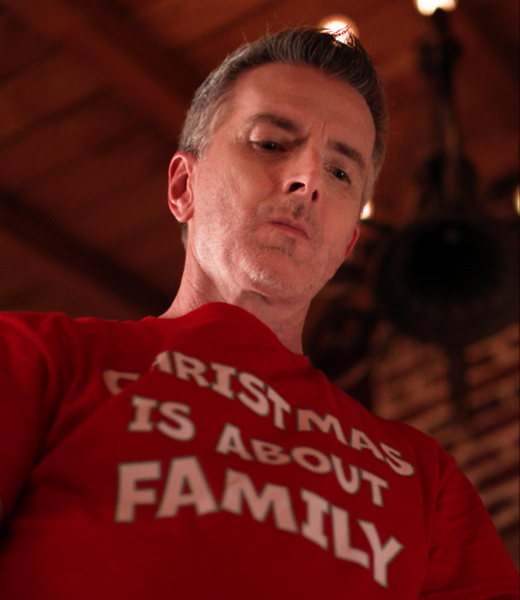
One of the most important elements supporting that ambiguity is the cinematography of Christopher Hamilton, whose visual approach is light, bright, colorful, and beautifully saturated. Reds, greens, golds, whites, and blues dominate the screen, celebrating the familiar palette of Christmas in a way that is both inviting and deceptively comforting.
Hamilton makes excellent use of framing, with an abundance of close-ups and extreme close-ups that keep us intimately connected to Ralph, particularly as he smiles, talks, and presents his version of the perfect holiday. There’s a visual immediacy to these compositions that reinforces Ralph’s direct relationship with the audience while subtly increasing our awareness of his increasingly unusual behavior.
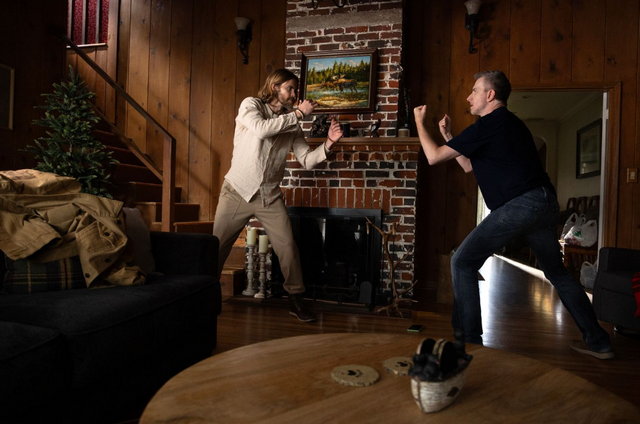
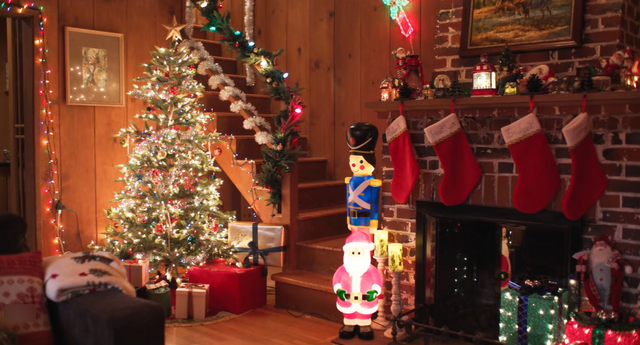
Particularly noteworthy is the photography inside the Big Bear cabin. With its wood-paneled walls, darker corners, and beautifully decorated Christmas tree, the location provides a rich visual playground. Hundreds of tiny white lights illuminate the tree, creating a constant source of practical light that Hamilton incorporates into his compositions. The result is a warm, almost storybook atmosphere, with glowing points of light adding depth and dimension to the frame.
But there’s a wonderful contradiction at work here. Even as the narrative moves toward darker emotional and psychological territory, the Christmas lights continue to glow. The decorations remain cheerful. The colors retain their vibrancy. The visual world refuses to abandon the holiday spirit, even when the events unfolding within it become decidedly less festive.
It’s a clever visual counterpoint that heightens the film’s tonal contradictions rather than diminishing them.

The care taken with lighting and color correction is apparent throughout. Even in scenes involving shadow, backlighting, and the darker recesses of the cabin, the imagery retains a polished, dimensional quality that belies the film’s independent budget. The production values are impressive, particularly given the challenges of maintaining visual consistency across a story that moves from broad comedy into much more dramatic territory.
The film’s editing, credited to Ana Christiano, also plays an important role in negotiating those shifts. The juxtaposition of Ralph’s cheerful direct addresses, his increasingly elaborate plans, and the reactions of those around him creates a rhythm that alternates between playful comedy and mounting unease. Although some sequences could benefit from tightening, the cumulative effect is one of escalating unpredictability, with the audience never entirely certain where Ralph’s next decision will lead.
Equally important is the music.
Composer Alexandre Côté delivers an original score that works in tandem with familiar Christmas music, creating a soundscape that reinforces both the film’s nostalgic sensibilities and its evolving dramatic tension. The integration of traditional holiday selections with Côté’s fresh compositions is particularly effective, allowing the music to move between warmth, whimsy, and more ominous emotional territory without feeling disconnected from the film’s overall identity.
Of particular note is the use of live musicians for selected dramatic passages, adding an organic richness and immediacy to moments when the story demands greater emotional weight.
The soundtrack is also filled with musical surprises. Bill Mumy’s wonderfully cheeky “I’ve Got Some Presents for Santa” is put to especially entertaining use, while Jill Schoelen’s rendition of “Have Yourself a Merry Little Christmas” brings an unexpected emotional resonance. And for those who, like me, watch a film all the way through its end credits, there’s the added pleasure of hearing Susan Anton singing “Jingle Bells.”
Even the musical selections become part of the film’s larger celebration of performers and entertainment history.
And speaking of celebrating craft, how can one resist a film that brings in the talents of Howard Berger for its alien prosthetic makeup? The alien mask featured in “The Alien Who Saved Christmas” is a wonderful creation, adding an authentic touch of genre filmmaking to Ralph’s beloved fictional holiday movie.
Stunt coordinator Alex Kingi also contributes to the production, bringing another connection to a family steeped in Hollywood history. And when the film ventures into its darker material, practical effects take center stage, with just enough blood and gore to remind audiences that this isn’t your grandmother’s Christmas movie.
Which brings us to one of my favorite elements.
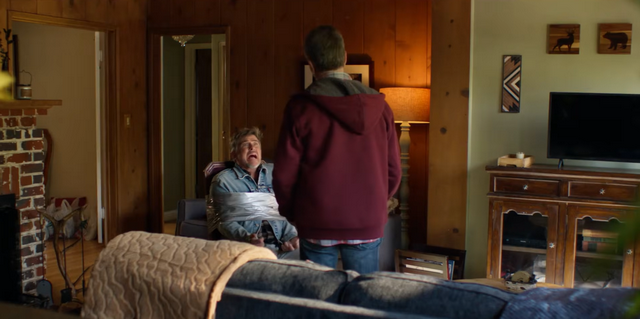
DUCT TAPE!
Yes, duct tape. And you all know how much I love seeing the many different ways duct tape is used in films! That wonderfully versatile, indispensable, practically magical substance that can seemingly solve any problem, repair any object, and, in the hands of an imaginative filmmaker, become an essential part of cinematic storytelling.
RALPH’S PERFEKT CHRISTMAS understands the value of duct tape. And for that alone, it deserves a place on the holiday viewing list.
But beneath the humor, the nostalgia, the wonderfully unexpected casting, and the increasingly outrageous developments lies something surprisingly poignant. RALPH’S PERFEKT CHRISTMAS is, in its own peculiar way, a story about the lengths to which someone will go to preserve an idealized vision of happiness. Ralph’s obsession with Christmas is about more than decorations, movies, or holiday traditions. It’s about family, belonging, love, and the desperate desire to make everything right again.
Of course, there’s a rather significant difference between wanting the perfect Christmas and understanding what actually makes Christmas perfect. And therein lies the film’s delicious irony.
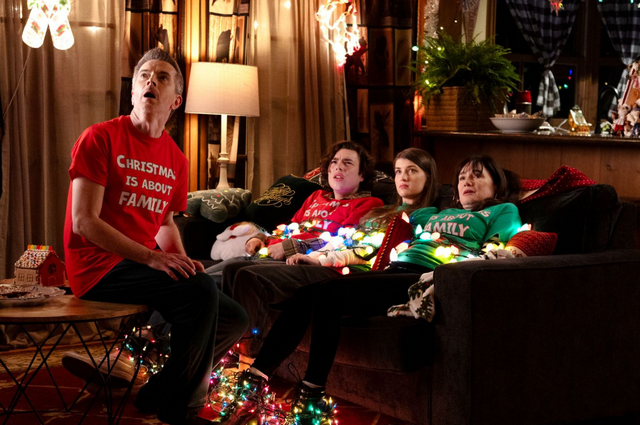
Tom and Mary McLaren have created a holiday movie that wears its love of classic cinema proudly, embraces its independent filmmaking spirit, and refuses to be constrained by the predictable conventions of the genre. Is it a little overlong? Yes. Does its vignette-like structure occasionally create uneven pacing? Absolutely. But those shortcomings are outweighed by its imagination, its impressive craftsmanship, its affectionate celebration of performers, and its willingness to take audiences somewhere they never expected to go.
RALPH’S PERFEKT CHRISTMAS is funny, colorful, nostalgic, occasionally outrageous, and ultimately far more twisted than its cheerful holiday wrapping suggests.
So pour yourself some eggnog, put on your favorite ugly Christmas sweater, settle in beneath the twinkling lights, and prepare for a holiday experience unlike any other.
And perhaps keep a roll of duct tape handy. Because when Ralph Bailey sets out to have his perfekt Christmas, all bets are off.
Directed by Matthew Bellamy, Mary & Tom McLaren
Written by Jeremy Padlow and Tom McLaren with story by Jeremy Padlow
Cast – Tom McLaren, Charlie Schlatter, Jill Schoelen, Casey Burke, Landon Jimenez and Lynda Day George with guest appearances by Susan Blakely, Marta Kristen, Nicholle Tom, Trevor Lissauer, Bill Mumy, and Angela Cartwright
RALPH’S PERKEFT CHRISTMAS is available On Digital