By debbie lynn elias
What’s the most important consideration when a collection of federal agents, mercenaries, and assorted killers converges on a small-town diner for a potentially deadly confrontation? The weapons? The strategy? The identities of the people they’re supposed to kill? Not necessarily. Sometimes it’s whether the bacon is regular or turkey, whether the pancakes are hot, or whether somebody has remembered to bring the silverware.
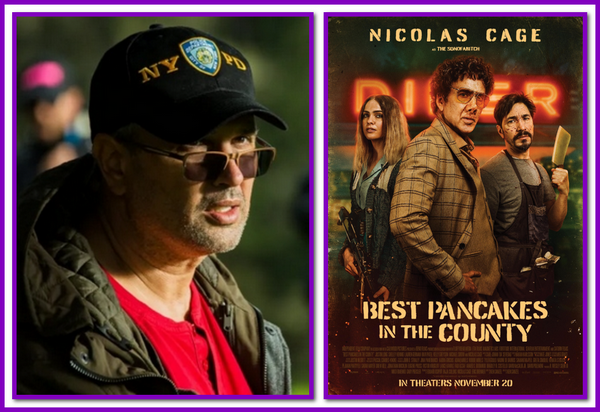
Welcome to BEST PANCAKES IN THE COUNTY, a madcap action extravaganza from writer/director Ken Sanzel that serves up a deliciously twisted combination of guns, food, deception, humor, and Nicolas Cage as a character known simply as Sonofabitch. And yes, that really is his name.
With Justin Long and Shelley Hennig anchoring the action as diner cook Cookie and waitress Dolly, respectively, Sanzel takes an ostensibly simple premise—a group of dangerous people waiting for someone to arrive—and transforms it into an increasingly outrageous game of competing agendas, shifting allegiances, and spectacularly choreographed violence.
But beneath the mayhem is a filmmaker who has thought carefully about the construction of every element, from character development and casting to production design, cinematography, lighting, editing, and stunt work. And the inspiration for much of the film’s wonderfully peculiar humor comes from an unexpected source: Sanzel’s own experience as a police officer.
FROM POLICE STAKEOUTS TO PANCAKES
The idea for BEST PANCAKES IN THE COUNTY began during the COVID pandemic, when filmmakers were searching for ways to develop projects that could be produced within controlled environments. For Sanzel, a diner offered possibilities beyond the conventional single-location action movie.
“I’m pretty sure I started—it was during COVID, when we were all kind of locked into locations, and I was thinking about what kind of location you could shoot a movie in that was contained and controllable, especially with an eye towards shooting it at a budget.”
The diner appealed to him because it offered multiple distinct areas within a single location. “I initially picked it for the fact that it would have multiple cool locations within it, that you were shooting a one-location movie that wasn’t a warehouse, that wasn’t kind of constrained to being in one place.”
Once Sanzel established the location and the premise of two groups of killers converging upon it, the story began taking shape around something far more mundane than murder. “Once I was there, it really became about the fact that food matters to these guys more than killing each other.” It’s an observation rooted in Sanzel’s earlier career.
“Back in the ’80s and ’90s, I was a cop, and I like to say that it was the first thing you talked with your partner about when you went out in the morning: Where are we going to go eat?”
For Sanzel, food is not merely sustenance. It is a means of expressing personality, status, and the relationships between individuals. “There’s something about food that trumps everything. If you look at letters from Civil War soldiers, it’s about how bad the food is. There’s something about food that becomes a way that people establish where they are in a hierarchy—how well they’re being fed and what they’re being fed.”
And therein lies the delicious absurdity of his screenplay.
“It ended up being the tension between there being some kind of violent stakes and the fact that these kinds of people would be just as concerned with whether they got turkey bacon or regular bacon as they were with where the guns were at.” That contrast becomes an essential part of the film’s comedic construction. Indeed, one of the principal catalysts for the escalating violence is something as ordinary as two men becoming irritated about their dining arrangements.
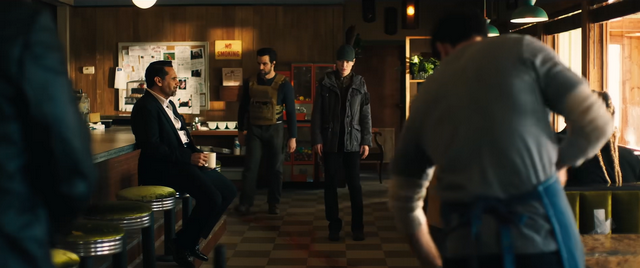
“What catalyzes the violence is Blondie and Ike sitting outside away from them, not wanting to eat cold food without silverware.” Their decision to enter the diner triggers the confrontation.
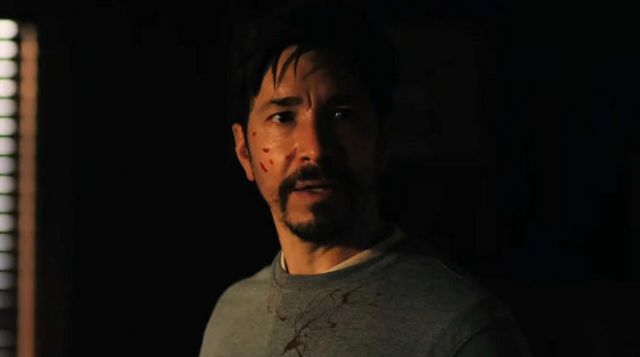
“It’s not the usual plot engine of some scheme or revealing a hidden gun. We do that later. But it’s something really kind of human and relatable that triggers the violence.” And it creates an opportunity for Cookie and Dolly, two characters whose own motivations are anything but straightforward.
A COLLECTION OF IDIOSYNCRASIES
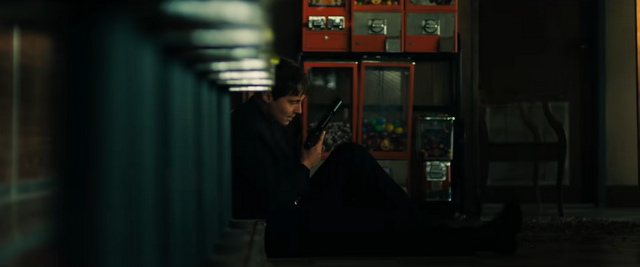
Sanzel’s police background also proved invaluable in developing the film’s extensive collection of federal agents, mercenaries, and assorted criminal personalities. Having worked in plainclothes units conducting stakeouts and decoy operations, Sanzel understood that people assigned to the same operation rarely share identical personalities or attitudes.
“What you find is that you’d all hop in the van, and you weren’t sort of a monolithic group. You were a collection of idiosyncrasies.” That experience became the foundation for his characters. “When I started building the groups, I built them from the characters up.”
Although the competing factions have clearly defined objectives, Sanzel was less interested in presenting conventional action-movie archetypes than in creating individuals whose personalities would generate their own conflicts. “The agendas are actually pretty simple. At least they were in my head. Then it was about who these actual characters were.”
Consider French, a particularly obnoxious member of the ensemble whose inflated opinion of himself is not shared by those around him. “French was easy because you had to have that one asshole.” But Sanzel wanted more than a stock villain. “French is an omega dog who thinks he’s an alpha dog.”
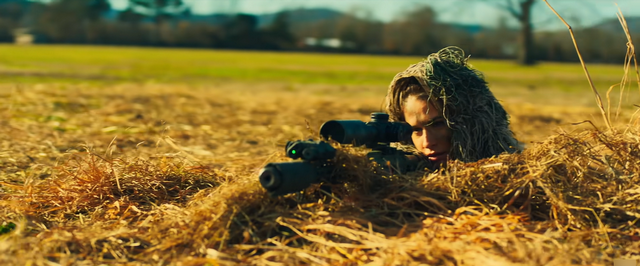
That distinction shapes his relationships with the other characters, particularly Red and Blondie, who delight in mocking him. Elsewhere, Duke is principally concerned with getting a decent meal, while the snipers find themselves physically and socially removed from the action unfolding inside the diner. Each character brings a different perspective to the situation, creating an ensemble in which humor emerges naturally from personality clashes.
Even the competing factions’ attempts to maintain a balance of firepower become a source of comedy, with the characters engaging in an almost childish insistence upon matching one another’s weapons and personnel.
And beneath the increasingly complicated maneuvering, Sanzel maintains a relatively straightforward dramatic foundation. One group wants to protect Sonofabitch when he arrives. Another wants to recover a valuable drive. Everybody has something to hide.
The result is a carefully constructed collision of agendas, with each character convinced that his or her priorities are the most important.
JUSTIN LONG, SHELLEY HENNIG, AND THE ART OF SURPRISE
For Sanzel, casting was essential to bringing those distinctive personalities to life. He knew that the film’s success would depend upon actors capable of balancing humor, action, and the occasional unexpected emotional moment.
Justin Long was an especially appealing choice for Cookie. “I love Justin because Justin brings a very everyman quality to the character Cookie, so that he’s a surprise.” That familiar, approachable quality makes Cookie’s more violent capabilities all the more startling.
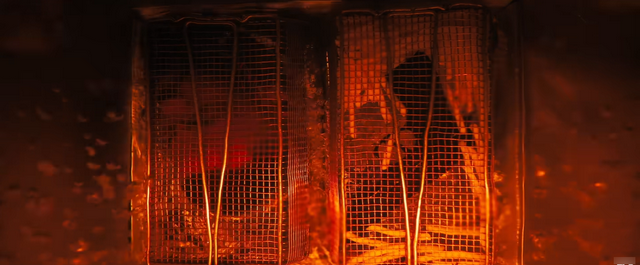
“If you’ve seen Justin in something, you don’t expect him to turn out to be a guy who can shove someone’s head in a fryer—a boiling bed of hot oil. Even after he does, he retains that kind of laconic humor.”
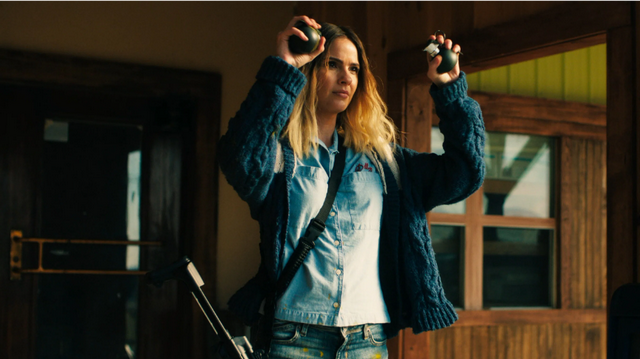
For Dolly, Sanzel turned to Shelley Hennig after seeing her performance in the Netflix series Obliterated. “Shelley I’d seen in this series on Netflix called Obliterated, where she just balanced action and humor so well that I knew she’d be great.”
Together, Long and Hennig create an engaging dynamic, with Cookie and Dolly continually challenging, surprising, and occasionally outmaneuvering one another. Their chemistry becomes especially important as the story reveals that neither character is quite what he or she initially appears to be.
Sanzel is particularly pleased with the playfulness between the actors. “From the moment that they’re talking in the shed after he thinks he’s rescuing her, but she’s taking care of French herself, from then on, you just really enjoy them.”
The director also appreciates the emotional undercurrents that emerge beneath the banter and violence. A later exchange in which the characters discuss why one did not shoot the other provides an unexpectedly affecting moment. “I find it really affecting every time I see it.”
For Sanzel, such moments are the result of allowing actors to develop their characters beyond the boundaries of the screenplay. “By the time you’ve cast actors, especially as a writer-director, you have to sort of surrender the characters to the actors. “You want to make sure we’re all making the same movie, but you have to trust that they then know the characters better than you do, and they’re going to bring all this process and preparation and thought about where they came from before we met them to the set.”
Long, in particular, repeatedly surprised him. “Justin certainly did that in all these wonderful little ways.”
The same philosophy extended to the supporting ensemble, assembled through a combination of previous collaborations, auditions, self-tapes, and conversations.
For Sanzel, the ability to communicate with an actor was as important as the initial audition. “Sometimes it’s really just about an actor. I feel like, oh, I can talk to them, and we’re kind of talking the same language.”
Understanding that every actor works differently, Sanzel sought to create an environment that allowed each performer to bring something individual to the production. “Every actor kind of has a different process, and you have to be able to talk to each one and create an environment for each one that makes them feel like they can do their best work.”
BUILDING THE DINER FROM THE GROUND UP
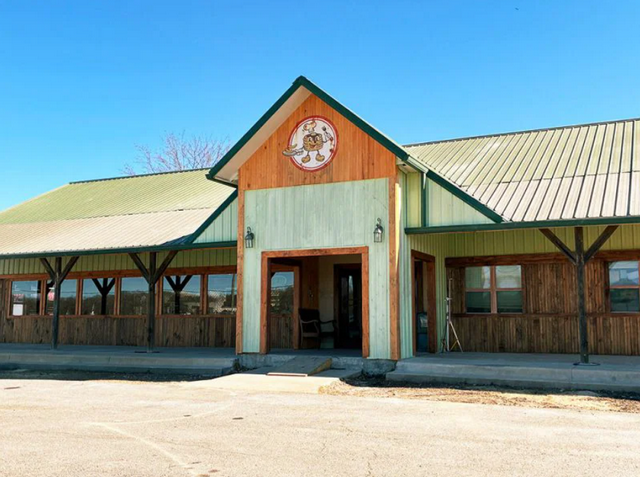
While the screenplay was conceived around the idea of a single contained location, finding the right diner proved considerably more challenging than Sanzel anticipated. “The biggest challenge of this movie was actually finding a diner in Arkansas that felt remote, which I did not think was going to be a problem.”
The production initially found a location approximately thirty minutes outside Little Rock that seemed ideal. Unfortunately, the owners reconsidered. “They decided they didn’t want a movie crew destroying it for two months. Kind of understandably so.”
The Arkansas Film Commission subsequently helped locate a former restaurant space operated by Pinnacle Catering. Although it lacked the desired diner interior, the building offered an opportunity. “We said, hey, we’ll build a diner. Can we build a diner in the front and we’ll leave it behind, and then you’ll have a diner?”
Working with production designer Nate Jones, Sanzel and cinematographer Pascal Combes-Knoke transformed the existing space into the film’s principal location. Building from scratch also allowed them to tailor the environment to the specific needs of the screenplay and the cinematography.
“We were really building it from the ground up, [which] allowed us to make a lot of decisions that maybe if we’d inherited a place, we wouldn’t have.”
Among those decisions was enlarging the windows to accommodate the film’s changing lighting requirements. “We cut those windows out. There were smaller windows when we started, and we got those big windows.”
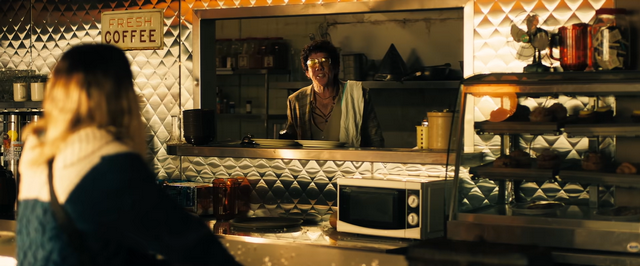
Another significant addition was a rotating fan in the kitchen. “We put in that rotating fan in the kitchen, which I think makes the kitchen, because it was such a great light source, and it gives you this geographic pin.” No matter how tightly the camera frames the action, the fan provides a recognizable visual reference. “You know where you are in the kitchen, looking which direction.”
The production design also incorporated extensive chrome and reflective surfaces, providing opportunities to create visual depth and texture within the relatively confined space.
For Sanzel, color was equally important. “I have a thing against too much yellow.” Instead, he and Jones favored bold reds, blues, and greens, creating a vibrant environment that could accommodate the film’s heightened visual style. “I wanted those colors that you could really punch up.”
And, as Sanzel notes, the shiny surfaces provided additional opportunities for lighting. “We had a lot of chrome. We had a lot of shiny stuff. We had a lot of stuff to bounce light off of, which was really nice.”
PASCAL COMBES-KNOKE AND THE VISUAL GRAMMAR OF MAYHEM
With the diner constructed, Sanzel and Combes-Knoke faced the challenge of photographing an ensemble action film within a space that needed to accommodate numerous characters, competing lines of sight, and increasingly elaborate confrontations.
The exterior location presented an additional complication. Unlike the original diner, which offered unobstructed views in nearly every direction, the replacement location had only two particularly useful exterior sightlines. Sanzel and Combes-Knoke responded by embracing long-lens cinematography. “I said to Pascal, I want to shoot this long lens so that we can let a lot of the stuff we don’t like in the background outside go away.”
The approach also reflected lessons Sanzel learned while working as showrunner on the television series Numb3rs. Executive produced by Tony and Ridley Scott, the series provided Sanzel with an opportunity to observe Tony Scott’s approach to cinematography firsthand.
“Tony shot an episode for us, a season opener, and I think I was really informed by a lot of what I’d seen him do in terms of how he wielded multiple cameras, used long lenses, didn’t get worried about stuff crossing other stuff.”
Sanzel wasn’t attempting to duplicate Scott’s distinctive visual style, but he wanted to incorporate some of that dynamic energy into his own film. He and Combes-Knoke also embraced cross-shooting, allowing cameras to photograph actors from opposing directions simultaneously.
For Sanzel, this was as much about performance as cinematography. “I’m a big believer in cross-shooting because I don’t want actors to ever feel like they have to save something for their director, or to be worried if they come up with an idea that it’s too late.”
That required Combes-Knoke to develop a lighting scheme capable of accommodating multiple camera angles without constant relighting. “He designed the lighting in a very liberated way so that we could be shooting two directions at any one time and getting good-looking stuff in both of those directions.” The result was greater freedom for both the actors and the camera operators. “We could be covering more actors at once.”
Sanzel and Combes-Knoke used ARRI Alexa cameras, whose flexibility and color reproduction proved particularly well suited to the production. “The Alexas are just great. These were gorgeous. They gave me the color space I wanted.”
Another important consideration was the progression of daylight throughout the film. Working with his first assistant director, and production designer Jones, Sanzel and Combes-Knoke carefully plotted the shooting schedule and the changing direction and quality of light entering the diner.
“Pascal and Joe and Nate and I, as we were constructing the diner, were actually plotting out all the sequences and how much we could shoot in order and what we couldn’t shoot in order.” That preparation allowed Combes-Knoke to maintain a convincing sense of time passing as the characters waited for Sonofabitch to arrive.
Sanzel is quick to credit his cinematographer. “That’s all Pascal. That’s not me.”
CHOREOGRAPHING THE CHAOS
Of course, BEST PANCAKES IN THE COUNTY isn’t merely a collection of colorful personalities exchanging insults over breakfast. Eventually, somebody starts shooting. And when the action erupts, Sanzel wanted the violence to feel like a continuous, chaotic event rather than a collection of isolated stunt sequences.
The climactic diner confrontation presented a particularly demanding challenge.
Long and Hennig rehearsed extensively, as did Lauren German for her own action sequence, while the stunt performers helped develop and execute the more elaborate physical confrontations.
Sanzel and Combes-Knoke approached the action with handheld cameras, allowing the operators to move with the performers. “We were doing a lot of stuff where we were shooting big chunks of it, where everything’s happening foreground and background at the same time.” The objective was to maintain a sense of simultaneous activity.
“I didn’t want it to feel like we were just doing discrete pieces. I wanted it to feel like it was a melee all going on at the same time.”
Handheld cinematography proved essential. “We needed to be on handhelds and moving forward with the action and pulling backwards with the action.”
The production also embraced a significant technical change in its approach to firearms.
For the first time in his career, Sanzel used airsoft weapons rather than firearms loaded with blanks. The experience was revelatory. “I thought I would never go back. Just on a technical level, it was so much safer, faster, and easier.”
Advances in visual effects also expanded the possibilities available to the filmmakers. With several years having passed since Sanzel’s previous feature, he found that contemporary VFX techniques offered greater flexibility during production and post-production.
Those lessons, he believes, will influence his approach to future projects.
HAKAN KARLSSON AND THE EDITORIAL RHYTHM
With multiple cameras, extensive action coverage, rapid-fire dialogue, and numerous characters occupying the same space, editing was another critical component of the film’s success.
Working with editors Hakan Karlsson and Magnus Hall, Sanzel had an enormous amount of footage from which to construct the finished film. But the process proved surprisingly comfortable.
“This was, in a way, probably my easiest edit.”
Karlsson worked in Sweden, initially sending cuts to Sanzel rather than having the director sitting beside him throughout the process. For Sanzel, that geographical separation became an unexpected advantage. “The first three, four weeks of passes, he was sending me cuts, and I wasn’t micromanaging it, which I think was better.” The experience allowed Karlsson to develop his own interpretation of the material.
“Normally by the second week, I’m sitting in the edit bay and probably doing as much harm as good by not letting the editor make his or her best first argument for the movie.”
The distance also gave Sanzel an opportunity to return to the footage with a fresher perspective. “I was able to step away from the material I’d done for long enough to come back and look at it a little bit more like a viewer.”
Naturally, there were moments when the abundance of material made decisions difficult. Particularly when Nicolas Cage was involved.
“Are there a million alternate takes of the ordering pancakes that I wish I could have crammed in there? Absolutely.”
And when it came to Cage’s increasingly outrageous vocal performances, Sanzel found an ingenious solution.
“I used almost every take of Nick screaming over the end credits because they were all just so freaking good. I was like, how do you just use one?”
The editorial process reinforced a philosophy Sanzel had already embraced with his other collaborators. “Here’s what I’m thinking, and then step back and let people do the work that they do better than I do, instead of trying to author every frame.”
NICOLAS CAGE IS SONOFABITCH
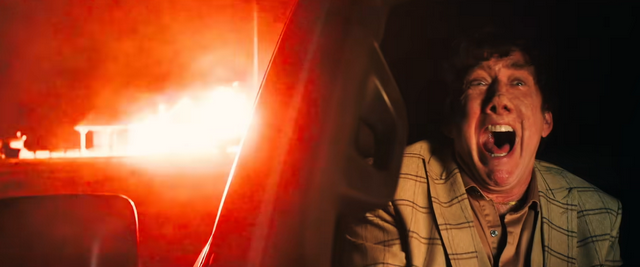
And then there is Nicolas Cage. Or, more precisely, Nicolas Cage as Sonofabitch.
Having previously worked with Cage on Kill Chain, Sanzel approached the actor about participating in BEST PANCAKES IN THE COUNTY. Cage was interested, but he had a question.
“Do you want me to play Cookie or do you want me to play the Sonofabitch?”
For Sanzel, either choice would have been welcome. “I will take you in any part you want to do.”
But it quickly became apparent which character was capturing Cage’s imagination. “I could feel him gravitating towards the kind of anarchic craziness of the Sonofabitch pretty early on.”
And once Cage committed to the role, he took complete ownership of the character’s physical appearance.
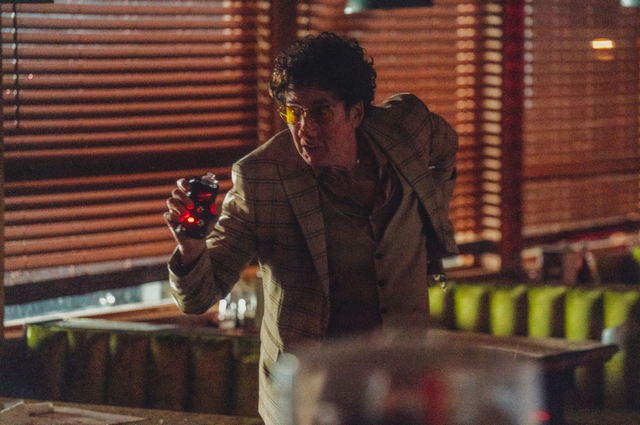
The peculiar nose, curly-haired wig, yellow-tinted sunglasses, and startling overall look were entirely his creation. “That’s all Nic.”
Cage developed an elaborate backstory to explain the character’s unusual appearance. Having angered numerous dangerous people, Sonofabitch had supposedly undergone plastic surgery while on the run, seeking out a disreputable surgeon in some distant location. Unfortunately, the procedure had not gone particularly well.
For Sanzel, the results were unforgettable. “I wish I had filmed the panicked expressions of the producers the first time they saw the makeup test because they were like, oh my God, it doesn’t look like Nic!”
But that transformation was precisely the point. Once Cage began arriving on set in full makeup, the character’s appearance became so familiar that seeing the actor without it seemed almost unnatural. “Every now and again he’d come to set before he’d go to makeup, and he almost looked wrong looking like Nic, because he was the Sonofabitch.”
Sanzel believes the makeup process helped Cage fully inhabit the character. “I think it’s very much the process of him disappearing into the character instead of being him.”
And the result was a performance that Sanzel found both surprising and entirely appropriate. “There’s something about it that’s startling for a minute, and then you can’t imagine him looking any other way.”
The director also praises Cage’s professionalism and preparation. “He is just so prepared and so much fun to work with.”
For Sanzel, that combination is rare. “You don’t really get that kind of combination very often, where it’s just explosive and a pleasure.”
TRUSTING THE PEOPLE WHO MAKE THE MOVIE
Reflecting upon the production, Sanzel acknowledges that a twenty-day shoot presents inevitable challenges. When something goes wrong, there is little time to recover, and a filmmaker must rely upon experience, preparation, and the abilities of the people surrounding him.
But the most important lesson he took from BEST PANCAKES IN THE COUNTY was not a new technical discovery. It was a deeper appreciation of collaboration.
“The biggest lesson I learned, or the biggest evolution I have, is that I’m ever more relaxed with letting other people [work].”
He explains that once the right collaborators have been hired and the creative objectives established, the director’s responsibility is not to continually second-guess their decisions. “Once I’ve done the hiring and the discussing, I don’t have to redo that work over and over again.”
Instead, Sanzel wants to create an environment in which everyone feels empowered to contribute. “You really want to create an environment where your actors and your crew come in every day and feel like they’re going to put their best work into the movie instead of being micromanaged.” That philosophy extends to everyone, from camera operators and production designers to props personnel and the stunt team.
And with a film as demanding as BEST PANCAKES IN THE COUNTY, the results are evident in the seamless integration of action, humor, performance, and visual storytelling.
As for the possibility of returning to the diner for another helping of pancakes? Sanzel isn’t ruling it out. “I would love it, and there’s certainly room for the next day. I guess it depends on how many people go see the first one.”
Considering the amount of mayhem that can erupt when a collection of armed professionals cannot even agree on breakfast, one can only imagine what might happen if they were forced to deal with lunch.
But whatever the next meal might bring, Ken Sanzel has already demonstrated that a diner, a collection of dangerous personalities, and a generous helping of Nicolas Cage can make for one explosively entertaining cinematic feast. And when Sonofabitch finally arrives, all bets—and possibly the pancakes—are off.
exclusive interview 11/10/2026
BEST PANCAKES IN THE COUNTY is in theatres and available on VOD and Digital on November 20th.