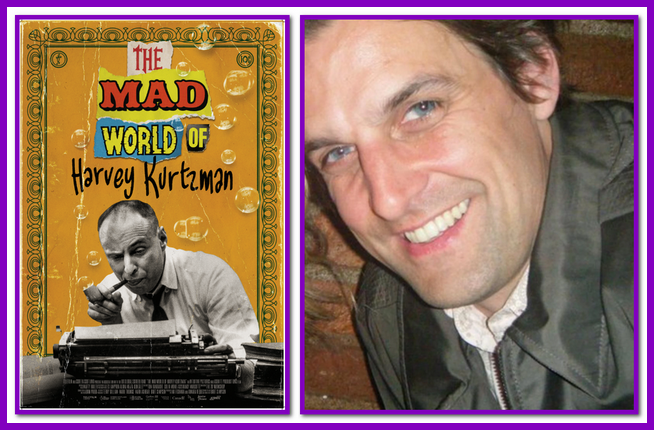
By debbie lynn elias
Long before The Simpsons, Monty Python, or the irreverent humor that permeates contemporary popular culture, there was Harvey Kurtzman. Cartoonist, writer, editor, satirist, and creator of MAD, Kurtzman transformed the comic book into something far more than disposable entertainment. He challenged conventions, questioned authority, exposed hypocrisy, and influenced generations of artists who would carry his distinctive sensibility into comics, television, film, and beyond.
But how do you tell the story of a man whose imagination seemingly knew no bounds? How do you capture the restless creativity of an artist whose work ranged from war comics and biting satire to magazine publishing, filmmaking aspirations, and the nurturing of other extraordinary talents?
For writer/director BART SIMPSON, the answer was to let Kurtzman help tell his own story.
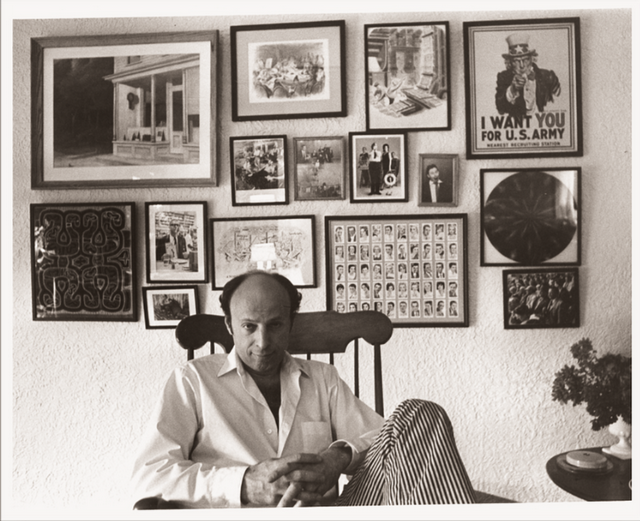
With THE MAD WORLD OF HARVEY KURTZMAN, Simpson takes audiences on a chronological journey through Kurtzman’s life and career, drawing upon an extraordinary collection of original artwork, archival interviews, historical footage, and contemporary conversations with family members, colleagues, and artists whose work bears the imprint of Kurtzman’s influence.
Featuring Terry Gilliam, Matt Groening, Robert Crumb, Art Spiegelman, and members of the Kurtzman family, the documentary brings together decades of creative history through animated montages, carefully selected archival materials, and a vibrant original score by composer Marty Hailey.
For Simpson, whose extensive producing career includes the controversial documentary BANANAS*!, the opportunity to return to writing and directing was also an opportunity to reconnect with something deeply personal.
“Comics were like my refuge,” Simpson recalled during our exclusive conversation. “My parents split when I was young, and comics were like my refuge.” That attachment extended well beyond childhood. “Even going down into my dating life in high school, to the extent I did it at all, whenever I got dumped or something, I’d pick up a new comic.”
Although Simpson had written and directed earlier in his career, producing eventually became his principal focus. But the possibility of making a documentary about Kurtzman was irresistible.
“My friend Garrett, who’s actually in the film, he runs a comic shop now. He met Mrs. Kurtzman by chance, and I emailed him saying, ‘Has anybody done a film on Kurtzman?’ And then, like seven, well, eight, nine years, I’ve lost track, years later, here we are.”
What Simpson envisioned was not simply another documentary about comics.
“I’ve seen a lot of comic documentaries, which I appreciated, but I really wanted to give that feel of something disposable and visceral and kinetic and all that stuff. And Harvey’s work, in particular, was a big way to do that.”
The undertaking would eventually lead Simpson and his collaborators deep into Kurtzman’s personal archives. “Especially searching through the 36 boxes of archives that we have. I mean, I’ve still got the smell of all the kind of slightly damp cardboard boxes in my nose. I don’t think it’s ever going to go away.”
But the experience was about far more than sorting through historical artifacts. “It was a real privilege to be able to get into his mind that way because I wanted to make sure that he told the story as much as possible, and we really had to dig through a lot of his archives and then support it with the people who worked most closely with him.”
FINDING ORDER IN A WORLD OF CREATIVE CHAOS
With 36 boxes of archival material, original illustrations, historical recordings, contemporary interviews, and decades of artistic evolution to consider, Simpson faced an immediate storytelling challenge: how to organize such a vast collection without losing the vitality of its subject.
His solution was refreshingly straightforward. Chronology. “For me, it’s pure and just sanity,” Simpson laughed when asked why he chose a largely chronological structure.
“There was so much stuff. We had so many variables and so many textures and so many colors and so much varied kind of material in the archive. I think there’s a real benefit to creating as simple a pathway through it as we can, and then trying to screw with it a little bit, just to play with it a bit.”
That chronological foundation allows the documentary to follow Kurtzman’s development from his early artistic interests and military service through his work on war comics, the creation of MAD, his complicated relationship with publisher William Gaines, and his subsequent ventures into Trump, Humbug, Help!, and other projects. The structure also provides an opportunity to examine the changing relationships that shaped Kurtzman’s career.
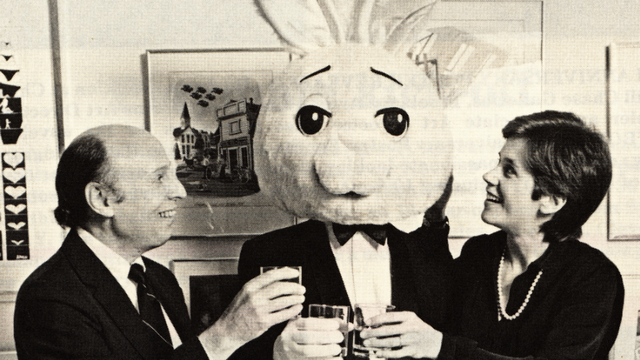
Particularly revealing is the documentary’s treatment of Hugh Hefner, who appears at two significantly different points in Kurtzman’s professional life. Rather than combine those encounters into a single segment, Simpson preserves their places within the larger timeline.
“There’s something weirdly fun about having Hefner show up twice because the first time it doesn’t end so well, and the second time we’re going, okay, what’s going to happen now?”
More importantly, Simpson recognized that the relationship itself had changed. “The power dynamic has changed so much by that point that it’s almost like a different Harvey-Hefner relationship.”
For Simpson, the straightforward narrative structure also provided freedom to experiment with the documentary’s other elements.
“A lot of the playing was visual and with sound because I’m a big sound guy. So we had a lot of sound archive to go through.” The challenge was to preserve clarity while giving the film the energy appropriate to Kurtzman’s creative personality. “We wanted to keep it mostly chronological because it will help the audience get through a whole lot of stuff in a hopefully entertaining way.”
That approach required complete collaboration among the filmmaking team, including editors Colin Monie and Tom Randaxhe, the animation team, composer Marty Hailey, and the producers responsible for locating and organizing the extensive archival materials. “Everybody bought into this idea of Harvey telling his own story, and that meant that we had to do things a certain way in order to make it sing.”
Simpson describes the documentary as essentially a first-person narrative, supported by the people who knew Kurtzman best. “If you don’t have your team totally buying into this idea of essentially a first-person narrative surrounded by those who are closest to him, it’s not going to work.”
BRINGING KURTZMAN’S ARTWORK INTO MOTION
Perhaps the documentary’s most significant visual undertaking involved translating Kurtzman’s original illustrations into a moving-image medium.
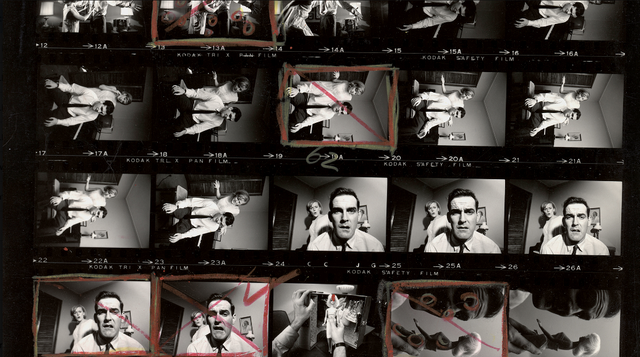
The film incorporates animated montages drawn from his artwork, tracing the evolution of his distinctive style while maintaining the integrity of the original material. For Simpson, that distinction was essential.
“We wanted to acknowledge that this is not a two-dimensional comic book. This is a film, and it’s moving. And I wanted to keep all of the art authentic.” He was particularly insistent that the animation should not involve contemporary artists attempting to reproduce Kurtzman’s drawing style. “Keep the integrity of the art, meaning it’s Harvey’s original art, not somebody pretending to draw like Harvey did.”
Instead, the filmmakers worked with the existing illustrations, finding ways to introduce movement and visual transitions without compromising their authenticity. “Actually using Harvey’s art and manipulating it in a way that would serve the story. Also be kind of fun sometimes, or human or somber in another kind of way.”
Determining how far to push that manipulation required careful consideration. “There were times I thought, okay, how much is too much? But Harvey wanted to be a filmmaker at the end of the day, and that gave me some latitude in actually maybe pushing it a little more than I would think.”
The resulting animated sequences serve several purposes. They introduce visual energy, illustrate Kurtzman’s developing artistic techniques, and allow audiences to experience the rhythm and expressive possibilities of his work beyond the printed page.
But animation was only one part of the editorial challenge. Kurtzman was as much a writer as an illustrator, and some of his publications relied heavily on extended passages of text. That presented a practical problem for a documentary intended to move at a cinematic pace.
“One of the biggest concerns, challenges we had actually was especially with some of his work, like on Trump and Humbug, was that there were essays in these magazines because it was almost like The New Yorker.”
Simpson understood that audiences could not reasonably be expected to read entire essays while simultaneously following the documentary. “You can’t expect an audience to sift through paragraphs of text in order to get the joke.”
Consequently, the editing process became an exercise in selecting material that could communicate the character and significance of Kurtzman’s work without overwhelming viewers.
“It was very much that. It’s like curating an accessible example of something that’s going to give you a feel of what happened there, and then move on from there.”
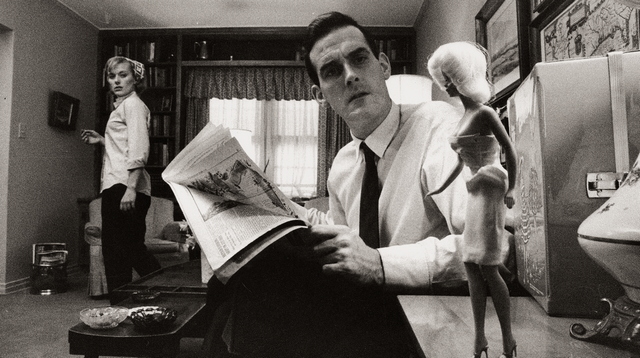
Other publications presented fewer difficulties. “Once you get to Help! magazine with the fumetti, it was a lot easier because you could concentrate on balloons with like one or two things and the joke.”
Throughout the process, the objective remained consistent: allow audiences to appreciate the scope of Kurtzman’s creativity while preserving the film’s narrative momentum.
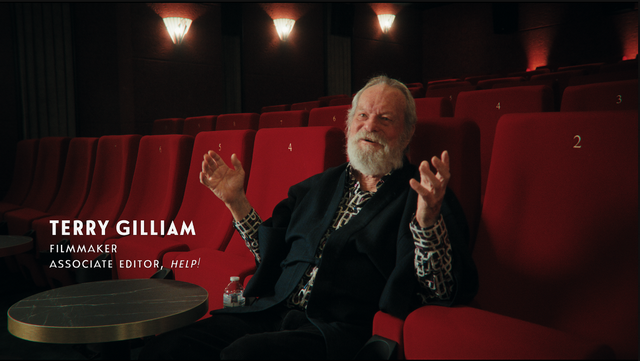
TERRY GILLIAM AND THE INFLUENCE BEYOND THE COMIC PAGE
One of the documentary’s central themes is the extraordinary reach of Kurtzman’s influence. His work did not remain confined to comic books and magazines. It helped shape the sensibilities of artists who would transform television, film, animation, and modern satire.
For Simpson, Terry Gilliam was indispensable to telling that story.
“It was crucial because, again, I think one thing we really wanted to express was Harvey’s influence beyond comics itself in general culture.”
Gilliam’s association with Kurtzman provided a direct connection between the world of illustrated satire and the development of a visual style that would become recognizable through Monty Python and Gilliam’s subsequent filmmaking career. “Terry, of course, is one of the best examples of that because not only through his work with Monty Python, which happened as a result of his working with Harvey, but also his later work as a filmmaker.”
Simpson points specifically to Brazil as an example of Gilliam’s distinctive artistic worldview and its relationship to Kurtzman’s influence.
“People still reference [it] to this day, and actually the fact that he’s bringing it all back to Harvey’s view of reality, and that’s a central part of his humor and also his artistic worldview in general.” That worldview, Simpson emphasizes, extended beyond satire.
“His war books were also very human and real, and I wouldn’t say satire because they certainly weren’t.”
For Simpson, Gilliam’s presence helped establish the breadth of Kurtzman’s creative legacy. “If we didn’t have Terry, it would be a totally different film.”
Gilliam was not alone in recognizing the importance of the project.
Robert Crumb, Matt Groening, Art Spiegelman, and other artists contributed their perspectives on Kurtzman’s work and influence.
Simpson found that the documentary’s subject often opened doors that might otherwise have remained closed. “Once they knew it was the film on Harvey, and that we were serious about it, they were extremely generous with their time.” He adds that some participants, including Crumb, might not have agreed to be interviewed for another subject.
The filmmakers also sought voices that could bridge Kurtzman’s era and contemporary popular culture.
Groening’s participation was especially valuable in demonstrating how Kurtzman’s influence continues to resonate with audiences who may know The Simpsons but have little familiarity with the artistic history that preceded it. Yet Simpson was careful not to let the documentary become dominated by famous admirers.
“We just need a little bit because we wanted to keep the focus on Harvey as much as possible.”
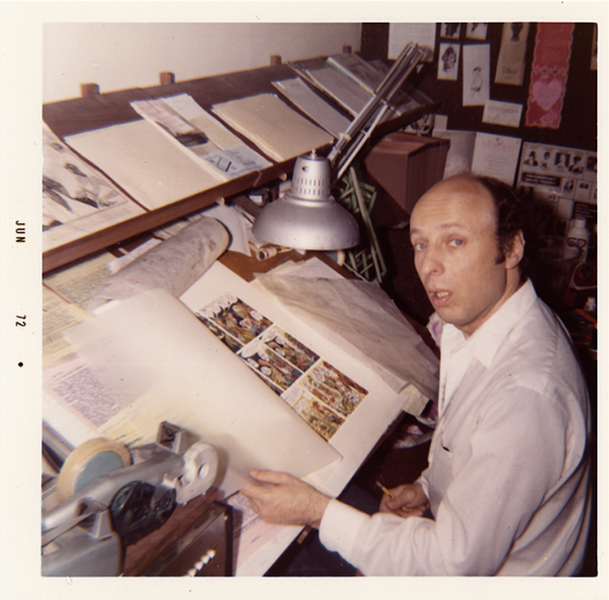
THE FAMILY BEHIND THE ARTIST
While Kurtzman’s professional accomplishments provide the documentary’s historical foundation, Simpson also wanted audiences to understand the man beyond his public persona. That meant turning to the people who knew him most intimately.
His wife Adele and daughters Nellie and Meredith offered access to aspects of Kurtzman’s life that professional colleagues and artistic admirers could not fully illuminate.
“Adele and Nellie and Meredith were all access points for us to get to know Harvey beyond his work life.” The family interviews were particularly important because Kurtzman himself was not always revealing in archival recordings.
“Harvey, in a lot of ways, at least in the video archive that we were getting, he doesn’t always give you a lot. There are moments where he’s vulnerable, but sometimes he’s in a just very formal setting, and that’s the way it is.” This limitation also increased the importance of archival audio, which sometimes provided a more intimate perspective than the existing visual recordings.
For Simpson, the family’s contributions helped the documentary move beyond the accomplishments of a celebrated artist to explore the emotional realities of family, memory, and legacy. “Being able to bring in his family, especially pushing a lot of it to the end, allowed us to really leave with a space of deeper understanding of this guy than just his work provides.”
Nellie Kurtzman, in particular, emerges as a significant guardian of her father’s artistic legacy, helping preserve the material that documents his extraordinary career.
The documentary’s later passages find moments of humor and tenderness in the family’s recollections, including an outdoor sequence that approaches Kurtzman’s final wishes with an unexpectedly matter-of-fact sensibility. Photographed in bright natural light, the scene provides an emotional counterpoint to the historical and professional material that precedes it.
For Simpson, the family’s experience also touches something universal. “We’ve all got parents, and we’re all kind of dealing with, or had parents, we’re all dealing with legacies of our own kind. So there’s a bit of a universal path in what she was trying to do too.”
The documentary also reflects the filmmakers’ awareness that some of its participants were reaching an age when opportunities to preserve their recollections were becoming increasingly limited.
Simpson and his team began recording interviews with older colleagues and associates around 2017 or 2018, before the COVID pandemic interrupted production. “With a lot of these folks, we deliberately over-interviewed because it would have been the last time with most of them.” The result is a substantial archive extending well beyond what could be incorporated into the finished documentary.
Simpson hopes to make some of that additional material available in future releases, including more archival interviews with Gloria Kurtzman. “We’ve got this huge library of stuff that we can’t wait to get out there after the film.”
MARTY HAILEY AND THE SOUND OF REBELLION
For all its extraordinary visual material, THE MAD WORLD OF HARVEY KURTZMAN is equally dependent upon sound. Simpson readily acknowledges that he approaches filmmaking with a particularly strong interest in the aural experience.
“Sound in general can be an afterthought. But I’m very… It’s funny, the world can be divided into visual people and audio people in some ways. And even though I’m directing, I would put myself very much in the audio camp.”
That sensibility influenced not only his use of archival recordings but also the development of the documentary’s original score by composer Marty Hailey.
The musical approach began with an unlikely but inspired reference point: the Beastie Boys.
Simpson was considering temporary music for editor Tom Randaxhe when he began thinking about Kurtzman’s personality and artistic temperament. “Harvey is rebellious. He’s kind of awkward, from New York, and he happens to be Jewish, and all that stuff said to me the Beastie Boys.” The group’s jazz-oriented instrumental recordings provided a starting point for the documentary’s musical vocabulary.
“The Beastie Boys put out a couple of sort of funky jazz-oriented instrumental albums, and [we] used a lot of that to kind of start to get a feel of what this thing might be.”
Another influence came from Anthony Bourdain’s comparison of Kurtzman to revolutionary musicians such as Charlie Parker and Jimi Hendrix. For Simpson, the comparison reflected the extent to which Kurtzman had transformed his artistic medium. “He was somebody who completely changed the craft he was in.”
Simpson also recognized a direct relationship between jazz and Kurtzman’s visual compositions. “When you look at Harvey’s Jungle Book work in particular, there’s a lot of jazz influence in the drawing and the way he lays things out.” That observation helped establish the score’s musical direction.
“Something with a bit of jazz, something with that kind of attitude of the Beastie Boys, a bit of funk in there.” Enter Marty Hailey.
“I luckily found Marty, and he and I share so much in common of that kind of appreciation of stuff.”
Rather than construct the entire score electronically, Hailey proposed recording with live musicians. “He said, okay, if we’re going to do this, let’s do this with a real band.” The production embraced that approach, assembling instrumental sessions with bass, drums, and guitar before adding horns and strings. “We treated it like an actual band.”
The result is a score that reflects the irreverence, restlessness, and musicality of Kurtzman’s creative personality while also providing emotional support for the documentary’s more intimate passages.
Simpson notes that the need to balance music with archival voices sometimes required restraint in the final mix. “Just by the virtue of having to integrate some voices that are sometimes softer and other things, we couldn’t always bring the music to the level that I was hoping.”
Nevertheless, he remains enthusiastic about the finished score and hopes it might eventually receive a standalone release. “I’d love to hear it on its own too.”
The music also helped address another aspect of the archival material: Kurtzman’s occasionally reserved on-camera demeanor.
“Harvey was, like I say, sometimes visually he can come across a little cautious in parts. Not all of it, but some. And bringing up this kind of music really helps give him the attitude that I think he really had.” In that respect, Hailey’s score does more than accompany the images. It becomes another means of expressing the personality and creative energy that Simpson discovered through years of archival investigation.
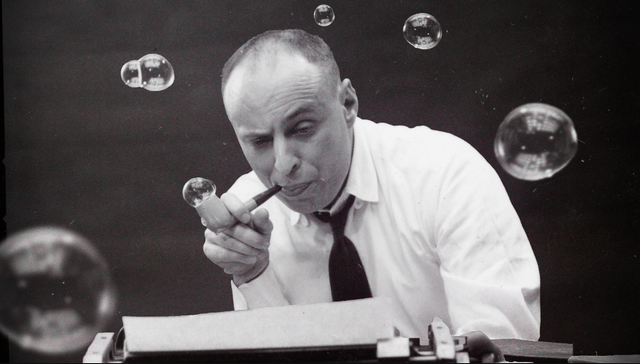
THE PLEASURE OF REDISCOVERY
After years spent immersed in Kurtzman’s work, Simpson has emerged with renewed enthusiasm for the possibilities of documentary filmmaking and archival storytelling.
Although he continues to value producing, the experience of writing and directing THE MAD WORLD OF HARVEY KURTZMAN has reminded him of the particular satisfaction that comes from exploring historical materials and shaping them into a cinematic narrative.
“I will always love producing. But I think this film in particular has really reminded me of how much I love archives, and I’m really eager to tackle that in one of the next few projects I’m developing.”
Those projects remain in development, and Simpson is understandably reluctant to reveal too much before his current film has completed its launch. He does, however, acknowledge that one potential project involves language, while another occupies territory adjacent to comics and music. But for now, his attention remains squarely focused on introducing audiences to the extraordinary life and artistic legacy of Harvey Kurtzman.
And after nearly a decade spent pursuing the story, searching through 36 boxes of archival treasures, collaborating with artists and filmmakers, and finding ways to give movement and sound to Kurtzman’s imagination, Simpson has accomplished something deeply personal. He has returned to the world of comics that once provided refuge during his childhood, this time not simply as a reader, but as the filmmaker entrusted with bringing one of its most influential creators to the screen.
For a director whose subject helped redefine the possibilities of satire and visual storytelling, perhaps the greatest tribute is allowing the artist’s own work, words, and imagination to lead the way.
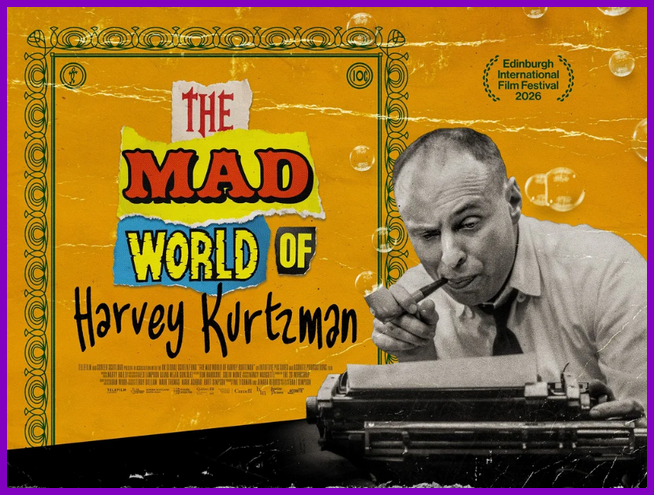
THE MAD WORLD OF HARVEY KURTZMAN is written and directed by Bart Simpson, with cinematography by Alexander Lampron and Alana Mejia Gonzalez, editing by Colin Monie and Tom Randaxhe, and an original score by Marty Hailey.
exclusive interview 11/13/2026