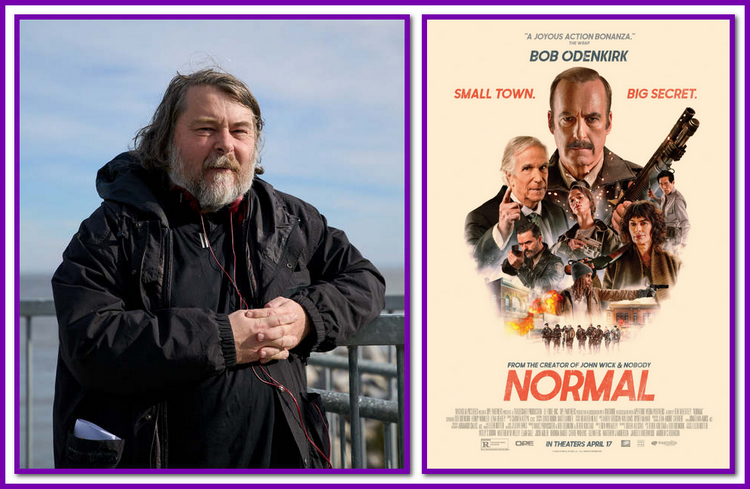
With practical effects, precision camerawork, and a deadpan Bob Odenkirk at the center, in this exclusive interview, director BEN WHEATLEY discusses turning a neo-Western setup into something wildly original—and anything but normal.
There is nothing remotely “normal” about NORMAL—and that is precisely the point.
For director Ben Wheatley, a filmmaker long known for bending genre expectations and visual language to his will, this latest outing is less a departure than an escalation. A neo-Western action film anchored by Bob Odenkirk as an unassuming substitute sheriff with a troubled past, NORMAL begins with a deceptively simple premise: a quiet Midwestern town, a man looking for respite, and a bank robbery that goes sideways. But from the moment the first cracks appear, Wheatley makes it clear—this is a world where tone, violence, and visual storytelling collide in exhilarating, unpredictable ways.
“It was one of the things that was said to me right up front,” Wheatley explains, “that everyone wanted to do… was to make it so the computers would only get involved if it was for safety or cleanup. So everything was as practical as we could make it.”
That commitment is felt immediately—and viscerally. Blood squibs burst with unapologetic force, practical effects land with tactile impact, and in one particularly jaw-dropping third-act sequence, the action doesn’t just stay contained within the frame—it hits the lens. It’s a bold, almost gleeful reminder of cinema’s physicality, something increasingly rare in an era dominated by digital polish.
But Wheatley’s approach is not about excess for its own sake. It is about control.
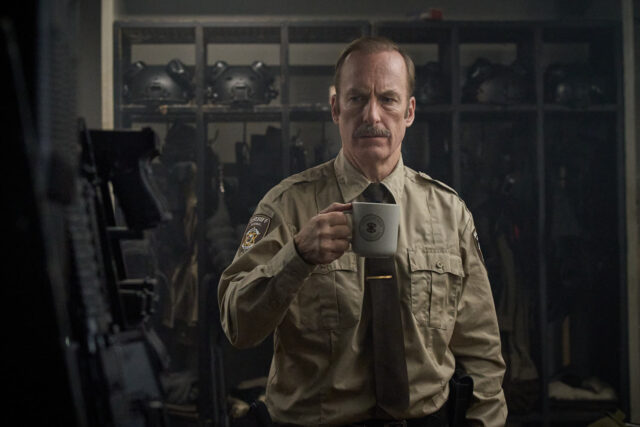
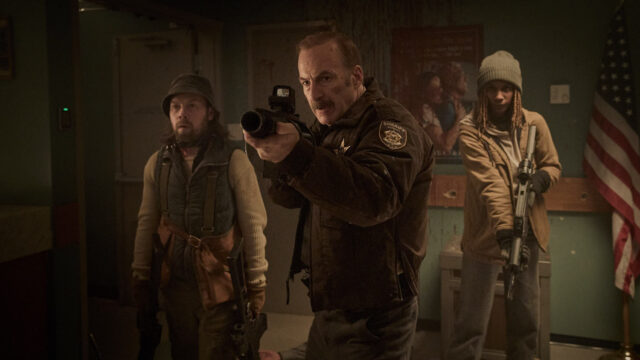
At the center of NORMAL is Sheriff Ulysses, played with deadpan precision by Odenkirk, whose performance becomes increasingly economical as the film progresses. Dialogue recedes. Reaction takes over. Action speaks. Wheatley and his team deliberately shape the film around Ulysses’ point of view, building a visual grammar that prioritizes emotional connection over chaos.
“It’s all about Ulysses’ point of view,” Wheatley says. “Looking at things… then looking at his face for his reaction. So you feel like it’s personal… every beat has an emotion to it.”
That restraint is key. Despite the film’s escalating violence and kinetic set pieces, Wheatley avoids the trap of action fatigue by grounding everything in empathy. Ulysses is not a gleeful participant in the mayhem; he is a man navigating it, reacting to it, burdened by it. The result is a film that feels propulsive without ever becoming hollow.
The seeds of that approach can be traced back to why Wheatley signed on in the first place. With a script by Derek Kolstad—best known as the creator of John Wick—and a team already in place that included Odenkirk, Wheatley admits the decision came quickly. But it was the tone that sealed it.
“What I really liked about it was that it was a neo-Western,” he says. “I’d wanted to do something like a Western for a long time… that Americana, that one-horse town, the main drag.”
That “one-horse town” is the ironically named Normal—a place that, as the film unfolds, reveals itself to be anything but. Wheatley leans into that contradiction, crafting an atmosphere that begins as a slow burn before erupting into full-scale chaos. Even the environment plays into the film’s thematic structure.
The looming blizzard, which hangs over the latter half of the film, becomes both literal and metaphorical—a storm descending on the town as its hidden truths surface. Achieving that effect, however, was no small feat.
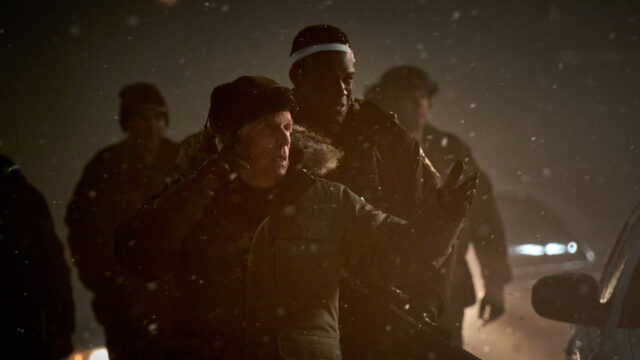
“It was a major concern,” Wheatley admits. “How do you shoot a storm at night? … How do you make it look like snow?” Rather than relying on preconceived cinematic tropes, Wheatley and his team studied real storm footage, discovering that snow behaves more like mist at a distance. That insight allowed them to shape the visual field more effectively, creating a storm that feels immersive without overwhelming the frame.
If the film’s environmental design adds texture, its action sequences deliver the knockout punch.
Working with a seasoned stunt team and a game Odenkirk—who performs much of his own physical work—Wheatley constructs action that is not only dynamic but remarkably clear. There is no frantic cutting to mask movement. No visual confusion. Every hit lands. Every beat registers. The now-legendary third-act restaurant fight is a masterclass in controlled chaos, blending choreography, camera placement, and editorial precision into something both brutal and exhilarating.
“A lot of it is the people,” Wheatley says. “Bob does a lot of his stunts… we’ve got to see his face.”
That philosophy carries through into the edit, where Wheatley once again collaborates with editor Jonathan Amos. Known for his ability to balance tension, pacing, and tone across wildly different genres, Amos brings a subtle but crucial discipline to NORMAL. Scenes are compressed, tightened, refined—not to rush the audience, but to keep the film moving with the momentum of what Wheatley describes as “an express train that never feels rushed.”
Complementing that momentum is a richly textured score by Harry Gregson-Williams, which blends electronic propulsion with elements of American folk. The music mirrors the film’s hybrid identity—part modern action, part neo-Western, part something altogether stranger—while reinforcing its tonal shifts without overpowering them. As Wheatley notes, the goal was “a modern action score” that still carried “that feeling of folk music… half electronic and half guitar,” a fusion that underscores both the film’s relentless drive and its roots in a distinctly American landscape.
And then there is Henry Winkler, whose presence as the town’s mayor adds yet another unexpected layer. For Wheatley, working with Winkler was both a professional and personal thrill. “He’s the nicest guy in all of Hollywood,” he says, noting not only Winkler’s on-set warmth but his long-standing habit of documenting productions with his own photography—an off-screen contribution that quietly preserves pieces of cinematic history.
Ultimately, what makes NORMAL so exhilarating is not just its action, or its performances, or even its striking visual design. It is its refusal to conform.
Wheatley has crafted a film that embraces originality at every turn—a weird, wacky, and wildly entertaining ride that feels as though it was made with intention, precision, and just enough madness to keep audiences on their toes.
And in a cinematic landscape that too often plays it safe, that may be the most radical thing of all.
by debbie elias, exclusive interview 04/07/2026
NORMAL is in theatres on April 17, 2026