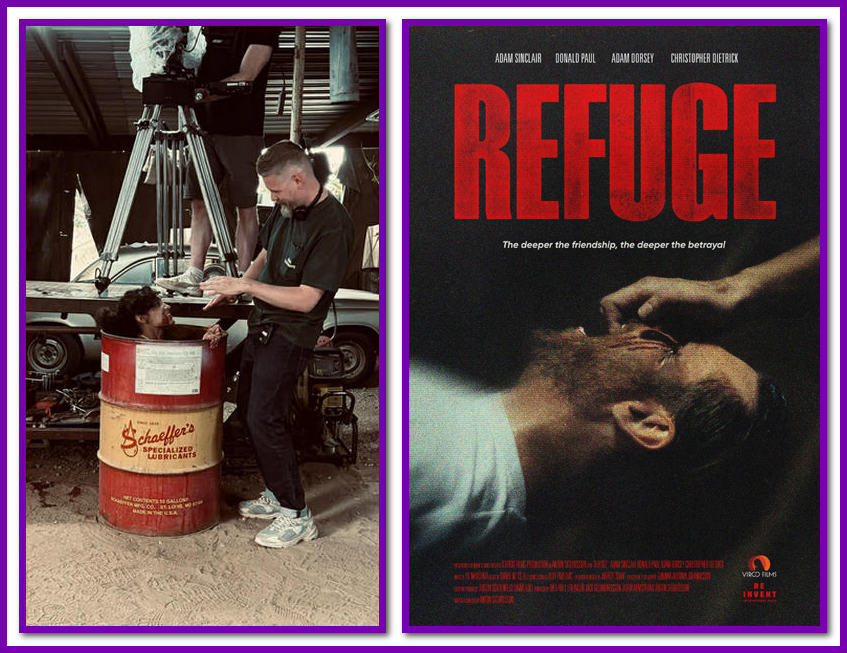
There’s something deceptively simple about the premise of REFUGE. Four longtime friends gather at a remote cabin. One of them—Sam—has never recovered from the disappearance of his young daughter four years ago. Grief lingers. Questions fester. His young daughter’s diary entries consume him. And before long, suspicion turns inward, accusations fly, and the walls—both literal and emotional—begin to close in.
But as writer/director Anton Sigurdsson reveals, REFUGE is anything but simple. What unfolds on screen as a brutal, blood-soaked psychological thriller is, at its core, a meticulously engineered exercise in visual and sonic storytelling—one built under pressure, on the fly, and, in more ways than one, discovered in the moment.
Sigurdsson conceived REFUGE as what he calls “a bottle film with a big heart”—a single-location, four-hander that leans heavily into performance and character dynamics. It’s a structure that could easily have translated to the stage. But for Sigurdsson, the challenge—and the opportunity—was to make it unmistakably cinematic.
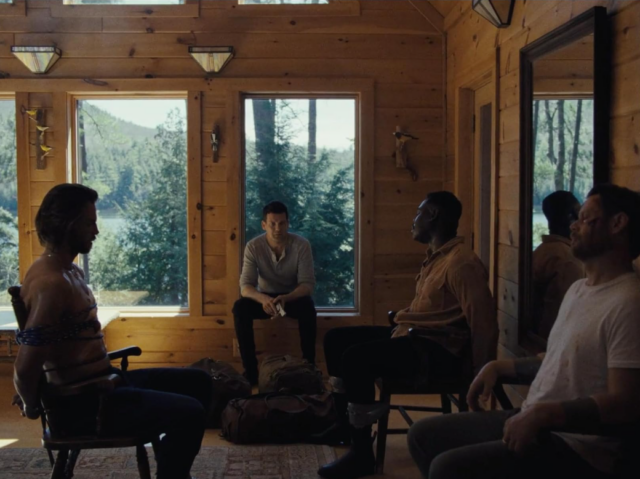
“How do you keep it visually compelling the whole time?” he asks. “How do you reintroduce spaces and new sets inside a single location so people don’t get bored?”
The answer lies in a carefully calibrated visual grammar developed in close collaboration with cinematographer Gunnar Audum Johansson, a longtime creative partner who instinctively understands Sigurdsson’s instincts as both a storyteller and visual architect.
“I don’t like a lot of coverage. I like less coverage than [that] usually is, maybe done. And he understands that,” Sigurdsson explains. “And he’s such a great operator—how he operates the camera, the movement, all of that.”
That shared sensibility is key. Rather than relying on traditional coverage to build a scene in the edit, Sigurdsson and Johansson construct tension within the frame, allowing shots to breathe, performances to unfold in real time, and camera movement to carry emotional weight. It’s a methodology that demands precision and trust—and one that pays off in a film where every visual choice feels intentional.
Together, they transform the cabin into a living, breathing environment—one that evolves alongside the unraveling psyches of its inhabitants.
Shot in a 4:3 aspect ratio, the film embraces a deliberately constricted frame, amplifying the claustrophobia that defines the narrative. Extreme close-ups press in on the actors, while Dutch angles subtly destabilize the viewer’s sense of equilibrium. Camera placement becomes psychological positioning—peering from upstairs to downstairs, around corners, into negative space—each choice reinforcing the idea that no one in this house is ever fully at ease, or fully in the clear.
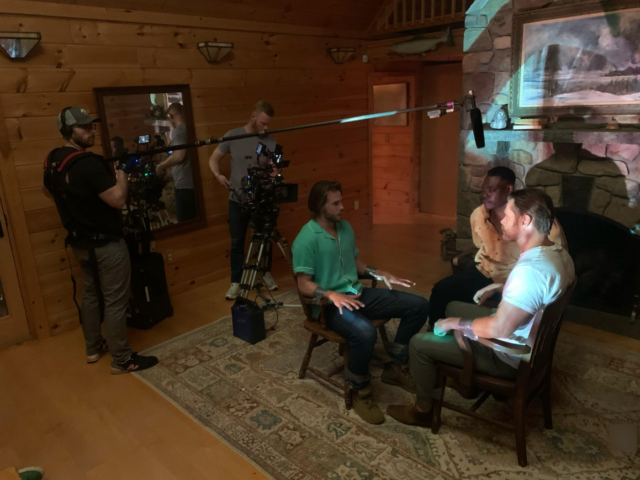
“This could have been a play,” Sigurdsson admits. “But I wanted it to look amazing…we can kind of mix old school cinema in with a fresh wave of punk rock and roll.”
That tonal blending—rooted in classical restraint but energized by something more volatile—extends into every facet of the film’s construction. And nowhere is that more evident than in the film’s most unexpected assets: the basement…and the lake.
When Sigurdsson and his team first secured the Lake Placid cabin that would serve as their primary location, they designed the film without any knowledge of what lay below—or just beyond.
“We were told there was no basement,” he recalls.
Only upon arriving for prep did the truth reveal itself. And in that moment, everything changed.
Standing in the newly discovered space alongside Johansson and production designer Jarrett Staaf, Sigurdsson immediately recognized the narrative and visual potential. The basement wasn’t just an added location—it was a tonal shift, a descent, a physical manifestation of the film’s psychological undercurrents.
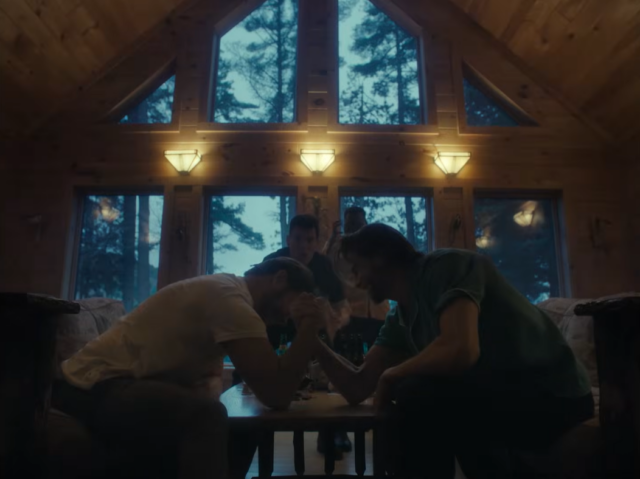
“We’re looking at each other, going, ‘This thing, that thing…’” he says. “And Gunnar is so quick on his feet…we could make decisions right there.”
It’s a moment that speaks volumes about Sigurdsson’s instincts as a filmmaker. Rather than rigidly adhering to pre-planned structure, he embraces discovery, allowing environment to inform story in real time. That same instinct extended beyond the walls of the cabin.
“We weren’t supposed to shoot at that lake. We had another lake,” he explains. “But then we see the lake, and we’re like, we’re doing it here…It was just a few feet from us…It had this amazing atmosphere in it. So we were very lucky once we figured where to shoot.”
That freedom to pivot—to follow instinct rather than infrastructure—is something Sigurdsson doesn’t take lightly.
“We weren’t locked to a location because of tax rebate or anything,” he notes, a reality that afforded him a level of creative autonomy rarely available to filmmakers working at this scale.
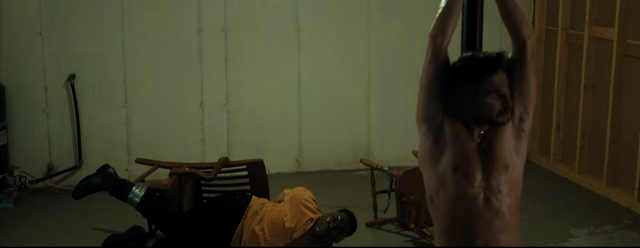
Working with a skeletal six-person crew and a lighting package small enough to fit in a standard vehicle, Sigurdsson and Johansson relied heavily on natural light and environmental conditions, shaping the look of the film in real time. The result is a visual language that feels at once controlled and organic—precisely composed, yet alive to the moment.
That same philosophy extends into Sigurdsson’s decision to shoot chronologically, a rarity in modern filmmaking but one that proves invaluable here. “A lot of the backstory and the character gallery that we had was kind of built by the cast alongside me. I also shoot in a chronological order, so we could see stuff happening in real time, and go back and change.”
With escalating violence, mounting emotional tension, and, yes, a significant amount of blood—and duct tape—the continuity benefits are obvious. But more importantly, the approach allows performances to build naturally over time.
“It fuels the emotional tension,” Sigurdsson notes, emphasizing how actors could track their characters’ psychological descent in real time.
If the visuals define the film’s physical space, it is the sound design that gives REFUGE its pulse.
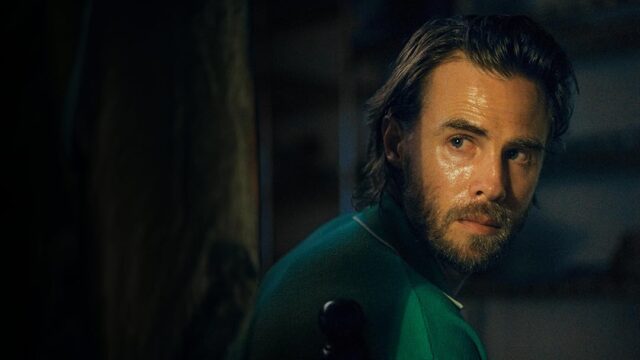
Sigurdsson approaches sound as narrative architecture, interrogating every auditory choice. “Why is this sound here? Why does it work?” he asks. “You want to hear the house breathe.”
From the ambient acoustics of the cabin—where voices carry differently from basement to upper floor—to the interplay between silence, score, and environmental sound, REFUGE constructs a layered sonic landscape that mirrors its visual intensity. Working with a sound team in Denmark, Sigurdsson spent months refining this dimension, experimenting freely in post-production.
“We could try things. Be creative. Nobody was looking over our shoulder saying no.”
That freedom manifests in bold choices, including unexpected musical textures and contrasts that heighten unease and draw viewers deeper into the film’s psychological terrain.
For all its technical precision, however, REFUGE never loses sight of its emotional core. At the center is a father’s desperate need for answers, and a group of men whose shared history fractures under the weight of suspicion and buried truths. It’s a dynamic Sigurdsson roots in personal experience, drawing from stories and personalities encountered in his upbringing in Iceland, while infusing the narrative with a distinctly Scandinavian tonal sensibility—where even the darkest moments can carry a flicker of humor.
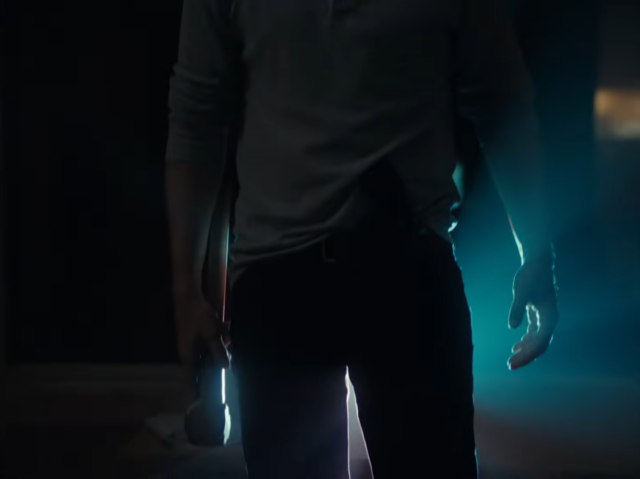
And then, of course, there’s the duct tape.
A recurring visual and practical element within the film’s more brutal sequences, it became something of an unexpected production signature.
“We blew our tape budget pretty quickly,” Sigurdsson laughs. “I think the duct tape budget was higher than the whole production design.”
For Sigurdsson, though, every element—no matter how seemingly mundane—serves the story. Whether it’s the constriction of the frame, the breath of the house, or the tactile presence of something as simple—and as essential—as duct tape, REFUGE is built on the idea that tension lives in the details.
And thanks to a filmmaker willing to pivot, adapt, and trust those details, it’s a tension that never lets go.
by debbie elias, exclusive interview 04/14/2026
Available now on Digital and On Demand