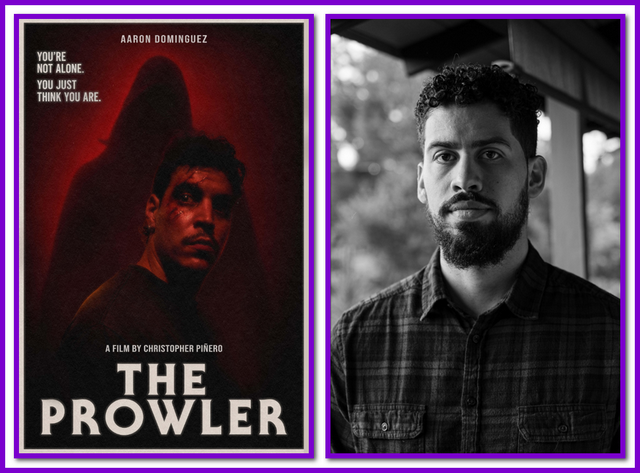
Silence can be terrifying. Not movie silence. Not the manufactured quiet that telegraphs the inevitable crash, scream or jump scare waiting somewhere on the other side of the frame. Real silence.
The kind that leaves you alone with the sound of your own footsteps. A refrigerator door opening. Silverware shifting inside a kitchen drawer. Crickets outside an open door you could have sworn you closed. A faint whisper of wind slipping into the house. And the increasingly uncomfortable realization that you may not be alone.
Writer/director/editor CHRISTOPHER PINERO understands the power of that silence.
In THE PROWLER, his exquisitely crafted psychological thriller running a mere nine minutes and 58 seconds, Pinero doesn’t simply withhold answers. He weaponizes their absence. Working in concert with cinematographer David Rivera, sound designers David Raymer and Marcos Butron, and composer Alex, Pinero constructs an environment in which virtually every image and sound encourages us to question what we’re seeing, what we’re hearing—and ultimately, whom we should fear.
“Suspense is a delicate balance between giving information and withholding information,” says Pinero. And for nine minutes and 58 seconds, he walks that knife edge beautifully.
From its opening frame, THE PROWLER announces itself with a visual and sonic boldness that immediately commands attention. Saturated red fills the screen while an unnerving score grabs hold. It’s striking, aggressive and impossible to ignore. But then Pinero begins taking things away.
The score disappears. Ordinary sounds become extraordinarily prominent. Footsteps. A creaking door. Wind. Crickets. The unmistakable weight and suction of a refrigerator door opening. Drawers sliding. Silverware and knives shifting against one another.
We awaken with Aaron, who is fully dressed and sprawled on a couch, scratches and blood visible on his face. We don’t know what happened to him. Neither the film nor Pinero is in any hurry to tell us. Maybe he was in a fight. Maybe he came home drunk and passed out. Maybe there is someone else in the house. Maybe what he’s experiencing is supernatural. Maybe it’s all happening inside his head. Pinero wants every possibility alive.
“I really just wanted you to be in Aaron’s shoes for the whole time until it flips,” he explains. Aaron knows what lies at the end of a red hallway inside the house. We don’t.
And that imbalance between what Aaron knows, what we think we know, and what Pinero deliberately refuses to tell us becomes the engine driving THE PROWLER.
A voracious student of genre, Pinero knows the cinematic language audiences bring with them. He has watched THE CONJURING repeatedly, along with PSYCHO, HALLOWEEN and countless other films whose grammar has taught generations of moviegoers how to interpret a noise in the darkness, a partially open door or an unidentified figure lurking at the edge of a frame.
“I am the audience,” he says. “I’m the first audience member on set.”
That means he’s constantly considering what we’re thinking—or at least what we might be thinking—and deciding whether to satisfy that expectation, complicate it or turn it completely against us.
For a filmmaker working in psychological suspense, that’s an exceptionally useful weapon. Because Chris Pinero understands that suspense lives in the space between what an audience knows, what it thinks it knows, and what a filmmaker deliberately refuses to tell it. And THE PROWLER is built inside that space.
The Camera Knows More Than We Do
Pinero doesn’t merely withhold information from us. Sometimes he gives us the answer and trusts that we won’t realize we’ve received it.
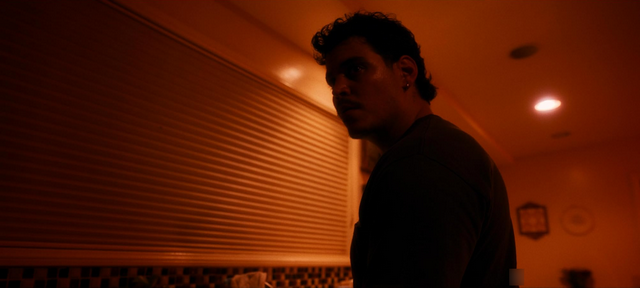
One of THE PROWLER’s most fascinating shots comes in the kitchen. We’ve previously glimpsed a figure concealed in the darkness behind Aaron. When the perspective changes, the camera appears to adopt that figure’s point of view.
Aaron rummages through a drawer looking for a fork. The camera begins moving. Slowly. Very slowly. For nearly 30 seconds, it creeps toward him. Everything we’ve learned from decades of thrillers tells us what is happening. Someone—or something—is approaching Aaron from behind. We’re waiting for the payoff. Waiting for the attack. Waiting for Pinero to reveal whatever has been hiding in the darkness. And then the camera whips. But it doesn’t whip toward the doorway or some waiting figure. It returns to Aaron.
“I wanted to subtly put into the audience’s mind that he’s the danger,” Pinero explains.
The camera has just told us something. We simply don’t understand it yet.
“There are things you can do visually that can put little breadcrumbs in the audience’s mind,” he says, so that after the eventual revelation we can mentally retrace our steps and recognize the clues that had been there all along.
That’s the game Pinero is playing throughout THE PROWLER. Not cheating the audience. Manipulating our perception. There’s a difference.
He gives us information, but controls its context. He shows us something without necessarily explaining what we’re seeing. He lets our familiarity with genre supply an interpretation—and then waits. Which brings us to perhaps the most dangerous collaboration on THE PROWLER. Chris Pinero versus Chris Pinero.
When the Director Fights the Editor
Pinero’s determination to keep THE PROWLER below ten minutes created an unusual problem. Editor Chris started hurting Director Chris’s movie.
“I was so hell-bent on getting it under 10 minutes,” he admits.
His first editing pass moved efficiently. Too efficiently. Pinero realized he was cutting through precisely the moments in which tension needed time to grow.
So Director Chris had to intervene.
Those moments need breath. Consider something as simple as Aaron discovering an open door. Hold on Aaron’s face. Cut to the door. Return to Aaron. Let what he’s seeing register. More importantly, let it register with us. Aaron may be thinking that he simply forgot to close the door. We’re thinking somebody opened it. Nothing conventionally frightening needs to happen during those extra seconds because the audience is already doing the work.
Pinero has provided the empty space. We fill it with fear.
“It’s fun to manipulate the audience when you know the ending,” he admits.
For a filmmaker serving simultaneously as director and editor, however, that requires the discipline to recognize when efficiency becomes the enemy of experience. Sometimes a cut improves a scene. Sometimes the best editorial decision is simply to wait.
Dreaming in the Same Cinematic Language
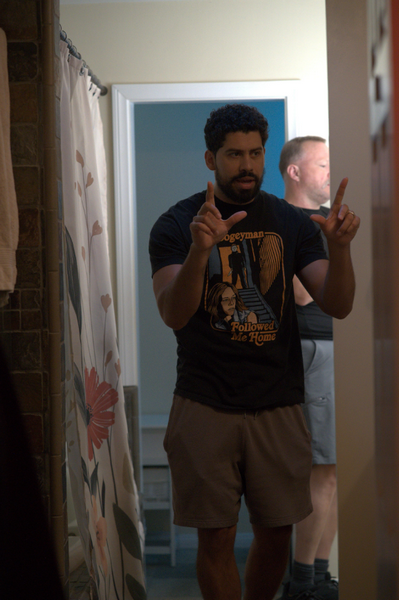
That meticulous control doesn’t mean Pinero operates in a vacuum. Quite the opposite. He arrives with strong ideas about framing and camera placement—often having already “dreamed up” shots before production—but he also wants collaborators willing to challenge those ideas and make them better.
Enter cinematographer David Rivera.
One of Pinero’s favorite films is NO COUNTRY FOR OLD MEN. He was attracted to its deep shadows, sodium-vapor lighting and what he calls its “sweaty, dingy” appearance, and had that visual character floating around in his head while considering THE PROWLER.
He didn’t tell Rivera. He simply sent him the script. Rivera came back with a suggestion. What about a sweaty, dingy, NO COUNTRY FOR OLD MEN look? There was his DP.
That kind of shared cinematic vocabulary is invaluable to Pinero, particularly on a production where there isn’t time to spend hours translating a visual concept. A filmmaker should be able to invoke an image from another movie, pull up a reference or describe a feeling and have the person beside him understand the language he’s speaking.
With Rivera, Pinero found that shorthand. And THE PROWLER benefits enormously from it.
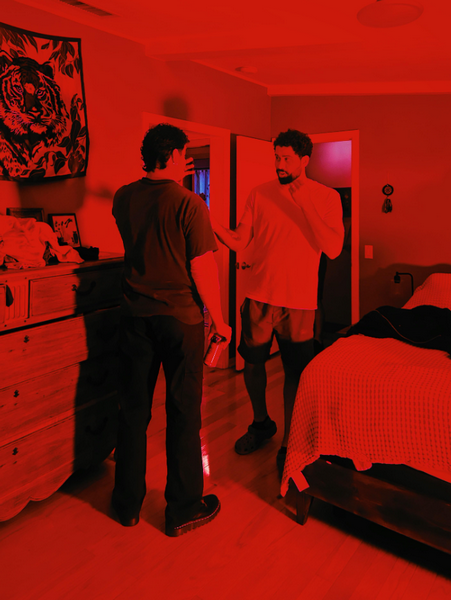
The house surrounding Aaron becomes its own psychological environment: deep reds, burnt oranges, dark wood, low ceilings and heavy shadows. The palette feels hot and increasingly oppressive, as though Aaron is trapped inside a space slowly tightening around him.
One particularly memorable visual element is a slice of saturated red light pouring from a bedroom into the otherwise dark hallway. Pinero knew exactly what he wanted it to look like. He had absolutely no idea where the hell the light was supposed to be coming from. He described the image to Rivera during a walkthrough. Rivera’s response?
“Doesn’t matter. We’ll figure it out.”
Eventually Pinero’s storytelling brain supplied a practical justification: red bedroom lighting has become popular with people who use it as a sleep aid. Problem solved. But what’s more revealing is that Rivera first understood the emotional purpose of the image. Reality could catch up afterward.
Submit to the Process
One of THE PROWLER’s most unsettling compositions also demonstrates something Pinero readily acknowledges: no matter how thoroughly a director prepares, filmmaking gets better when good collaborators are allowed into the process.
His wife plays both victims in the film, a decision born largely from the realities of a limited budget. As they prepared to shoot a bedroom sequence, she noticed something Pinero hadn’t. Aaron and the body hadn’t appeared together within the same frame.
“You need to see them both together,” she told him.
Pinero considered the problem and proposed a Dutch-angle two-shot. Rivera went one step further. What if the camera rolled with Aaron as he leaned toward the body? Done. The resulting shot has a queasy visual instability perfectly suited to the moment. For Pinero, that’s filmmaking.
“You’ve got to submit to the process,” he says.
He can arrive with the architecture firmly in his head. Rivera can question it. An actor can spot a missing piece. An idea born of budgetary necessity can inspire another idea that becomes one of the film’s strongest visual moments. The director still has a vision. But everybody gets to help sharpen the knife.
Sound, Sound, Sound
As striking as Rivera’s cinematography is, however, THE PROWLER may be even more fascinating when you stop looking at it and simply listen. Sound is not embellishment here. It is narrative.
Pinero originally tried to write THE PROWLER essentially as a silent film. Eventually he realized that complete silence would call attention to itself and become a gimmick. Characters naturally need to speak at certain moments. But his underlying philosophy remained.
He doesn’t want dialogue simply because movies are expected to have dialogue. He loves filmmakers who make language itself an attraction, citing Quentin Tarantino and Aaron Sorkin, but otherwise finds constant conversation can become an overload of information. He’d rather let us watch. And listen.
Sound designer David Raymer, working with Marcos Butron, became crucial to creating that experience. Raymer doesn’t work out of some enormous post-production facility, but when Pinero heard the finished mix playing theatrically while testing the DCP, he felt the scale of the work. That’s when THE PROWLER finally became a movie to him. The magic lies in details that might escape conscious notice.
That open side door? Raymer added the faintest whisper of wind entering the house. Tiny. Almost nothing. But we hear it. And we feel it.
The mundane becomes ominous because every sound occupies space that would ordinarily be filled with music. Which makes Pinero’s relationship with composer Alex especially interesting.
He tells composer Alex Kish to go “full tilt.” Score whatever you feel should be scored. Put music everywhere.
Then Chris starts removing it. Music disappears from sequences. Cues get relocated. Something beautiful that doesn’t belong in one scene may find a home somewhere else. Pinero isn’t rejecting the score. He’s protecting the silence. “Sometimes music can kind of let [the audience] off the hook a little bit,” he explains.
A conventional score can tell us exactly how we’re supposed to feel. Danger. Sadness. Relief. Fear.
Silence offers no such instructions. And without instructions, we’re left searching.
Pinero compares it to that uncomfortable lull during a real conversation when someone suddenly blurts out something utterly meaningless just to fill the void. How about that weather next week?
We hate empty space. So Pinero leaves it empty. “Don’t fill it,” he says. “Just let it be silent and let the audience kind of fill in this silence in their mind.”
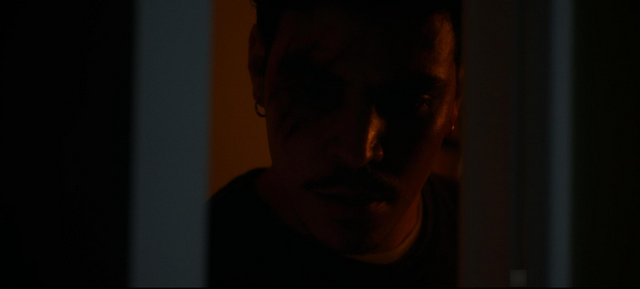
He even describes one room as a “black hole.”
The camera moves toward it. We can’t see what’s inside. There’s no foreboding musical cue assuring us that, yes, we are officially in a Scary Movie Moment. Nothing gives us permission to relax. So we don’t. And therein lies the genius of THE PROWLER’s soundscape.
The terror isn’t necessarily in what Pinero and his team put into it. Sometimes it’s in what they deliberately leave out.
And Then Everything Turns Cold
Throughout most of THE PROWLER, we’re imprisoned inside that fiery visual world of red, orange, wood and shadow. Then Aaron enters the bathroom. Everything changes.
Cold. Blue. Tile. The heat disappears and the movie suddenly feels clinical, icy, alien. Something has shifted. To say more would be criminal.
Because THE PROWLER has one final card to play, and anybody who reveals that card before an audience sees the film should probably be locked inside Chris Pinero’s black-hole room and forced to listen to refrigerator doors opening for eternity.
There will be no spoilers here. Suffice it to say that the final shot is a beauty.
Pinero constructs THE PROWLER as a bookend. The film begins with an out-of-focus hooded figure looming in darkness, seen from the initial victim’s perspective. The indistinct image encourages yet another interpretation: perhaps this is something supernatural, even a kind of reaper. Eventually we return to that visual idea. Except now it’s clear.
Focused. Understood. And Pinero has the figure look directly into the lens.
“I almost wanted it to feel like…did we get you? We got you, didn’t we?”
Yes, Chris. You got us.
Nine Minutes and 58 Seconds
THE PROWLER didn’t initially begin as the opening of a feature. Pinero had already spent years developing a larger project when he and collaborator Aaron, tired of waiting for the machinery of feature filmmaking to move, decided to make something. Pinero compares the original idea to the tie-in comic books released alongside comic-book movies: a separate little mission existing within the same universe, offering a taste of its tone, world and characters.
Then he started editing THE PROWLER. People started seeing it. And Pinero started thinking. What if this wasn’t merely a companion piece? What if this were the opening sequence? He pitched the idea, received encouraging feedback and rewrote accordingly.
Now THE PROWLER serves two purposes beautifully. It is a complete short film. And it is a promise of something larger.
That larger film is ROSEMONT FOREST, named for the neighborhood where Pinero grew up. The feature is developed and being packaged, with Pinero hoping THE PROWLER’s festival life will put the short in front of precisely the person who might approach him afterward and ask every filmmaker’s favorite question: What do you have next? He has an answer ready. And he has one hell of a calling card. THE PROWLER was produced for under $10,000. You would never know it.
Pinero’s ambition was straightforward: if somebody took ten minutes from an A24 or NEON film—or a larger studio production—and placed those ten minutes alongside THE PROWLER, he didn’t want audiences to see the difference. “We tried our best to immerse you in something and make you feel like, for 10 minutes, you’re inside of a movie you paid to see in a theater.”
Mission accomplished.
Because what makes THE PROWLER impressive isn’t simply that it looks like a fully realized theatrical production. It’s that nothing feels cheap in thought. Every dollar in the world can’t buy a filmmaker a point of view. It can’t buy an understanding of where to put a camera. It can’t teach someone when to cut—or, more importantly, when not to cut. It can’t create the instinct to let a whisper of wind do the work of an entire musical cue. And it can’t teach a filmmaker to understand that sometimes the most frightening thing you can give an audience isn’t an answer. It’s just enough information to make them desperately want one.
Chris Pinero understands that. And with THE PROWLER, he leaves us standing in the darkness, listening. Waiting. Wondering what’s there. And anxious to follow him deeper into the forest.
by debbie elias, exclusive interview 08/07/2026