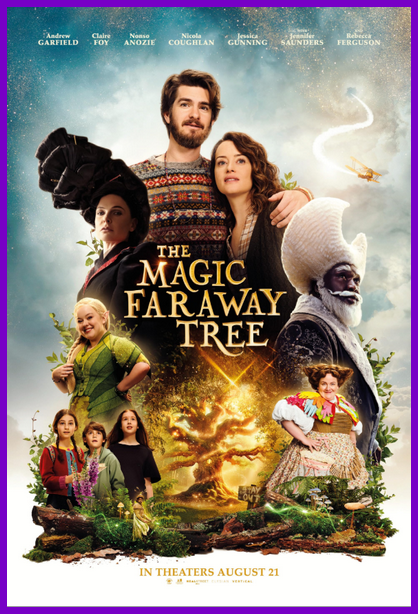
There are some films that feel designed for our very worst days. The ones you reach for when the flu has you pinned beneath a blanket, when the job disappears, when your heart gets broken, or when the world simply feels a little too heavy. Films that remind us that wonder still exists, imagination still matters, and somewhere inside even the most beleaguered grown-up is the child who once believed a tree really could lead to another world.
THE MAGIC FARAWAY TREE is one of those films.
Fanciful, kooky, colorful, heartfelt, and unabashedly fun, director Ben Gregor’s adaptation of Enid Blyton’s beloved classic, adapted for the screen by Simon Farnaby, is a frothy, light, pure delight backed by some seriously impressive filmmaking craft. Better still, it accomplishes something increasingly rare in family entertainment: it never mistakes sophistication for cynicism. It believes wholeheartedly in its own magic.
And so do we.
Coming to THE MAGIC FARAWAY TREE without the nostalgic attachment that generations of readers have to Blyton’s book, I had no childhood memories for the film to trade upon. I’ve never read the novel. That means Gregor and screenwriter Simon Farnaby had nowhere to hide behind my affection for the source material. The movie had to create its magic from scratch.
It does. By the time the credits rolled, I wanted to read the book.
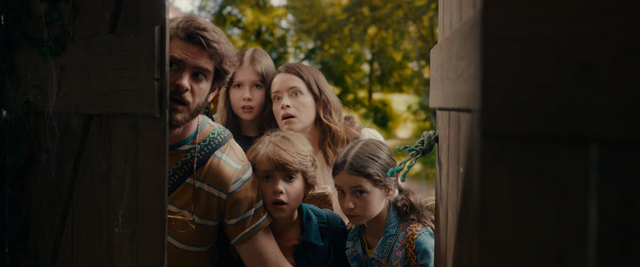
At the heart of the story are Polly and Tim and their three children, Fran, Beth, and Joe, a thoroughly modern family forced by financial hardship to abandon the familiar comforts of their former life and relocate to the English countryside. Electricity, Wi-Fi, and the conveniences that once cushioned their existence are suddenly scarce or nonexistent. But their real problem runs much deeper. This is a family whose members have gradually stopped truly seeing one another.
And that is where the magic begins.
When the children discover an extraordinary tree inhabited by the likes of Moonface, Silky, Dame Washalot, Saucepan Man, Mr. Watzisname, and Oom Boom Boom, they find not merely an escape from an inconvenient new life but a doorway into possibility. At the top of the tree lie ever-changing lands filled with food, birthdays, topsy-turvy rules, danger, absurdity, and wonder.
Yet THE MAGIC FARAWAY TREE isn’t simply a movie about children discovering magical worlds.
The children discover. The adults rediscover.
Polly and Tim had lives, aspirations, personalities, and dreams before bills, parenthood, disappointment, and practicality began wearing away at them. The adventures of the Faraway Tree don’t simply bring parents and children physically together; they gradually revive pieces of the people each of them used to be.
That emotional grounding is essential. Without it, the various lands would be little more than beautifully mounted fantasy episodes. With it, every new adventure becomes another step toward reconnecting a family that had forgotten how much it needed one another.
And what marvelous adventures they are.
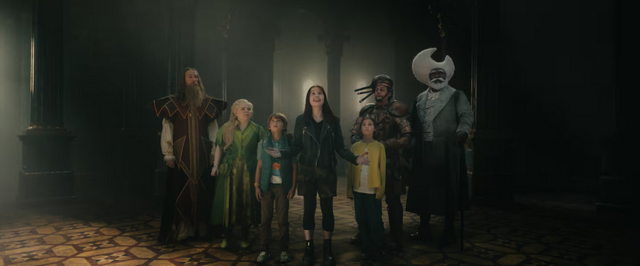
Welcome to Blytopia, a tactile meeting place between humble domestic life and unfettered fantasy, where sandwiches, cakes, chores, gardens, hand-built machinery, and salvaged objects live comfortably alongside gravity-defying trees and impossible realms.
There is a handmade beauty to virtually everything.
Nothing feels shiny simply for the sake of being shiny. Wood has grain. Fabric has texture. Machinery looks as though someone actually assembled it from pieces lying around a barn. Ladders, tunnels, household objects, and inventions speak to a kind of Swiss Family Robinson ingenuity in which imagination transforms what is already at hand rather than demanding something synthetic and new.
Adding immeasurably to that tactility is the absence of plastic throughout Blytopia. Found, salvaged, fabricated, and repurposed materials give production designer Alexandra Walker’s designs an organic integrity that makes even the most impossible creations feel as though they could have been assembled by hand just beyond the garden gate.
You can practically feel the wood beneath your hands. You can almost smell the sugar.
And in the Land of Goodies, you could quite literally eat the scenery.
The Land of Goodies isn’t merely designed to look edible; much of it actually is, giving the young actors something tangible to encounter and allowing their astonishment to spring from physical interaction rather than an imagined digital environment. Sets are physical. Objects have weight. Environments can be touched. When the magical lands begin destabilizing, the world around the children actually shifts and moves.
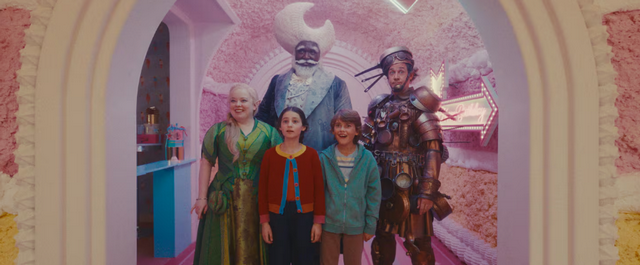
Their wonder has something real behind it.
So does their fear.
That matters because THE MAGIC FARAWAY TREE understands a principle too many contemporary family films have forgotten: Magic without risk is merely spectacle. Adventure requires the possibility that something might go wrong.
The film’s magical lands do not remain conveniently parked above the tree waiting indefinitely for visitors. Time matters. The lands move. Stay too long and you may not get home. As the clock runs down, environments begin coming apart, forcing the family to move, react, dodge danger, and rely on one another.
There is real jeopardy amid all this delicious silliness.
And there is a rich cinematic and literary heritage woven throughout it.
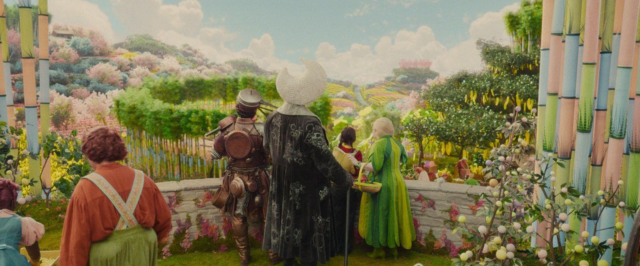
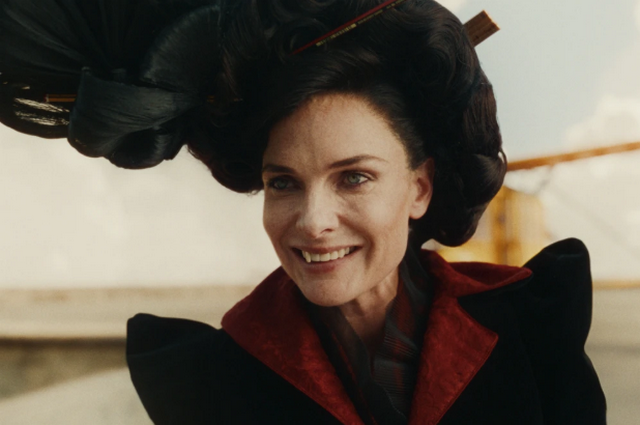
Echoes of MATILDA, JAMES AND THE GIANT PEACH, NARNIA, CHITTY CHITTY BANG BANG, THE HOBBIT, and THE LORD OF THE RINGS abound, drawing upon that great tradition of fantasy in which perfectly ordinary village life can suddenly tip sideways into something extraordinary. Rebecca Ferguson’s deliciously wicked Dame Snap, for example, carries more than a whiff of Miss Trunchbull, an imperious figure of authority whose menace feels perfectly at home amid the heightened world around her.
But THE WIZARD OF OZ is an especially affectionate touchstone, nowhere more beautifully realized than with the introduction of Oom Boom Boom. The entire sequence is structured and photographed with an unmistakable kinship to Dorothy and her companions finally reaching the gates of the Emerald City, only to have the officious gatekeeper slam his little window shut on them. But it isn’t merely the staging or visual design that Gregor evokes; it’s the emotional construction of the scene. Just as Dorothy’s tears ultimately reduce the Emerald City gatekeeper to tears of his own, Oom Boom Boom allows silliness and theatricality to give way to something unexpectedly tender. The homage is impossible to miss, but more importantly, it understands precisely why the original moment still touches us.
I found myself tearing up.
Elsewhere, the Land of Goodies carries just enough of a Munchkinland flavor to trigger recognition without becoming imitation. And that’s key to the film’s relationship with its cinematic forebears. These aren’t references inserted simply to make audiences point at the screen. Gregor draws upon the emotional language of the fantasies that came before him while allowing THE MAGIC FARAWAY TREE to speak in its own voice.
And like OZ, this is a fantasy that recognizes the value of fear.
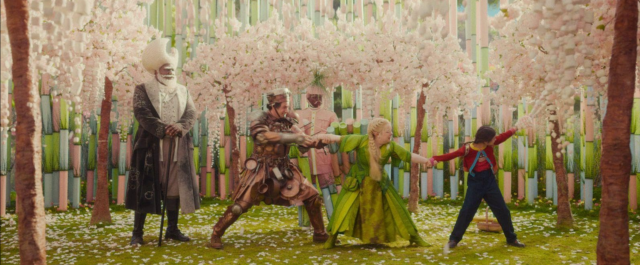
Children’s fantasy works best when it trusts young audiences enough to let wonder and danger occupy the same world. Dorothy’s journey matters because Oz is beautiful but never entirely safe. Likewise, the lands atop the Faraway Tree can be hilarious, ridiculous, delicious, and breathtaking, but the possibility of becoming stranded—or worse—is genuine.
That sense of danger gives consequence to the wonder.
Visually, the film is a feast, and cinematographer Zac Nicholson gives each realm its own distinct tonal bandwidth while maintaining cohesion across the whole. Color becomes an emotional and geographic language. The hues of one land do not simply repeat those of another, yet the film never feels as though we’re switching channels into unrelated movies.
Nicholson and camera operator Ian Mackay also resist allowing these worlds to become static showcases for production design. The camera moves with an easy fluidity, taking us through the environments rather than merely standing back and admiring them. Frames evolve as people move. Scale changes. Space opens and contracts. The camera participates in discovery.
We aren’t looking at Blytopia. We’re traveling through it.
And that makes the transitions back to the real world all the more effective. The countryside, the woods, the family home, and the magical environments exist on opposite sides of possibility, yet they remain visually related enough that one always feels capable of spilling into the other.
Imagination doesn’t require abandoning reality here. It transforms reality.
The film repeatedly mirrors the fantastical with the ordinary. Real-world machinery finds echoes in magical contraptions. Everyday objects become inspiration for seemingly impossible inventions. A tunnel through the Faraway Tree finds visual kinship with mechanisms back on the ground. Fantasy and reality begin feeding one another until the division between them feels less like a wall than an invitation.
The raw material for wonder is already around us. Someone simply has to imagine what else it might become.
That same imagination runs riot in Ann Maskrey’s superb costume design, easily among the film’s craft standouts and worthy of serious awards consideration.
These aren’t merely eccentric outfits designed to announce “fantasy character.” They tell stories.
Mr. Watzisname, unable even to remember his own name, is dressed with the fading grandeur of someone who might once have been a formidable wizard. The contradiction is quietly heartbreaking. His mind can no longer tell him who he was, but his clothing can. His clothes remember him even when he cannot remember himself.
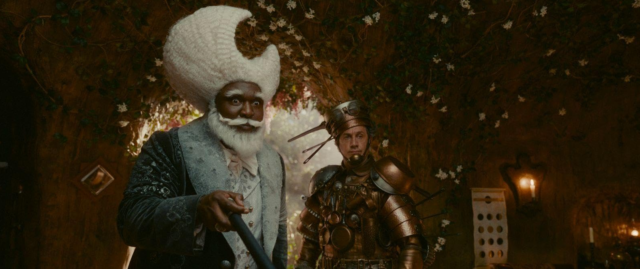
But it is Moonface who may be Maskrey’s most immediately arresting triumph. The character is identifiable by silhouette alone, beginning with that gloriously oversized crescent headpiece and continuing through the stately sweep of his coat and cloak. Look closer and the whimsy gives way to extraordinary detail, with lunar and celestial motifs carried through fabrics, embroidery, pattern, and design. Light and dark, waxing and waning, are effectively stitched into the character.
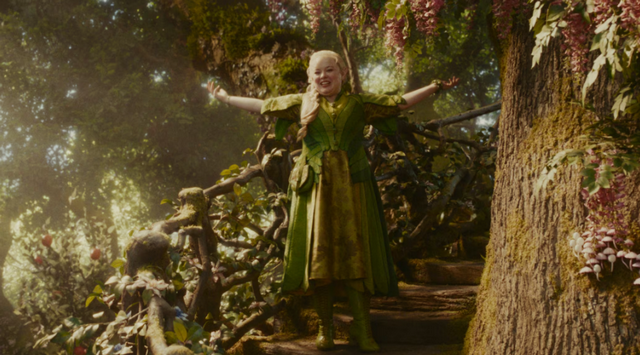
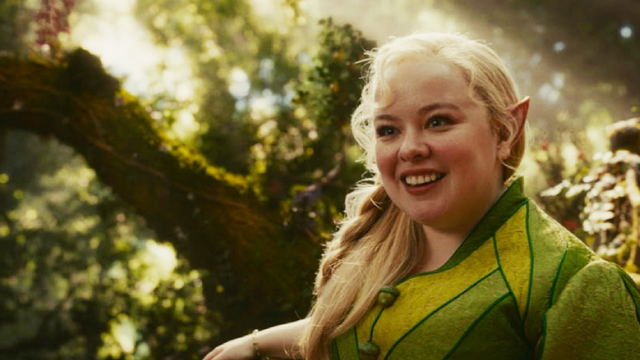
Silky provides a beautiful counterpoint, her costume alive with organic shapes and gradations of green that evoke leaves, petals, and the natural world without reducing her to a walking botanical display. Set against the flowering trees and pastel architecture of the magical lands, she appears almost to have grown organically from the environment around her.
And that points to one of the great successes of the film’s entire visual design. Maskrey’s costumes become inseparable from Alexandra Walker’s production design and Zac Nicholson’s cinematography, with silhouette, texture, pattern, and color working in concert so that the characters don’t merely inhabit these fantastical environments.
They become part of their visual architecture.
Put Moonface, Saucepan Man, Silky, and the children together within one frame and every silhouette remains distinct. Every texture contributes something different. Every color has purpose. Yet nobody appears visually disconnected from the world around them. That is costume design functioning not merely as wardrobe but as character, storytelling, and composition.
The hair and makeup follow suit, allowing the residents of the tree to appear eccentric and fantastical without losing the handmade cohesiveness that defines the production. Nothing looks as though it wandered in from another fantasy franchise.
And then there are the performances.
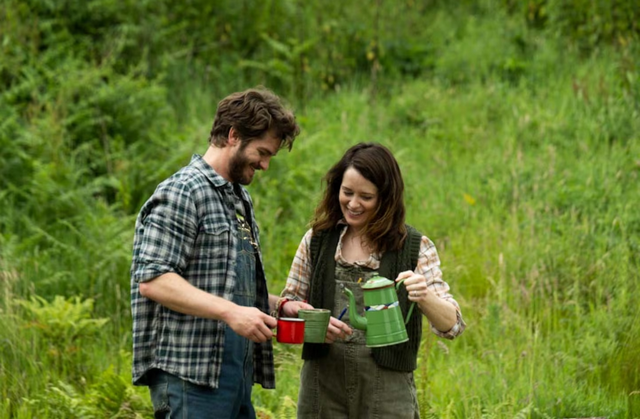
Andrew Garfield and Claire Foy provide the film with its necessary emotional anchor as Tim and Polly. Both understand that the adults cannot merely function as straight men to the children’s adventures. Their own disappointments and vulnerabilities matter. As the fantasy grows larger, Garfield and Foy make the family’s emotional world more intimate.
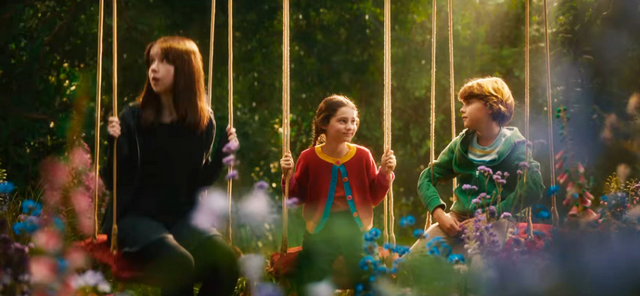
The young cast is equally essential. The movie depends upon Fran, Beth, and Joe being adventurous without becoming cloying, frightened without becoming helpless, and awestruck without seeming as though they’re waiting for somebody to insert the wonder in post-production. Giving them physical worlds to inhabit pays enormous dividends.
Around them is an embarrassment of riches. Nonso Anozie brings warmth and personality to Moonface; Nicola Coughlan’s Silky fits beautifully into this strange community; while Jessica Gunning, Jennifer Saunders, Dustin Demri-Burns, Oliver Chris, Mark Heap, and the rest of the ensemble add to the delightful sense that one never knows who—or what—might be waiting around the next bend of the tree.
And Ferguson clearly relishes every deliciously imperious moment as Dame Snap.
Editor Gary Dollner then has the unenviable job of stitching together domestic comedy, family drama, fantasy spectacle, action, visual effects, practical effects, emotional beats, and multiple distinct magical lands without allowing the film to feel episodic.
He succeeds beautifully.
Transitions through the woods become almost ritualistic passageways between reality and fantasy, while wonderfully constructed montages allow the film to compress time and emotion without sacrificing character. Particularly effective is a family-centered slow-motion sequence late in the film that quietly shifts the emotional register and may catch more than a few viewers reaching for tissues.
Dollner’s editing has the confidence to move briskly when adventure demands it but also knows when to let the movie breathe. That breathing room is important.
A fantasy film like this needs texture—the little moments that aren’t mechanically required to advance plot but make a world feel inhabited. THE MAGIC FARAWAY TREE has enough narrative momentum for children while preserving enough oddness, warmth, and observational detail for adults.
Isabella Summers’ music completes the spell, supporting rather than smothering the fantasy. The score understands when to swell with adventure and when to leave room for the emotional sincerity beneath the spectacle, helping maintain that difficult balance between exuberance and heart.
And heart is ultimately what keeps THE MAGIC FARAWAY TREE from becoming merely an impressive exercise in production design.
For all its fantastical lands, edible scenery, eccentric characters, slippery-slips, wild costumes, and improbable machinery, this is a movie about people finding one another again.
The tree doesn’t fix the family. It gives them opportunities to fix themselves.
It forces them to move together, take risks together, fail together, laugh together, protect one another, and remember what it feels like to share something other than a roof.
And perhaps most importantly, it reminds Polly and Tim that adulthood doesn’t require surrendering every imaginative part of themselves.
That idea extends beyond the characters.
If THE MAGIC FARAWAY TREE has one particularly delightful side effect, it’s that by the time the adventure ends, I’m not ready to come down. With so many other lands waiting at the top of Blyton’s tree, Gregor has created a world that practically begs for another climb. I want a sequel. I want to see what other lands appear overhead, what new dangers and absurdities await, and what Gregor and this extraordinary team of artisans might create when given another opportunity to let their imaginations run wild.
And perhaps that’s the greatest testament to how completely the film works on someone coming to Blyton’s world for the first time – I began THE MAGIC FARAWAY TREE having never read the book. Now I’m already wondering where the tree might take us next.
THE MAGIC FARAWAY TREE understands something we are too often encouraged to forget as grown-ups: imagination isn’t frivolous. Wonder isn’t childish. Play isn’t wasted time. Sometimes losing ourselves in an impossible world is precisely what allows us to find our way back to the real one—and to ourselves and one another.
There is no cynicism here about believing in magic.
No embarrassment about sincerity.
No apology for delight.
There is simply a beautifully handcrafted invitation to climb.
I accepted that invitation knowing nothing about Enid Blyton’s Faraway Tree.
Now I don’t want to come down.
Directed by Ben Gregor
Written by Simon Farnaby based on Enid Blyton’s book of the same name
Cast: Andrew Garfield, Claire Foy, Nonso Anozie, Nicola Coughlan, Jessica Gunning, Jennifer Saunders, Rebecca Ferguson
by debbie elias, 07/27/2026
THE MAGIC FARAWAY TREE is exclusively in theatres.