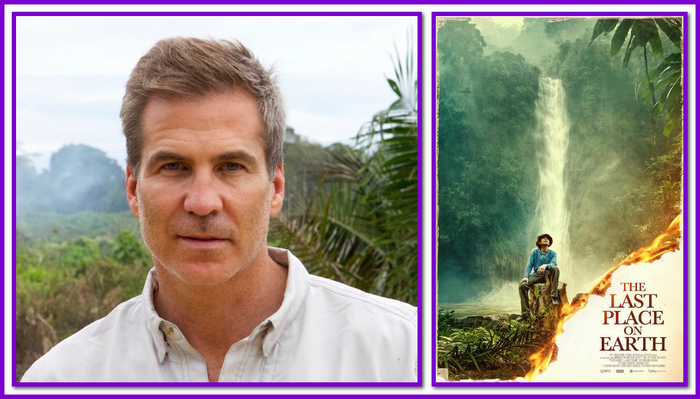
There are documentaries that inform, and there are documentaries that quietly, irrevocably change how you look at the world.
THE LAST PLACE ON EARTH, directed by David Booth Gardner, belongs in the latter category. Filmed over nine years in the Leuser ecosystem of northern Sumatra, this is a film that marries craft and conscience, using stark beauty and hard-won access to illuminate a rainforest under siege from the global palm oil industry—and the people who refuse to surrender it.
Gardner came to the project with decades of experience behind the camera, but also with a gnawing sense that something was missing.
“I have been working in… film and television… for 25 to 30 years in LA, and a huge variety of jobs, and learning many skills along the way,” he recalls. “But, you know, I was quite dissatisfied with the fact that much of the content I was making… wasn’t having any lasting impact, and I’d always been interested in ecology and environmental justice, animal justice.”
In 2014, that dissatisfaction became a pivot.
“I sold my house and I formed an organization called Planet Experts… with the goal of telling the stories of environmental activists and scientists, and also providing a platform for them to tell their own stories.”
Within a few years, Planet Experts had gathered more than 400 NGOs, scientists, activists, and universities beneath its umbrella while publishing thousands of articles on environmental issues. Somewhere within that torrent of reporting, two subjects caught Gardner’s attention.
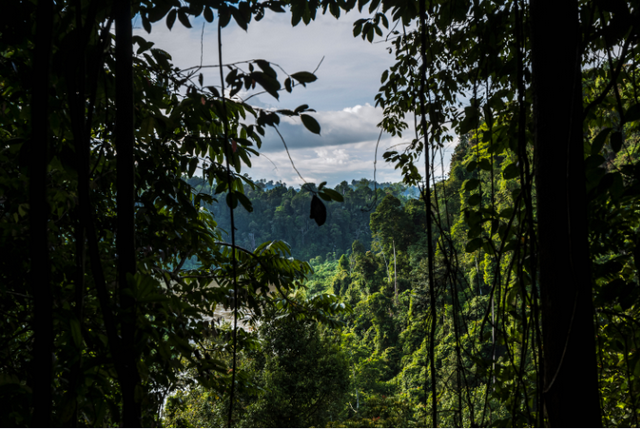
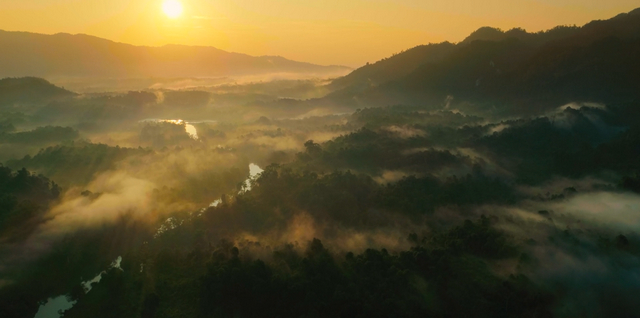
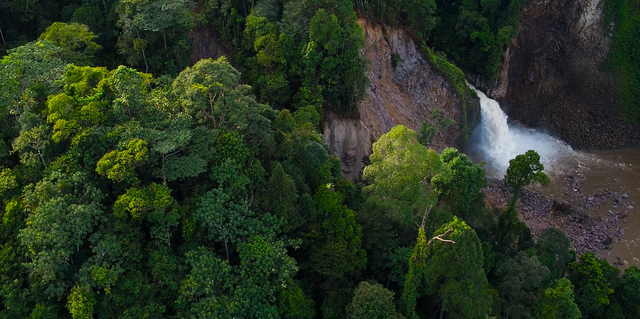
The first was the Leuser ecosystem, a vast rainforest in northern Sumatra that remains one of the most biodiverse places on earth.
“The Leuser ecosystem is a phenomenal… landscape ecosystem of biodiversity in the northern part of Sumatra Island in Indonesia,” Gardner says. “It’s about 6 million acres, three times the size of Yellowstone, and few people around the world have heard about it. Everyone knows the Amazon and the Congo…”
The second was palm oil.
Indonesia, alongside Malaysia, is the world’s largest producer of a commodity Gardner notes is found in roughly half of all packaged goods and touches consumers around the world every day, whether they realize it or not.
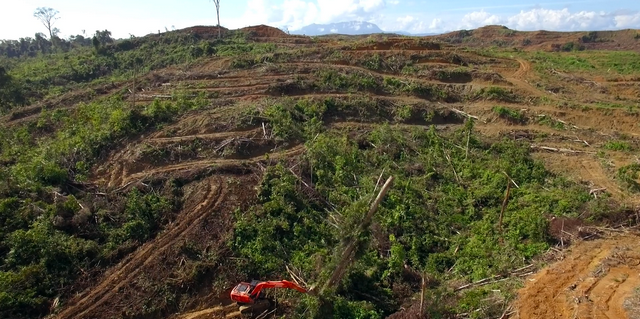
“I found the intersection of those two things quite fascinating,” Gardner says, “because… Sumatra had lost 29,000 square miles of rainforest… since 1990, due to many industries, but primarily, you know, palm oil.”
That collision—between one of the planet’s most extraordinary ecosystems and one of its most pervasive industries—was enough to send Gardner to Sumatra in October 2016.
His way into the region came through producing partner Shane McGrath, a longtime activist who had worked in Sumatra for years and co-founded HAkA with environmental advocate Farwiza Farhan. McGrath had also been closely involved in Leonardo DiCaprio’s climate documentary BEFORE THE FLOOD and brought with him an intimate knowledge of both the region and the realities of environmental field production.
Together, Gardner and McGrath assembled a small crew and began moving through the ecosystem, meeting the local activists, investigators, scientists, and conservationists whose lives would eventually shape the documentary.
Then, on Gardner’s third day of shooting, the film found its beginning.
And, as it turned out, its ending.
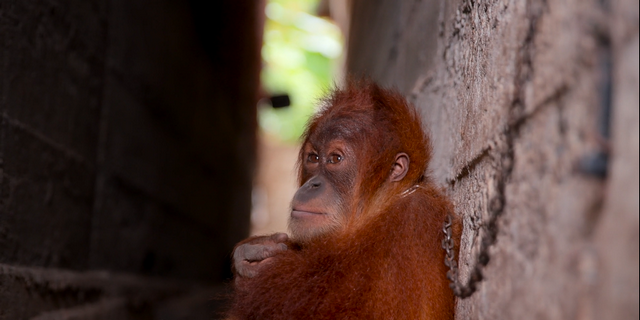
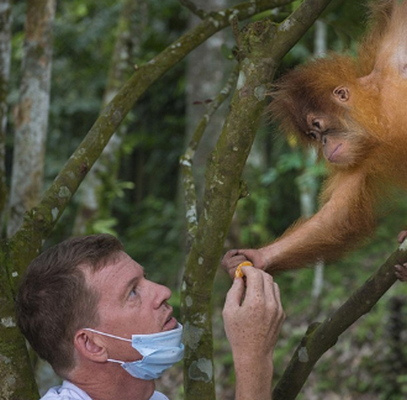
The crew accompanied a wildlife crime rescue team into a small village in Aceh. There, they found Ermalin, a three-year-old juvenile orangutan who had been kept as a captive pet, chained by the neck to a cement wall for a year.
“One of the first, I think my third day there, we filmed the rescue of this three-year-old juvenile orangutan who was bolted to a cement block wall by the neck for a year,” Gardner remembers. “I was just kind of blown away by the… stories we were seeing in this far-off, exotic place that was important and vital and fascinating and a bit dangerous.”
Ermalin was confiscated by a wildlife rescue team working with Panut and taken to a rehabilitation center run by conservationist Ian Singleton. Watching that rescue unfold, Gardner immediately understood something about the film he had only just begun.
“As soon as we shot that, I knew that I had the beginning and ending of the film.”
Rehabilitating an orangutan for eventual release back into the wild takes roughly three years. Gardner knew that if they stayed with Ermalin, her return to the rainforest could become the film’s final image of possibility.
“I knew that in three years we’d be around to get that, and there’s the ending,” he says. “It’s hard to figure out all the stuff in the middle, but… as we went along, we pieced all that together.”
That “stuff in the middle” ultimately became nine years of filmmaking.
From the outset, Gardner and McGrath knew they did not want a dry policy-driven documentary about deforestation. THE LAST PLACE ON EARTH would be character-driven, rooted in the men and women confronting the destruction of Leuser every day.
“We knew at the beginning that we wanted this to be a character-driven documentary,” Gardner says, “and that we wanted it to be about the local activists and all their teams of men and women that are fighting every single day for the protection of the Leuser ecosystem…”
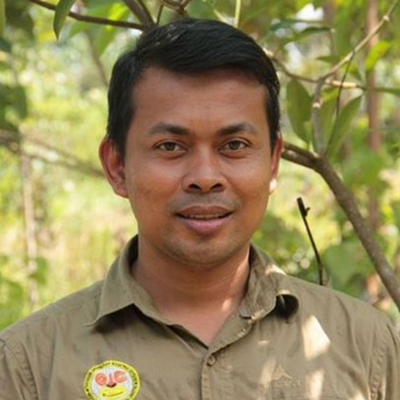
Among them is Panut, whose wildlife crime investigators operate undercover, developing relationships with traffickers, arranging sting operations, and coordinating with Indonesian authorities.
“Panut is one of the main characters, and he has a team of wildlife crime investigators that go undercover,” Gardner explains. “They build relationships online with sellers, and they set up sting operations… we go undercover with them, and we give them… hidden cameras to follow them into some of these transactions.”
Their work is only one front in a much larger battle.
For Gardner, the connection between deforestation and wildlife trafficking became increasingly clear the deeper the production moved into Leuser. Cutting virgin rainforest does more than eliminate trees. Roads follow. Settlements expand. Villages move closer to habitat once buried deep within the forest. Wildlife becomes more accessible to traffickers and increasingly displaced into human communities.
“Anytime you create a new plantation, you knock down virgin rainforest. You build roads. You then… build huts and then stores and it becomes a village,” Gardner says. “And so the animals that were kind of deeper in are now accessible. They’re accessible to the wildlife crime trade, which is a massive problem around the world.”
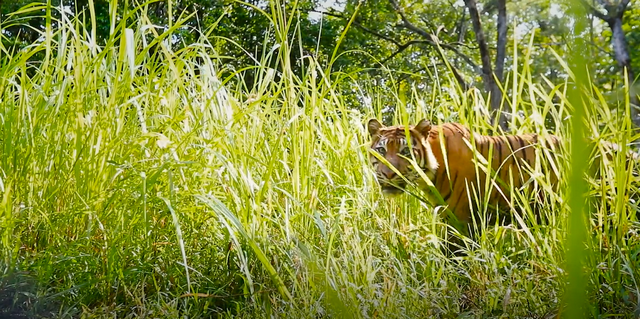
THE LAST PLACE ON EARTH does not shy away from the consequences. Tigers are caught in traps. Pangolins are killed for their scales. Orangutans forced from the trees search for food in villages where they are often killed. Elephants pushed from their habitat wander into human settlements.
One story in particular lodges under the skin.
“We were in a small village where elephants kept coming in trying to find food,” Gardner remembers, “and it turns out that one of the things they were doing was trying to get help because one of their babies had fallen into a hole where an oil palm tree had been taken out and left a big cavity, and the baby fell in the hole, and the elephants were just coming into the village, literally to get help.”
It is an image that distills the environmental conflict of Leuser into something painfully immediate. Habitat destruction is no longer an abstraction measured in acreage. It is a frightened animal searching for help in a landscape that no longer behaves as home.
And yet THE LAST PLACE ON EARTH never allows despair to become its only language.
“We knew that we couldn’t shy away from the truth,” Gardner says. “It is a delicate balance between the truth and the horror and the hope and the beauty and the justice and the successes.”
That balance is embedded not only in the storytelling, but in the visual language of the film.
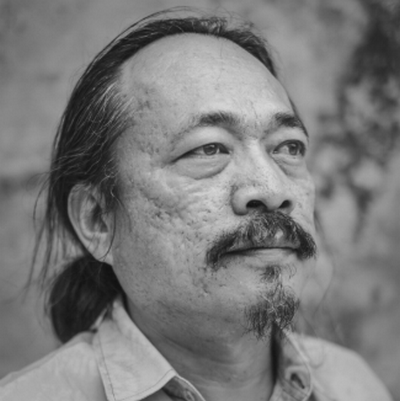
At the center of that visual language is Indonesian cinematographer Nanang Sujana, whom Gardner is quick to describe as far more than a director of photography.
“I’m glad you brought up Nanang’s name,” Gardner says. “He’s an integral part from day one of making this film alongside myself and Shane.”
Nanang served as cinematographer, producing partner, co-storyteller, and associate editor. He also went into areas where Gardner himself could not safely or inconspicuously work.
“Nanang very often had to go into places without any support because there are a lot of dangerous areas that we did film in and areas that I couldn’t go to—it would have just drawn too much attention.”
Gardner takes particular pride in the fact that the production relied on a predominantly Indonesian camera team, with roughly 12 to 15 Indonesian cameramen working across the years of filming.
“They were all dedicated and passionate and fearless, and all led by Nanang’s extraordinary work.”
The result is a film packed with images that feel at once painterly and perilously earned.
Sweeping aerials reveal endless grids of palm plantations and industrial plants belching smoke into the sky. Intimate handheld images place us beside activists, investigators, journalists, and animals. And in one of the film’s most arresting compositions, a solitary figure stands amid a charred landscape as the camera pulls farther and farther away until he seems almost microscopic against the devastation surrounding him.
Gardner and Nanang designed that contrast deliberately.
“It was always from the beginning we knew that we’d be dancing between wide overhead shots for perspective and scale, and intimate shots of close-up for characters,” Gardner says, “to kind of bring the audience down on the ground viscerally in the mix…”
“We’re toggling back and forth between nature and beauty and industry machine, and scale for perspective and intimacy.”
If the visual strategy was carefully considered, actually capturing the material required something more unpredictable. Serendipity.
“In some cases, yes [we knew in advance],” Gardner says of the film’s major sequences. “In other cases, we just went over there and had some plans…”
The production developed quick-response camera teams that could move whenever information surfaced. One cameraman, Mirza, was effectively put on permanent alert.
“We gave him a camera and we said, ‘Listen, if we call you day or night, you’ve got to go get something.’”
Some sequences arrived with almost no warning. Gardner learned of one undercover transaction involving the sale of a stuffed tiger in Bekasi, Java, only three days before it happened.
“I jumped on a plane and flew over there, and we got it.”
Others demanded extraordinary patience. “In the case of the tiger release… I waited a year and a half for that to happen.”
For Gardner, documentary filmmaking in Leuser became exactly that combination: “It’s a combination of pre-planning and serendipity.”
Yet one important piece of the documentary refused to reveal itself for years.
Gardner and McGrath knew that the palm oil supply chain was essential to understanding the destruction of Leuser, but they struggled with how to make that chain cinematic rather than simply informational.
Then, late in production, they met acclaimed Indonesian photojournalist Ulet Ifansasti.
“For years Shane and I weren’t really clear how we were going to tell the palm oil supply chain story,” Gardner admits.
McGrath had a relationship with Ulet, and once the photographer agreed to participate, Gardner found the perspective the film had been missing.
“That was a big piece that fell into place… three quarters into shooting… and everything clicked when that happened.”
Through Ulet’s curiosity, investigation, and camera, audiences trace palm oil from the landscape outward through its industrial chain. Just as importantly, the film allows us to see not only what Ulet witnesses, but how he sees it through the photographs he creates along the way.
By then, however, Gardner faced another problem.
He had more than 1,000 hours of footage.
The film that had begun with such clarity—with an opening and an ending discovered on Day Three—now had to be found somewhere inside a mountain of material accumulated across nearly a decade.
Gardner spent a year with Nanang at his home in Jakarta sorting through it. “We had over 1,000 hours of footage, and we sorted all the footage into scenes, and all the… scenes into each character, and then started to string out each scene.”
Rather than immediately trying to impose an overall structure on the documentary, they worked character by character.
“We worked in an assembly line fashion like that, one character at a time and one scene at a time,” Gardner explains. “We didn’t think about the structure of the film at that point. We thought about the structure of each character…”
The footage also had to be translated and subtitled. Gardner would shape the scenes, Nanang would string them together, and editor Matt Sam would refine them. Only after the individual character arcs became strong did editor David Henry help weave those strands into a single narrative. Executive producer Louis Psihoyos, director of “The Cove,” contributed structural ideas along the way.
Early cuts ran between three and a half and four hours.
“We started with a three and a half, four hour cut,” Gardner says, “and then over time just moved things around and shifted them until… the pieces fell into place.”
The film, in other words, was not simply assembled. It was discovered.
“That’s how we discovered the film in the edit.”
If editing provided the architecture, music supplied the emotional current.
Gardner had admired composer Zach Hemsey’s work for years, particularly the emotional versatility of music that could move between darkness and light. “There was a lot of moodiness in his music, which I wanted.”
Hemsey had long been sought after by filmmakers for trailer music, but had repeatedly declined opportunities to score films. Gardner nevertheless decided to try.
He cut a five-minute sizzle reel using one of Hemsey’s existing tracks and sent it to him cold.
“We cut a five-minute sizzle reel to one of his songs, and I sent it to him, and I said, ‘Would you be interested in our film?’”
Hemsey responded not only to the footage, but to the environmental urgency behind it.
“He was also touched by… the importance of the film and protecting nature and all the themes that we have. And he wanted to be part of it.”
Gardner calls Hemsey’s work “a huge, huge component of the power of the film,” while also crediting composer Katie Jarzebowski for three additional tracks that contribute to the finished score.
For all of its scale, danger, beauty, and years of labor, THE LAST PLACE ON EARTH ultimately becomes a story about persistence.
Gardner sees that persistence most clearly in the activists who devote their lives to protecting Leuser, but nine years of filmmaking taught him something about endurance as well.
“I certainly learned, much like the activists, that they’re fighting a long war, and there are many, many battles along the way, and there are a lot of victories and defeats along the way,” he reflects.
He is careful not to equate the hardships of filmmaking with the dangers faced by those working on the ground in Sumatra. But he recognizes a shared truth in the refusal to give up.
“For us as filmmakers, it was… a long, long journey filled with many, many highs and lows. There were times that we… didn’t know where the next dollar would come from, if we would ever finish the film, and we just kept going.”
That persistence, Gardner believes, carries a lesson beyond filmmaking.
“It can feel hopeless,” he says of humanity’s relationship with the natural world. “It can feel like those that have power are the ones making decisions. But when we unify, when we work together, we can accomplish anything.”
“In the case of our film, the film is the result of many, many, many contributions of an entire team who never gave up, who fought through all kinds of adversity,” Gardner adds, “and… it was just the fearless passion of all of us to see it through, much like the activists, and that’s why I’m drawn to their stories—because it’s a David and Goliath story.”
Today, THE LAST PLACE ON EARTH is only beginning its festival journey, seeking a distribution home in what Gardner acknowledges is a difficult landscape for independent documentaries.
But for him, the completion of the film is not an endpoint. It is another beginning.
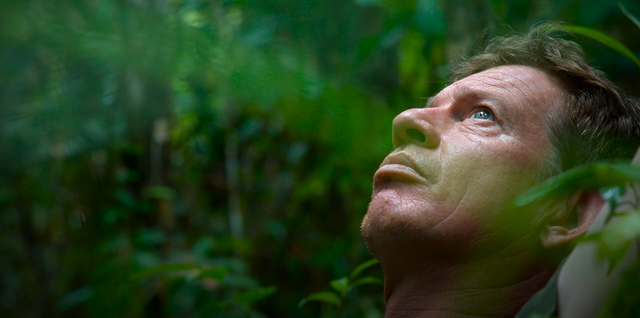
“We hope the film has a lasting impact,” he says. “We made the film to positively impact the Leuser ecosystem, to support the work of the main characters and their organizations… All these characters are doing incredible work, and we want to support them.”
“The release of the film is the beginning [of] the worldwide impact campaign that will follow for years to shine the light on Leuser and the people there.”
Nine years after Gardner went to Sumatra searching for a story, THE LAST PLACE ON EARTH ends where he knew it would almost from the beginning—with Ermalin and the possibility of return.
But the journey between those two points transformed the film into something larger than the rescue of one orangutan, or even the protection of one rainforest.
The title, then, is not just a geographic marker. It’s a warning and an invitation—to look closely, to care deeply, and to ask, as the activists and filmmakers of Leuser do every day, what it will take to ensure that “the last place on earth” does not become a eulogy.
By debbie elias, exclusive interview 07/30/2026
THE LAST PLACE ON EARTH is currently on the film festival circuit.