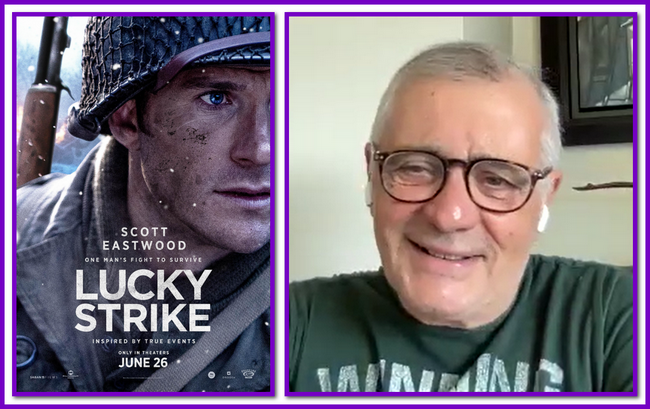
In the “powerful and emotionally immersive” LUCKY STRIKE, together with director and co-writer Rod Davis Lurie, writer/producer MARK FRYDMAN turns a high school encounter with a WWII veteran, his own family’s survival in Belgium, and the story of a life-saving radio into Scott Eastwood’s best performance to date.
For decades, audiences have known the name Rod Lurie—the military man turned film critic turned filmmaker whose dramatic, character-driven, often political and militarily themed stories carry a rare blend of grit, conscience, and emotional clarity. What they may not know is that quietly beside him, from the earliest days of television series like “Commander in Chief” and “Line of Fire,” and films like “The Contender,” “Nothing But the Truth,” and the recent “The Outpost,” there has been another architect of those worlds—producer and writer Mark Frydman.
When Frydman’s name appears on screen as a producer or writer—or, in the case of LUCKY STRIKE, both—he doesn’t lead with his résumé. Instead, he leads with a story. And in his case, the stories go back not just to his career, but to his family, his high school classrooms, Belgian farmhouses, and a single radio that, in more ways than one, saved a man’s life.
“I’ve been working with Rod for a long time,” Mark recalls, almost offhandedly. “When I met Rod, he was a critic. He had a screenplay that he had never shown to anybody, and I read it. I thought it was fantastic, and that’s how he started writing and directing.”
That act of reading, recognizing, and championing a voice has echoed through their careers. Their partnership, by now, feels almost inevitable. And yet, with LUCKY STRIKE, it becomes something even more personal—a bridge between memory and cinema, between the ghosts of World War II and a modern audience that risks forgetting what those shadows once felt like.
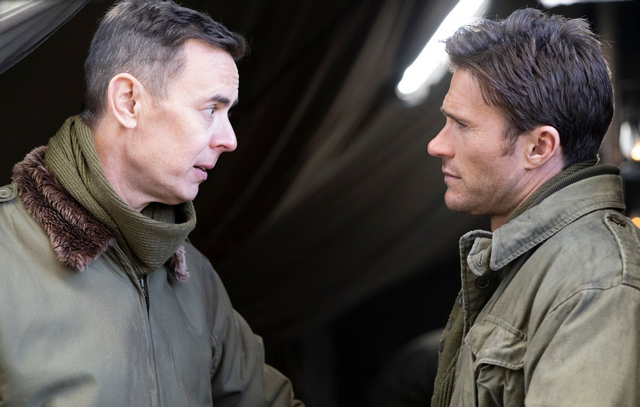
A High School Assignment That Became a Life’s Story
The seed of LUCKY STRIKE is not a logline or a concept. It is a teenager in Europe, a school trip, and a room full of men who had once crossed oceans under fire.
In high school, at just age 15, Mark joined a program that today would sound almost unbelievable in its intimacy and ambition. Students raised money to bring World War II veterans back to the places where they had once fought—Normandy for the men of D-Day, Belgium for those who had endured the Battle of the Bulge.
“Everybody chipped in some money from the high school,” he explains. “We brought back to Europe World War II vets… The vast majority of those vets, they were mechanics, they were farmers, they were factory workers. They didn’t have a lot of money, so what we did is we paid them for a trip to Europe.”
This wasn’t a tourist junket. Each student was paired with one veteran, assigned not to entertain them, but to listen.
“Each pupil was assigned one of the vets and listened to their stories.” Frydman eventually interviewed 40 of those vets.
Forty stories of fear, survival, loss, and endurance. Many of them, he notes, were “horrible, harrowing,” and often similar in their broad strokes—a tragic chorus of shared trauma. But one of them was different. One veteran’s account refused to fade, haunting him into adulthood and onto the page.
The Turncoat, the Jeep, and “Hitler’s Last Gamble”
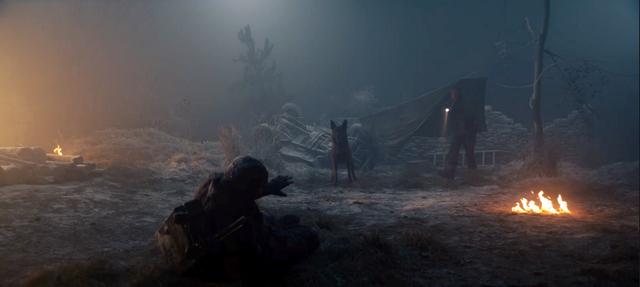
That singular story involved a meeting that almost no one else in history could claim—a face-to-face encounter with an American turncoat who had joined the Wehrmacht.
“That soldier told me the story that stuck with me over time because he had met one of those traitors,” Mark says. “There were turncoats… Mainly from Wisconsin, where there is a very heavy German population. They felt close to Germany. They felt close to the country of origin, and some of them decided to go back and some of them joined the Wehrmacht.”
These weren’t simply men in different uniforms. They became part of a special commando unit designed specifically to weaponize their Americanness.
“They could speak English, knew American customs, and so on, and they were used for kind of behind-the-line sneaky operations,” he explains.
Their mission was to penetrate and disrupt American lines during what has been called “Hitler’s Last Gamble,” the Ardennes offensive, better known as the Battle of the Bulge, one of the largest and bloodiest operations of the entire war.
From that encounter by a jeep, now dramatized in the film, Mark found a story that was at once intimate and epic, grounded in a moment that belonged almost wholly to one man.
“Because he was unique, that guy had something unique to tell, and so it stuck with me.”
Years later, the adolescent listener became the screenwriter. Draft followed draft. And finally, he went back to the filmmaker whose career he had once helped nudge into motion.
“One day I told Rod, ‘Listen, we should tell the story,’” he says. “He read it, and he said, ‘I like the story very much, but I’d like to bring my own [spin] …’ It was not a matter of style. It was a matter of Americanizing the American side of the vet, lingo-wise. And he’s also, as you know, from the Army. So he has his own lingo that he can inject into the screenplay.”
The result is a script co-originated by two men who inhabit different sides of the same subject: Mark Frydman, lifelong student of history, and Rod Davis Lurie, the soldier and storyteller who knows how these men talk when the guns go quiet and the memories don’t.
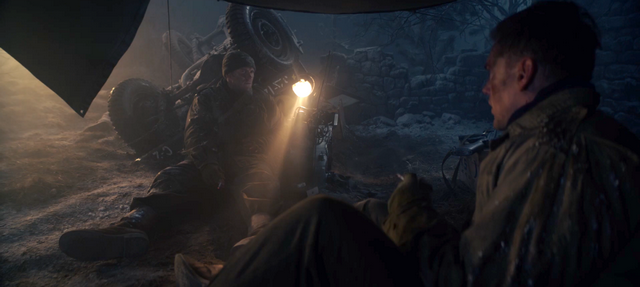
The Shadow of a War That Never Left
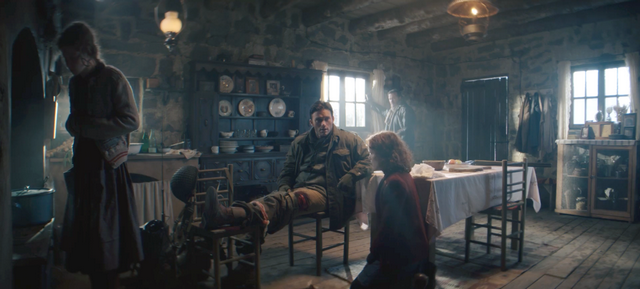
If the veteran’s story gave LUCKY STRIKE its narrative spine, Frydman’s own family history lent it its emotional marrow. His connection to World War II is not purely academic. It is carved into his family tree and the houses that once kept them alive.
“We are a family of Jewish heritage,” he says quietly. “During World War II they had to hide. There were families in Belgium or in France who decided to hide Jewish families.”
His father, grandmother, and aunt were hidden by a Belgian family who risked everything to protect them.
“When they did that, they knew they put everything on the line. Because if they had been caught, they would have been all in front of a firing squad. They put everything they had on the line, their life, their children’s life, everything. So they deserve to be recognized.”
Mark still returns to that house in Belgium. The geography of it—the walls, the rooms, the ghosts—is not theoretical for him.
“It’s very emotional when I go back to that house in Belgium because my dad was hiding there,” he says. “My grandmother was hiding there. I had an aunt that was hiding there. My generation, I’m 64, growing up, the shadow of World War II was very, very, very heavy over us. There was a big cloud.”
He draws a sharp but necessary distinction between the American experience of the war and the European one.
“American troops landed and they went through an incredible ordeal—D-Day, crossing Normandy, crossing the Rhine. But the civilians were under the boot of the Nazis for five years,” he says. “Everybody who wanted to resist was eliminated right away, or tortured and killed.”
That sense of a war that never quite ends, of trauma that lingers in objects, houses, and bloodlines, is baked into LUCKY STRIKE. This is not just about tactics and battles. It is about the people who survived and the ones who made sure they could.
Crafting a War Film in a World That Still Remembers
For a film this steeped in lived history, production couldn’t be an afterthought. It needed to feel, visually and physically, like the world these men actually inhabited. That level of authenticity demands a location that can still remember the war in its bones.
As they did with their last outing together, “The Outpost,” Lurie and Frydman found that in Nu Boyana Film Studios in Bulgaria, a familiar home base for them and a powerhouse when it comes to large-scale production.
“The resources they have there are amazing,” Frydman says. “It’s easier in Europe to get the vehicles, the tanks, all the military equipment from the German side. You can find them in Czechoslovakia, in Russia, in Central Europe, everywhere, and even in France or England.”
He cites a tank depot in Bovington in the UK, one of several sources they tapped to bring period-accurate armor and vehicles to screen. But recreating the Battle of the Bulge isn’t just about uniforms and rifles. It’s about building an entire world of steel, mud, and weather.
Ironically, the greatest production challenge came not from tanks, vehicles, or period hardware, but from the weather. Early snow arrived in Bulgaria, creating potential continuity problems. History, however, gave them some latitude: conditions during the Battle of the Bulge had themselves been remarkably patchy, with snow-covered areas sometimes only a mile from bare ground.
“In the end, the few continuity issues we encountered were not a problem at all,” says Frydman.
From a production standpoint, he’s almost disarmingly modest.
“Everything came together very fast. We got the elements that we needed in terms of wardrobe and vehicles. All that was very well organized. We had been thinking about this movie for a while, so I would say we were ready.”
What could have been the most combustible element—two co-writers, one of them directing their shared script—never exploded.
“Rod told me, you know, this might be the last movie we do together because we’re going to be at each other’s throat,” Mark laughs.
Frydman, who admits he would normally be looking over Lurie’s shoulder “minute by minute” at the monitor, decided to give his longtime collaborator “more distance than usual.”
“We had one little flare-up that lasted like five minutes, and that’s it. It ended up being a great cooperation.”
Scott Eastwood, Reluctance, and a Performance Held in Check
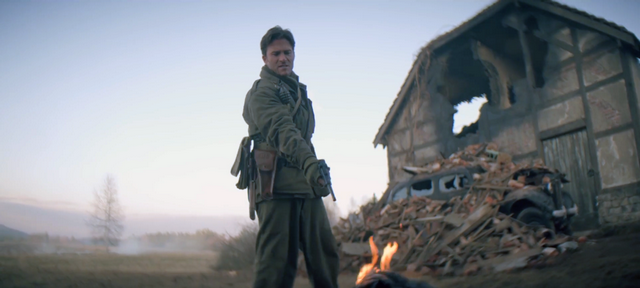
LUCKY STRIKE also marks perhaps the strongest work to date from Scott Eastwood—a performance that, in Mark’s eyes, succeeds not by going big, but by resisting the urge to.
Scott had already been through one war picture with Rod and Mark on “The Outpost” and, understandably, he hesitated at first.
“Scott was reluctant to do another war movie,” Mark admits. It took Yoni Younger at Millennium to bridge the gap. “Yoni convinced him, and he liked the screenplay, and he decided to jump in.”
What he delivers as Castle, particularly in the film’s closing movements, is a portrayal built on quiet gravity rather than grand displays of emotion. For Frydman, that restraint is everything.
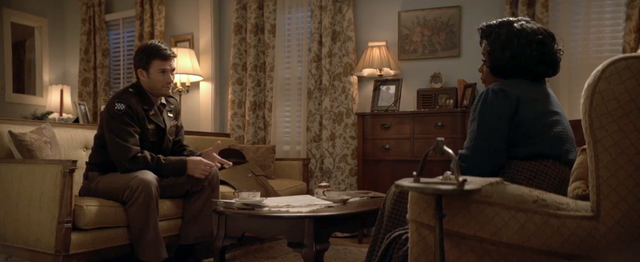
He points to a late scene in which Eastwood’s character visits a woman some years after the war, whose wartime labor, and a pending lawsuit, are tied to the radio that once kept him alive.
“Every time I see it, it gets me because I know that what he did was very important to him,” Mark says. “Scott was absolutely terrific in that scene. He didn’t go over the top. He was not mushy. He’s trying to be as matter-of-fact as possible, and I think he pulled it off. The scene really works with the audience.”
That same matter-of-factness applies to the way the film approaches its most unexpected emotional thread—a postwar fight for justice waged with serial numbers and procurement leverage.
The Radio That Saved a Life—and Paid a Debt
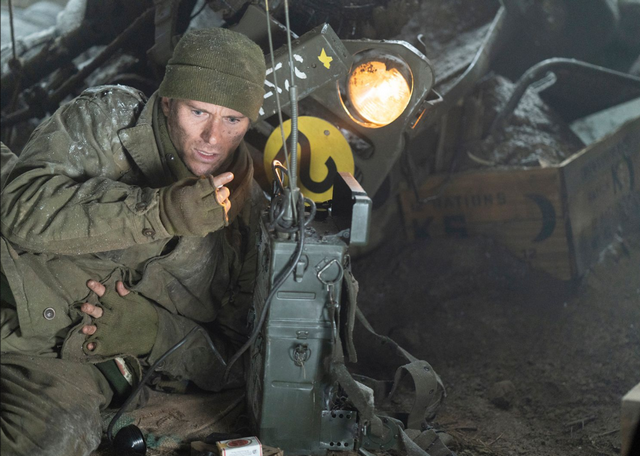
If there is one story that distills what makes LUCKY STRIKE so different from many war films, it’s the one Mark Frydman tells about the radio that becomes both the soldier’s lifeline and his obsession. A true story.
“Part of the story is that soldier was saved by his radio. He considered really that his radio saved him because it was so reliable, and it was his lifeline to the headquarters and his company.”
After the war, the man didn’t just move on. He embarked on a decade-long mission to find out who had built that specific piece of equipment.
“Everybody told him, ‘Listen, radios are mass product. You can never find who actually did it,’” Mark recalls. “And he said, ‘I don’t think so. I think there is a serial number. There is a batch number. There is a production chain. You can find the name of who was working at that moment on that day to produce this specific model.’”
Ten years later, he proved everyone wrong. The serial number led him to a woman who had built his radio on a line working for Galvin, the company that would become Motorola.
By then, she was embroiled in a bitter dispute with the company. Like so many of the real-life “Rosie the Riveters,” she had given her labor to the war effort only to find herself shortchanged once that work was done.
“They were shortchanged in a big way. Basically, they were let go, and the corporations started to renegotiate. Even the small salary they were getting, a lot of Motorola in that case didn’t want to pay them, because they were not regularly registered workers.”
She didn’t have the means to fight. He, on the other hand, had become an important buyer for the U.S. Army, with the kind of influence corporations notice.
“He helped her out because at that point he had become an important buyer for the U.S. Army. He can strong-arm them. So they settle with this woman and other women that are not mentioned in the movie. He went beyond that. He wanted Motorola to pay all the women who had built those radios and other type of weaponry.”
That moral insistence, that refusal to let the story end at Castle’s survival, becomes the emotional culmination of LUCKY STRIKE. In the film, it’s captured in the scene where Castle visits the woman and brings her a check, a moment shot through with the understanding that debts from war are not only paid in blood, but sometimes in back pay and recognition decades too late.
It is also the vehicle through which LUCKY STRIKE is told, as Castle relates his experience during the Battle of the Bulge to the woman whose hands had helped build the radio he called “Lassie.”
The film closes, fittingly, on a quieter image. A radio sitting in a child’s bedroom, a relic that refuses to fade into mere nostalgia.
“What it means,” Frydman says, echoing the veteran’s own words, “is that the soldier can leave the war, but the war never leaves the soldier.”
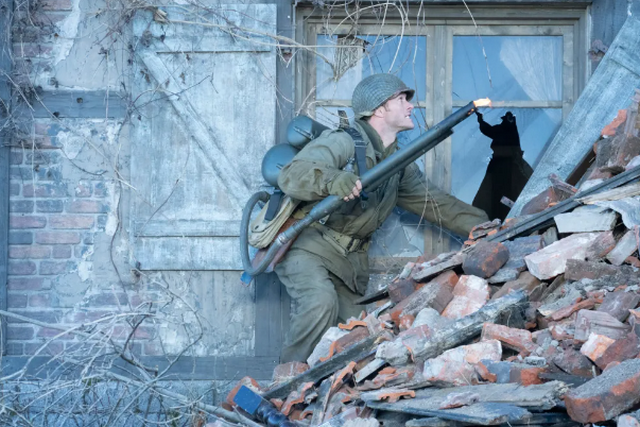
When History Comes Home
For anyone who grew up in the shadow of that war, even at a generational remove, LUCKY STRIKE doesn’t just feel researched. It feels remembered. In my own case, that connection runs through a basement and a piece of hardware almost identical to the one that anchors Mark Frydman’s story of the soldier whose only lifeline behind enemy lines was this radio, “Lassie.”
My father, stationed at Fort Benning in the Signal Corps during the early days of the Korean War, brought home one of those radios after discharge. It sat in our basement for years. As kids, we played with it, pretending we could reach across oceans with a twist of the dial. Long after my father passed, the radio remained—a heavy, humming silence in metal form.
So when that model appears in LUCKY STRIKE, it’s not just a prop. It’s a conduit. I recognize the weight of it, the way it sits in a room. I recognize what it meant to men who trusted it to cut through chaos with a crackling line of voice and code.
That’s the quiet magic of LUCKY STRIKE and of Mark Frydman’s storytelling. The war is not an abstraction of strategy and gunfire. It lives in cars and kitchens and family arguments, in radios on shelves and houses in Belgium that still remember who once hid there.
In the storytelling hands of Mark Frydman and Rod Davis Lurie, war is not only about who fired the gun. It’s about who built the radio, who opened the door, who hid the child, and who, decades later, still carries the sound of a distant signal in their ears.
And that, perhaps, is why LUCKY STRIKE lingers. Not as a film that reenacts battles, but as one that understands how deeply—and how quietly—those battles keep echoing long after the shooting stops.
By debbie elias, exclusive interview, 08/04/2026
LUCKY STRIKE is available now On Digital and on DVD on September 15th.