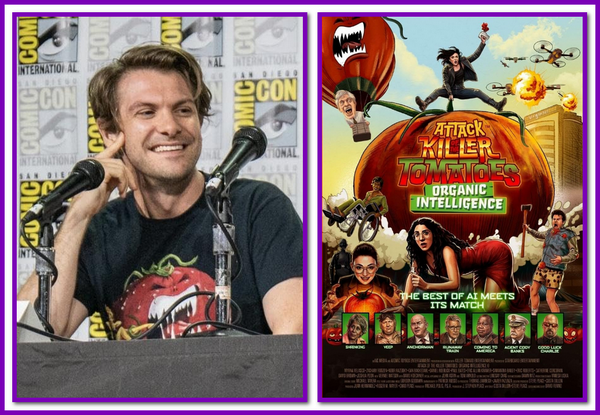
From a two-person chamber drama set during the 2020 pandemic to a franchise built on homicidal produce. Not exactly the career trajectory one might expect for a filmmaker, but that’s precisely where director DAVID FERINO found himself with ATTACK OF THE KILLER TOMATOES: ORGANIC INTELLIGENCE, the fifth installment in the cult-favorite franchise that first unleashed its tomato terror on unsuspecting audiences in 1978.
And what a gloriously ridiculous harvest Ferino has delivered, cultivating a cinematic crop of colorful, campy, laugh-out-loud insanity that honors its roots while finding fertile new ground in the absurdities of contemporary life.
Written by original franchise creators Costa Dillon and J. Stephen Peace, ORGANIC INTELLIGENCE embraces everything that made the original film a cult classic while bringing a fresh, contemporary sensibility to the proceedings. Genetic engineering, artificial intelligence, environmental concerns, political satire, pop culture references, sight gags, and more puns than you can shake a tomato vine at, all wrapped in an explosion of cinematic color and camp.
But behind the outrageous comedy is a director with a keen eye for visual storytelling, an intuitive understanding of comedic rhythm, and a deep appreciation for the collaborative craftsmanship that brings even the most absurd cinematic visions to life.
For Ferino, whose previous narrative feature was a two-person chamber drama set during the pandemic, landing in the middle of the Killer Tomatoes universe was an unexpected turn.
“My story was very unexpected. I had made my first feature, my first narrative feature, [which] was very unlike this. It was a two-person chamber drama set during the 2020 pandemic, and my producer on that, a guy named Roger Mayer, was attached to be a producer on this project very early on in pre-production, and they didn’t have a director yet. And the two of us had a really great time working together on that last movie. So he put me up for the job, and here we are. That’s honestly it.
“I think what I had to do was showcase not that movie, but some of my older short films because their tone and humor was much more in line with the zaniness of the Killer Tomatoes legacy.”
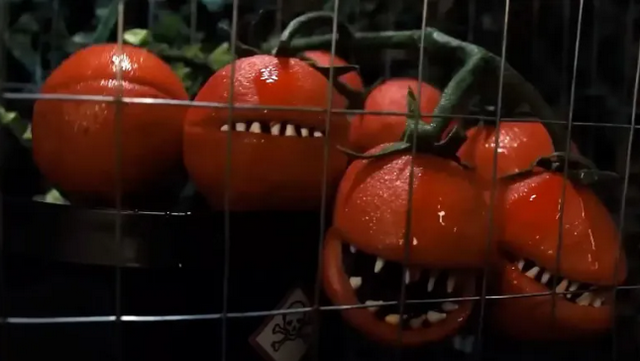
That zaniness comes with nearly five decades of cinematic history, something Ferino was keenly aware of when stepping into a franchise with such a devoted following. Fortunately, he had the benefit of working directly with the men responsible for creating that history.
“The benefit that we had was that this was produced and written by [Costa and Stephen], who were obviously responsible for the original franchise. I mean, all the films in the franchise. And so we worked very closely with them. I mean, I knew the movies, but it was nice to actually hold hands with them and get some explanation as to what’s totally new, what’s canon, what’s canon but we can have some fun with revising some things. That legacy stuff was all them. We really worked closely with them in preserving all of that.”
Preserving the past, however, didn’t mean remaining visually anchored in 1978. Working with cinematographer Patrick Russo, Ferino sought a contemporary cinematic look that could accommodate the franchise’s cartoonish sensibilities without becoming an actual cartoon.
And given the prominence of killer tomatoes, that meant finding a way to work with a LOT of red. “I think we wanted to give this movie a little bit of modern gloss, and so I think it was about marrying the old with the new.” The color reference Ferino and Russo ultimately selected was somewhat unexpected.
“We were trying to figure out at least one film that we could turn to, as opposed to ten films, so that we could really dial in a look. And I’m not a Marvel fan, but we somehow settled on DEADPOOL & WOLVERINE. That movie had a brightness to it that was just a little kind of dirty, was the term we called it. It wasn’t so bright that it was neon. It’s not so Crayola that it’s total cartoon. But it is obviously very bright, it’s very colorful, it’s very cinematic, but it’s just a touch grounded. So that was a good reference for us.
“And then, and this kind of runs counter to what I was just saying, I kept talking about the Killer Tomatoes cartoons, the Saturday morning cartoons. I was like, if you can think about this as sort of like a live-action cartoon or a live-action comic book or something, let’s look at those colors as well and see how all of that felt unified. “So, for me at least, I think it was those two things: DEADPOOL & WOLVERINE and then the Killer Tomatoes cartoons.”
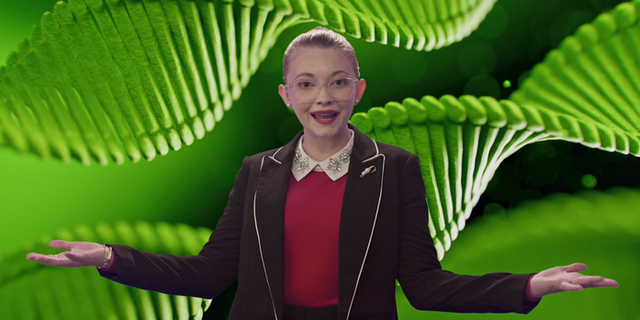
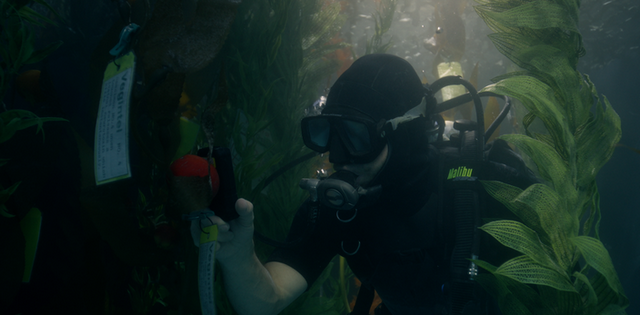
That visual marriage is evident throughout the film, particularly in the beautifully photographed underwater organic tomato farm, where undulating water, lush greens, and vivid tomato reds create a striking contrast. Those same greens carry through into Finletter’s lair and Professor Grangreen’s laboratory, establishing a visual continuity that helps unify the film’s wildly disparate environments.
And then there are the opening titles.
Produced by IVC Media, with Juan Hernandez among the company’s leadership and also serving as a producer on the film, the animated sequence takes seminal moments in world history and reimagines them as the result of tomato-related catastrophes.
“IVC did that whole sequence, and we’re all really proud of it. I mean, first of all, just the idea alone is funny. Like you said, these seminal moments in history kind of being rewritten with tomato chaos. But just this sort of almost spy thriller, glitchy effects, BOURNE IDENTITY kind of spoof stuff, they did really well. I’m just really proud of their whole team.”
The spy-thriller influence doesn’t stop there. It carries into the music and returns in the post-credit animation, while the film’s end titles offer another nostalgic treat with a follow-the-bouncing-ball sing-along reminiscent of television’s Sing Along with Mitch.
For Ferino, those touches were essential to making ORGANIC INTELLIGENCE accessible to multiple generations.
“That was always the hope is that this is something that you could watch with your whole family, and it’s something that fans of the original could appreciate and catch little Easter eggs from, callbacks and Easter eggs to those old movies, and then somebody that’s totally uninitiated could really appreciate it too.
“And also just in terms of age range, what Costa and Steve always reminded me is that when the original came out, you had six-year-olds and sixty-year-olds laughing equally. The sixty-year-olds might catch some adult jokes, not necessarily racy jokes, but jokes that only an adult would understand. And the six-year-olds are obviously just there because it’s colorful and wacky and weird. And we were very conscious of preserving that throughout, and having references and gags that a kid would understand, and references and gags that an adult would understand from their own childhood.”
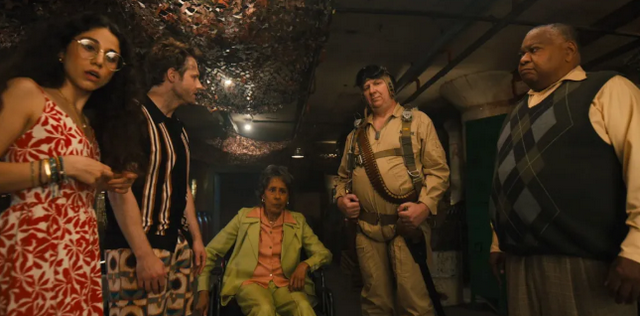
Achieving that multigenerational visual and comedic appeal extended well beyond cinematography and animation. Production designer Vanessa Escobar Liska and costume designer Dawn Ritz were equally instrumental in creating a world that feels simultaneously retro and contemporary.
For Liska, much of the challenge involved transforming existing interiors at Willow Studios in Los Angeles into the film’s varied locations.
“We shot the majority of the movie, all the interiors were shot here in Los Angeles at a place called Willow Studios, which used to be, I believe, a furniture warehouse, and now they’ve converted it into sets. There’s bedrooms, there’s living rooms, there’s a police cubicle bullpen, there’s some medieval chamber. There’s all these other things that we were able to kind of trick out and make our own.
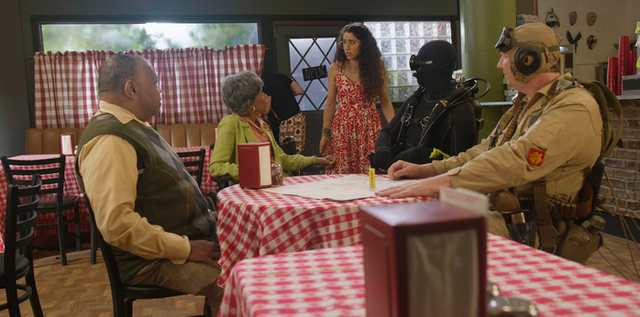
“And I think that for Vanessa, probably the most fun was the interior of the pizza shop. That place was totally transformed. It was just kind of the shell of a location, and she and her team did that within the span of like five days, and watching that come to life was a huge joy.”
Ritz faced a different challenge: how to honor the franchise’s 1970s origins through wardrobe without making a contemporary story about artificial intelligence look like a period piece.
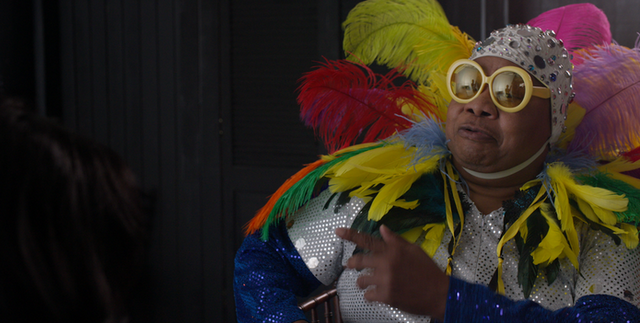
From Vernee Watson’s glittering tracksuits to Samantha Bailey’s pearl-adorned sweater and Zachary Roozen’s retro bowling shirts, the costumes become an extension of the comedy and the characterization.
“Dawn Ritz, our costume designer, she knocked it out of the park. We met really early on, and I had quite a few references for her. But then she was the type of person, and everybody was really, to take what I provided and then level it up and say, I understand what you want. Now I’m gonna give you that and then some. So I was just so thankful and tickled to work with her.”
Ferino and Ritz were particularly interested in allowing some of the older characters to retain a fashion sensibility rooted in the original film. “For some people, like [Eric Roberts] and Vernee, I think we wanted to give them some ’70s styling to call back both to the original and because these are older characters, and we’re kind of having some fun with the idea that, well, I guess their fashion hasn’t changed.
“And even we let some of that retro fashion kind of bleed into some of the younger characters too, just to make this movie feel of a piece with the others. But we did have to be careful not to go too overboard with that to make it seem like a period piece or something, because we’re obviously talking about all these modern issues like artificial intelligence.”
The result?
“We wanted them to feel like these were people that might have gotten launched out of the 1978 original but then just landed in modernity somehow.”
Of course, even the most carefully constructed visual world needs performers capable of delivering the comedy. And ORGANIC INTELLIGENCE boasts a marvelous combination of seasoned character actors and emerging talent, including Dan Bakkedahl, Paul Bates, Noor Razooky, Zachary Roozen, Samantha Bailey, Eric Roberts, Vernee Watson, David Koechner, Daniel Roebuck, Myrna Velasco, Tom Arnold, and the legendary John Astin.
For Ferino, the franchise name itself proved to be a significant advantage in attracting talent.
“I think we had the benefit of the franchise name, so that when we were starting to reach out to actors, some people didn’t even need to see a script. They were just like, ‘Killer Tomatoes sounds like a hoot. Sign me up!’
“And so you get guys like [David Koechner], who could say hello and have you laughing, and Vernee likewise. It was, I think, a very unexpected movie and role for her, but she was just a blast. She had so much fun, and I think that exchange of excitement was just so palpable between everybody.”
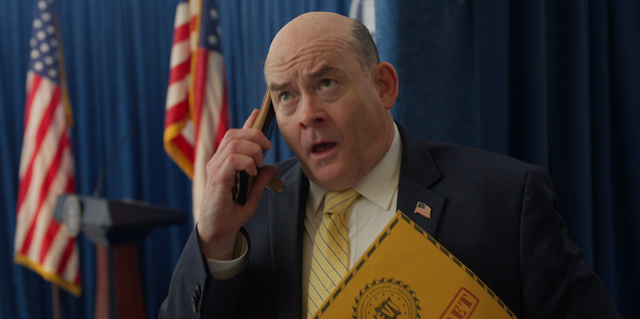
The younger performers brought an equally infectious energy.
“We always think about it in terms of the younger cast and the older cast. You have these veterans, even you get your Eric Roberts appearing, and then you have these younger names that people might not know yet, but we just feel very strongly that these are really talented kids who are on their way up, and we’re happy to have caught them when we did.”
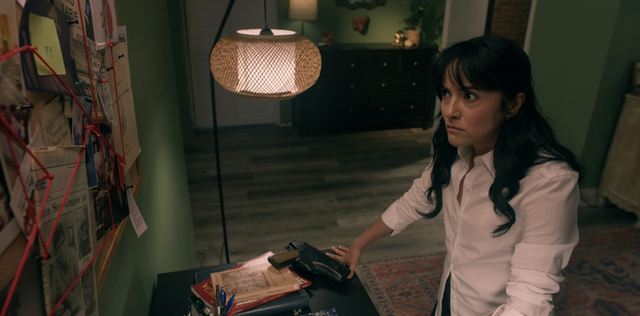
Myrna Velasco, in particular, made an immediate impression during the casting process.
“We watched when she sent her self-tape. I think I watched it for like thirty seconds, maybe less, and was like, ‘That’s her.’ We can look at other tapes, but I think my mind’s made up.”
Casting director Lindsey Chag also had to navigate the logistical realities of assembling such a diverse ensemble, particularly when working with busy performers.
“With David Koechner, he was on the road touring his stand-up act, and he happened to have one day free in Los Angeles before he skedaddled again, and so we caught him for that single day and just maximized our time. Those casting-wise, I think that was the biggest hurdle we faced.”
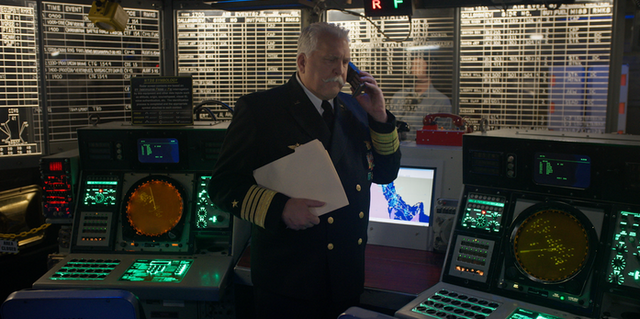
Eric Roberts similarly joined the production for a brief shoot, but his enthusiasm extended well beyond his time on set.
“He came in for a quick day. We had our fun, and then he left. However, he and his wife, we had a table read, and for those that couldn’t make it, we offered a Zoom link, but with no pressure. It was really just to kind of get to know one another. And he zoomed in, he and his wife zoomed in, and they hung out for the whole table read just because I think they were tickled to be a part of a franchise that they knew with so much fondness as well.”
Ferino also found himself discussing Roberts’ remarkable performance in Bob Fosse’s STAR 80 between takes. “I wasn’t quite sure if he was the type of person who loved talking about his past career, or if he was like, no, I’ve moved on, let’s just talk about here and now. But I didn’t know, so I was asking him about specifically STAR 80. I just think that movie is haunting and incredible, and his performance is unbelievable. And he just had a hoot talking about it, telling me so many stories.”
And Roberts was more than happy to repeat those stories for another appreciative listener. “He didn’t care that he was telling the same story twice. He was just excited to talk about these movies that we’ve grown to love.”
Then there is John Astin.
For longtime fans of the franchise, Astin’s return as the voice of Professor Gangreen is particularly special, carrying forward a connection that dates back to RETURN OF THE KILLER TOMATOES and the animated television series.
“John’s presence was always going to be a thing. Costa and Steve have remained in touch with him since he was in the second movie of the four Killer Tomatoes movies, and of course he was also the voice of Grangreen in the cartoon. I believe he was the only person from the movies who did the voice work for the cartoons as well.
“But he loved it. As the lore goes, when he got the script, when his manager and agent got the script for RETURN OF THE KILLER TOMATOES, they said, ‘Don’t even bother.’ And he said, ‘Are you kidding me? I love this stuff. I love camp. I love schlock. Of course I want to do this.’
“And he’s been really faithful to the franchise ever since. And I know Costa and Steve sort of look up to him almost as a bit of a father figure. And so having him involved in whatever way possible was always a must.”
For Ferino, speaking with Astin was itself a memorable experience. “As a fan of THE ADDAMS FAMILY and Killer Tomatoes and the original BATMAN series, it was such a joy to just be able to talk to the guy.”
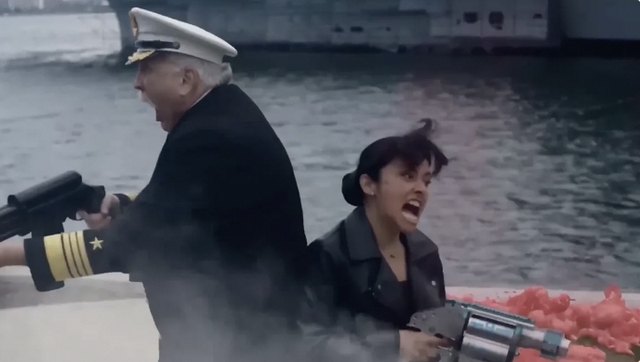
But assembling the performances was only half the comedic battle. Ferino also served as the film’s editor, a role that proved both natural and challenging.
“Editing is the thing technically, in terms of filmmaking, that I’m most comfortable at. I could practically edit in my sleep. I just know my way around footage very well. I don’t know why. It’s something weirdly intuitive.”
Having directed the film, Ferino came into post-production with a significant advantage.
“Having directed it, I had the distinct advantage of having a very thorough shot list, and we storyboarded as much as we could. So when I came into the edit, it went pretty quickly. I think we had, albeit a very rough cut, but we had a rough cut within like three weeks.”
Three weeks!
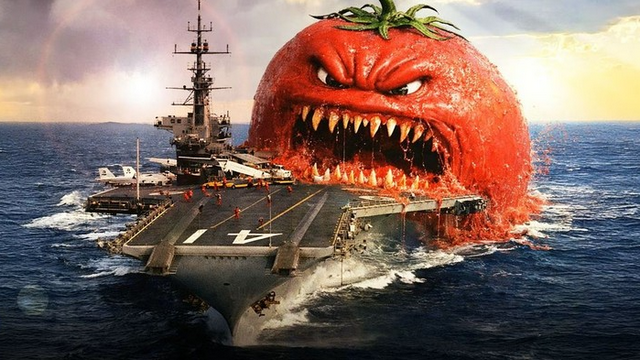
Yet speed was not the greatest challenge. With an ensemble of performers capable of improvising joke after joke, Ferino faced the unenviable task of deciding which laughs had to go.
“Pacing is something that I kind of pride myself on. I think that I have a pretty good ear and rhythm for pacing. I think what became harder was what to keep and what to cut.
“Some of the actors, Dan Bakkedahl specifically, who plays Finletter, he’s an incredible improv comic, and Vernee Watson, she’s also really funny. And so sometimes the challenge is figuring out what we couldn’t keep, what had to go, and the cutting room’s littered with gags and jokes I wish we could have kept.”
For a film so proudly committed to ridiculousness, ORGANIC INTELLIGENCE also contains some pointed contemporary observations. Artificial intelligence, environmental concerns, genetic engineering, and the broader chaos of modern society all find their way into the comedy.
And while Dillon and Peace have consistently maintained that the franchise is intended as pure escapist entertainment rather than message-driven filmmaking, Ferino sees something more beneath the surface.
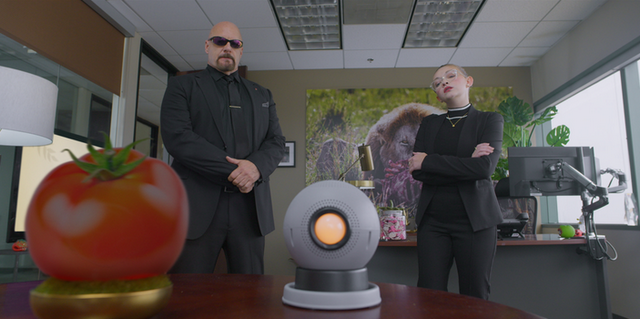
“Cost[a] and Steve have said over and over they don’t want this to be a movie with a message. They want this to be pure escapist fare. But I occasionally roll my eyes a little bit because you’re right. It’s there. There’s plenty there to chew on that holds a mirror to society.
“But also, my initial pitch to them was like, look, if I’m viewing each of your movies, regardless of the period that I’m viewing them in, the underlying theme of it all is nonsense.
“And I actually think no matter the era that you’re living in, so much of our world is chaotic and confusing, and so to have a movie that reflects that chaos and confusion in a very specific way, I think is its own form of art, whether people want to call it that or not.”
For Ferino, ORGANIC INTELLIGENCE also represented a major step forward in his development as a filmmaker. It was his largest production to date, yet he discovered that the scale of the project was far less intimidating than he might have anticipated.
“This is by far the biggest project that I’ve done, and I felt weirdly comfortable only because all of our department heads were so talented and had so much experience. And I think that was my biggest learning lesson. So long as I know how to communicate what it is we want to see, then we’re gonna be fine. But I think I would have been scrambling if I was working with a bunch of novices who didn’t know special effects, who didn’t know rigging, who didn’t know lighting, et cetera, et cetera. And so I think that was sort of a cool discovery, that it doesn’t matter how big or small an idea is, if you’re surrounded by the right people, you’re going to be able to construct it.”
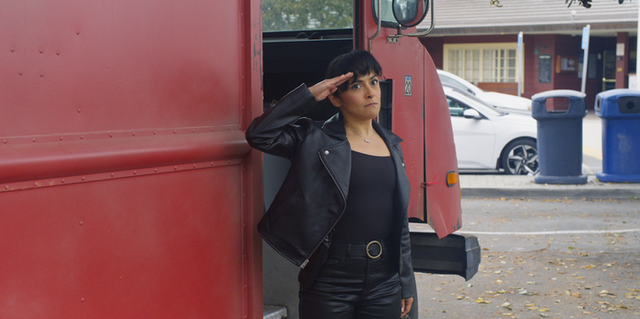
As for whether Ferino would return for another round of killer tomato mayhem?
“I will leave that in the hands of Costa and Steve, our fearless leaders. But I would obviously come back with bells on if that opportunity arose.”
And there may already be a particularly intriguing possibility lurking somewhere in the franchise archives.
“Last I heard, don’t know if this is still kicking around, but I only learned this in the past week. Somewhere is a KILLER TOMATOES IN SPACE script that they wrote decades ago, and they’re just sitting on. And I’m like, give me a break! Everyone would be dying for Killer Tomatoes in space.”
KILLER TOMATOES IN SPACE?
Now THAT would be mondo fabulosity! And if Ferino has anything to say about it, there’s every reason to hope that this latest harvest of cinematic insanity won’t be the last.
by debbie elias, exclusive interview 10/01/2026
ATTACK OF THE KILLER TOMATOES: ORGANIC INTELLIGENCE is now streaming on Prime Video, AppleTV, YouTube, and more.