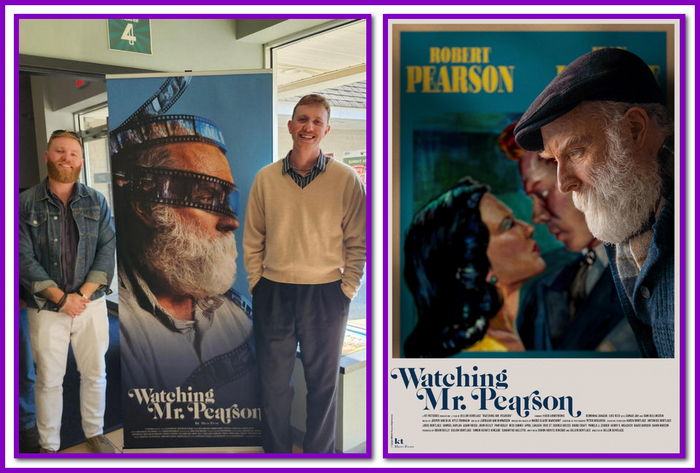
Co-Writer/Director DILLON BENTLAGE discusses memory, caregiving, collaboration, and the visual and emotional architecture of his deeply humane first feature, WATCHING MR. PEARSON.
For a first feature, WATCHING MR. PEARSON arrives with remarkable assurance. Written by Dillon Bentlage and Simon Kincade and directed by Bentlage, the film centers on Robert Pearson, a once-famous actor living with dementia, as two caregivers discover that imagination, performance, and friendship may be the only ways to help him reconnect with the world around him.
What makes the film so affecting is that Bentlage never frames Robert as someone who is already gone. Even as memory slips and time fractures, Robert remains present, emotional, reachable. Bentlage said that was always central to the story’s purpose, even as he is careful to distinguish the film from an educational or issue-driven piece. “This is really an artistic expression from our own experiences,” he said. “It’s not an educational piece. But I do hope people can come away seeing this with a glimpse of hope and sympathy for, you know, recognizing some things that they’ve gone through, dementia in their family, personally.”
That sense of hope is what gives Watching Mr. Pearson its emotional identity. The film is bittersweet, certainly, but it is never punishing. Bentlage and Kincade are interested not just in loss, but in the ways connection can still survive within loss.
Bentlage was quick to point out that the film’s beauty is not his alone. Asked about the visual softness and emotional intimacy of the piece, he immediately shifted the spotlight to cinematographer Peter Nogueira. “Pete is just a wizard with the camera,” Bentlage said. “True collaborator, and I’m so, so lucky to have worked with him.”
That instinct to credit others runs through nearly every part of Bentlage’s conversation about the film. He does not talk like a filmmaker interested in claiming singular authorship. Instead, he talks like someone who genuinely loves the communal act of making movies. “My true strategy as a director is just find the most talented, incredible people I know and put them in a room together and talk to them about the film,” he said. “And just allow them the creative space to put their imprint on there.”
He laughed a little at the idea of taking too much personal credit, insisting that what he loves most is “taking a bunch of really creative people and bringing them together to make something special.” That philosophy is visible all over WATCHING MR. PEARSON, from the performances to the production design to the score.
Bentlage’s own connection to the subject matter helped shape the film’s emotional foundation. Both he and co-writer/producer Simon Kincade drew from personal family experiences with dementia and Alzheimer’s, but Bentlage also knew he wanted to tell the story in a way that felt manageable as an independent production. “You’re trying to find ones that you feel are manageable to do at the budget ranges and time frames that we can do them,” he said. “Ultimately, this felt manageable.” He laughed at that understatement, acknowledging that even a film built around “just three characters, one house” quickly became far more expansive in practice than expected.
Still, the emotional reach of the material made it feel worth pursuing. Bentlage said the story’s power lay in how widely relatable it could be: “A lot of people from different generations can relate to it.”
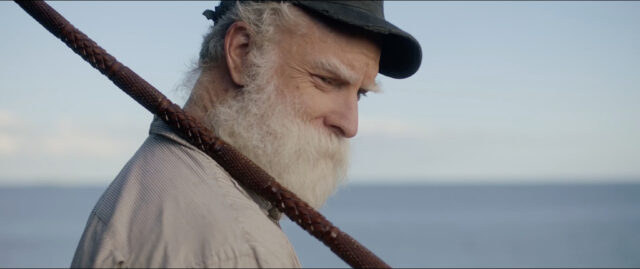
One of the film’s most inspired choices is making Robert a once-famous actor. That narrative decision opens up a rich backstory, allowing Robert’s past and present to overlap through fragments of fictional old movies, scripts, performances, and memories. Bentlage loved the possibilities that gave the film. “We wanted to make him feel like he was part of cinematic history, even though he wasn’t,” he said.
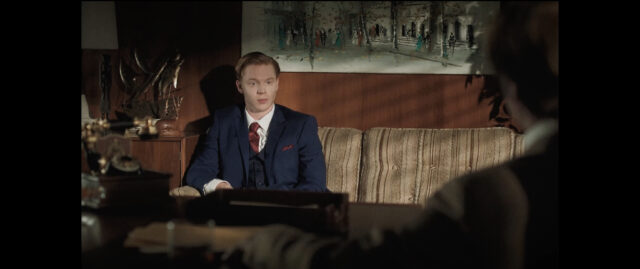
To build that illusion, Bentlage and Kincade looked to classic screen legends and old studio-era genre pieces. “We started looking at titles of movies from back then,” he said, “and we were thinking, which ones would we want to write? What genres would we want to write?” The result is a wonderfully textured fictional filmography for Robert, one that includes a western, a noir, and a billiards drama. Bentlage admitted, with more than a hint of enthusiasm, that he and Kincade have even joked about one day turning some of those invented films into real features. “We really want to do a genre film,” he said. “It would be really fun to actually adapt one of those.”
Central to making all of that work is the casting. Hugo Armstrong’s performance as Robert is extraordinary, and Sam Bullington’s work as young Robert is one of the film’s most elegant achievements. Bentlage revealed that Bullington actually came to them through Armstrong himself. “Hugo had called us,” Bentlage said, “because we were looking for someone to play the younger version of him. And he said, ‘Hey, I met this guy at a read-through once… I’m not sure if he can act, but maybe you want to call him.’”
The result was uncanny. Bentlage said the hope was that audiences might almost think they had “hired Hugo’s son” because Bullington and Armstrong share the same height, similar coloring, and remarkably compatible energy. More importantly, they feel like the same person. Bentlage admitted that was one of his biggest concerns in the script stage because the film never stops to explain Robert’s backstory in heavy exposition. “I didn’t want any exposition for it,” he said. “I think Sam did such a good job studying from Hugo, and Hugo doing that with Sam too, to find this commonality between them.”
Armstrong, of course, was not the most obvious age fit on paper. Bentlage initially worried that the actor was too young for the role, which briefly pushed the filmmakers toward older performers. But Armstrong kept pulling him back. “I just couldn’t get him out of my head,” Bentlage said. “I was so convinced he could play above his age.” Once Armstrong taped for the role, the producers agreed: “That’s the guy right there.”
The rest came down to performance, makeup, and a beard Bentlage now calls essential. “It was his idea to keep the beard,” Bentlage said. “I asked him, ‘Will you keep the beard?’ and he said, ‘I think it’s essential.’” On set, the transformation was so convincing that people instinctively reacted to Armstrong as if he actually were an elderly man in need of help. Bentlage laughed, remembering how crew members would see him come down the stairs in full makeup and think, “Oh my God, here comes this feeble old man. I need to help him to where his mark is.” Then the makeup would come off, and suddenly Armstrong was “like a skateboarder and a really chill kind of surfer California guy.”
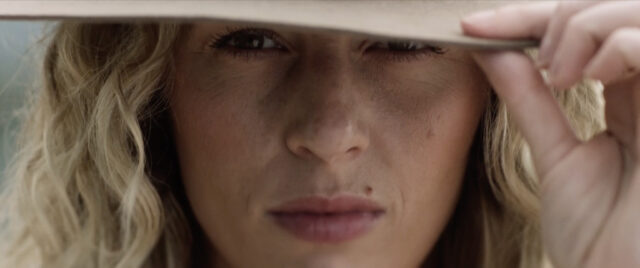
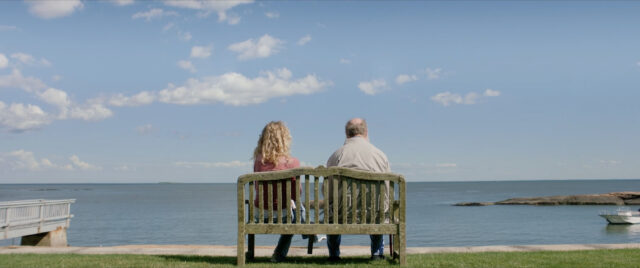
Just as carefully considered as the casting is the film’s visual language. WATCHING MR. PEARSON is luminous. It does not sink into darkness simply because its subject matter is painful. Bentlage said that choice was both practical and thematic. The house location itself had a great deal of natural light, but he and Nogueira were also intentionally drawn to films that allowed difficult emotions to live in brightness. “We were interested in movies that didn’t shy away from brightness with uncomfortable subjects,” Bentlage said.
That became a guiding principle. “We really wanted to make a film that was overall hopeful,” he said. “Obviously, it’s got drama. Obviously, the subject matter is still quite heavy. But I think what we want people to take away from it is the sense of the importance of care, the importance of friendship, and ultimately hope and joy.”
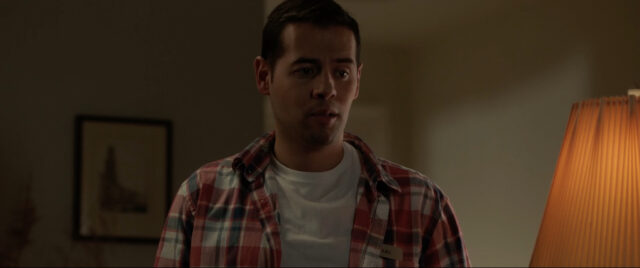
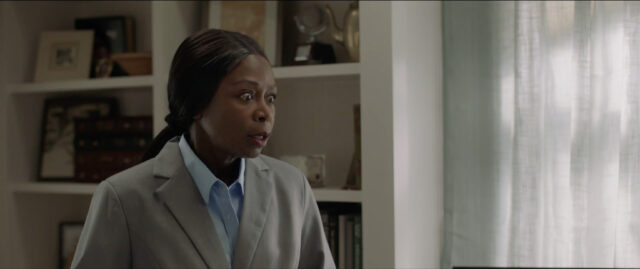
That care extends to the emotional worlds of Caroline and Miguel. Bentlage gives both characters distinct interior lives and differing relationships to Robert. Caroline meets him with warmth, imagination, and emotional openness; Miguel begins from a more practical and guarded place. Bentlage wanted the tension between them to exist without being overstated. “I didn’t want it to be preachy,” he said. “I just wanted it to make the characters feel more real.”
Their differences are partly personal and partly shaped by their experiences as immigrants or children of immigrants. Bentlage, whose father is from Holland, was interested in those contrasting perspectives. Caroline still believes fiercely in possibility. Miguel has been worn down by responsibility. Bentlage described Miguel as someone with “this deep, deep-seated desire to be a screenwriter,” but who no longer believes he can afford to chase that dream. Caroline, meanwhile, still believes “you can choose what you want in life.” Those opposing views create friction, but also depth.
Bentlage is especially insightful when talking about why Caroline’s emotional boundaries with Robert become so porous. Because she is new to the United States and largely alone, work begins to fill the space that friendship and family might otherwise occupy. “She is alone here,” he said. “So for her, she’s looking at Miguel as a friend, not a colleague, and she’s even at some point looking at Robert as a friend instead of a colleague.”
That emotional blurring is one of the reasons the film works so well. Robert is not merely being managed. He is being seen.
Bentlage’s approach with his collaborators follows a similar philosophy. Rather than dictating result-based instructions, he prefers to talk through intention and let actors and department heads find their way there. “I never want to tell someone, ‘Be more sad, be more angry,’” he said. “I’m much more interested in what is the scene trying to accomplish.” He said the same approach shaped his work with Nogueira. Bentlage knew what kind of shots moved him as a viewer, but he trusted his cinematographer to understand which lenses, angles, and framing choices would best convey emotion. “I think you’re better off acknowledging your pitfalls as a director,” he said, “and finding someone who’s better at that than you, than trying to pretend.”
That openness also allowed the film to evolve during production. Some visual ideas changed right before filming, including one major moment that shifted from a dock to the ocean itself. “Two days earlier, we were like, why don’t we just put him in the ocean?” Bentlage recalled. “Let’s get a fish tank. We’ll put the camera in the fish tank and risk our insurance and get that cool underwater shot.”
The editing process brought its own challenges. Bentlage praised editor Jurriaan Van Nimwegen in glowing terms, calling him “one of my favorite human beings” and crediting him with radically improving the film. The first cut ran around an hour and forty-five minutes, but the goal was always to shape something leaner without making it feel abrupt or emotionally fragmented. “The challenge we had was really trying to cut it down to that timeframe, not make it feel rushed, but also on the other side, not making it feel like it was just a string of scenes that didn’t have a continuing arc.”
Bentlage said Van Nimwegen found solutions that surprised even him. One sequence involving billiards was restructured so significantly that Bentlage warned Kincade in advance that it no longer resembled what had been written, but insisted it was better. Another breakthrough came in the shaving scene, when Caroline tries to shave Robert and he becomes confused by the repetition of the moment. Bentlage said that eerie loop was not on the page at all. “Jurriaan took that scene where he’s getting shaved and made it that strange loop,” he said. “It’s completely Jurriaan… somehow finding it in the performances.”
That editorial sensitivity is part of what keeps the film from ever feeling exploitative. It allows viewers to sit with Robert instead of simply observing his decline from a safe distance. Bentlage summed up his artistic goal with a piece of advice that has stayed with him: “Don’t try to write the next great story. Write the next great character.”
Music was equally important in shaping the film’s emotional tone. Bentlage spoke with deep affection about composers Jasper Van Dijik and Kyle Franklin, who have collaborated with him for roughly a decade. He also laughed that they may never forgive him for this one. “They both told me this was the hardest film they’ve ever done,” he said.
Initially, the idea was to pursue a sweeping, old-Hollywood sound. But Bentlage and his producing partner Brian eventually realized that kind of grandeur would overpower the film they had actually made. “We felt, all right, we made a good movie, but we can’t possibly compete with those large-budget productions,” he said. “The score doesn’t feel like it’s matching what you’re seeing. It feels too grand for the imagery that we’ve created.”
So the score evolved into something lighter, more character-driven, more emotionally porous. Bentlage said they listened to many soundtracks from the 1990s, especially films with a Randy Newman-like touch, looking for a sound that could be “a little bit more dramatic in certain moments” but still “complement that lighting and just be a little bit airier around this kind of sensitive subject.”
He was especially taken with the trumpet motif that emerged for Robert. “The first time I heard that, I thought, ‘ This is fantastic. Let’s build on that concept’.” Elsewhere, the score gets to play with genre, particularly in moments where Robert mentally drifts into other modes of storytelling. Bentlage loved the way the composers found room for Western echoes, noir shading, and even live jazz.
One of his favorite examples comes in the scene where Robert calls for an escort. Bentlage described how the composers decided to bring in a jazz band and “live score” the sequence, allowing the music to begin almost as if it were diegetic before tilting into something stranger and more expressive. “I thought that’s amazing,” Bentlage said. “That’s so funny. I like that. It’s different. It’s unique.”
That word, funny, matters. Bentlage was candid about wanting the film to leave room for humor alongside heartbreak. “People also tend to not want to focus on the funny as part of the experience,” he said. “And I think that’s kind of a shame, because it can be beautiful, it can be heartbreaking, it can be funny, and you’re allowed to say that it’s funny.”
That tonal flexibility is one of the film’s quiet strengths. Bentlage never makes fun of Robert, but he does allow the absurdity and unpredictability of life to remain intact. “We’re not making fun of Robert in that scene,” he said of the escort sequence. “But the whole thing is just believable and crazy and can happen, and that’s okay.”
The ending, not surprisingly, remains especially meaningful to him. Bentlage credited Kincade with the emotional shape of the closing beats, particularly Miguel’s final gesture, which points to a future he has nearly convinced himself not to want. “It feels like Simon just… getting the script, getting the piece of mail he wanted, you know, knowing Miguel is chasing his dreams just makes me feel really happy.”
But one of the ending’s most powerful lines came from Armstrong himself. When Robert quietly says, “He saved me,” Bentlage noted, “that was Hugo’s added line right there.”
It is the perfect grace note for a film built around mutual rescue, memory, and care. No one in WATCHING MR. PEARSON remains untouched by the others. Caregiving changes the caregivers. Friendship changes the lonely. Performance becomes a form of presence. Imagination becomes a bridge.
Looking back, Bentlage said the biggest lesson he learned from making the film was to trust even more. “Filmmaking is the most collaborative art form I can think of,” he said. “It requires extreme amounts of trust and respect and admiration for the people you’re working with.” If he takes one thing forward into future projects, it is that: “Bring more people in that I admire and respect, and give them absolutely the space to express themselves as much as I am.”
That collaborative spirit is deeply embedded in WATCHING MR. PEARSON. It is there in the performances, in the score, in the softness of the light, in the rhythm of the editing, and in the film’s refusal to reduce dementia to a single emotional note. Bentlage has made a debut feature with genuine compassion and a quietly confident sense of craft. More importantly, he has made a film that understands something essential: even when memory falters, feeling does not disappear.
by debbie elias, exclusive interview 04/09/2026
WATCHING MR. PEARSON is starting its theatrical rollout across the country on April 9, 2026.