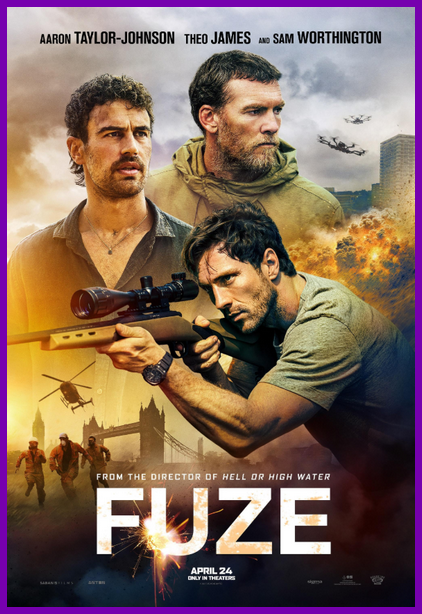
The Craft & Construction of Cinema – Controlled Detonation
With FUZE, David Mackenzie delivers more than a high-concept heist thriller—he constructs a rigorously engineered exercise in cinematic tension, one that hinges on editorial rhythm, visual restraint, and sonic minimalism to create a film that is as structurally disciplined as it is viscerally engaging.
For filmmakers and craft artisans, FUZE offers a compelling case study in how to compress narrative, manipulate audience attention, and sustain tension without excess.

Editorial Architecture: Cutting Against Expectation
At the core of FUZE’s propulsion is the work of editor Matt Mayer, whose approach eschews traditional continuity rhythms in favor of what Mackenzie describes as a “jagged” editorial style.
With more than 300 scenes distilled into a 90-minute runtime, the film operates on micro-scenic construction—short, information-dense beats that are rarely allowed to resolve in predictable ways. Cuts frequently arrive before the expected visual or emotional payoff, creating a subtle but persistent sense of dislocation.
This strategy yields two key effects:
Temporal compression
Cognitive destabilization
Visual Grammar: The Illusion of Transparency
Reuniting with cinematographer Giles Nuttgens, Mackenzie adopts a visual strategy that prioritizes observational immediacy over overt stylization.
Favoring mid-shots, two-shots, and controlled close-ups, the film keeps audiences locked into process—bomb mechanics, vault logistics, tactical movement—while quietly obscuring character alignment.
Lighting is driven by practical sources—flashlights, work lights, reflective surfaces—maintaining clarity even in subterranean environments.
Nothing is hidden. Everything is missed.
Narrative Design: The Shell Game in Motion
Structurally, FUZE operates as a multi-threaded shell game, distributing attention across military, law enforcement, and criminal spheres.
By anchoring each thread in procedural detail, the film directs audience focus toward what is happening rather than who is doing it, allowing revelations to land with maximum force.
The near real-time structure intensifies this effect, creating sustained forward momentum with minimal room for audience recalibration.
Performance Dynamics: Ensemble as Ecosystem
Rather than a single protagonist, FUZE thrives on a performance ecosystem.
Gugu Mbatha-Raw anchors the procedural core with precision and authority, supported by Honor Swinton Byrne in a high-functioning operational dynamic.
On the criminal side, Sam Worthington and Theo James generate tension through instability—hierarchies blur, trust erodes, and unpredictability reigns.
Sonic Design: Minimalism as Escalation
Composer Tony Doogan builds the score on minimalist principles inspired by Terry Riley, structuring the music around a consistent tonal center and tempo.
Rather than signaling emotional beats, the score functions as a pressure system, building tension through repetition and incremental variation.
Conclusion: Precision Over Excess
What distinguishes FUZE is not scale, but control.
Every department operates within clearly defined constraints, allowing Mackenzie to construct a film that is lean, disciplined, and relentlessly effective.
Tension here is not accidental.
It is engineered.
by debbie elias, as part of our Artisans Behind the Lens series