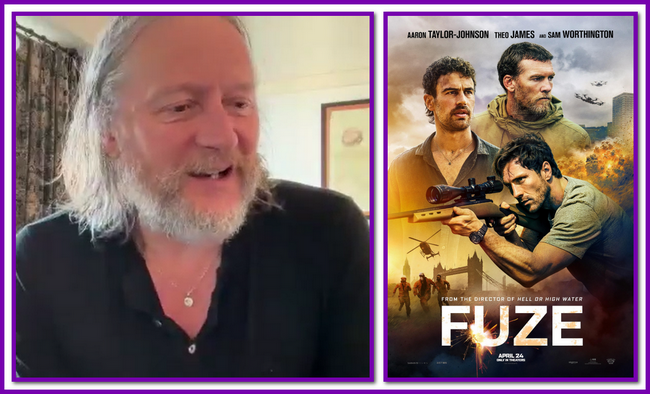
Forget ticking clocks—FUZE is a cinematic detonation.
There’s a particular kind of precision that defines a DAVID MACKENZIE film—an almost architectural approach to storytelling where structure, performance, and visual grammar interlock with clockwork efficiency. From its opening moments, David Mackenzie engineers a high-pressure, high-velocity thriller that doesn’t just build tension—it compresses it, weaponizes it, and then unleashes it in a relentless barrage of twists, reversals, and razor-edged misdirection. This is storytelling as controlled explosion—precise, punishing, and impossibly entertaining – a propulsive, high-stakes thriller that unfolds like a shell game played in real time.
And make no mistake: every move is deliberate.
“I think in both of these films (Relay and FUZE), the editing is getting more and more… slightly tenser,” Mackenzie explains. “We’re never kind of cutting in the obvious places… there’s a jaggedness in the editing… it pushes you forward all the time.”
That forward momentum is no accident. Clocking in at a lean 91 minutes and packing over 300 scenes, FUZE wastes no time—and no frame. The collaboration between Mackenzie and editor Matt Mayer proves once again to be a masterclass in controlled acceleration, compressing narrative space while amplifying tension.
“It’s a fast film. There’s a heck of a lot going on… bang, bang, bang,” Mackenzie says. “And there’s something really exciting about being able to do that and not lose sense of the film—actually create more of a sense of the film.”
The Art of the Shell Game
At its core, FUZE is a sleight-of-hand thriller—one that dares audiences to keep up as it shifts focus, perspective, and allegiance.
Mackenzie credits the film’s foundation to writer Ben Hopkins, but the concept itself had been simmering for over a decade, rooted in a very real and very recurring phenomenon: the discovery of unexploded World War II ordnance across Europe.
“These things happen all the time,” Mackenzie notes. “In the ten-plus years I’ve been developing this… I’ve seen so many reports of places being evacuated. It’s incredible.”
That realism becomes the film’s Trojan horse—an entirely plausible scenario that allows something far more intricate to unfold in plain sight.
“There are breadcrumbs throughout,” Mackenzie teases. “But they’re part of what we had to work out in the edit—how much to give and when.”
Seeing Without Seeing: Cinematography as Misdirection
Visually, FUZE operates on a fascinating contradiction: everything is visible, yet nothing is fully revealed.
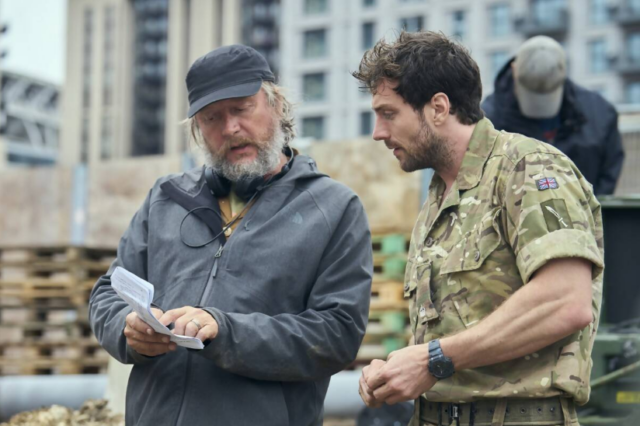
Reuniting with cinematographer Giles Nuttgens, Mackenzie leans into an organic shooting style that favors immediacy over spectacle—mid-shots, two-shots, and close-ups that keep audiences locked into the mechanics of the moment.
“I try and make it as organic as possible when we’re shooting,” he says. “Things are not necessarily being highlighted, but you’re kind of absorbing them in something that feels real.”
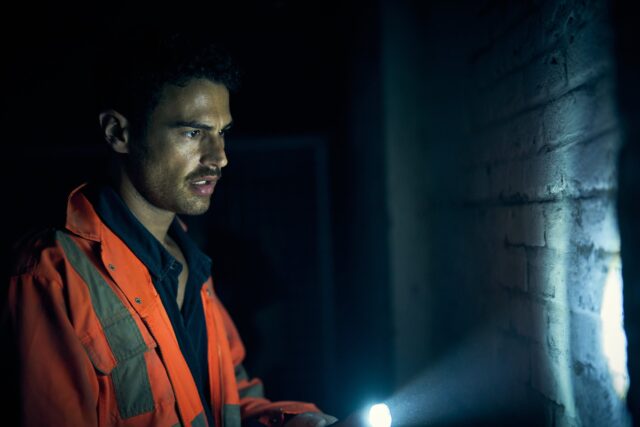
Even the film’s darker environments—bank vaults, subterranean corridors—eschew stylization in favor of practical illumination.
“It’s really sort of flashlights and reflective flashlights and work lights that create that atmosphere,” Mackenzie explains. “Giles is really just great at that.”
The result is a visual strategy that hides nothing—except the truth.
Real Time, Real Pressure
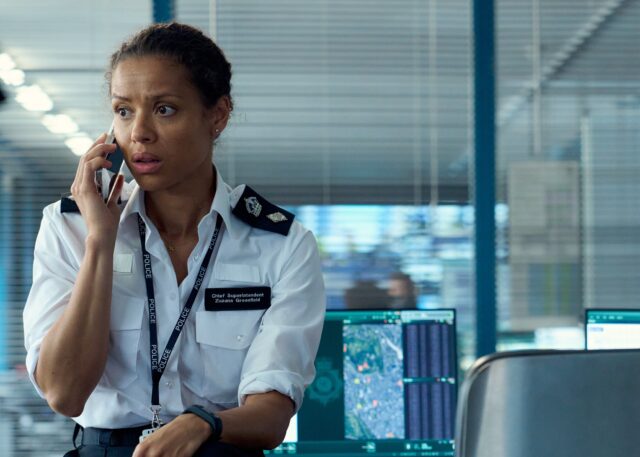
A key to the film’s immersive tension is its near real-time structure, a ticking-clock framework that keeps both characters and audience in a constant state of forward motion.
Nowhere is this more evident than in the police operations room, led by Gugu Mbatha-Raw’s Chief Superintendent—a performance that anchors the film’s procedural spine.
“It’s kind of almost the backbone of the film,” Mackenzie says. “We actually had to shoot that first… so we were throwing her into the deep end.”
The dynamic between Mbatha-Raw and Honor Swinton Byrne brings a grounded, investigative clarity to the chaos, while Alexander Arnold’s perceptive young corporal quietly becomes one of the film’s moral compasses—always one step behind, but asking the right questions.
Building a Criminal Ecosystem
On the other side of the equation, FUZE thrives on the unpredictable chemistry of its criminal ensemble.
Theo James’ Karalis emerges as a roguish, physically dynamic presence, while Sam Worthington’s enigmatic X exerts a more calculated authority.
“Sam was like the head of the operation, and Theo was the brains,” Mackenzie explains. “There was always a sense of ‘I don’t trust you, and I don’t trust you.’”
What began as minimally defined characters on the page evolved into a fully realized group dynamic during production.
“They find their own dynamics… they became—knocking down walls, getting sweaty… they kind of connected as a group.”

Scoring the Tension
If the edit provides propulsion, the score provides pressure.
Longtime collaborator Tony Doogan approaches FUZE with a minimalist philosophy inspired by Terry Riley’s In C—building tension through repetition, rhythm, and incremental variation.
“All the music was in C… 120 beats a minute,” Mackenzie reveals. “So [musicians] could just get on and play.”
The result is a score that doesn’t dictate emotion—it escalates it.
Permission to Be Entertained
For all its precision and tension, FUZE never loses sight of its ultimate goal: to entertain.
“It’s been a ride… on the edge of your seat,” Mackenzie says. “But it’s also supposed to be entertaining. Permission to be entertained.”
And in true Mackenzie fashion, that permission comes with a payoff—one that releases the film’s carefully wound tension with a final, unexpected twist of tonal brilliance.
by debbie elias, exclusive interview 04/21/2026
FUZE is in theatres on April 24, 2026