
With his first serious dramatic turn as a director with A LOVE LIKE THIS, JOHN ASHER talks Malibu light, emotional risk, editing with intention, and a surprise hello from his mother, actress Joyce Bulifant.
John Asher has built much of his directing career on comedy, on rhythm, on finding the laugh. But with A LOVE LIKE THIS, the filmmaker steps into markedly different territory, trading overt comic beats for emotional messiness, romantic deception, and the uneasy push-pull between love, lust, and lies. The shift is intentional, and for Asher, personal.
“It absolutely is,” he says of venturing into a new storytelling mode. “It’s time for me to grow up.”
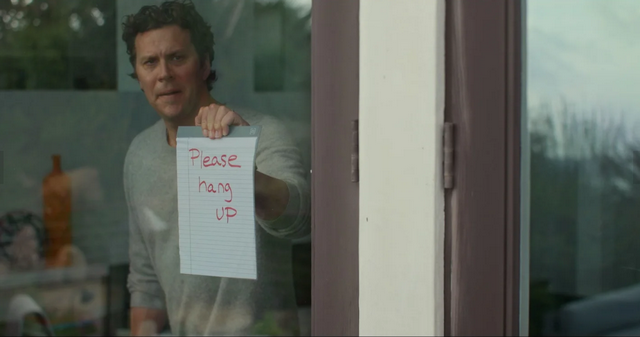
That self-awareness, paired with genuine pride and just a hint of nerves, hangs over Asher’s discussion of the film, which follows Leah and Paul over the course of a long weekend in Malibu as the couple is forced to confront the consequences of past decisions and ask whether a deep, burning love can survive what’s underneath the surface. Asher was immediately drawn to the material when he first read Jeffrey Ruggles’ script, but he also recognized the challenge embedded within it. Once the film reveals, early on, that all is not as it seems, the question becomes how to keep an audience emotionally invested in characters whose choices are anything but simple.
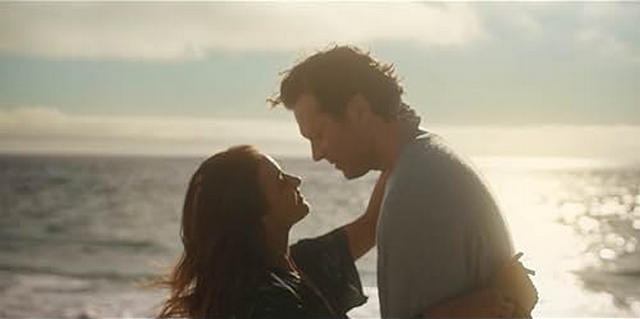
“I fell in love with these characters,” Asher says. “And then on page 10, when I realized what they were doing, I was like, ‘Oh, no, wait a minute.’ … How do I get the audience to root for them? How do I give everybody a peek into their world and let the audience experience this?”
That sense of invitation matters in A LOVE LIKE THIS, especially because the film knowingly pivots around revelation. For Asher, the goal was never to sensationalize the premise or tip into something campier or more extreme, but to guide viewers onto an emotional ride grounded in feeling. “Heart is the key to every story,” he says, and it is a point he returns to repeatedly. In fact, he sees this film as the first time he has been able to fully put that belief on screen.
The film marks the first time in Asher’s career that he had final cut, a distinction that clearly means a great deal to him. “It’s the first time I’ve ever had final cut on a movie,” he says. “All of my other movies I’ve had so many cooks in the kitchen.” That creative control, however, did not mean shutting out collaboration. Instead, it changed the nature of the conversation. “There’s a big difference between getting feedback and getting notes,” he says. With final cut, he could listen, weigh reactions from his actors and producing team, and still protect the emotional shape of the film as he saw it.
That process became even more intimate because Asher also edited the movie himself. Wearing both hats, he says, sharpened his decision-making on set, particularly given the film’s brutally tight schedule: a 12-day shoot, with 12 eight-hour days and no room for overtime. “Everything was pretty planned out,” he says. But rather than force actors into rigid marks, Asher prefers to let performance lead and have the camera adapt. “I don’t really like to pin them into anything,” he explains. “Rather than making the actors work for camera, I make the camera work for actors.”
That flexibility, married to an editor’s instinct for what was truly needed, saved valuable time. Asher could identify the beats he knew he would cut on, compress coverage, and move quickly without sacrificing emotional clarity. It is a workflow he sees as transformative in his growth as a filmmaker, one he traces back to earlier work but one that feels fully realized here.
If A LOVE LIKE THIS has a secret weapon beyond its performances, it is location. Asher shifted the story from Palm Springs to Malibu for practical budget reasons, but the change proved creatively invaluable. The film’s stunning mountaintop home overlooking the Pacific becomes far more than a backdrop; it becomes an extension of mood, desire, isolation, and illusion. Asher scouted locations himself and found the house that ultimately defines the film’s visual identity. “Where is a romantic place to go?” he recalls asking himself. “I was born and raised in Malibu. That’s a romantic place.”
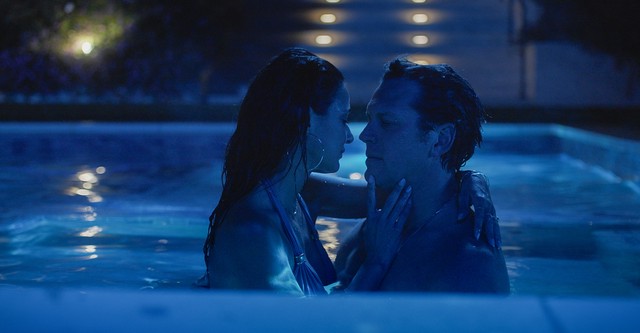
The home’s expansive windows, white interior, pool reflections, and shifting natural light gave Asher and longtime cinematographer Graham Futerfas a rich visual playground. The two have worked together for roughly 15 years, and Asher speaks about Futerfas with the trust of a filmmaker who knows his collaborator will not simply execute an idea, but elevate it. “When I give him a direction or a move that I want the camera to do, always when I come back to check the shot, it’s 90% better than what I said,” Asher says.
Natural light became central to the visual strategy. Because of the structure of the shoot, the production worked in day splits from 10 a.m. to 10 p.m., carefully timing scenes to capture the exact quality of sunlight Futerfas wanted. “He always made sure that those actors were backlit,” Asher says. The house, meanwhile, allowed light to flood the interiors, enabling Futerfas to shape rather than overpower it, often with negative fill. The result is a look that feels soft and romantic on the surface, yet subtly suggestive of what lies beneath, a visual language that mirrors the film’s emotional slipperiness.
Asher says that he and Futerfas made a pact during production: “We’re not going to shoot it unless it’s interesting.” It is a deceptively simple rule, but one that speaks volumes about the care behind the film’s aesthetic. Every composition, every move, every sun-dappled reflection on the water needed to serve both beauty and story. By the second day, Asher says, they realized they were onto something and knew they had to keep the standard high.
That attention to mood extends beyond the Malibu house and into the film’s striking bar sequence, where darker woods, richer tones, and a swirling, more volatile energy signal a key shift in the story. It is a scene Asher is especially proud of, describing it as a “winner,” and one that allowed him and Futerfas to rely on their shared comfort with extended camera movement. Asher points to earlier collaborations, including the continuous-take comedy Somebody Marry Me, as evidence of the creative shorthand the two share. Here, that shorthand pays off in a sequence that is fluid, emotionally loaded, and pivotal in revealing cracks in Paul’s facade.
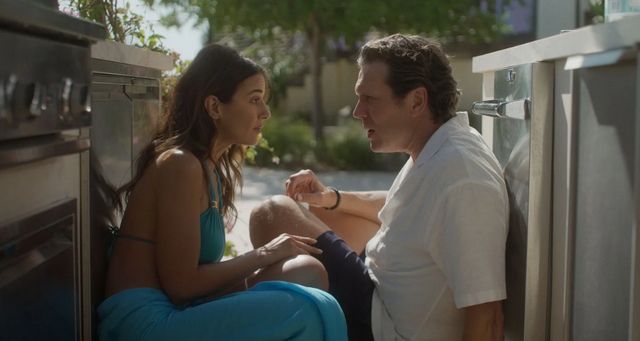
Casting, too, was crucial, particularly in finding actors who could navigate the film’s intimacy and volatility. Emmanuelle Chriqui and Hayes MacArthur bring a convincing chemistry to Leah and Paul, and Asher credits Chriqui with helping shape that choice. After meeting with her and discussing the intimate tone he wanted, he says they began talking through possible co-stars. When MacArthur’s name came up, Chriqui was immediate and decisive. “She said it has to be Hayes,” Asher recalls. More importantly, “She said she felt safe with Hayes. And when she told me she felt safe with him, that’s all I cared about.”
That trust mattered. Chriqui was the only woman on set, and Asher praises her not only for her preparation but for the way she anchored the production. “She was the mother of the ship,” he says, noting that both leads came ready to work, without scripts in hand during rehearsals, fully prepared to explore the characters under the pressure of a very fast-moving shoot. Their readiness allowed the film to maintain its pace without compromising performance.
And then there is one of the film’s most charming surprises: the appearance of veteran actress Joyce Bulifant in a small but memorable role as the owner of an antiques shop. Her scene, involving the poignant backstory of a piece of artwork, lands with warmth and grace, and when praised for it, Asher could hardly contain his delight. “Do you want to know a secret about Joyce?” he asks. “She’s my mother.”
What follows is one of those moments no publicist could script, and no interview strategy could improve upon. Touched that Bulifant’s scene had made such an impression, Asher tried calling her mid-conversation. The first attempt went to voicemail. Then, near the end of the interview, she called back.
“Mom, I’m in the middle of doing a live interview right now, so you’re on speaker phone,” Asher says, laughing. “They didn’t know that you were my mom.”
Bulifant’s cheerful hello is every bit as lovely as one might hope. Told how much her appearance in the film was appreciated, she responds with immediate sweetness: “Oh, thank you! That’s so sweet.” And when teased that John needs to give her even bigger roles in future projects, she does not miss a beat: “Tell him to get at it.”
The exchange says a great deal about Asher, his affection for his mother, and the spirit in which he made the film. He clearly relishes directing Bulifant, calling her his “good luck charm” and laughing over how badly she wants to impress him on set. “Talk about a pro,” he says. “She so badly wants to impress me. She wants to do a good job. And I’m like, ‘Mom, you’re crushing it.’”
The film’s emotional atmosphere is also shaped by its music, from Sarah Trevino’s score to its carefully chosen needle drops. Asher admits that his initial director’s cut included songs far beyond the budget, but producer Jordan Bogdonavage helped guide the music choices into a more realistic range, in some cases securing help from artists who responded positively after seeing the film. Asher discovered Trevino through a short film she scored and was immediately struck by her ability to deepen feeling through music. “Sarah is a raw nerve,” he says. “She watches something and she can just take it and elevate it.”
For all the specific craft choices in A LOVE LIKE THIS, the biggest takeaway for Asher seems to be internal. Making the film taught him something about his own instincts and what kind of stories he wants to tell going forward. “I learned that it’s okay to be vulnerable as a filmmaker and not to be so guarded,” he says. “To trust my instincts. To listen to that little voice.”
That voice is already guiding him away from old assumptions. He recently passed on directing a comedy because, as he puts it, “I don’t think that’s my wheelhouse.” Instead, he is looking ahead to a new project, Reach for the Sky, the true story of Bill Gaines, a woodshop teacher who helped bring aeronautics into high schools in 1968. It is another sign that Asher is less interested now in landing easy laughs than in making audiences feel something lasting.
With A LOVE LIKE THIS, he has done exactly that. The film may represent a tonal and genre shift for the director, but what emerges most strongly is not reinvention for reinvention’s sake. It is a filmmaker finally claiming space for the heart he says has always been there.
And if he keeps Joyce Bulifant nearby as a good-luck charm, nobody should complain.
by debbie elias, exclusive interview 04/06/2026
A LOVE LIKE THIS is in limited release in select theatres now.