
Emmanuelle Chriqui and Hayes MacArthur bring emotional volatility and real chemistry to a romantic drama elevated by striking Malibu visuals and an unexpected tonal maturity from director John Asher.
John Asher’s A LOVE LIKE THIS opens with a promise of romance bathed in sun, sea air, and sleek modern luxury. Set largely within a gorgeous mountaintop Malibu home overlooking the Pacific, the film quickly uses location as more than backdrop. With its white-on-white interiors, expansive windows, reflective pool surfaces, and an abundance of natural light, the setting becomes an essential part of the storytelling, wrapping the characters in beauty even as emotional fissures begin to form beneath the surface.
That tension is what gives A LOVE LIKE THIS its hook.

At first, Leah and Paul seem like a couple very much in love, enjoying a long weekend retreat in one of the most enviable locations imaginable. But by the 13-minute, 47-second mark, the film reveals that all is not what it seems. Spouses exist outside this idyllic bubble. In Leah’s case, so does a child. Suddenly, what initially feels like an intimate romance pivots into something more morally complicated, emotionally volatile, and dramatically charged.
To its credit, A LOVE LIKE THIS understands the value of that reveal and knows how to pull viewers in with it. While much of the narrative that follows is fairly predictable, Asher keeps the film engaging through tone, visual control, and, most importantly, the chemistry between Emmanuelle Chriqui and Hayes MacArthur.
Chriqui and MacArthur are the film’s strongest assets. Their connection feels lived-in and believable from the outset, which is crucial because the story depends on the audience understanding why these two people are drawn to each other despite the emotional fallout gathering around them. Chriqui gives Leah a quiet emotional accessibility, while MacArthur does the heavier lifting with a performance that requires him to pivot from sweetness and vulnerability to anger, petulance, and behavior edging close to violence. He handles those tonal swings skillfully, allowing Paul to become increasingly less appealing without ever losing the dramatic thread of who this man is and why Leah remains caught in his orbit.
That performance work helps elevate the film beyond what might otherwise have played like a made-for-television romantic melodrama. The story may travel some familiar roads, but the actors keep it from flattening into cliché. There are also a few satisfying twists along the way, along with some effective visual and emotional tonal shifts that help keep the material moving.


Asher, best known for broader comedic work, makes a notable genre and tonal shift here, and it is one that suits him surprisingly well. There is a sincerity to the film that feels genuine, not manufactured. Speaking recently about the project, Asher described heart as the key to every story, and that philosophy is evident onscreen. Even when the script leans into familiar dramatic beats, the film is clearly reaching for emotional honesty rather than easy sensationalism.
That intention is reinforced by the visuals. Asher’s collaboration with cinematographer Graham Futerfas pays off beautifully, particularly in the way the film uses sunlight, reflections, and framing through glass to create both intimacy and distance. Shooting outside into the home and from within the home out toward the surrounding landscape gives the film a constant sense of looking through something — windows, surfaces, layers of emotional concealment. There is even a softness to the lensing that lends the romance an almost dreamy quality while quietly hinting that not everything underneath is as pristine as it appears.
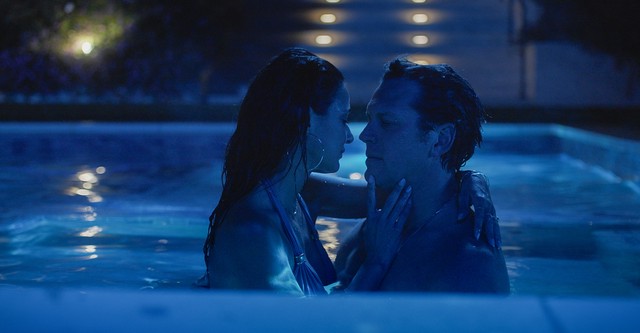
The Malibu house itself does a great deal of heavy lifting, but the filmmakers know exactly how to use it. This is not simply a pretty location. It is a storytelling tool. The openness of the architecture, the flood of natural light, and the visual contrast between interior calm and emotional unrest all work to the film’s benefit. A later bar scene offers a particularly effective counterpoint, shifting into richer woods, darker tones, and more fluid movement as tensions escalate.
The score by Sarah Trevino, paired with well-chosen needle drops, also adds texture. Music gives the film an immediate energy from the outset and helps shape the emotional flow without overwhelming it. And yes, there is also an inadvertent and amusing Jack in the Box plug that earns a genuine chuckle when Leah wolfs down a Jumbo Jack after a rough night and no dinner. It is one of those small, unexpectedly human moments that lands just right.
Supporting appearances by Ray Abruzzo and Joyce Bulifant add extra charm, with Bulifant in particular making the most of a brief but lovely scene that leaves a warm impression.

A LOVE LIKE THIS may not reinvent the relationship drama, and seasoned viewers will likely anticipate much of where it is headed. But thanks to attractive visual design, sincere performances, and a welcome directorial pivot from John Asher, the film proves more engaging than its premise alone might suggest. It is an enjoyable, emotionally accessible drama that benefits from strong chemistry, handsome craftsmanship, and a filmmaker willing to lean into vulnerability rather than hide from it.
For Asher, A LOVE LIKE THIS feels less like a detour than a meaningful next step — and one worth taking.
Directed by John Asher
Written by Jeffrey Ruggles
Cast: Emmanuelle Chriqui, Hayes MacArthur, Ray Abruzzo, and Joyce Bulifant
by debbie elias, 04/06/2026
A LOVE LIKE THIS is in limited release in select theatres now.