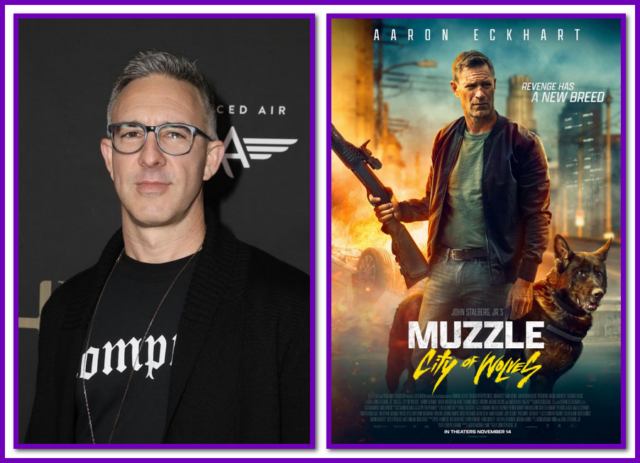
Director JOHN STALBERG, JR. goes deep into MUZZLE: CITY OF WOLVES in this exclusive conversation.
SYNOPSIS: Jake Rosser is haunted by PTSD from his days as a K-9 officer and endeavors to lead a peaceful life with his family and retired K-9 companion, Socks. But the tranquility quickly dissolves when a ruthless gang, headed by the mysterious Totec, targets them in a brutal attack. Determined to protect his loved ones, Jake and his new K-9 partner Argos delve into a violent underbelly of crime where Jake confronts corrupt officials, uncovers a perilous drug trafficking ring and battles his own inner demons. Racing against time, Jake and Argos must dismantle Totec’s sinister scheme, leveraging every clue to reveal the truth and secure justice.
Directed by John Stalberg Jr., with script by Jacob Michael King, MUZZLE: CITY OF WOLVES stars Aaron Eckhart, Tanya van Graan, Karl Thaning, and Nicole Fortuin.
*****
For director John Stalberg Jr., MUZZLE: CITY OF WOLVES isn’t simply a sequel—it’s a descent.
While the first Muzzle established Jake Rosser as a damaged former K-9 officer struggling to survive his past, MUZZLE: CITY OF WOLVES pushes that struggle inward and outward at once, transforming the story into what Stalberg describes as a modern odyssey—one that operates simultaneously on a brutal action level and a psychological, even metaphysical plane.
“The sequel was always about going deeper,” Stalberg explains. “Not just bigger action, but a deeper psychological and spiritual journey for Jake.” A thinking man’s action movie.
Stalberg conceived CITY OF WOLVES as an urban echo of The Odyssey: a violent journey through a hostile landscape where every external obstacle reflects an internal battle. Cartels, corrupt cops, bureaucracy, and the film’s central antagonist Totec are not just plot mechanics—they are manifestations of Jake’s PTSD, rage, addiction, and fear of failing his family. “Everything Jake is fighting on the outside is something he’s wrestling with on the inside,” Stalberg says. “It’s all personified.”
At the core of that contradiction is Jake himself—simultaneously a loving husband and father, and a government-trained weapon struggling to control his capacity for violence. That duality is mirrored throughout the film, nowhere more powerfully than in Jake’s bond with his new K-9 partner, Argos. Together, they are forced to battle the malevolent forces of Totec. Rather than grounding the mysterious Totec as a conventional cartel enforcer, Stalberg leaned into something more unsettling. “Totec was never meant to be just a guy with a gun,” he says. “We built him as a metaphysical presence—almost a devil figure.” Totec often exists as a disembodied voice, speaking through phones and earpieces, omniscient in a way that defies logistics. For Stalberg, that was the point. “When people ask, ‘How could he possibly know all this?’ my answer is: that’s the point. In our world, the devil always knows.”
Totec represents the path Jake refuses to take—the man who has made peace with violence and surrendered to it completely. “Totec is the flip side of Jake,” Stalberg explains. “He’s the guy who accepted the devil’s terms. Jake is trying to stay sober, be a husband and a father, and control his violence. Totec is what happens when you don’t.”
Sound design plays a crucial role here, making Totec’s presence feel invasive and internal. “We wanted him to feel like the voice in Jake’s head,” Stalberg says. “Something that crawls under your skin.”
As John discusses, visually, CITY OF WOLVES marks a deliberate evolution from the first film and required a re-engineering of the visual language we saw in Muzzle. Stalberg and cinematographer Pieter Vermeer consciously re-engineered the franchise’s look, treating the sequel as an opportunity to bend tone and style the way long-running franchises like Mission: Impossible have done. “A lot of what you’re responding to came from Pieter and I very consciously re-engineering the visual language from the first film,” Stalberg says. Where Muzzle leaned into spherical lenses and reportage-style realism, CITY OF WOLVES embraces anamorphic widescreen and operatic subjectivity.
“We went anamorphic, 2.39:1,” Stalberg explains. “Wide, shallow depth close-ups that still feel epic. Strong horizontal compression, flare, and a very subjective frame that stays close to Jake psychologically.” The camera is rarely passive. Long anamorphic lenses are pushed uncomfortably close to Aaron Eckhart, capturing moments of suicidal ideation, moral paralysis, and raw fear. “There were times we wondered if we were too close,” Stalberg admits. “But the combination of Aaron’s performance and the anamorphic texture made those moments brutally effective.” Steadicam movement becomes an emotional barometer, never decorative. “We designed moves that were emotionally motivated,” he says. “The camera rides Jake’s internal volatility instead of observing from a safe distance.” Color reinforces that psychology. Present-tense sequences are denser, grittier, and higher contrast, while memories of Jake’s wife Mia are lighter and cleaner—subconscious reminders of what he’s fighting to reclaim.
With multiple narrative threads in play—Jake’s odyssey, Argos’s parallel journey, Totec’s omnipresent menace, and the emotional through-line with Mia—the edit became a critical storytelling tool. Editor Bella Erikson worked closely with Stalberg to balance clarity with psychological momentum. “Every cut had to progress both plot and psychology,” Stalberg says. “Not just check in on subplots.” One of the film’s most striking motifs—Jake and Argos as mirrored selves—was built in the edit. “Argos running a corridor, smash cut to Jake running a corridor,” Stalberg explains. “That had to feel intuitive, not clever.”
Performance always took precedence over technical perfection. “We were willing to break continuity, line rules, anything,” he says. “It was always perfect geography versus perfect emotion—and we chose emotion.”
That philosophy extends to tone. The film is brutal and violent, but punctuated by gallows humor—moments like the OnStar call or calls to an insurance adjuster release pressure without deflating stakes. “Where you drop the joke, how long you hold a reaction—those milliseconds matter,” Stalberg notes.
Of course, John had to discuss Argos. The emotional heartbeat of MUZZLE: CITY OF WOLVES is not a man—it’s a dog. “Argos really is the co-lead here,” Stalberg says without hesitation. Argos is played by two Belgian Malinois brothers, each bringing a distinct aspect of the character to life. “Uzo is the older one,” Stalberg explains. “A former bomb-sniffing dog from Afghanistan. He became the face of Argos—the close-ups, the emotional beats. He has this incredibly soulful, present energy.” Malawi, the younger brother, handled the physical demands. “He’s the muscle,” Stalberg says. “Running on the beach, jumping walls, going through cars—he’s the stunt double.” Together, they embody the same contradiction that defines Jake: affectionate and loyal, yet dangerous and highly trained. “They’re true working dogs,” Stalberg adds. “They’d run horses on farms for hours in the morning, then work all day on set. Very affectionate—and genuinely dangerous.”
“From the beginning, we thought of Argos as a reflection of Jake,” Stalberg says. “They’re both these trained ‘animals’ trying to live in a domestic world.” When Argos hesitates to attack, it mirrors Jake’s struggle to restrain his own violence. “Jake can’t fully open up to his wife,” Stalberg explains, “but he can talk to his dog in the car. Argos becomes his conscience. You’re watching a man argue with the animal inside himself.”
Stalberg hopes MUZZLE: CITY OF WOLVES is not the end of Jake Rosser’s journey. “There’s absolutely room for a third film,” he says. “Even more intense action, but also more character.”
Given the operatic ambition and emotional commitment on display here, it’s hard not to believe him. MUZZLE: CITY OF WOLVES is a visceral, violent film—but it’s also a deeply human one. Beneath the blood, grit, and gunfire lies a story about trauma, restraint, loyalty, and the cost of trying to remain good in a world that rewards brutality.
At its center stands a man—and a dog—both fighting the same war.
TAKE A LISTEN. . .
by debbie elias, exclusive interview 11/18/2025
MUZZLE: CITY OF WOLVES is available on all major VOD platforms.