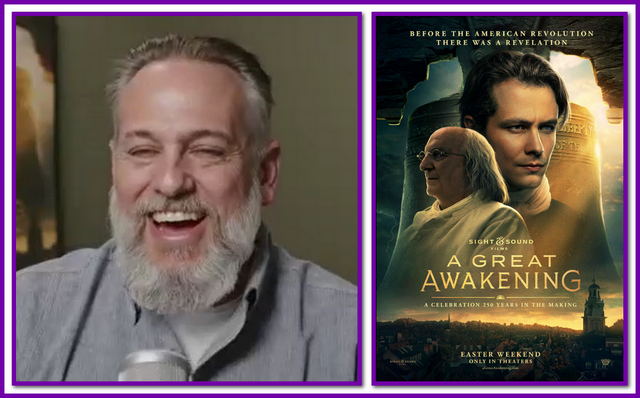
JOSHUA ENCK, the director of A GREAT AWAKENING, explores history, sound, and storytelling in bringing George Whitefield to life.
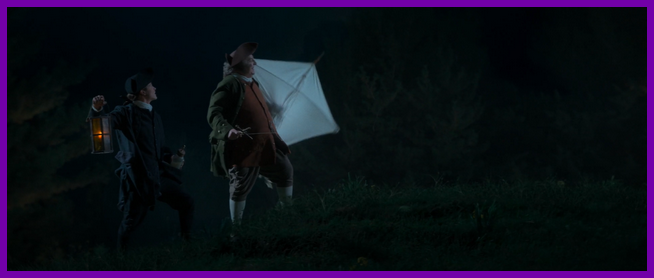
There’s a particular kind of electricity that runs through A GREAT AWAKENING—and it’s not just the familiar image of Benjamin Franklin’s kite catching lightning in a storm. It’s something more elusive. More human. More spiritual. A current that, as director and co-writer JOSHUA ENCK reveals, was as present behind the camera as it is within the story itself.
Speaking with me about the film, Enck is quick to emphasize that authenticity—historical, emotional, and spiritual—was never negotiable.
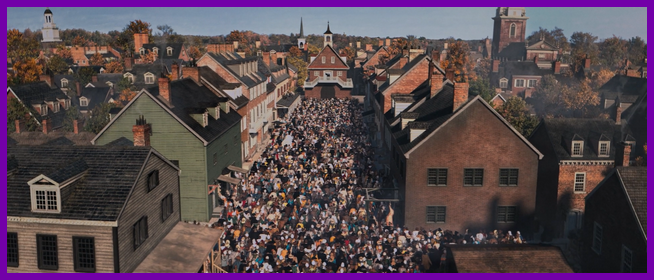
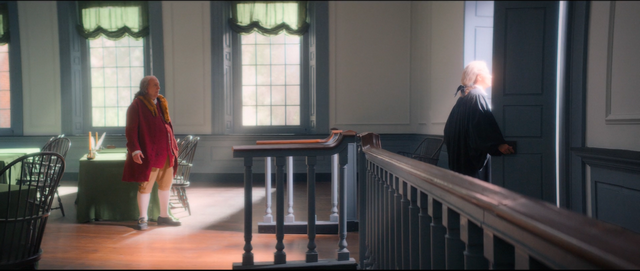
“We didn’t want to phone anything in,” he says, recalling the painstaking efforts to recreate Independence Hall down to its famously specific paint colors. “That beautiful, sacred place…we wanted to stay true to what we know.” Same with building and recreating Market Street of 1739.
That commitment extended beyond aesthetics. At one point, Enck’s production designer called with an unexpected detail: the flooring order for their reconstructed Independence Hall set came to exactly 1,776 square feet.
“‘You’re kidding me,’ I said,” Enck laughs. “He showed me the receipt. There were moments like that all along the way.”
Divine intervention? Perhaps. At the very least, it’s a fitting anecdote for a film rooted in what Enck describes as inspiration rather than invention.
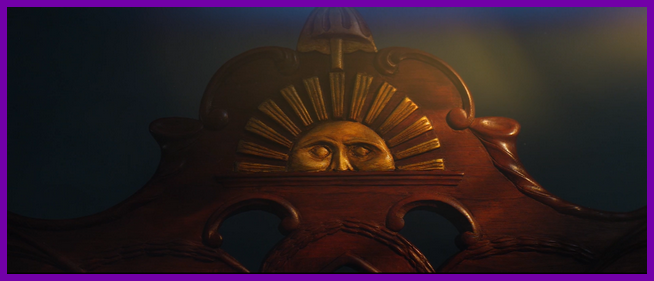
Telling the Story Through Memory—and a Grandson Named “Lightning Rod Jr.”
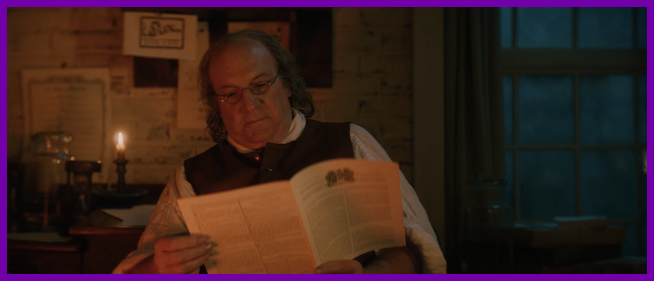
From the outset, A GREAT AWAKENING distinguishes itself structurally. Rather than a straightforward historical recounting, the film unfolds through the recollections of Benjamin Franklin in 1787, as he grapples with the discord of the Constitutional Convention.
The key to unlocking that narrative, however, came from an unexpected source: Franklin’s grandson.
“When I learned his grandson’s name was ‘Lightning Rod Jr.’ and that Franklin built him a print shop right in front of his house just before the Convention—I said, ‘This is gold,’” Enck recalls. “Who better to hear this story than his grandson? He becomes the surrogate for the audience.”
That framing device—Franklin recounting the past to a curious younger generation—anchors the film’s non-linear design while allowing it to transition fluidly into the true heart of the story: Reverend George Whitefield.
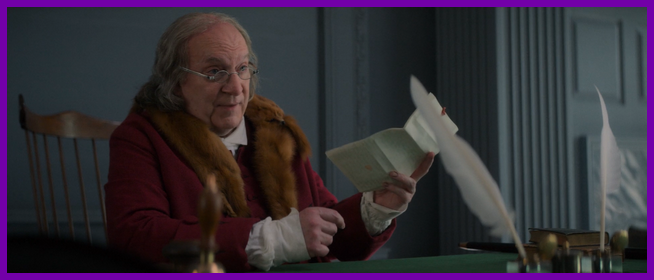
Finding Whitefield’s Voice—Literally
If the film feels grounded in history, it’s because much of it quite literally is.
“All of Whitefield’s sermons in the film are original,” Enck explains. “We have them because Franklin printed them.”
The production leaned heavily on primary sources—sermons, journals, and letters exchanged between Whitefield and Franklin—resulting in a screenplay where, by Enck’s estimate, “about 90% is based on fact and truth.”
Actor and co-writer Jonathan Blair was given free rein to immerse himself in those texts.
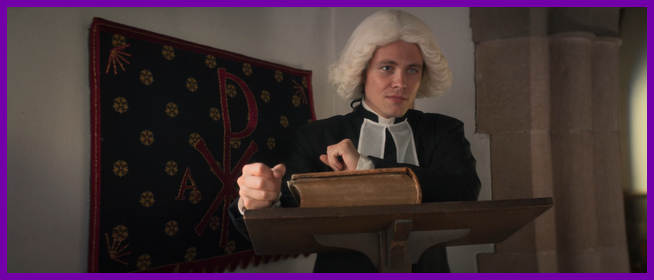
“I told him, ‘Find a sermon about liberty. Find one about relationship versus religion,’” Enck says. “He memorized them. When we shot, they were long takes—real performances.”
The result is a film where rhetoric isn’t stylized—it’s experienced. Where preaching becomes performance in the most cinematic sense.
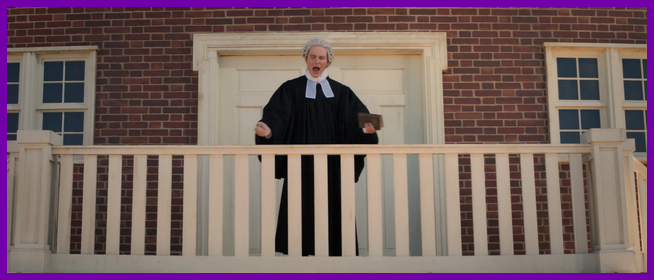
Visual Grammar: Matching Scope to a Voice That Reached 30,000
For Enck and cinematographer Steve Buckwalter, the challenge wasn’t simply how to depict history—it was how to match the scale of Whitefield’s voice.
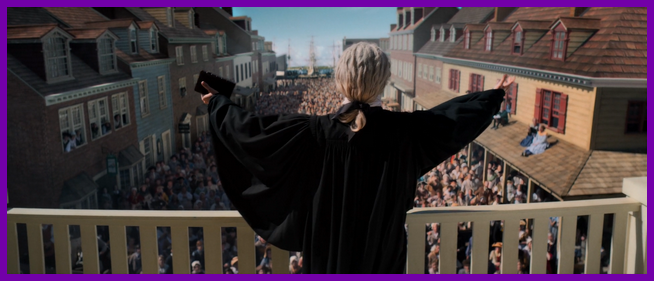
“We kept asking, how can the visuals match a man whose voice could reach 30,000 people?” Enck says.
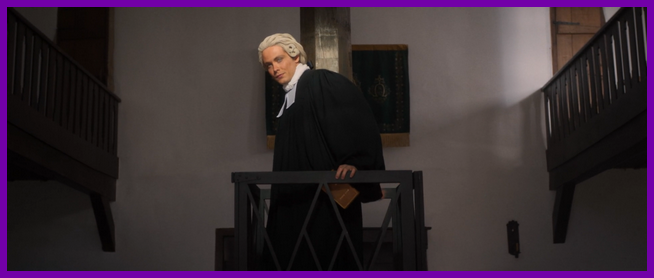
The answer lies in the film’s sweeping visual design—anamorphic lenses, expansive compositions, and a deliberate embrace of cinematic scale rooted in both Sight & Sound’s theatrical DNA and the influence of 80s and 90s epics.
“We grew up on films like Braveheart, Dances with Wolves, Schindler’s List,” he notes. “We wanted it to feel like a feast for the eyes.”
But scale alone wasn’t the goal.
“We didn’t want to impress people with detail—we wanted it to serve the story.”
That philosophy is evident in everything from the bustling recreation of colonial Philadelphia—its brickwork and color palettes meticulously matched—to the intimacy of quieter moments, where light and framing draw us inward rather than overwhelm.
Editing Time Without Losing the Audience
Non-linear storytelling can easily fracture a narrative. Enck was determined that wouldn’t happen here.
“I don’t ever want an audience member to say, ‘Wait—who is that? Where are we?’” he says. “That drives me crazy.”
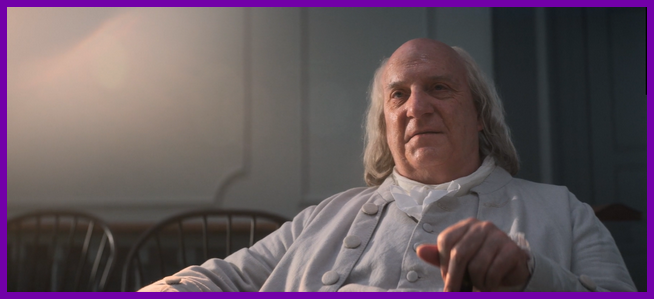
Working with editor Jordan Graff, Enck focused on transitions that were not just seamless, but motivated. A knock at one door becomes another in a different time. A visual gesture carries across decades. Even elements like water—clear turning to coal-black—become connective tissue between scenes.
“The movie gets made three times,” Enck notes. “In the script, on set, and in the edit. This is where it all comes together.”
Sound, Score, and the Soul of the Story
If visuals provide scope, sound provides soul.
“I always say sound is half of what you see,” Enck explains.
Composer Chad Marriott delivered exactly what Enck was seeking: a sweeping, layered score recorded in Nashville, blending orchestral power with choral elements that elevate key moments into something almost transcendent.
“When you add choir, it becomes otherworldly,” he says. “It takes you somewhere deeper.”
For Enck, the goal wasn’t simply to impress, but to connect.
“It’s not about impressive music—it’s about the right music.”
Faith, Ego, and the Story Beyond the Story
At its core, A GREAT AWAKENING is a film about faith—but Enck is just as clear about what it is not.
It’s not about ego.
“Ego stands for ‘edging God out,’” he says. “We didn’t want to make this about how good we are. We wanted to point people to something beyond ourselves.”
That perspective shaped not only the film’s content, but its creation.
“Lean not on your own understanding,” Enck reflects, quoting scripture that took on new meaning during production. “For me, it was about being inspired—and having a team that shares that vision.”
And notably, it’s a message delivered without heavy-handedness.
As I observed to Enck during our conversation, the film never feels like it’s “slamming conversion down people’s throats”—a balance he openly acknowledges and appreciates.
Awakening the Audience
For all its historical detail and cinematic scale, A GREAT AWAKENING ultimately returns to something simple—and deeply human.
Storytelling.
Not just of events, but of influence. Of friendship. Of ideas that travel—like sound, like light—farther than we can measure.
Or, as Franklin might say, farther than we can calculate.
And perhaps that’s the film’s quiet triumph: reminding us that before a nation can be written into existence, it must first be imagined…felt…awakened.
by debbie elias, exclusive interview 04/01/2026
A GREAT AWAKENING is now in theatres.