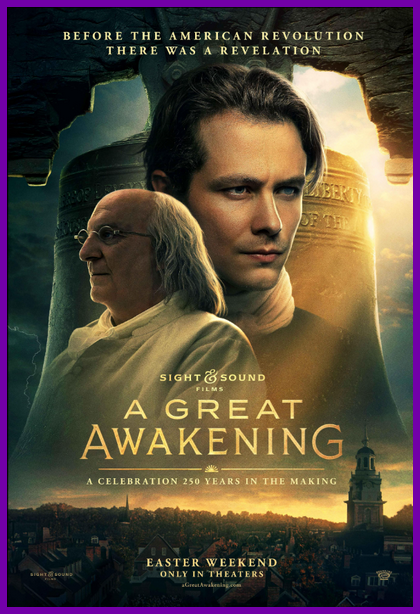
In honor of America’s 250th anniversary, A GREAT AWAKENING, from director/co-writer Joshua Enck, arrives not merely as a historical drama, but as a cinematic excavation of a spiritual movement that helped ignite a revolution—both of the soul and of a nation.
Telling the true story of the unlikely friendship between Reverend George Whitefield and Benjamin Franklin, the film situates itself within the First Great Awakening of the 1730s and 1740s—a seismic cultural and religious shift that, as history now affirms, served as connective tissue for the American Revolution. Through Whitefield’s thunderous sermons and Franklin’s dissemination of those words through print, an ideological spark spread across the colonies, uniting disparate populations with a shared sense of purpose and identity.
Enck frames this story through memory—specifically, Franklin’s via Whitefield’s journals, letters, and sermons.
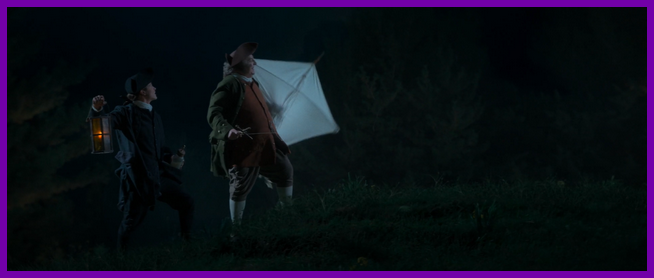
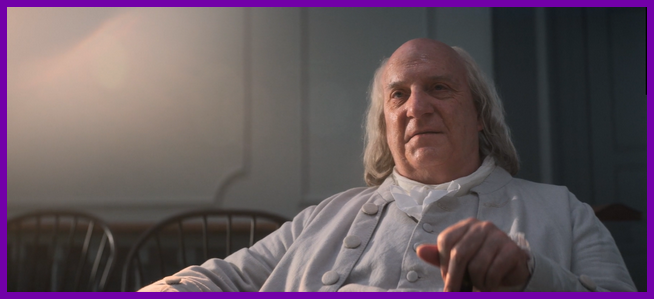
Opening in June 1787 at the Constitutional Convention—ten years after the Declaration of Independence and four years after the Revolutionary War’s end—we find an aging Franklin quietly observing the discord around him. As debates rage, he folds a paper kite—a subtle but effective visual nod to his experiments with electricity—before the narrative slips into reflection. What unfolds is not simply history, but recollection: a deeply personal revisiting of a friendship that shaped not only a man, but a nation.
The storytelling structure is elegantly non-linear. Through journals belonging to Whitefield and read by Franklin and his grandson, the film transitions fluidly between past and present, grounding its narrative in primary texts—sermons, letters, and firsthand accounts—lending the film both authenticity and gravitas. Nearly 90% of the dialogue is drawn from these historical documents, giving the film an almost archival immediacy.
And it is here that the film makes its most compelling choice: shifting the narrative perspective to George Whitefield himself.
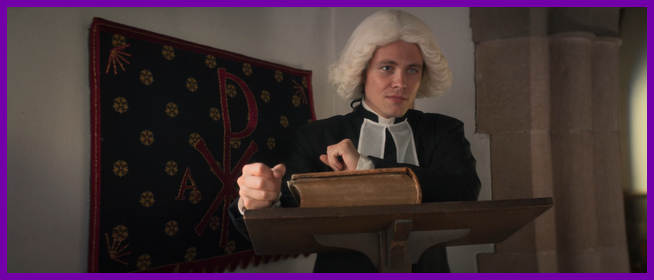
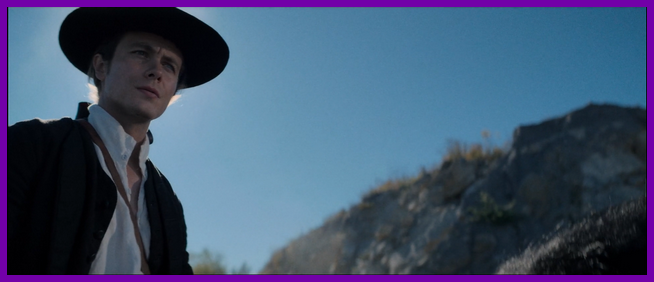
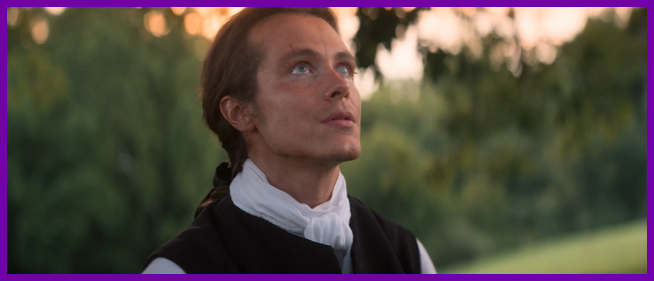
Jonathan Blair’s Whitefield is nothing short of mesmerizing. There is a magnetic intensity to his performance—one that commands attention in a way that feels both theatrical and deeply human. His sermons are not mere speeches; they are events. Blair channels a presence that recalls the grand tradition of biblical epics—echoes of Charlton Heston or Burt Lancaster—yet grounds it in vulnerability and personal struggle.
The film does not shy away from those struggles. From Whitefield’s early days as a tavern busboy with dreams of the stage, to his time at Oxford with the Holy Club, to his evangelical awakening among prisoners and the impoverished, Enck and his collaborators paint a portrait of a man shaped as much by hardship as by faith. These moments humanize Whitefield, making his later impact all the more profound.
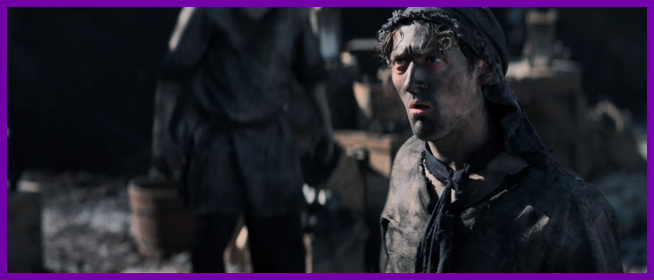
Visually, cinematographer Steve Buckwalter elevates the film with a striking command of tonal bandwidth. Light becomes metaphor. One particularly arresting sequence—Whitefield preaching to coal miners in Bristol—uses stark contrasts of blackened faces and radiant sunflare to evoke spiritual emergence. As his voice echoes into the mine shafts—“Arise! Arise!”—the sequence takes on an almost mythic quality, reminiscent of classic DeMille grandeur while remaining grounded in emotional truth.
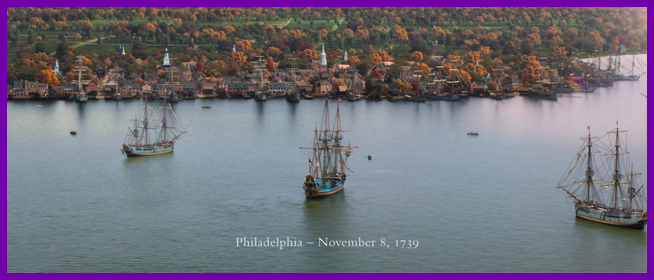
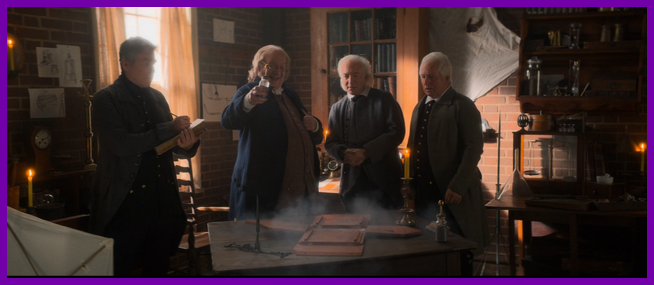
Once the narrative shifts to the American colonies, the film expands in both scope and familiarity. Philadelphia becomes a living, breathing character. From Market Street to Independence Hall, the production design by Chris Rose and set decoration by Amy Teague achieve remarkable historical specificity. For anyone intimately familiar with Colonial Philadelphia, the details—from paint palettes to architectural textures—ring with authenticity.
Costume designers Lily Steiner and Andrea McCormick further enrich the world, crafting almost 2000 thousand garments that bring the bustling colonial populace to life, particularly in the sweeping Market Street sequences. Meanwhile, John Paul Sneed’s portrayal of Franklin provides a grounded counterbalance to Whitefield’s fervor—a man of reason standing alongside a man of faith, their mutual respect forming the intellectual and emotional backbone of the film.
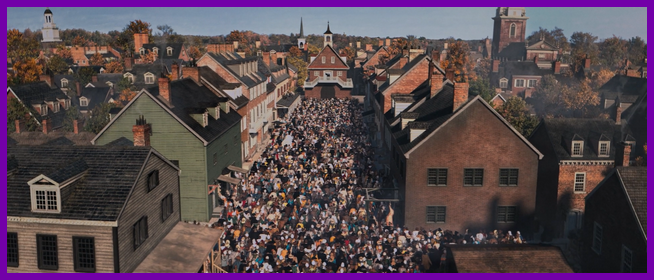
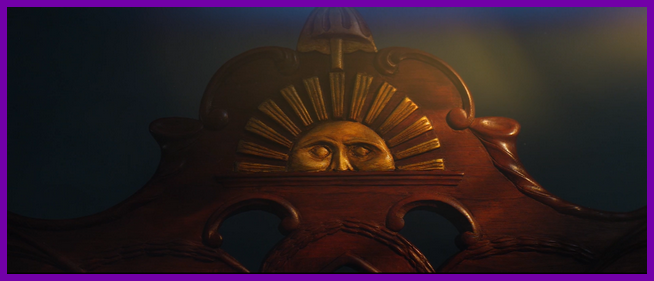
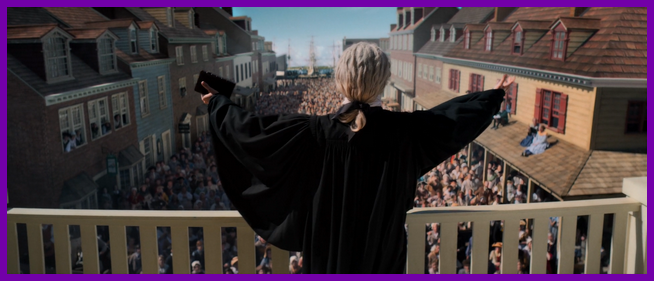
Their first meeting in 1739—Whitefield addressing a staggering crowd of more than 20,000 in Philadelphia, a number that rivaled the city’s entire population—is among the film’s most powerful moments. As Whitefield’s voice rolls across Market Street, Franklin is seen weaving through the masses, calculating in real time just how far that voice can travel, estimating a total of 30,000 who could hear the sermon. It’s a brilliant character beat—part scientist, part showman—and one that subtly foreshadows later discussions between the two men about light, sound, and the unseen forces that shape both nature and belief. It is here that rhetoric becomes revolution, not through politics, but through persuasion. Not through law, but through awakening—carried, quite literally, on the air.
Editor Jordan Graff deserves particular recognition for navigating the film’s temporal shifts. Non-linear storytelling is notoriously difficult to execute without disorientation, yet here, transitions are fluid and purposeful. Notably, the film avoids the overused visual shorthand of desaturated “past” imagery. Instead, color remains vibrant across timelines, reinforcing the idea that for Franklin, these memories are not distant—they are alive, immediate, and formative.
Complementing the visual design and emotional tonal bandwidth is Chad Marriott’s score, which moves seamlessly between restrained instrumentation and choral elements, underscoring both the intimacy and the spiritual scale of the story.
Ultimately, A GREAT AWAKENING builds to a moment of profound historical resonance. Years after Whitefield’s death, Franklin—still not a convert, but undeniably influenced—calls upon the Constitutional Convention to embrace prayer in its deliberations. It is a moment that underscores the film’s central thesis: that true liberty is not solely codified in law, but awakened within the human spirit.
This is not merely a film about faith. Nor is it simply a historical recounting. It is about influence. About rhetoric. About the power of voice—both spoken and printed—to shape a people and, ultimately, a nation.
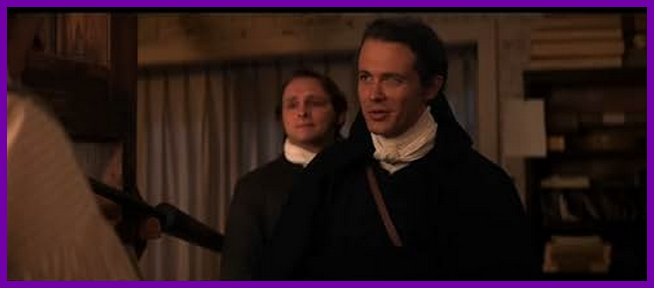
A complete and compelling portrait of a man whose revelations ignited an awakening—and in doing so, helped forge a revolution.
Eye-opening. Insightful. And, in its own way, revelatory.
by debbie elias, 04/05/2026
A GREAT AWAKENING is now in theatres.