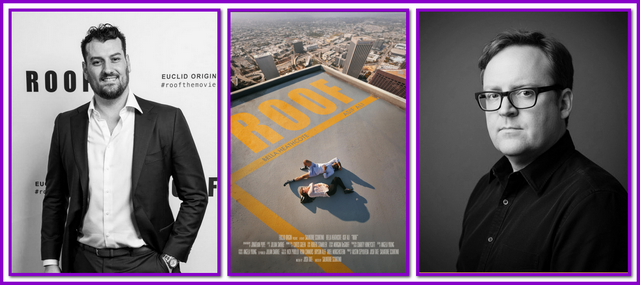
A fun-filled and enlightening conversation with director SALVATORE SCIORTINO and screenwriter JOSHUA TATE discussing Sal’s feature directorial debut – and the World Premiere at DWF NY this week – of ROOF.
SYNOPSIS: When a catastrophic blackout leaves two strangers, Dev, a trader who just lost the company millions, and Mary, a pregnant woman with nowhere to turn, trapped on a rooftop in downtown L.A. over July 4th weekend, survival becomes a brutal waiting game. With no water, no exit, and the city oblivious to their cries for help, the heat and hunger push them to the brink, both physically and mentally. As desperation sets in, a bond forms between them, blurring the lines between fear, trust, and something deeper. But as their bodies weaken and the ledge starts looking like the only escape, they must decide: wait for a rescue…or take fate into their own hands.
Directed by SALVATORE SCIORTINO with script by JOSH TATE, ROOF stars Asif Ali and Bella Heathcote.
***
When a first-time narrative feature arrives with this much precision and personality, it’s hard not to root for it. ROOF, making its World Premiere at the Dances With Films in New York next week, feels like the product of two filmmakers who have spent years learning how movies are built—and then decided to see how little they could strip one down and still make it sing.
Directed by Salvatore Sciortino and written by Josh Tate, ROOF is a survival thriller, a character study, and—somehow—a film born out of a joke.
Sciortino and Tate met as coworkers at Bad Robot, where tossing around movie ideas over lunch was practically second nature. One afternoon, a conversation drifted toward The Hangover and an offhand thought landed harder than expected. “What happened to the guy on the roof the whole time?” Tate recalls them wondering.
That curiosity became the seed for ROOF. The first draft was far more abstract: one man, alone, slowly unraveling. “It was very existential,” Tate says. “He kind of goes crazy, talks to a bird, and the core theme was the destruction of identity.” Then came a blunt but invaluable note from a producer friend: you can’t do a 90-minute one-man monologue. That note didn’t just add a second character—it changed the soul of the film. “That really pushed us,” Tate explains, “to rethink the theme as a journey from selfishness to selflessness.”
The finished film traps Dev and Mary on a downtown L.A. rooftop during a catastrophic blackout over the Fourth of July long weekend. Dev (played by Asif Ali) is a fast-talking trader who just torched millions of dollars. Mary (played by Bella Heathcote) is pregnant, practical, and immediately unimpressed by his bravado.
Early on, Dev believes he’s in charge—money, confidence, “solutions.” But Sal is quick to point out how fragile that illusion is. “There’s an earlier scene when he makes the trade,” he says, “and there’s not someone there to call him out for being… a little bit ridiculous.” Mary becomes that voice. In one key moment, Sal explains, “He thinks he can control the situation—but he can’t. And there’s this other person calling him out on it in real time.”
As the danger escalates, the dynamic flips. Mary becomes increasingly fearless—even crawling into vents while pregnant—while Dev grows more skittish. By the third act, Sal notes, “The playing field emotionally levels out. Power becomes shared instead of positional.”
Keeping a single rooftop visually engaging was the film’s biggest technical challenge. Sciortino knew he needed a cinematographer who could turn limitation into language, and found that in Jonathan Pope. “We tried to make a crescendo across the film that follows our characters,” Sal explains. “It starts with isolated shots, a lot of negative space, bodies literally facing away from each other… and gradually progresses to closer, tighter framings and extreme close-ups.”
Color followed the same arc. “We wanted to start with a washed-out, bleached vibe on the roof,” Sal says, “and then move into a more golden-hour, cinematic feel as the story goes on.”
Lighting, too, embraced realism. “We knew there were going to be a lot of limitations,” Sal says. “So we leaned into the grittiness—bounce cards, flags to shade stuff, not a lot of literal lighting, except at night.”
Josh jumps in to underline how intentional the framing was. “Our movie was shot with a lot of wides,” he says. “Sizing was a big thing Sal and I talked about. We wanted it to feel big, even though we were limited.” That choice pays off later. After so much distance, the close-ups hit hard—tar under fingernails, cracked lips, sunburned skin. As you observed during the conversation, the contrast makes those moments land viscerally.
One of the funniest reveals of the interview is how little of the rooftop actually existed. “There was nothing on top of the roof,” Sal laughs. “That was all the production department—building the box, the air vent, the fire hose, the window washer rig. All of it.” Those elements aren’t just practical; they’re playful and purposeful. The fire hose and vents recall Die Hard, while the window washer rig echoes Martin Campbell’s Cleaner. When those nods came up, Josh immediately pounced: “That is not an accident. We talked about that.” These aren’t empty references. They give the audience instant genre shorthand, then subvert it. As Sal and Josh see it, viewers expect action-movie mastery—but instead get anxious, imperfect humans negotiating fear, pregnancy, and bad decisions.
Although ROOF was largely shot in story order, post-production reshaped it dramatically. Editor Julian Smirke helped reorder scenes based on emotional logic rather than chronology. Josh is candid about the lesson. “You can’t be precious,” he says. “You have to let the film decide what it wants to be.” That flexibility extended to performance. While the script was refined over a year and a half of constant collaboration, Sciortino encouraged improvisation—especially from Ali. Some of the film’s biggest laughs came straight from the moment, not the page.
Composer Curtis Green was tasked with expanding the emotional canvas. “He’s such a talented guy,” Sal says. “He really elevates the film to another degree.” Early cues lean almost into horror, priming the audience for confinement and threat, before evolving into something more lyrical. “Some of the cello at the end was played live and recorded live,” Sal notes, acknowledging how rare that is on an indie budget. The emotional release comes with the end-credit song, “Alive,” written and performed by Kate Grahn. (All of the General Hospital fans out there are already familiar with Kate thanks to her mother, soap legend Nancy Lee Grahn, who often sings her daughter’s praises on social media.) Josh explains that they gave her almost no instruction. “I think it was like a two-sentence brief,” he laughs. “We wanted it to burst.” When they heard it, the response was immediate. “As soon as we heard it, we were like, yes,” Sal says. “That’s the greatest feeling in the world.”
For Sciortino, his feature debut clarified what directing really means. “It’s not just line readings,” he says. “It’s people management. Understanding that every actor needs a different communication style.”
For Tate, the film was equally clarifying. “This is the place I want to be,” he says. “I love big movies—but as a storyteller, I realized I want to make small ones.”
Together, ROOF became more than a debut—it became a statement of intent. And as it premieres at Dances With Films, it’s clear this rooftop wasn’t a creative dead end. It was a launch point.
TAKE A LISTEN. . .
by debbie elias, 01/09/2026
ROOF makes its World Premiere at Dances With Films New York on January 18th, 2026.