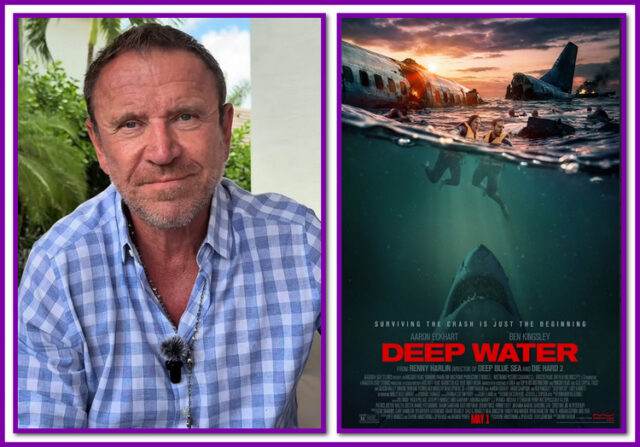
After more than three decades of filmmaking—from the vertiginous heights of Cliffhanger to the visceral terror of The Strangers trilogy—RENNY HARLIN remains, at his core, a craftsman. And with DEEP WATER, his latest survival thriller, that craftsmanship is on full display—layered, deliberate, and designed to be felt as much as seen.
Reuniting in person after several years of phone interviews, the conversation with Harlin quickly moves past pleasantries and into the granular details that define his work. It’s a space where sound, image, editing, and performance are not separate disciplines, but interlocking gears—each essential to the machinery of tension and emotion that drives DEEP WATER.
And it’s a space Harlin clearly relishes—especially when speaking with someone attuned to those details.
“You’re one of those few people who actually appreciates what we do,” Harlin says, responding to observations about the film’s soundscape, editorial rhythm, and visual construction. “So many times, you do all this work… and people don’t even notice. But you notice everything—the sound, the editing, the cinematography—it means a lot.”
That ethos—of intentionality, of building every element with purpose—sits at the heart of DEEP WATER.
Designing Fear Through Sound
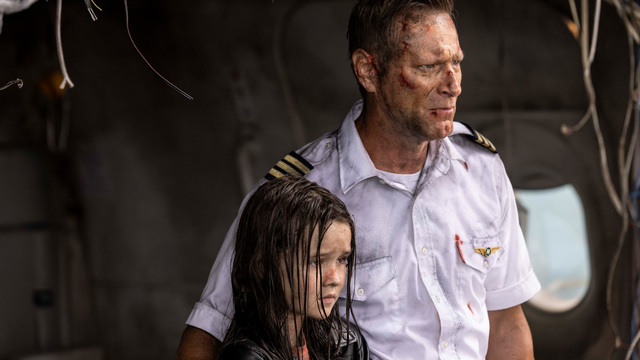
For Renny Harlin, sound isn’t a supporting player—it’s the architecture of the experience. If the image builds the world, the sound puts you inside it.
“You always talk about the sound, and I love that,” Harlin says with a grin, clearly energized by the focus. “I wanted these sequences to feel really realistic… what people hear, what they feel, what happens when everything starts to fall apart.”
That realism is not achieved through sheer volume, but through precision and contrast. Harlin and his sound team construct a layered sonic environment that evolves with the film’s escalating crisis—beginning with the subtle and almost imperceptible before erupting into chaos.
Early cues are deceptively small: the faint sizzle of ignition in the cargo hold, the distant hum of flight systems, the rhythmic tick of a clock that quietly foreshadows catastrophe. These details don’t call attention to themselves—they accumulate, creating a subconscious tension that tightens its grip long before the first explosion.
“When the plane starts coming apart, yes, you have the big sounds—the engines, the tearing metal, the explosions,” Harlin explains. “But then I wanted to take it all away. Strip it down. Force the audience to really be there with the characters.”
And that’s where DEEP WATER distinguishes itself.
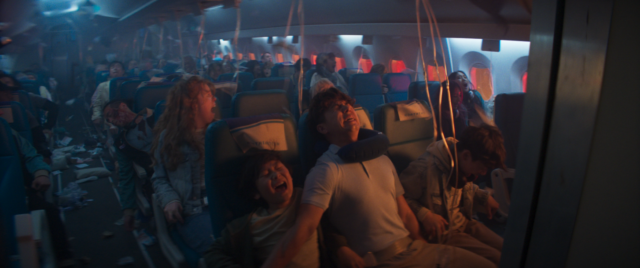
As the aircraft descends into disaster, the soundscape fractures. Layers of noise give way to something far more intimate and unsettling: muffled voices beneath water, fragmented prayers, oxygen-starved breaths, the eerie distortion of human sound filtered through liquid and pressure. The chaos doesn’t disappear—it becomes internalized.
Coupled with Fernando Velázquez’s score—anchored by that haunting, recurring single-note piano motif—the film resists the obvious. There are no musical cues telegraphing danger in the tradition of Jaws. No escalating stabs to signal a shark’s approach.

Instead, the music breathes with the characters.
“That piano note… sometimes it’s slower, sometimes quicker,” Harlin says. “It’s not about telling you what’s coming. It’s about what they’re feeling.”
The effect is profoundly human. Even at the height of spectacle—engines exploding, bodies thrown through the fuselage—the sound design continually pulls us back to the individual experience: the fear, the confusion, the fleeting moments of clarity before impact.
And perhaps most striking is Harlin’s willingness to embrace silence.
Not absence—but intentional subtraction.
In the film’s most critical moments, he dials everything down, allowing the audience to sit in that suspended space between life and death. It’s a choice that demands attention rather than commanding it, trusting the viewer to lean in rather than recoil.
It’s also where the film’s emotional core lives.
Because in DEEP WATER, sound isn’t just about what you hear.
It’s about what you feel when everything else falls away.
A Visual Grammar Built on Control and Collapse
That same philosophy extends to the film’s visual design. Working closely with cinematographer D.J. Stipsen, Harlin mapped out the film’s visual language long before cameras rolled.
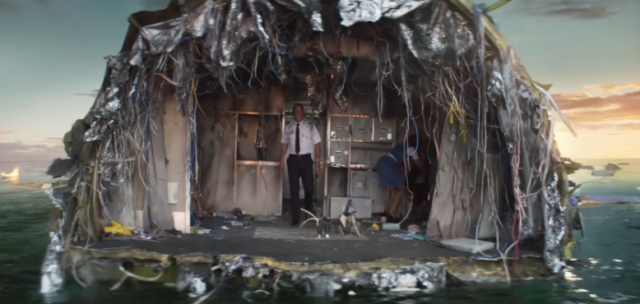
“I do a lot of research and a lot of preparation for the movie. We spent a lot of time figuring out: what lenses, what light, where the camera goes,” he says. “ I’m sure you noticed in the beginning, when the plane is about to take off, we wanted it to have this late afternoon low sunlight coming in through the windows, and these flares and all that stuff. It’s beautiful—sunlight coming through the windows, flares, warmth. We wanted it to be really beautiful. And then, as things get worse, the lenses change, the perspective changes, everything becomes more immediate. In the shooting of it, we really had a plan of how we go from longer lenses into the wider lenses, and where we place the camera, and how the camera sometimes goes underwater and then above water. It was all very, very carefully planned.”
The shift is subtle but profound. Long lenses give way to wider ones. Controlled compositions fracture into kinetic, immersive movement. The camera transitions fluidly between above-water and underwater perspectives, often placing the viewer at eye level—vulnerable, exposed.
It’s a deliberate descent, visually mirroring the narrative’s collapse from order into chaos.
Finding the Film in the Edit
If production establishes the architecture of DEEP WATER, it is in the editing room where that architecture finds its final form.
For Harlin, that process hinged on his collaboration with editor Geoff Lamb.
“I got plainly lucky,” he says with a smile. “I had to find an editor in Australia, and I found Geoff. He’s so intuitive. He reshaped the story in ways I didn’t expect.”
Working out of his home, Lamb brought a sense of instinct and intimacy to the edit—balancing the film’s multiple points of view while maintaining clarity and momentum.
“You have the cockpit, the fuselage, the tail, the water… all these different places,” Harlin explains. “And you have to make sure the audience always knows where they are, what’s happening, and why it matters.”
The result is a film that never loses its bearings, even as it fragments physically and emotionally.
Why Character Matters—Even in a Shark Movie
For all its spectacle, Harlin is adamant that DEEP WATER lives or dies by its characters. Finding that humanity amidst all of the blood and shark feeding frenzy is, as Harlin says, “Tricky. It’s a tricky balance.”
“If you don’t care about the people, nothing matters,” he says. “The sharks can eat everyone, everything can explode—but if you don’t care, it’s just noise.”
That philosophy is perhaps most evident in the character of Becky, exquisitely and sensitively played by Kate Fitzpatrick, the grandmother whose quiet resilience becomes one of the film’s emotional anchors. Unabashedly admitting that “she is my favorite character in the whole movie”, Harlin recounts the casting story with palpable affection.
“She hadn’t acted in 20 years,” he says. “She thought her career was over. And then she comes in, and she’s just… Becky. Completely. It was like giving someone their moment again—and she brought so much truth to it. She was like Gloria Swanson in Sunset Boulevard or something. It’s like she got her chance to come down that stairway one more time. She got to walk down those stairs with the camera on her, with the light on her. I love her so much. And she came to work every day, dedicated and ready and prepared and happy and smiling. She was just an exceptional, exceptional person.”
It’s that truth—woven into even the briefest character beats—that elevates the film. Becky comforting Finn. Ben revealing a photo of his son. Small gestures that resonate amid the chaos.
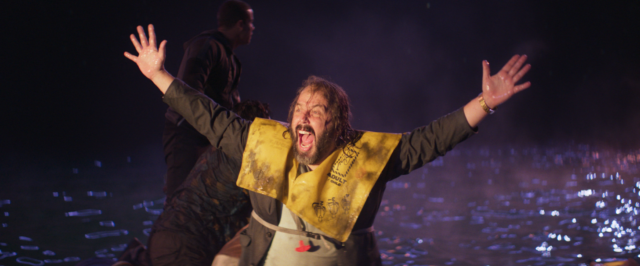
Even the film’s most abrasive character, Dan, (deliciously played by Insidious franchise fixture, Angus Sampson), is not rendered as purely one-dimensional.
“He’s not a great person,” Harlin admits. “But he has a family. He has kids. There’s still humanity there.”
It’s a choice that keeps the film grounded, even as the body count rises.
Beyond the Interview: A Shared Language of Craft
In a conversation that extended beyond the formal interview, Harlin’s focus on craft remained unwavering.
During a brief hallway exchange with Gene Simmons—a producer on DEEP WATER and the driving force behind an ambitious slate of upcoming films—Harlin spoke not about spectacle or scale, but about the importance of engaging with the mechanics of filmmaking itself. He pointed to the level of detailed observation I brought to the discussion and our interview —awareness of sound design, editorial precision, and visual construction—as emblematic of the kind of engagement a film like DEEP WATER invites.
From there, the conversation flowed seamlessly back to character.
To Becky.
To the children.
To the necessity of emotional investment.
“The real art,” Harlin says, “is weaving those things in so that you know who these people are—even in just a few moments.”
The Depth Beneath the Surface
What emerges from DEEP WATER—and from Harlin’s reflections on it—is a film that refuses to be dismissed as mere genre exercise.
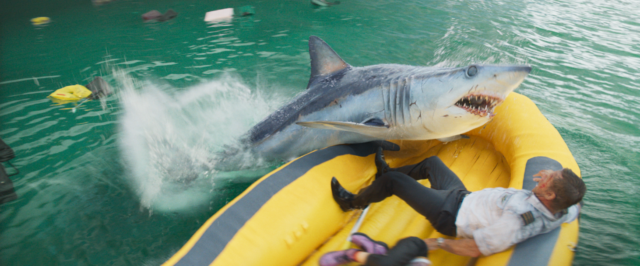
Yes, there are sharks.
Yes, there is spectacle.
But beneath that surface lies a carefully constructed experience—one built on sound, structure, performance, and a deep respect for the audience’s ability to feel.
“I take this seriously,” Harlin says. “I always have.”
And in DEEP WATER, that seriousness is not heavy-handed. It’s embedded—in every cut, every note, every moment of silence before impact.
The result is a film that doesn’t just immerse you in danger.
It reminds you why survival matters.

From its opening images bathed in the warmth of sunset—golden light spilling across sky and sea, lulling both passengers and audience into a deceptive calm—to a final sunrise that signals not just survival, but the fragile, hard-won promise of what comes next, DEEP WATER charts a journey as visual as it is visceral. Renny Harlin frames that passage with a painter’s eye, using light and color as emotional markers—day giving way to night, chaos to stillness, despair to something quietly hopeful.
Long after the sharks recede and the wreckage settles, what stays with you isn’t just the terror—it’s the sound of it. The breaths, the silence, the fragile thread of humanity that Renny Harlin weaves through every moment, proving once again that the most powerful immersion isn’t what we see… but what we feel.
by debbie elias, 04/27/2026 exclusive interview
DEEP WATER is in theatres on May 1, 2026.