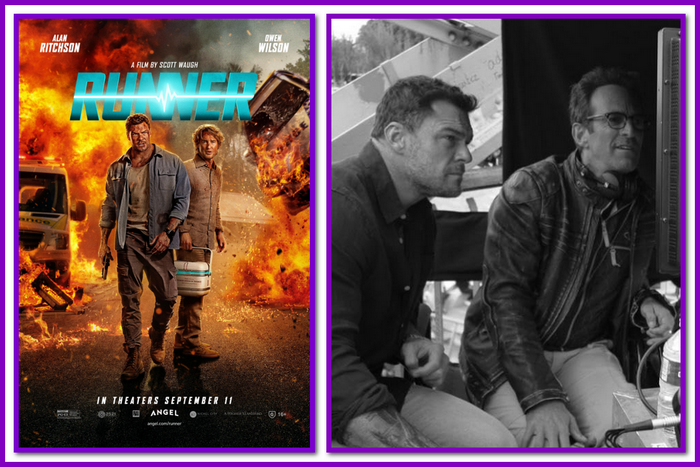
Scott Waugh made me cry.
That is not a sentence I ever expected to write.
I’ve known Waugh and his brother, fellow director Ric, for more than four decades, going back to when they were youngsters learning the stunt trade from their father, legendary stuntman Fred Waugh. I’ve watched Scott grow from stuntman to stunt coordinator to filmmaker, following him through the visceral authenticity and emotional sacrifice of ACT OF VALOR, the roaring practical vehicular mayhem of NEED FOR SPEED, and the explosive action of EXPEND4BLES. I know what Scott Waugh can do with action.
But with RUNNER, he did something I hadn’t experienced before. He made me cry.
And not just a stray tear or two. By the third act I was blubbering, caught completely off guard by the emotional wallop delivered at the end of what, until then, had been a nonstop, rock-’em-sock-’em, action-packed thrill ride.
When I told Waugh exactly that as we sat down to talk about RUNNER, his response was immediate. “I’m sorry.”
Some things never change. Neither does the easy banter that comes with knowing someone for more than 40 years. We should have been having this conversation in person. I was in Culver City. Unbeknownst to me, Waugh was sitting in Santa Monica. “We were like six minutes from each other,” he laughed. Had anyone bothered to tell us, I assured him, we could have scrapped the remote interview and gone to dinner.
But perhaps there was something fitting about a little distance between us while talking about RUNNER, because distance—and the gradual closing of it—is woven into the very fabric of the film.
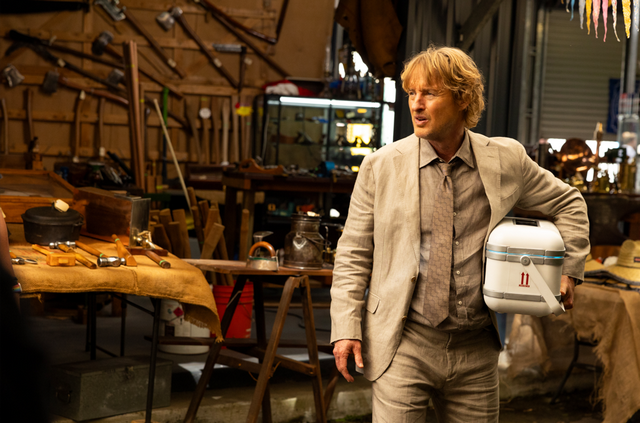
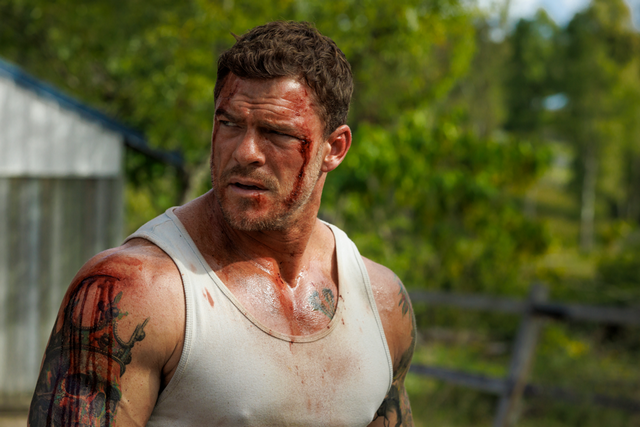
At its center are Hank and Ben, played by Alan Ritchson and Owen Wilson, an inspired yin-and-yang pairing thrown together by circumstance and united by something far more urgent than either man initially realizes: getting a donor liver to a critically ill little girl named Ellie before time runs out.
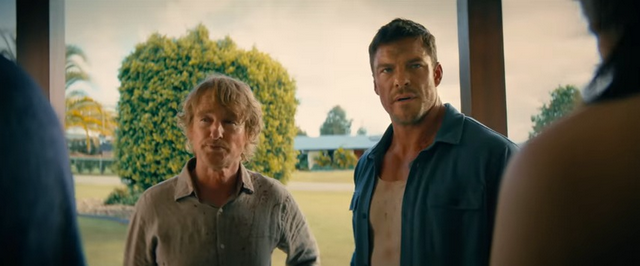
There are criminals in pursuit. Cars will crash. Guns will fire. Fists will fly. A knife eventually joins the party. Bodies will tumble, vehicles will roll, and Waugh will even unleash what he affectionately calls the “ultimate masculine brawl.”
But none of it matters unless we care about the little girl waiting at the other end. “She is the movie,” Waugh said. “You needed as an audience member to fall in love with her so that the action is justified—what these men are trying to save.” And fall in love with Ellie we do.
Our introduction to her is quiet. In a hospital room, soft light filters through the curtains as her mother tries to lift her spirits. The camera slowly finds Ellie in bed, tired and failing, and within moments the stakes of RUNNER cease to be theoretical. She has a face. She has a mother. She has a life that could disappear. For Waugh, finding the right young actress was critical.
“You wanted to find somebody that you would just stop at nothing to save,” he explained. “And she just has that.”
From there, every explosion of action has a reason.
No Action for Action’s Sake
Given Waugh’s pedigree, staging action is hardly unfamiliar territory. But RUNNER presented him with a different challenge. He didn’t merely want more action. He wanted an escalating vocabulary of action in which no sequence repeated what another had already accomplished.
“One of my real aspirations with the movie was I wanted all the action to feel different from each other, so there was no redundancy in the fights. There was no redundancy in the car chases. Each one kind of elevated to the next level throughout the movie.”
That meant starting not with machinery or choreography, but with story.
“We really did spend time talking about, what’s the emotional story in this moment? How can we make sure that the center focus of all of this action is around the liver in the case? Because that’s what they’re fighting for. That’s what they’re driving for.” It is an important distinction.
For all the horsepower, weaponry and physical punishment Waugh throws onto the screen, the most valuable object in RUNNER is a small case containing an organ, and the most important person is a sick child nowhere near most of the action. Everything orbits them.
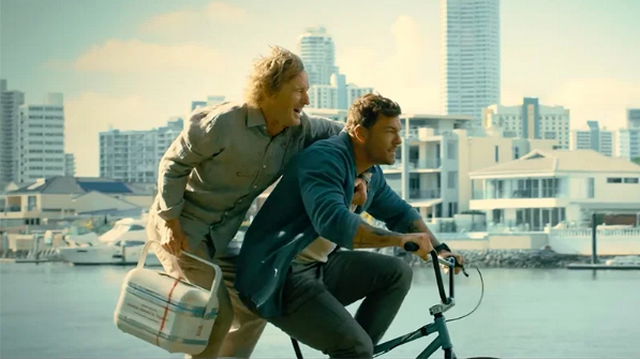
Working with cinematographer Lorenzo Senatore, Waugh designed camera movement around that central objective. The fights then developed individual identities. Gunplay has its moment. Brutality intensifies elsewhere. Hand-to-hand combat grows progressively more punishing until Waugh arrives at that aforementioned “ultimate masculine brawl.”
The vehicle work follows a similar progression. “We start out intimate and kind of controlled, and it just gets more elaborate and more elaborate to the end.”
And then Waugh finally got to attempt something he had wanted to do for years: an elaborate, seemingly continuous camera move through the climactic vehicular action, inspired in part by CHILDREN OF MEN but pushed through Waugh’s own action sensibilities.
“I pitched it to the producers. ‘I’ve got this crazy idea. What do you think if we do the camera, we go through the ambulance, we come out of the ambulance, we go to the other car, and we fly down here?’ And they’re looking at me starry-eyed like, ‘Hey, go at it. Try it.’” He did.
The result is technically dazzling, but more importantly, it moves.
That distinction matters to Waugh.
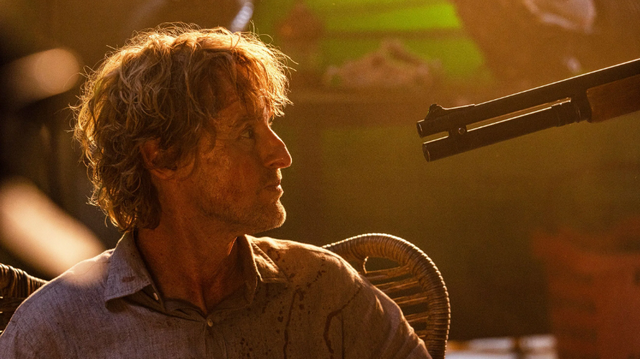
Closing the Distance: Scott Waugh and Lorenzo Senatore
For all the vehicular carnage and physical action in RUNNER, some of Waugh’s most sophisticated storytelling happens quietly through the lens of cinematographer Lorenzo Senatore.
Senatore is no stranger to action or to Waugh, having served as second unit director of photography on EXPEND4BLES. But RUNNER asks something more of the cinematography. Waugh isn’t merely interested in capturing action; he wants the camera to chart character.
That becomes particularly apparent in the evolving relationship between Hank and Ben.
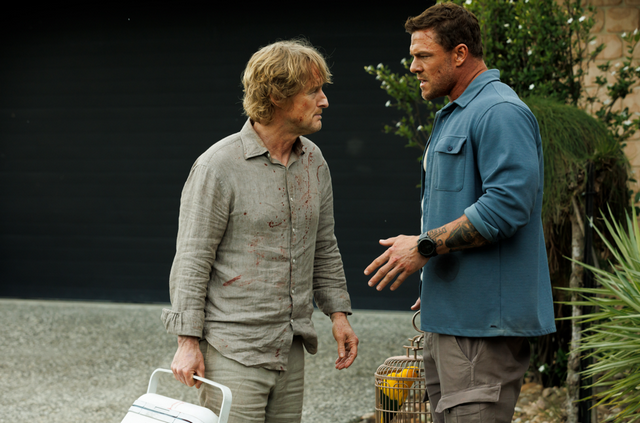
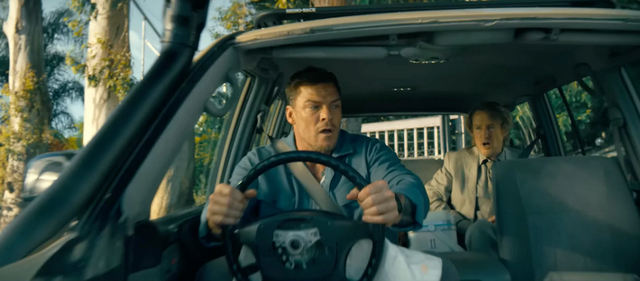
When the two first find themselves together in the car, they may share the same confined space, but visually they remain separated. Hank is up front. Ben is in the back. Their personalities are equally distant. Ben talks incessantly while Hank would seemingly be delighted never to utter another word.
Eventually Ben offers a solution: he’ll dial himself down, Hank can crank himself up, and perhaps they’ll meet in the middle.
It’s funny dialogue. It’s also the blueprint for their relationship. And Waugh and Senatore quietly make it the blueprint for the camera.
As Hank and Ben begin to understand one another, the compositions progressively tighten. The physical space separating them diminishes along with the emotional distance until the visual language itself reflects what is happening between these two men.
When I mentioned that progression to Waugh, his reaction was immediate.
“Oh my gosh, Debbie, you’re the best. You picked up on that because that was something subtly Lorenzo and I discussed extensively. The camera work starts wide and distancing them. As the tension compresses them, the relationship gets closer, and so does the camera.”
It’s an elegant piece of visual storytelling precisely because Waugh doesn’t want the audience consciously thinking about it. The technique disappears into the emotion.
That same philosophy informs Waugh and Senatore’s approach to the action. Even as the scale and complexity of the set pieces increase, the camera remains tethered to what matters.
“With Lorenzo, myself, we said, ‘How can the camera move around the focus of what they’re fighting for?’”
That focus is the liver.
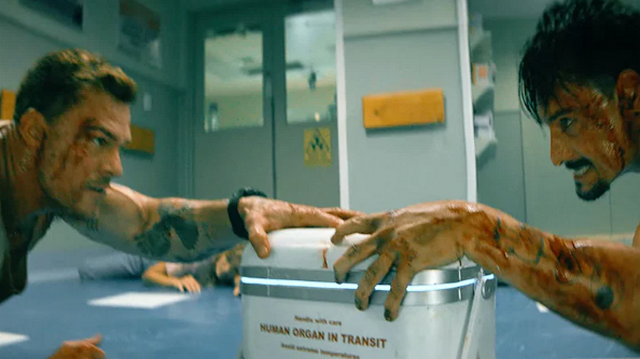
Cars can crash around it. Guns can fire over it. Men can beat one another senseless trying to possess it. But Waugh and Senatore never allow the spectacle to obscure the reason for it. Somewhere beyond all that motion is Ellie, waiting in a hospital bed while her time disappears.
Senatore’s lighting of those quieter hospital moments is equally important. Our introduction to Ellie is almost delicate, with light filtering through the curtain as the camera slowly discovers the little girl in bed. There is no visual assault screaming SICK CHILD at us. The image invites us toward her, and her face does the rest.
The palette similarly resists convention. “I didn’t want to do the desat look that’s kind of so common in these last 20 years,” Waugh said.
Once production moved to Australia, Waugh and Senatore took their cues from the Gold Coast itself.
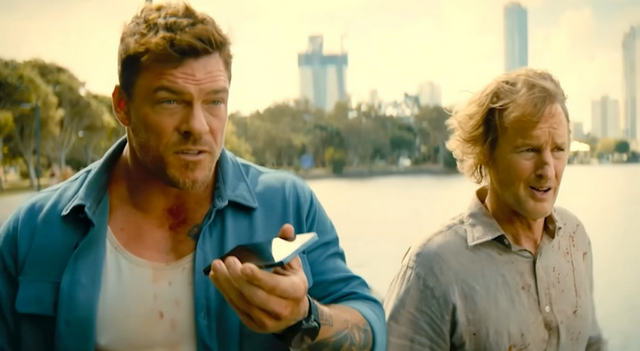
“When you really analyze that whole region of Gold Coast—that beautiful blue sky, blue water, kind of green tree palette—I wanted to carry [that] through in all of the interiors as well as the exteriors.”
Those blues become particularly effective in the hospital, replacing the sickly greens so often used as cinematic shorthan for illness with something cooler and calmer. Outdoors, the blue of sky and water and the green of the landscape give RUNNER a richness often stripped from contemporary action imagery.
But Senatore does something else equally important: he gives Australia distance.
In a story built around an organ with a finite window of viability, geography matters. Destinations cannot conveniently feel five minutes apart simply because the screenplay needs the characters to get there. The landscape has breadth. Roads stretch. Locations feel separated. Waugh and Senatore allow us to feel the miles that must be conquered while an invisible clock continues ticking.
The result is cinematography doing far more than making RUNNER look good. It makes the emotional and physical geography of the story visible.
Meeting in the Middle
The visual progression between Hank and Ben would mean little, of course, if Ritchson and Wilson didn’t make us believe the relationship developing inside those increasingly intimate frames. They do.
Ritchson’s imposing physical presence and taciturn restraint play beautifully against Wilson’s affability and rapid-fire verbal rhythms. Initially, Ben can smooth-talk his way through almost anything and is perfectly content believing he can control whatever situation presents itself. Hank would apparently prefer that everyone—including Ben—simply stop talking.
“Aren’t they great together?” Waugh said. “Their chemistry is such magic.”
Ritchson was already attached as both actor and producer when Waugh came aboard. Wilson wasn’t.
“When Owen’s name came up, I just lit up. When I’m thinking about rhythms and actors and how the chemistry is probably going to go, I was like, ‘Wow, that could be an amazing pairing.’” It is.
And Waugh believes Wilson reaches somewhere audiences haven’t seen from him in quite some time. “He goes a whole other level in this movie. He’s always terrific, don’t get me wrong, but he just goes an extra step in this film that makes you really love him.”
That becomes increasingly important as Ben’s smooth-talking certainty begins to fall away. What starts as an odd-couple pairing evolves into partnership and ultimately friendship.
As Waugh observed, there is inherent comedy in “one dude that doesn’t want to talk, and the other guy that can’t stop talking.” But gradually Ben begins “noodling on Alan’s character and opening him up.”
They begin moving toward that middle ground Ben jokingly proposed when they first got into the car. And the closer they get, the more dangerous RUNNER becomes to the heart.
Bring tissues.
Finding Performance Inside the Action
Waugh also knew where he wanted help.
Action editing is almost second nature to a man who spent years performing, designing and coordinating stunts before moving into the director’s chair. Character and performance were where he wanted another set of particularly sensitive eyes. Enter editor Matt Villa.
Villa’s work on ELVIS had stayed with Waugh, not merely because of its kinetic construction but because Waugh felt Villa knew how to find performances amid the film’s enormous visual machinery.
“I really need somebody to help me craft the performances because action, as you know, Debbie, I come from that world. It’s easy for me to edit the action, but I really wanted somebody to make sure the story and the characters were in it.”
When Villa’s name appeared among the prospective editors, Waugh’s reaction was simple. “Do you think we could get him? He would be amazing!” They did.
The collaboration proved so satisfying that Waugh is already trying to keep Villa from wandering away. “I keep trying to tell him, ‘I’m taking you on the next one. Don’t take another job. Come on, you’ve got to stay with me.’”
Our discussion of Villa unexpectedly sent Waugh tumbling backward more than four decades. I mentioned Villa’s recent work on Ron Howard’s EDEN.
“Do you know that Ron Howard is the director-slash-actor that got me into the business?” I didn’t.
Waugh was about 12 years old when his father approached him with a proposition. A young director named Ron Howard needed a kid doubled for a bicycle stunt involving a jump from a garage.
Waugh arrived on set and discovered that the director was Richie Cunningham. Then Potsie appeared. Then the Fonz. They had come to support Howard as he moved into directing, while young Scott Waugh was there to launch himself off a garage.
“I was a 12-year-old rat running around the set creating havoc,” Waugh laughed. “I know,” I told him.
More than four decades later, he’s still doing it. He just has a considerably larger playground.
When the Villain Becomes a Little Boy
Waugh’s interest in character doesn’t stop with Hank and Ben.
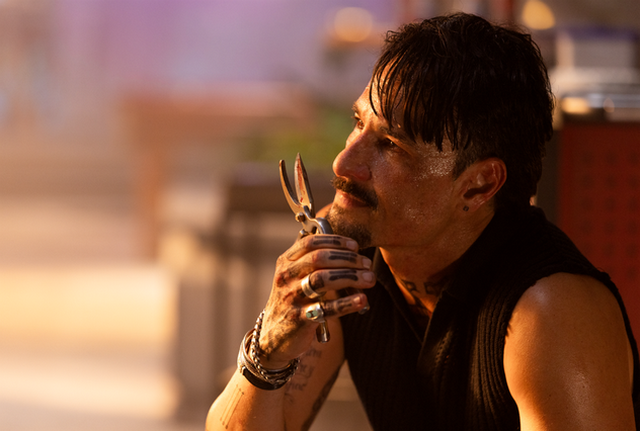
As Damian, Rodrigo Santoro could easily have been rendered as a conventional action-film villain. Instead, Waugh wanted discomfort. Damian does terrible things, yet as his motivation becomes clearer, understanding begins creeping in where an audience doesn’t necessarily want it.
“You have somebody that’s just so evil, but you sympathize with him,” Waugh explained. “You actually almost want to care about him, and yet you don’t because you’re conflicted.”
Waugh sees that moral gray area as part of RUNNER’s magic. We may never condone Damian’s methods, but as the circumstances driving him become clearer, it becomes increasingly difficult not to ask what we might do in his position.
Nothing humanizes Damian quite like his mother.
Already gravely ill and isolated behind protective plastic, she nevertheless finds the strength to rise, confront her son, slap him across the face, and call him a disgrace. I burst out laughing when that scene appeared on screen.
Not because Damian suddenly isn’t dangerous, but because for one glorious instant this terrifying man is reduced to what disappointing sons have been reduced to since time immemorial: A little boy who has upset his mother.
Waugh and Santoro carefully designed the moment around exactly that vulnerability, while Senatore’s camera catches the shock and shame washing across Santoro’s face.
“It’s such a humanizing moment when your lead scary villain gets brought down to his knees by his mother,” Waugh said. “After she slaps him, he’s like a little boy.”
Seconds earlier, the man could kill someone. Then Mom arrives. Even cartel villains apparently have an Achilles heel.
Racing a Real Clock
The ticking clock driving RUNNER is more than a convenient screenplay device.
Waugh and his team researched the realities of transplantation and organ transport with medical professionals, paying particular attention to the viability window for the liver and the logistics of moving it from Honolulu to Brisbane.
“We really spent time trying to architect the real truth to the transport of that liver coming from Honolulu, knowing how long the flight is and how long the duration [is]. That’s what’s spoken in the movie. We have until five o’clock because the expiration of that liver—it will exceed the timetable it can be out of a human to be put back in. We did a lot of research with transplant doctors to make sure that was accurate.”
The subject has also acquired unexpected personal resonance for Waugh.
“My best friend right now in Nashville—he had a kidney transplant ten years ago, and his kidney’s failing again, and he needs a new transplant right now. So it’s something actually really near to my heart right now.”
For Waugh, the film also provides an opportunity to recognize an entire ecosystem most people rarely contemplate until they or someone they love needs it: donors, doctors, transplant organizations and the people responsible for getting an organ where it needs to go while the clock is running.
“I don’t think there’s enough awareness on that entire community because the amount of lives being saved is so important.”
That reality gives RUNNER’s velocity weight. The characters aren’t racing simply because an action movie requires them to race. Time is tissue.
Don’t Show Them the Trick
For all the detail Waugh puts into these choices, ideally he doesn’t want an audience thinking about any of them.
That’s the paradox.
“Don’t you feel like in filmmaking the whole idea—the magic—is you don’t want the audience to actually pay attention to the trickery or pay attention to the things you’re doing because you just want them to experience it? You never want them to leave the movie.”
That may be the most revealing thing Waugh said during our conversation.
A filmmaker spends months or years obsessing over lenses, blocking, choreography, color, cutting, performances, camera movement, geography and rhythm in the hope that an audience will eventually forget all of it.
“You just stay focused. You’re in the movie. That’s what I’m trying to do, especially with RUNNER.”
If that happens, Waugh believes, he’s done his job.
And there is a delicious irony in hearing him say it to me, because I had just spent much of our conversation telling him about all the filmmaking tricks I’d noticed.
The changing compositions. The palette. The action escalation. The geography. The editing. The close-ups.
I saw the tricks. But I never left the movie.
And when the emotional hammer fell, none of that intellectual awareness protected me. I cried.
Which may be the greatest evidence that the trick worked.
“I Think I Found My Stride”
With our time rapidly disappearing, there was one question I wasn’t going to leave without asking.
What had Scott Waugh learned about himself as a filmmaker making RUNNER that he could carry into whatever comes next?
I’ve watched him grow as a director over the years, but RUNNER felt different. There was another level of emotional confidence here, a synthesis of spectacle and character I hadn’t seen from him quite this way before. His answer surprised me.
“I think I found my stride on what compels me.”
He traced that feeling back to ACT OF VALOR and the sacrifice at the heart of that film—the willingness of one person to give his life for another.
“When you’re compelled to tell a story, you just—I don’t know—you do better work when you really feel the pull.”
That pull, Waugh now recognizes, is where his filmmaking becomes most distinctly his own.
“I knew that was really something that drives in me, and when I’m allowed to find stories like RUNNER, that that’s an innate strength in the entire movie, I think my quality and style of filmmaking kind of lets me go to one of my biggest filmmakers that I idolized, which was Tony Scott.”
The influence makes sense. Tony Scott could make images soar without sacrificing the human beings inside them. His films could be unabashedly commercial and intensely stylized while remaining grounded in character and, at their best, unexpectedly poetic.
Waugh points specifically to TRUE ROMANCE—the sweetness and humanity of Christian Slater and Patricia Arquette amid a story populated by violence, madness, danger and characters operating somewhere beyond the outer limits.
“The end of the movie is so poetic,” Waugh said. “I’m like, I just want to make those type of movies.”
Then came the sentence that, in retrospect, RUNNER had been building toward all along.
“RUNNER for me is that, and I’m now looking for more of those.”
Scott Waugh has spent a lifetime learning how to make action work.
Fred Waugh helped give him the physical vocabulary. Decades as a stuntman taught him what bodies, vehicles and cameras could do. Directing taught him how to transform that knowledge into spectacle. But RUNNER reveals something more—something Waugh himself now recognizes when he says, “I think I found my stride.”
Scott Waugh isn’t turning away from the action filmmaker he has always been. He’s bringing that filmmaker together with the storyteller increasingly compelled by sacrifice, vulnerability, friendship and the emotional stakes behind the spectacle. And perhaps that is why RUNNER feels like such an important film for him.
Early in the film, Ben recognizes that he talks too much and Hank too little. Maybe, he suggests, he can dial himself down, Hank can crank himself up, and they’ll meet somewhere in the middle. Slowly, almost imperceptibly, they do.
Senatore’s camera moves with them, closing the physical distance between two very different men as their emotional distance disappears. But ultimately Hank and Ben do more than meet in the middle. They become one—a hero. Each brings what the other lacks until, together, they become something neither man could have been alone.
In RUNNER, Scott Waugh achieves much the same synthesis.
The stuntman and the storyteller meet in the middle. The physical and the emotional. Spectacle and intimacy. Adrenaline and poetry.
Everything Waugh learned at his father’s side and throughout a lifetime of stunt work meets everything he has discovered about himself behind the camera. And they, too, become one.
A filmmaker who has found his stride.
And after more than four decades of watching that 12-year-old “rat” grow up, I couldn’t be happier to have been along for the ride.
Or, in Waugh’s own words: “You’ve been Waughed.”
by debbie elias, exclusive interview 08/27/2026
RUNNER is exclusively in theatres on September 11th.