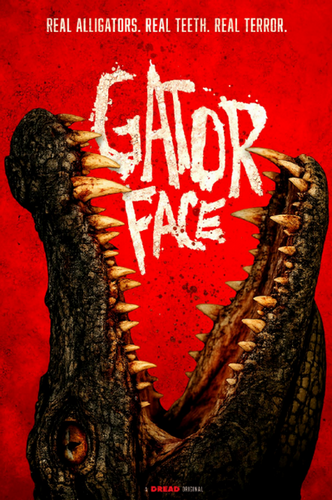
There are low-budget horror movies that spend so much time trying to hide what they cannot afford that they forget to show audiences what they came to see. Then there are filmmakers like Padraig Reynolds, who understand that sometimes the smartest thing you can do is embrace your limitations, put every possible dollar on the screen, and make damn sure the blood flows when it counts.
Such is the case with GATOR FACE, a scrappy, unapologetically bloody creature-feature/slasher hybrid that mixes a murderous cult, Southern folklore, real alligators, practical gore and a reptilian masked killer into an increasingly wild romp through the Florida swamps.
GATOR FACE knows which corners it can afford to cut—and which limbs it needs to cut instead.
And cut them it does.
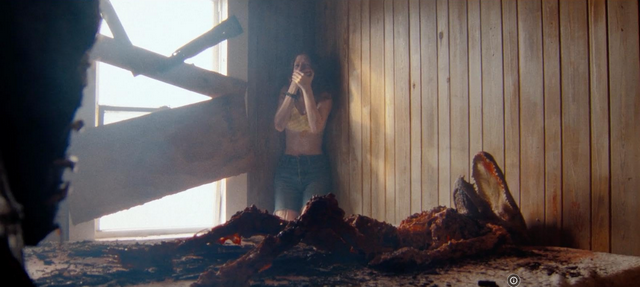
Reynolds wastes no time announcing what kind of bloody ride we’re in for. Within the first two minutes, Jessica (Amariah Dionne) and girlfriends Nikki and Sierra come upon a dilapidated beach house with the ominously helpful warning “3 Dead Inside” painted on the outside. Jessica has the good sense to tell her friends not to go in. Naturally, they go in. Almost immediately, tasty bloody gator bits are flying courtesy of the very real alligators residing inside, while the appearance of Gator Face sends Jessica running for her life.
With Gator Face in hot—literally and figuratively—pursuit, a visibly shaken and initially speechless Jessica is eventually picked up by David (Barron Regan), Andy (Iain P. Smith), Claire (Tabitha Brownstone) and Samara (Ella Mosca).
Safety proves short-lived.
Their van, plagued by recurring radiator problems, overheats, allowing Gator Face to catch up in his own delivery truck, taunting the stranded group with a drive-by almost like a gator playing with its food. He circles back on foot, breaks into the van and whacks Samara, leaving Jessica, David, Andy and Claire instant allies in the rather pressing business of outrunning Gator Face on foot.
The premise is ridiculous.
It is also ridiculously fun.
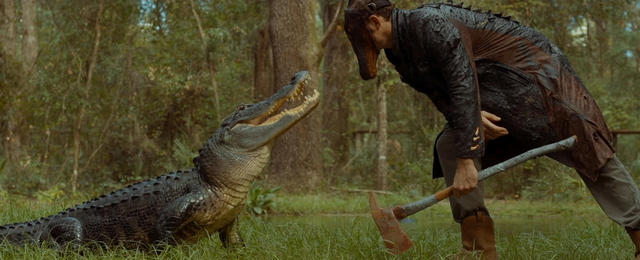
Reynolds understands the difference between making something campy and allowing a horror movie to have a sense of humor about itself. GATOR FACE never treats its danger as a joke. The kills hurt, the blood flows, and the alligators are allowed to remain genuinely threatening. But neither does Reynolds pretend there isn’t something inherently funny about a guy dressed like an alligator commanding actual alligators with an axe held aloft like a scepter.
That tonal balancing act becomes one of the film’s greatest assets.
There is no disguising GATOR FACE’s budgetary limitations. They are visible in the scale of the production, the relatively small number of characters and extras, and occasionally in the mechanics of the storytelling itself. The narrative is straightforward, characterization is economical, and there are moments where one can almost see Reynolds finding the shortest route between Point A and the next bloody Point B.
But here’s the thing: he gets to Point B.
And frequently somebody loses a body part when he arrives.
Rather than attempting to manufacture production value the film doesn’t have, Reynolds takes advantage of what Florida gives him. Dilapidated buildings, a junkyard, a church, thick vegetation and the swamps themselves lend GATOR FACE texture. More importantly, cinematographer Drew Suppa knows how to use them.
Building on the visual language established by cinematographer Michael Bolten on Reynolds’ original GATOR FACE short, Suppa carries that aesthetic seamlessly into the feature, shooting 2K with vintage 16mm lenses from the 1970s. The resulting imagery has an appropriately gritty quality without sacrificing clarity. During the day, Florida feels hot, humid and almost deceptively inviting.
But once darkness descends, Suppa really gets to play.
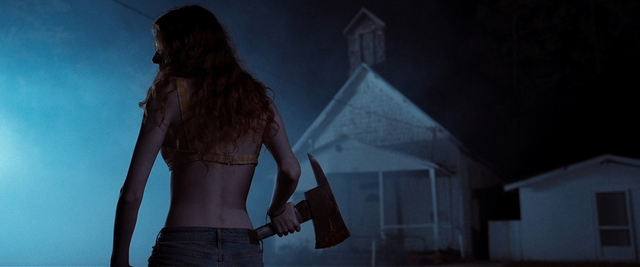
Night brings mist, torchlight, deep shadows and silhouettes, with shafts of illumination cutting through the swamp. Dutch angles add unease and accentuate shifting power dynamics while compositions using foreground and background keep us looking into the darkness for whatever may be approaching. One particularly effective image finds a bloodied Jessica gripping an axe as danger materializes behind her, while other nighttime sequences make excellent use of mist and the geography of the swamp.
For a movie operating on this scale, GATOR FACE often looks surprisingly good.
It also wisely avoids one of the easiest ways to make a low-budget creature feature look cheap.
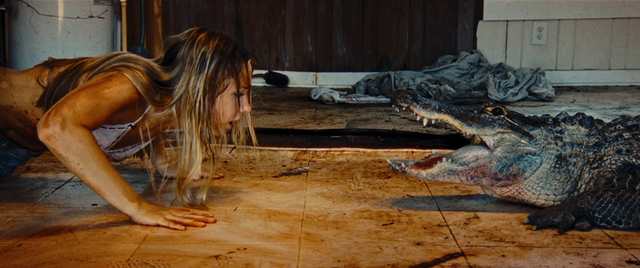
The alligators are real.
Reynolds uses compositing and judicious cutting to place his human prey and reptilian predators within the same cinematic space without putting his actors in danger. Because we’ve actually seen the animals—the weight of them, the movement through water, the way they sit almost motionless before suddenly becoming anything but—the threat has a physical credibility that digital creatures would have been hard-pressed to achieve on this budget.
And then comes the training montage.
Gator Face. Axe in hand. Alligators following along.
It’s gloriously absurd, yet Reynolds and editors Ed Marx and Bryan Colvin know exactly how far to push it, with Colvin’s montage work giving the sequence a playful rhythmic energy that lets us enjoy the sheer lunacy of what we’re seeing without turning the movie itself into parody.
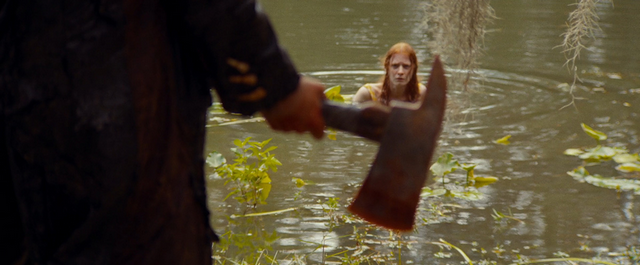
The practical gore is equally important.
Heads are whacked, skulls split, bodies bleed, wounds gush and alligators eventually get their own opportunities to join the feast. Reynolds doesn’t have the resources for elaborate spectacle, so the tactile quality of the practical effects becomes spectacle. There’s a pleasing physicality to the blood and wounds that fits beautifully with Suppa’s gritty imagery and the real animals.
In other words: Great Gory Goodness!
As Jessica, Amariah Dionne increasingly becomes the film’s anchor as events move deeper into the swamp and considerably farther off the rails. There’s a vulnerability to Jessica, but Dionne never allows that to become helplessness. Once bloodied, pursued and generally put through Reynolds’ wringer, she keeps fighting. Give the girl an axe and she’s ready to use it.
Dionne also sells the physical exhaustion of the ordeal. Jessica doesn’t emerge from one encounter magically refreshed for the next; the cumulative abuse registers, making her determination to survive all the more satisfying.
Barron Regan brings an amusing bravado to David, who rather fancies himself the alpha male of the group when it quickly becomes apparent that Jessica may be made of considerably tougher stuff. That reversal gives their dynamic some welcome personality without requiring the screenplay to stop and explain it.
And then there’s Scot Scurlock as Father Eli.
Scurlock arrives with exactly the sort of conviction a movie called GATOR FACE needs from the leader of an alligator-worshipping cult. Father Eli has history to impart, ceremonies to conduct and sacrifices to celebrate, and Scurlock attacks the material with such enthusiasm that the character’s lengthy exposition becomes part of the entertainment. He doesn’t wink at the mythology. He believes every damn word of it.
That matters.
The film is at its best when everyone involved commits completely to its strange little world.
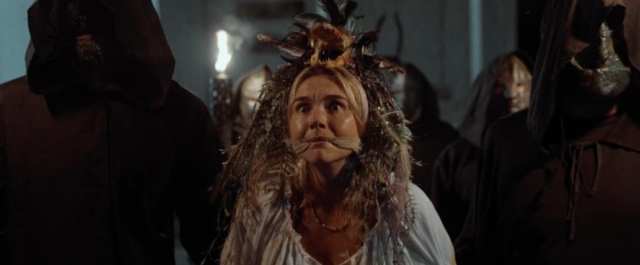
And the cult has clearly given some thought to presentation. When Claire is drugged and prepared as their sacrifice, she is ceremonially gussied up in swamp growth fashioned into an elaborate crown, topped by a small alligator skull with its jaws spread wide. It’s macabre, primitive and wonderfully bonkers—the kind of specific visual detail that gives GATOR FACE’s mythology personality beyond the requisite robes, rituals and sacrificial victim.
Call it Gator Queen couture.
Nobody embodies that commitment more physically than Nikolas Kolasinski as Gator Face. Behind the mask, Kolasinski gives the killer an animal vocabulary all his own—crawling, sniffing, stalking and occasionally moving with an odd little hop or burst that makes him feel less like a conventional masked slasher and more like a man who has spent far too much time identifying with his reptilian companions.
Josh Eckberg’s sound design completes the transformation. Gator Face’s guttural growls give him an increasingly animalistic presence, working in tandem with Kolasinski’s physicality to further blur the line between man and reptile.
Holly Amber Church’s music similarly knows when to assert itself and when to stay out of the way. As GATOR FACE moves past the one-hour mark into its third act and night envelops the swamp, tribal drums begin pulsing beneath the action. The percussion is particularly effective as torches, mist, cult ritual and pursuit converge, giving the final stretch an almost primal momentum.
By this point Reynolds has stopped merely introducing the pieces and started throwing them at us.
Jessica is running. Gator Face is hunting. The cult is closing in. Axes are swinging. Blood is flowing. Alligators are waiting. And the movie moves.
That’s important because GATOR FACE’s simplicity could easily have become its undoing. Instead, the lean plotting works increasingly in Reynolds’ favor as the body count rises. He isn’t interested in padding a small idea into something grandiose. Once the machinery is in place, he lets it run.
There are rough spots. Some narrative transitions are abrupt, supporting characters are necessarily thin, and the mythology occasionally raises more questions than this first film intends to answer. Viewers looking for elaborate character studies or polished studio creature effects have wandered into the wrong swamp.
But Reynolds understands what he has—and, more importantly, what he doesn’t have.
He has atmosphere. He has an energetic young cast. He has a memorable killer. He has practical blood and gore.
And by God, he has alligators.
That self-awareness carries GATOR FACE a surprisingly long way.
It also allows Reynolds one final tonal flourish. After all the bloodshed, cult ceremonies, growling, axes, severed anatomy and reptilian mayhem, what better way to send us into the credits than with “See You Later, Alligator.”
Perfect.
But don’t leave too quickly.
A post-credit epilogue finds Gator Face making his way to another dilapidated location, where an elegant woman dressed in black and veiled awaits him. He kneels before her. She places a hand upon him.
Meet The Mom. Suddenly the mythology gets a little bigger, a little weirder and a lot more intriguing.
GATOR FACE isn’t polished. It isn’t expensive. And it doesn’t need to be.
What Padraig Reynolds has made is something increasingly rare in the low-budget horror landscape: a movie that understands precisely what it can afford, recognizes where practical ingenuity matters more than money, and possesses enough personality to turn its limitations into part of its charm.
Sometimes all you need is a swamp, an axe, a few gallons of blood and some real alligators.
Just watch out for the water moccasins.
Written and Directed by Padraig Reynolds
Cast: Amariah Dionne, Tabitha Brownstone, Scot Spurlock, Nikolas Kolasinski, Ella Mosca, Iain Smith, Kiara Mitjans, Barron Regan, and Ellie Shaddix
by debbie elias, 09/01/2026
GATOR FACE is in select theatres on September 11th and on digital on September 15th.