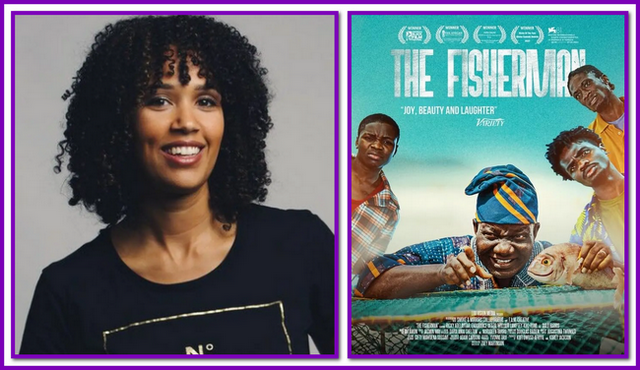
There is a particular quality to the morning light in Ghana that writer/director ZOEY MARTINSON knows well. There is the haze, the dew coming up, the shadows, and the warmth of golden hour. And along the coast, there are the fishermen, already at work during those cooler early hours, pushing out to sea.
Martinson has been watching that world since she was young, first while living in a small fishing village in Ghana and later through the eyes of a photographer and filmmaker.
“I had kind of gotten to know the fishermen because the whole village kind of has to help with when they pull in the net, and then you get some fish,” Martinson recalls. Already interested in photography, she remembers recognizing something cinematic in what she saw. “Even when I was younger, I just thought there was so much beauty in this world…and in the way things were done traditionally.”
But every time Martinson returned to Ghana, she saw that world changing.
“I was noticing the erosion of the coastline due to global warming, and they had to build these sea defenses. I was noticing the massive development that was happening.” And then came a different kind of change. “I think the biggest change I noticed is when everybody and their mother had a cell phone.”
That changed more than communication. Traditionally, Martinson explains, village elders commanded respect in part because they were repositories of knowledge. “You used to have to go to them. You’d ask questions. You’d learn.” Now a younger generation could simply Google the answer.
For Martinson, that shifting relationship between young and old was something worth exploring. Somewhere inside those observations, THE FISHERMAN began to swim.
And eventually, naturally, the fish started talking.

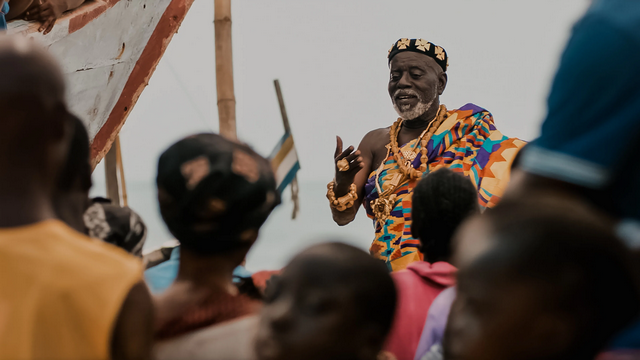
What began as a short film eventually grew into Martinson’s feature, a funny, enchanting and poignant tale of Atta, a traditional fisherman forced into retirement and increasingly at odds with a world changing around him. Played with delicious physicality and facial expressiveness by Ricky Adelayitar, Atta soon finds himself traveling with three considerably younger associates—Shasha, Kobina and Emmanuel—while receiving advice from Koobi, a sarcastic talking fish whom everyone except Atta quite reasonably regards as dead.
But before there was a feature, there was a changing Ghanaian fishing community that Martinson felt compelled to capture.
When a traditional fishing area in Accra’s Jamestown was being cleared, her producer suggested making a documentary. Martinson knew that wasn’t the kind of filmmaker she was.
“I’m not a doc director, so I wrote this short film, like, overnight, and we went and shot it with a bunch of friends, and then edited it. And it just had this huge impact.” The short traveled, audiences responded, and people kept asking Martinson the same question: What was the feature?
“I was like, ‘I don’t have a feature. I just wrote this as a short.’ But it got me started to think, what is that world? What could I say on a larger, longer time? And that really brought me to the idea of change and exploring pluses and the minuses of that.”
Change may provide the dramatic undercurrent of THE FISHERMAN, but Ghana provides its pulse.

Seeing the Light
Visually, THE FISHERMAN is sumptuous. Reds, yellows and golds dominate, punctuated by vibrant blues and greens. The aqua of the sea provides its own canvas. And cinematographer Adam Carboni captures a texture and quality of light that makes Ghana itself feel alive within the frame.
For Martinson, capturing that light began with understanding it.
“In Ghana, I think the thing that really makes it beautiful is the haze, because in the morning there’s this dew that’s kind of coming up, and the fishermen really are active in that golden hour. That’s the time they’re really setting out to sea. It’s less hot… It’s the time where you get the shadows and you get the light, and you don’t have to do much.”
But “not doing much” photographically doesn’t mean leaving anything to chance.
Working with Carboni and gaffer Justin W. King, Martinson was conscious not only of what additional light they needed, but when they needed it and what bringing that equipment into a community meant. Generators were necessary. So were choices about lenses, camera bodies and shooting times. And because THE FISHERMAN itself touches upon environmental change, Martinson wanted the production to remain conscious of its own footprint.
“We wanted to be very conscious of our environmental footprint and just our kind of footprint in the community, period. And so it is being very intentional about the time you’re filming, how it’s being done, the lenses that are being used, the camera body that can capture things at different times.”
Limited resources became another part of that equation. “The not having the money and as much resources makes you be incredibly resourceful.”
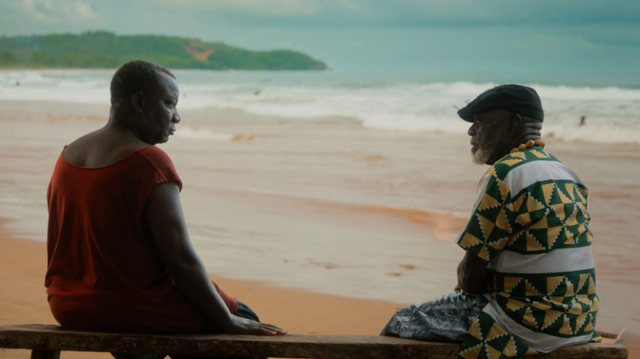
And then there was the moon.
For a nighttime beach sequence between Atta and the Boat Chief, Carboni had calculated precisely when the moon would rise, how low it would be in the sky and the narrow window in which they could capture what they wanted.
Martinson remembers the experience vividly. “Adam looked up. He’s like, ‘Okay, the moon is going to rise, and it’s going to be low in the sky because you need the moon low, and it’s going to be a harvest moon. But we only have two hours.’ We looked up the date and the time…”
They were shooting in a remote fishing village, the production scheduled around that celestial window.
And the moon was late.
The solution required adapting the technology to the conditions rather than surrendering the image. A lower-level Sony camera with exceptional low-light capability was brought into play for the wide, while the ARRI cameras and LED lighting were used for closer coverage that would cut naturally with the visual language already established for the rest of the film.
Sometimes resourceful filmmaking means knowing precisely which camera can capture the image in your head. And sometimes it means waiting for the moon to cooperate.

From Moonlight to Memory
Capturing that moonlit conversation between Atta and the Boat Chief was only half the equation. In the hands of editor Jasmin Way, the scene becomes something more—a conversation between past and present as well, moving between the two aging men on the beach and memories of the boys they once were.
It is one of several moments in THE FISHERMAN where editing allows memory, character and emotion to coexist rather than simply moving the story forward.
For Martinson, working with Way meant knowing when to be specific about something she had designed and when to step away. “A lot of the transitions and things I’ve shot according to kind of how I mapped it out. So some of it is kind of like me saying, ‘This is what I did,’ and she can see that. Usually a good editor can kind of see how you shot it.”
But Martinson deliberately gives her editor something equally important: space.
“I let them do a first pass because it gives me distance from it, and I’m able to see it when I come in. And usually, I’d come in and be like, ‘Oh my God, this is like damn near perfect.’ So it was a great working relationship.”
Then comes the fine-tuning, particularly with comedy.
“You’re kind of just, with comedy, finessing the timing so that it feels the way it would live. Comedy is all about when something’s delivered versus a few frames could, like, make it not funny.”
Way’s instinct for cutting heavily with music opened another door, one that ultimately led to composer Avi Amon and yet another marriage of cinematic craft and Ghanaian culture.
“I tend to like the way comedies are scored in Italy,” Martinson explains. Amon drew inspiration from that musical tradition but approached it using West African instruments. “So it still felt like it was coming from that community and that region, which I just was like, this is so, so smart.”
And then there is Koobi. Ah, Koobi.
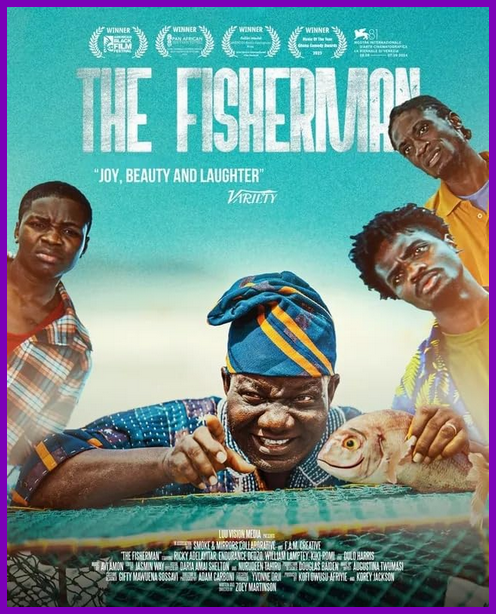
How Dead Should a Talking Fish Look?
In a film filled with questions about tradition, progress and what happens when the old encounters the new, it somehow seems perfectly appropriate that one of its wisest voices belongs to a fish who occupies a rather peculiar state of existence.
Koobi talks.
Koobi gives Atta advice.
Atta talks back.
Atta even makes Koobi a comfortable little bed and lovingly tucks his fins beneath the covers.
To everyone else, however, Koobi is quite dead.
And therein lay the VFX challenge.
“We did a bunch of tests,” Martinson explains. “There was a CGI version, but weirdly enough, it wasn’t as funny because it was too alive and too animated, and it felt misplaced.”
The problem wasn’t the quality of the effect. It was the effect being too effective. “Koobi’s actually dead to everybody else except Atta, and so you needed the fish for a lot of the humor. Most people are looking at this, like, dead fish.”
The answer was restraint. Rather than replacing Koobi with a fully animated creation, the actual fish imagery was used as the foundation and subtly enhanced.
“Our animator kind of came up with this using the actual fish that we had used, and she would animate the actual fish in more subtle ways. So it kind of had a breath, its eyes, its fin, but it was also kind of dead feeling. It didn’t animate and move too, too much.” And that’s precisely why Koobi works.
He is alive without becoming too alive, expressive without becoming cartoonish, and sufficiently dead that everyone around Atta has ample reason to question why an elderly fisherman is carrying on conversations with his prospective dinner.
Yet Koobi also feels strangely at home within the larger ideas of THE FISHERMAN. He exists between states—something familiar altered just enough to function differently. He is neither entirely of an old world nor wholly of a new one. Change without complete erasure.
For a film about what we preserve, what we relinquish and how we carry one into the other, perhaps a talking dead fish isn’t such an unlikely philosopher after all.
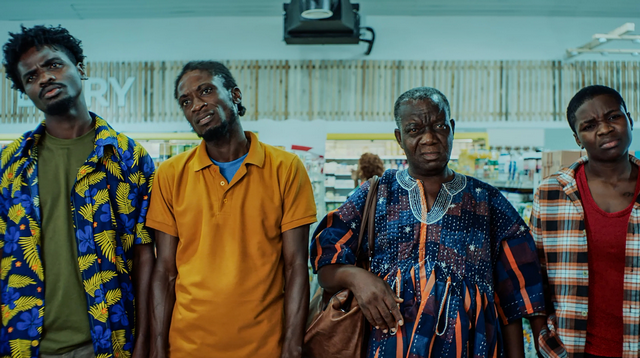
Atta—and Uncle Ricky
Of course, Koobi needs somebody worth talking to. And in Ricky Adelayitar, Martinson found her Atta.
Adelayitar was known to Martinson as a dramatic actor, with some 30 years of experience, including roles capable of making him genuinely frightening. What she discovered through his audition was an unexpected natural gift for comedy.
“He’s a very dramatic actor,” Martinson says. “And then he auditioned, and I was like, ‘Oh, he’s naturally funny.’”
That humor never comes at the expense of Atta’s humanity. Adelayitar can seemingly conduct an entire argument with a grimace, a suspicious glance or the dismissive wave of a hand. But beneath the stubbornness is a man watching the world change faster than he would like and wondering where that leaves him.
His relationship with his “young associates”, Shasha, Kobina and Emmanuel, gradually changes that equation. The younger generation needs something Atta possesses, even if they don’t initially recognize it. And Atta has something to learn from them as well.
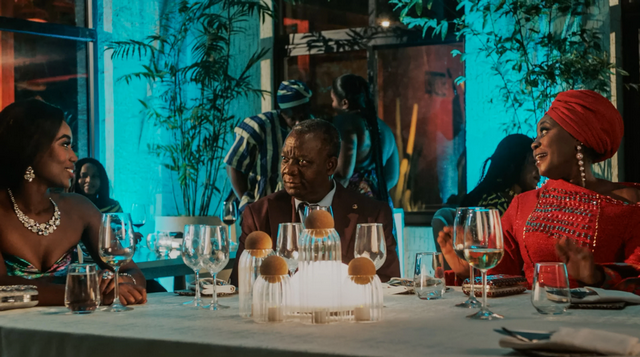
At a pivotal point in their journey, when the three younger companions are questioning themselves, Atta reminds each of them who they are: one saved an old man from the ocean, another is the only person in the village with a degree, another has the ability to find family wherever he goes.
The man who once demanded respect because he was an elder begins demonstrating what being an elder actually means.
And, according to Martinson, something remarkably similar was happening away from the camera.
“Ricky really set the tone,” she recalls. “He would check in on WhatsApp. He would remind everybody to be authentic.”
Before long, he had another name. Uncle Ricky. “He’s now their uncle for life.”
For Martinson, that role has cultural resonance as well. Adelayitar occupies the position of an elder within his own family and community, and that instinct carried naturally into the filmmaking family around him. And Uncle Ricky’s wisdom wasn’t reserved for the younger cast.
“If anything went wrong, you could just be like, ‘Uncle Ricky, I didn’t make my day,’ and he’d come back with the best wisdom ever.”
Stepping Into Her Own Power
THE FISHERMAN was made with limited resources, but Martinson discovered she possessed another resource that couldn’t be entered on a production budget: community.
For years she had been the person who said yes to other artists. She helped with sound. She helped with load-ins. She showed up. When it became her turn to make THE FISHERMAN, people showed up for her.
Her experience in television also proved invaluable. Working with limited prep time had taught Martinson how to prepare intensely, make decisions quickly and execute ideas efficiently—skills that became essential in making the film look and feel far larger than its resources might suggest. And now, having taken a feature from ideas on paper through the physical reality of production, her relationship with the next blank page has changed.
“I’ve learned so much about the tangible execution of things, ideas being on paper. So when you’re writing, it’s like I’m seeing it as well, and I’m knowing kind of how it all could come together, and I also kind of know the budget of how it comes together.”
That lived experience has altered something deeper.
“It feels less scary. It feels less new. It feels more like a stepping into one’s own power a bit, and knowing that you have the skills and the experience to back it, and that feels good.”
And should the occasional filmmaking crisis threaten that newfound confidence, Uncle Ricky remains only a message away.

Putting Ghana in the Light
Nothing in THE FISHERMAN exists in isolation.
Place informs light. Light informs photography. Photography gives Way material with which to shape memory. Editing finds rhythm through music. Music draws from one cinematic tradition while being performed through the instruments of another culture. Performance reflects an understanding of elders and community that, in Adelayitar’s case, extended beyond the screen. And running through all of it is Ghana.
For Martinson, returning there to make another film isn’t simply a matter of finding another beautiful location. There are more stories there. More filmmakers telling them. More voices, faces, images and experiences that she believes audiences would welcome—if audiences were given the opportunity to encounter them.
And that is where a conversation about THE FISHERMAN and filmmaking inevitably becomes a conversation about distribution.
“One thing I learned about distribution is so many distributors, they just don’t distribute Ghana. They say Ghana is not a country of focus. Just flat out doesn’t consider a film.” Martinson sees a fundamental problem in the assumption.
“I think people are curious because you guys have not focused on Ghana. They’re interested in seeing work from Ghana, but you can’t get access to it. And filmmakers are making tons of incredibly interesting things, but nobody—they can’t get it into the world.”

It is an issue that Martinson says is now part of the conversation within Ghana’s National Film Authority as filmmakers confront the difficulty of making work that may never receive meaningful consideration from distributors. But difficulty is not deterrence.
“Tricky does not mean that I’m not going to return and make another film.”
Perhaps that’s the most fitting place to leave Zoey Martinson and THE FISHERMAN.
The film itself understands that progress need not mean abandoning what came before, just as honoring tradition need not require standing still. Atta and his young companions ultimately need one another. Old knowledge finds new ears. New ideas make room for old wisdom.
And a dead fish keeps talking.
Martinson began by seeing something in Ghana—the fishermen, the traditions, the people, the colors and that extraordinary morning light—and wanting to capture it cinematically. Now she wants audiences to have the opportunity to see it, too.
And if the obstacles are tricky?
Zoey Martinson has already made her intentions quite clear. She’ll keep putting Ghana in the light.
by debbie elias, exclusive interview 09/25/2026
THE FISHERMAN is available digitally on September 29, 2026.