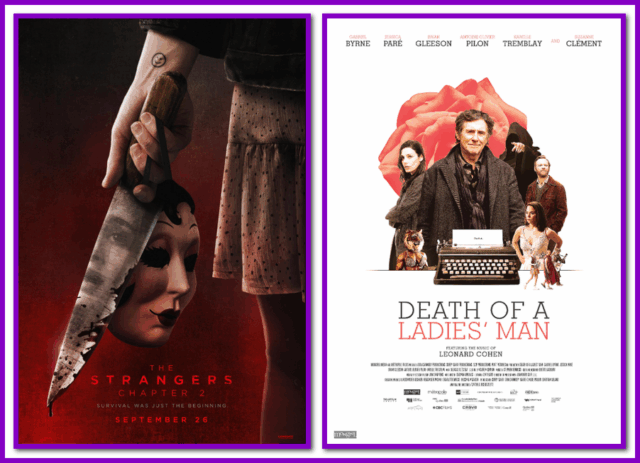
I’m excited for this week’s BEHIND THE LENS, thanks to a director whom I adore and have been chatting with for multiple decades, RENNY HARLIN, who goes in-depth with me for THE STRANGERS: CHAPTER 2, and writer/director MATTHEW BISSONNETTE, who brings us a film I immediately connected with, DEATH OF A LADIES’ MAN starring Gabriel Byrne.
Let’s kick things off with RENNY HARLIN.
THE STRANGERS began back in 2008 thanks to w/d Bryan Bertino, who treated us to the tale of James Hoyt and Kristen McKay, who visit an isolated vacation home to enjoy some time together. Hopeful bliss turned into terror making their stay a nightmare. In 2018, director Johannes Roberts, with a script by Bryan Bertino and Ben Ketai, rebooted the franchise with THE STRANGERS: PREY AT NIGHT starring Bailee Madison, Lewis Pullman, and Christina Hendricks. It was always Johannes’s intent to do a sequel, but that didn’t pan out, and THE STRANGERS legacy kinda fell apart; that is, until 2024, when director Renny Harlin stepped into the franchise with what has become a three-chapter series with all three films shot at the same time over 53 days of principal photography, with a cast led by Madelaine Petsch.
In THE STRANGERS CHAPTER 1 – we met Maya and Rory, whose car breaks down in a creepy and eerie small town, forcing them to spend the night in a remote cabin. Panic ensues as they are terrorized by three masked strangers who strike with no mercy and seemingly no motive.
Now in 2025, we have the chilling next chapter of THE STRANGERS franchise with THE STRANGERS: CHAPTER 2. Directed by Renny Harlin and written by Alan R. Cohen & Alan Freedland, Madelaine Petsch returns as Maya, and joining her are, among others, Gabriel Basso, Ema Horvath, Richard Brake, and Pedro Leandro.
This go-round picks up the morning after the final scene of Chapter 1, where we find Maya in a hospital as the sole survivor of The Strangers’ murdering spree of the previous night. But the night’s events aren’t over as she must now do everything in her power to survive the continued, relentless attacks from the masked killers while reckoning with the ways that these events are transforming her into someone else.
As we saw in the original 2008 movie and then again in 2018 and 2024, THE STRANGERS attacks are focused on one location, one home. A very violent home invasion. But with THE STRANGERS: CHAPTER 2, we go from one home to an entire of the town, expanding the terror and violence AND letting Renny Harlin embrace the environment of the town to include forested areas, animals, wild boars, farms, hospitals, not only amping up the tension and action, but fueling the character development of Maya as she fights to survive. I love THE STRANGERS: CHAPTER 2 and the development and broadening of not only the characters of Maya and The Strangers themselves, but also the visual tonal bandwidth and visual grammar. Renny uses all the tools in the toolbox to expand the story, from adding a tonally different – and beautiful – backstory, to cinematographer Jose David Montero’s more challenging gorgeous and textured lighting and lensing, to editor Michelle Harrison’s rapier edge-of-your-seat editing that showcases the ECUs and dutching of Jose’s impressive work, to composer Justin Caine Burnett’s impeccable score that adds tonal elements that connect it to Chapter 1, but are enhanced and expanded to musically embrace the wider scope of the story.
THE STRANGERS: CHAPTER 2 is all about survival for Maya and using her physicality and real environs to deliver a visceral moviegoing experience.
Always a pleasure and privilege to speak with Renny Harlin, this time was no different, as we tried to cover as much filmmaking territory about this film as possible in a very brief interview. An insightful and enlightening conversation, we dive headfirst into not only the evolution of the franchise but the challenges of bringing it to life, along with Renny’s creative freedom in the second chapter as he develops and broadens not only the characters of Maya and The Strangers themselves, but the visual tonal bandwidth and visual grammar; emphasizing the importance of real environs, adding a tonally different – and beautiful – backstory, developing cinematographer Jose David Montero’s more challenging gorgeous and richly textured lighting and lensing which includes ECU’s and the use of special macro lenses, careful planning to maintain tension without dialogue, the complexity of the editing with Michelle Harrison’s rapier edge-of-your-seat seamless integration of new and original material, and Justin Caine Burnett’s impeccable score that adds tonal elements that connect it to Chapter 1, but are enhanced and expanded to musically embrace the wider scope of the story, complementing the visuald without overtly signaliing tension.
A side note to you: When you see the movie, stay through the credits because there’s a sneak peek into CHAPTER 3. And dare I say, it had me gobsmacked when I saw it. Based on the post-credits tease, CHAPTER 2 sets us up perfectly for what’s in store in CHAPTER 3.
THE STRANGERS: CHAPTER 2 is currently in theatres.
Now let’s turn to DEATH OF A LADIES’ MAN with writer/director MATTHEW BISSONNETTE.
Described as a “lyrical dramedy”, DEATH OF A LADIES’ MAN is poetic and emotionally charged, infused with the music and spirit of Leonard Cohen, tackling multiple themes that evoke heartbreak, absurdity, and hope.
Gabriel Byrne stars as the hard-drinking, twice-divorced professor Samuel O’Shea whose life seems to be going into the toilet. First, he starts seeing things – Frankenstein at the bar, strangers breaking into Leonard Cohen songs, a woman with a tiger’s head and face, and conversations with his long-dead father, Ben O’Shea. He chalks it up to stress. But a terminal brain tumor diagnosis sends him reeling into a surreal, darkly funny odyssey through memory, regret, and an unexpected romance in Ireland. Retreating to his family’s remote Irish cottage, Samuel tries to write the novel he’s always avoided—and instead begins rewriting his own story.
Despite some of the themes, or maybe because of some of them, for the bulk of the film, I had a smile on my face watching it, quite possibly, because I have known men over the course of my lifetime who were in many ways, very much like Gabriel’s character of Samuel. In terms of the thematic elements, we see father-son, father-daughter, husband and ex-wife, husband and ex-wife number two relationships, punctuated by self-doubt, the refusal to grow up, and/or age. And part of that refusing to grow up or grow old often involves drinking copious amounts of alcohol daily, making Samuel a functioning alcoholic, destroying all of the relationships in his life. But as he navigates all of that, it brings forth such light and realization so that by the time we get to the third act, the film takes on a lightness of self that is beautiful and welcoming. Peppered throughout this tale is a brilliant performance by Gabriel Byrne, Leonard Cohen’s music, and spectacular, surreal musical numbers. And yes, you will really see an ice hockey team skate ballet on ice.
Comedically chapterized, the film is beautifully structured into three sections of Samuel’s adult life, with the Cohen songs and accompanying dance numbers succinctly punctuating each stage, and perhaps, Samuel’s own renaissance, while stunning visuals courtesy of cinematographer Jonathan Cliff immerse us in Samuel’s mind and how he sees the world around him and how it sees him. Cliff captures some of the most beautiful and expressive faces, each of which speaks volumes. Showcasing both Canada and Ireland, editor Matt Lyon seamlessly goes between the two as Samuel’s dark, closed, and “stuck” world slowly sobers up and expands into the wide open spaces of Galway, Ireland.
In this exclusive conversation, Matt highlights the themes of father-son and father-daughter relationships, self-doubt, and addiction. Surreal musical numbers depict internal struggles. Leonard Cohen songs, including “Bird on the Wire” and “Hallelujah,” were carefully selected to enhance the narrative. The film’s visual grammar, particularly the use of close-ups and wide shots, captures the emotional depth of the characters. And we talk casting, especially Gabriel Byrne and Brian Gleeson, which adds authenticity to the portrayal of complex family dynamics. A bonus in this conversation is the depth Matt goes into on developing the character of Samuel through costume and Gabriel Byrne’s work with costume designer Odette Gadoury.
DEATH OF A LADIES’ MAN is currently available on VOD, and digital platforms Amazon, Apple TV and more.